Last updated: November 20, 2026
Quick answer: if you rely on paper tracking instead of apps, choose the debt payoff method that you can keep accurate on one ledger page or a small set of pages for at least 1 billing cycle. For most people choosing how to choose a debt payoff method when you rely on paper tracking instead of apps, that means a method you can track with a ledger, a notebook, a paper checklist, or an envelope system without rebuilding the plan every month. If you are unsure, a qualified adviser or nonprofit credit counselor can review the setup with you; the CFPB has general consumer resources on debt collection and credit reports and scores.
Key takeaways
- Pick the method that stays clear on paper after 1 month of use, not the one that sounds smartest.
- A paper system works best when each debt has 1 line, 1 payment date, and 1 next action.
- The simpler the recordkeeping, the less likely the plan is to break when balances change.
- Manual tracking suits people who want visible progress and do not want to depend on a phone or app.
- If your debts have changing rates, missed due dates, or uneven cash flow, the paper system needs extra structure.
What kind of paper system do you need?

A paper tracking system is enough if you can keep a running debt list, write payments down the same way each month, and update balances without using software. It assumes you can gather basic facts for each debt: creditor name, balance, minimum payment, due date, and any interest rate you already know.
Because paper makes some payoff plans easy to follow and others annoying to maintain, the method choice matters. A plan that depends on constant sorting, score changes, or automatic balance updates will feel clumsy on a notebook page. A plan with 1 fixed order and 1 payment log usually holds up better.
This page fits a person who wants to choose between common payoff styles using a ledger, notebook, or paper checklist. It does not try to replace the broader guide to debt payoff method fit by psychological and behavior constraints, which helps with the human side of the decision.
How do you choose a payoff method on paper?
You choose the payoff method that matches how often you are willing to rewrite, sort, and verify numbers by hand. The most paper-friendly method is usually the one you can keep accurate on a single page or a small set of pages for at least 1 billing cycle.
Use this decision process:
- List each debt in a ledger with creditor, balance, minimum payment, and due date on 1 line. Verify that every debt has a visible place on the page. Problem sign: if the list needs a second notebook page before you even start, the system is already too spread out.
- Mark the debts in due-date order on a paper checklist. Verify that you can see which payment comes next without flipping pages. Problem sign: if you need to rescan the whole list every time, the method is not paper-friendly.
- Compare a snowball order and a highest-interest order on 2 notebook columns. Verify which order you can keep without re-sorting every month. Problem sign: if the order changes often and you cannot update it quickly, the method will create errors.
- Choose the method that gives the clearest next action on paper: smallest balance first, highest rate first, or due date first. Verify that the rule fits on 1 sentence at the top of the page. Problem sign: if the rule needs paragraphs to explain, it is too complicated for manual tracking.
- Set 1 payment log in the notebook with date, amount, and remaining balance after each payment. Verify that each entry can be checked against the statement. Problem sign: if you cannot tell at a glance whether a payment was applied, the log is not doing its job.
- Test the plan for 1 month using the envelope system, if you use cash or set aside money by category. Verify that the paper labels and the payment order agree. Problem sign: if the envelope labels and the ledger disagree, the plan will drift.
- Review the balances against statements at the end of the month and rewrite only the changed numbers. Verify that the new balance is the same in the ledger and on the statement. Problem sign: if the plan needs full rewrites each month, switch to a simpler order.
- Track visible progress with a checkbox, bar, or shaded box next to each debt. Verify that the page shows both action and momentum. Problem sign: if the page gives no sense of movement, motivation may drop even when the math is fine.
Therefore, the practical choice usually comes down to this: if you want the least mental load, a due-date or smallest-balance order is easier to run on paper than a plan that demands frequent rate comparisons. If you can keep a neat ledger and like a clear target, a manual highest-interest order can still work, but only if you are willing to update it by hand.
For a neutral overview of debt management concepts, the Consumer Financial Protection Bureau has general consumer resources at https://www.consumerfinance.gov/consumer-tools/debt-collection/ and https://www.consumerfinance.gov/consumer-tools/credit-reports-and-scores/. The CFPB also offers guidance on debt collection rights and credit reports, which can help when you are checking statements manually.
Which payoff method fits paper best?

The simplest paper fit is usually the method with the fewest balance changes to track. A plan that stays stable on 1 notebook page is easier to follow than one that needs constant recalculation.
| Method | Paper fit | What it asks you to do by hand | Best for | Weak spot |
|---|---|---|---|---|
| Snowball | Good | Keep debts in smallest-balance order and mark each win | People who want visible progress | Needs reordering if balances change enough |
| Highest-interest order | Good if you stay organized | Keep debts sorted by rate and update the order when needed | People who can handle a neat ledger | More sorting if rates vary or are missing |
| Due-date order | Very good | Pay bills in calendar order and log each payment | People who want fewer missed due dates | Does not target payoff speed as directly |
| Envelope system | Good for cash or set-aside budgeting | Label envelopes and record each transfer | People who like physical separation of money | Needs strict matching between envelopes and ledger |
| Manual spreadsheet alternative | Fair to good | Copy spreadsheet logic onto paper columns | People used to columns and totals | Easier to make math mistakes by hand |
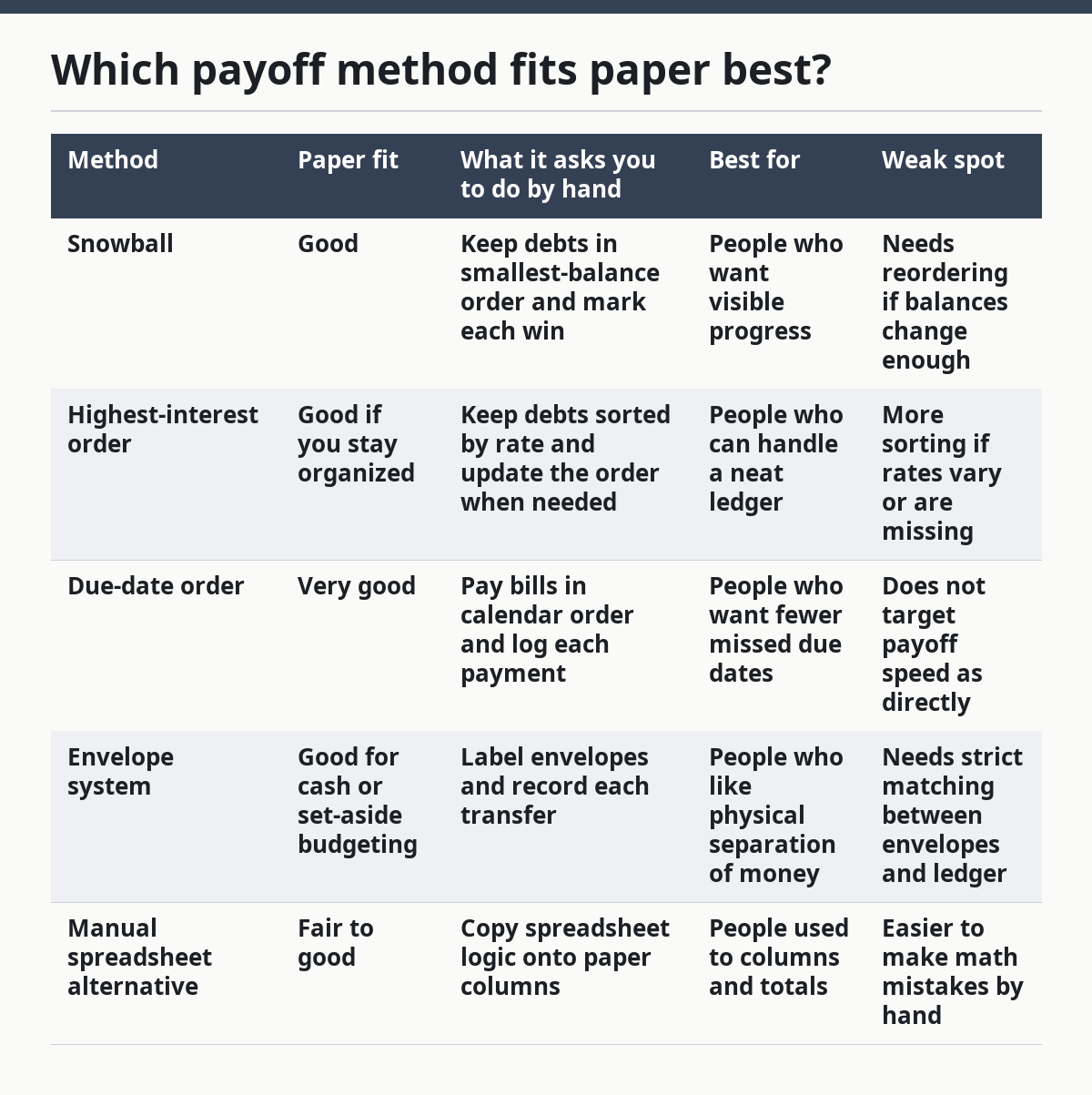
If the goal is simple recordkeeping, the due-date order often wins. If the goal is stronger motivation from crossing off 1 debt at a time, snowball is easier to see on paper than an interest-first plan. If the goal is pure organization and you are comfortable checking numbers, highest-interest can still work, but it is less forgiving when balance updates are late.
What should be on the page?
A usable paper debt list needs only a few fields, but it needs them every time. The page should show the creditor, current balance, minimum payment, due date, and payoff order in the same place.
Because a clean layout is more useful than a fancy one, 1 notebook page can hold the debt list while a second page can hold the payment log. A paper checklist can sit inside the notebook and mark which bill is due next, and the envelope system can mirror the same order with labels.
The core terms help here. A ledger is a running record of balances and payments. A payment log is the dated history of what was paid, how much, and what remained after the payment posted. Manual balance tracking means you update those figures yourself instead of waiting for an app to do it.
For visual progress tracking, use a checkbox, shaded bar, or short line of dashes next to each debt. That does not change the math, but it does make the page easier to live with for months at a time.
When should you use a different method?
You should stop using a paper payoff order if the page cannot stay accurate after normal life happens. A method that looks tidy but falls apart during a busy month is the wrong tool.
Balances change too often: If interest posts, fees appear, or statements shift faster than you can rewrite them, the paper order loses reliability — use a simpler due-date system and update once a month.
You miss paper updates for more than 1 cycle: If the ledger stays unchanged after payments, the log is no longer trustworthy — move to a method with fewer fields to update.
There are many debts with close balances: If ranking the debts takes too long because several balances are nearly the same, the snowball order becomes hard to maintain — switch to due-date order or a fixed rule you can keep on 1 page.
Your cash flow changes week to week: If you cannot promise the same extra payment every month, a rigid payoff sequence can break — keep the minimums organized first and use a flexible paper checklist for extra payments.
One debt keeps getting missed: If a bill repeatedly slips off the page, the system is not visible enough — put that debt at the top of the notebook page or on the front of the envelope stack.
You need exact, automatic math: If you are trying to manage multiple changing balances and cannot verify them by hand, the manual spreadsheet alternative may be better than a pure notebook, or you may need outside help to review the plan.
What mistakes cost the most?
The biggest paper-tracking mistake is choosing a method that depends on memory. A payoff plan is only as good as the last handwritten update.
One common error is writing the debt list once and never revisiting it. That leaves the ledger stale, so the payment log and the balance stop matching the statement. The fix is to assign 1 monthly update day and rewrite only the numbers that changed.
Another mistake is mixing 2 payoff rules on the same page. For example, a person may try to follow smallest balance first while also paying by due date. That creates confusion about which debt gets extra money, so the correct alternative is to pick 1 rule and write it at the top of the page.
A third mistake is using a notebook without any visible progress markers. Without boxes, bars, or crossings-out, the page feels flat and long. The fix is to add a simple visual mark next to each debt so the paper shows movement.
A fourth mistake is treating the envelope system like a replacement for the ledger. Cash labels can help, but they do not replace balance tracking. The safer alternative is to use envelopes for holding money and the ledger for confirming what was paid; if the setup becomes confusing, consult a qualified adviser or nonprofit credit counselor and review the plan with a source such as the CFPB.
A fifth mistake is making the page too detailed. If the notebook asks for interest math, extra notes, and several sub-totals every month, it becomes a chore. The better alternative is to keep the debt list narrow and the payment log short.
Can you still use a snowball on paper?
Yes, you can still use a snowball on paper if the order is stable enough to write once and update once a month. The smallest-balance rule is often easier to see on a notebook page than on a screen because each paid-off debt can be crossed out by hand.
Snowball works best when you want quick visible wins and when you do not want to compare interest rates every month. It is less convenient if the balances change fast enough that the order keeps shifting. In that case, a due-date method or another fixed paper rule may be easier to keep straight.
FAQ
What is the simplest debt payoff method to track on paper?
The simplest method to track on paper is the one with the fewest updates and the clearest next payment. For many people, that is due-date order, because it matches the bill calendar and reduces sorting. A notebook page with 1 debt list and 1 payment log is usually enough.
How do I track debt payoff without software?
Track debt payoff without software by keeping 1 ledger for balances and 1 payment log for every payment made. Write the creditor, balance, minimum payment, and due date on the list, then update the remaining balance after each payment posts. A paper checklist can show what comes next at a glance.
Can I use a debt snowball on paper?
Yes, a debt snowball can work well on paper if you keep the smallest balance at the top of the list and update the page on a set schedule. The paper version is easiest when the order does not change often. If balances shift too much, the notebook becomes harder to trust.
Drafted with AI; not yet reviewed by a person.