Last updated: November 20, 2026
Quick answer: use 1 payoff rule that your cash-envelope budget can follow for a full month without raiding spending envelopes. For most people, that means a simple, visible method such as debt snowball or a hybrid that keeps required payments steady and sends only clearly separated surplus to extra debt. If you want a practical place to start, the CFPB budgeting guidance and the FTC’s debt advice both stress plans that are easy to track and hard to bend.
Who this fits
This applies if you use a cash-envelope budget, also called the cash envelope system, and you want a debt payoff method that works with paper money, weekly spending caps, and physical cash budgeting. It assumes you already know your minimum debt payments, your discretionary spending categories, and how much cash is left after essentials.
This is information, not financial advice. Debt choices can change with interest rates, late fees, income timing, and country-specific rules, so a qualified adviser should be consulted for your own situation.
The main question is not “Which debt method is mathematically perfect?” It is “Which method can I follow without breaking the envelope system every time money feels tight?” If the method forces you to move cash between envelopes every week, it may look good on paper and fail in real life.
This page is for people who use cash-only spending or mostly cash-based spending and want to keep extra payment control simple. It is not a fit if your budget is already built around a zero-based system with frequent category changes, or if your surplus changes so often that any fixed plan falls apart in the first month.
A helpful rule from consumer budgeting guidance, such as the CFPB’s budgeting resources, is to make the plan easy to track and hard to bend. Cash envelopes do that best when the payoff method has few moving parts and one clear place for surplus allocation.
Key takeaways

- Pick a method that matches your cash handling, not just the math on the debt balance.
- If you use envelopes, the method should protect spending categories from being drained for debt.
- A simple order of debts is easier to keep than a plan that changes every time cash shifts.
- Extra payments need their own envelope or their own fixed rule.
- If the plan makes you raid cash envelopes often, the method is too complex for this budget.
How do you choose the right payoff method?
You choose the right payoff method by matching it to how your cash envelope budget actually behaves, not by chasing the fastest possible spreadsheet result. Start with the question of execution: can you keep making the same decision every pay period without opening every envelope and renegotiating your plan?
For a cash-envelope budget, a workable method usually has three traits. It uses a fixed order for debts, it keeps minimum payments untouched, and it gives surplus a single job. That reduces the chance that discretionary spending gets mixed up with debt money.
If you want a practical filter, compare methods on 2 tests. Does it require frequent reshuffling of physical cash? Does it force you to decide between “this envelope and that debt” every week? If the answer is yes to both, it is likely too fiddly for physical cash budgeting.
| Method | How it works | Why it fits envelopes | Main drawback |
|---|---|---|---|
| Debt snowball | Extra money goes to the smallest balance first | Easy to track on paper and simple to run with a debt payment envelope | Not the lowest-interest order |
| Debt avalanche | Extra money goes to the highest-rate debt first | Clear if you can keep the order stable in writing | Can feel slow if balances are large |
| Fixed hybrid | Minimums stay fixed, extra cash follows one simple rule you choose | Easier than constant optimization | Needs discipline to avoid changing the rule mid-month |
| Envelope-first payoff | Cash envelopes are filled first, then leftover surplus goes to debt | Protects spending guardrails | Can delay debt progress if envelopes are overstuffed |
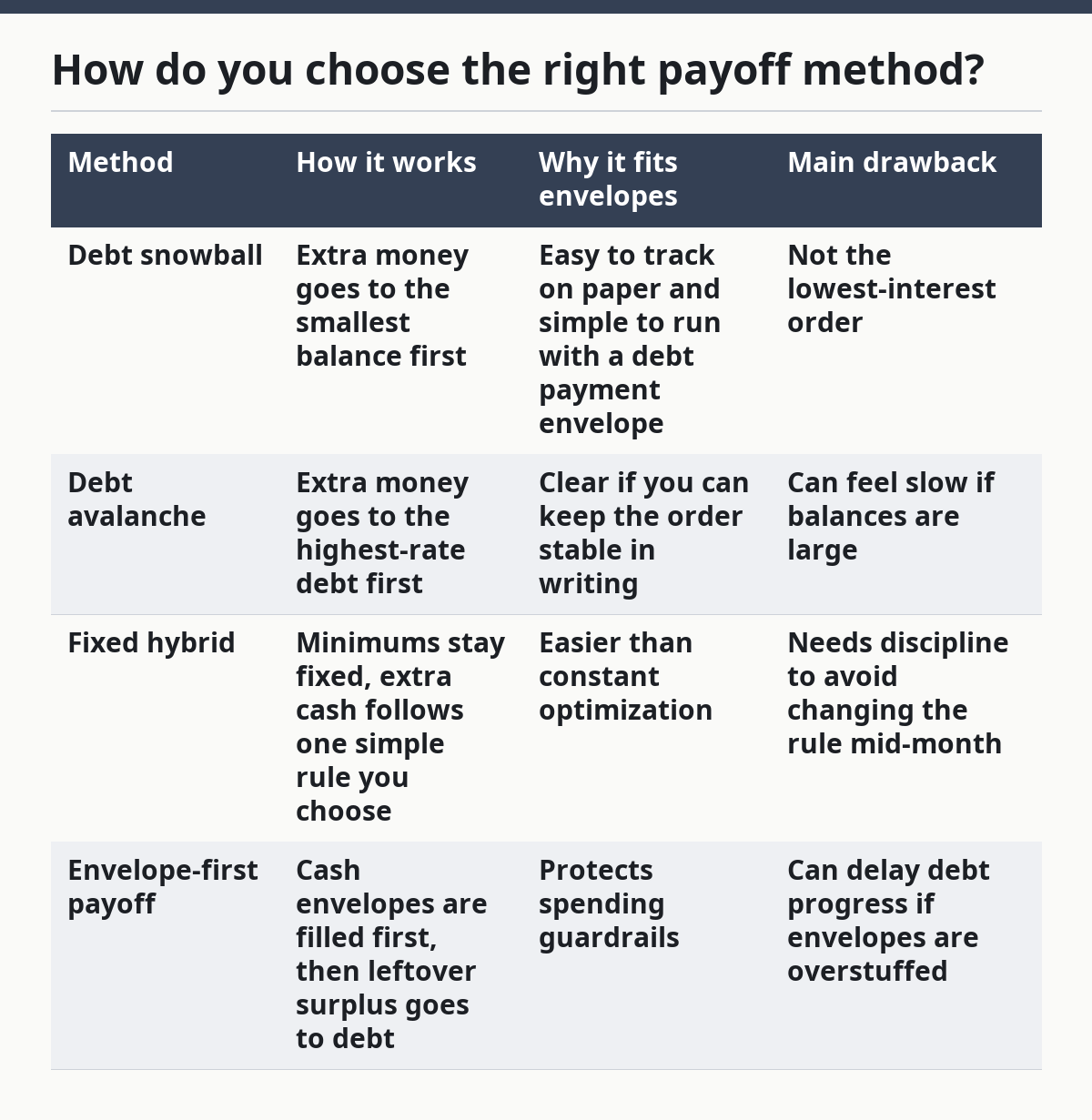
A cash-envelope budget often favors the method you will actually keep using for 6 months, not the one that wins in theory. If your habits are strongest when money is separated by category, snowball or a fixed hybrid tends to be easier to sustain than a plan that changes based on interest math alone. See also the CFPB’s debt and budgeting tools and your own lender’s payment schedule.
How do you set up debt payments inside envelopes?

You set up debt payments inside envelopes by separating “must pay” money from “extra pay” money before the month starts. That keeps minimum payments from competing with groceries, fuel, or discretionary spending.
Create one envelope or one tracked cash bucket for required debt payments, then create a second debt payment envelope for surplus allocation if you plan to send extra. If your cash never touches the extra-payment envelope, you are less likely to spend it on a non-debt category.
A useful rule is to label each envelope by purpose, not by emotion. “Rent,” “food,” “transport,” “minimum debt,” and “extra debt” are clearer than “miscellaneous” or “leftover.” Clear labels reduce the chance that cash gets reclassified when the month gets tight.
The key check is whether your envelope limits still cover the real timing of bills. If a debt payment is due before the next cash top-up, the method has failed as a timing system, not just a payoff method. In that case, the problem is the budget rhythm, not the debt strategy itself.
Which payoff method works best with cash envelopes?
Debt snowball is often the easiest match for a cash-envelope budget because it keeps the plan visible and simple. You can write the debt order on one card, attach extra cash to the first target, and leave the rest alone until that debt is gone.
Debt avalanche can also work, but it asks for more patience and more trust in the order. If your envelope system already feels strict, the slower emotional reward can make it harder to follow. It is not wrong; it is just less forgiving when the budget depends on visible progress.
A fixed hybrid is often the middle ground. In that setup, minimum payments stay on autopilot or in a tracked cash bucket, while extra debt money goes to one chosen debt until a clear checkpoint is reached. That checkpoint might be a balance target, a statement cycle, or the moment a debt is closed.
The better choice for a cash-only spender is usually the one that protects the envelope system from itself. If your plan needs you to move cash between envelopes more than once a week, the method is probably too complex for the way you handle money.
What should you check before you commit?
You should check 3 things before you commit: payment timing, surplus stability, and envelope pressure. Those 3 factors tell you whether the payoff method will work with physical cash or fight it.
Before you choose, check timing. If several debts are due on different dates, you need enough cash in the debt payment envelope before the earliest due date. A method that assumes one monthly surplus can fail when bills land mid-cycle.
Next, check surplus stability. If your extra money changes every week, a rigid avalanche order may be hard to maintain. In that case, a simpler rule, such as “extra cash always goes to the first debt on the list,” is easier to execute.
Then, check envelope pressure. If your discretionary spending envelope is already tight, a payoff method that demands frequent extra contributions can cause back-and-forth withdrawals. That is a sign to slow the method down, not to squeeze harder.
A quick self-check is this: can you explain the whole plan in 2 sentences? If not, the plan may be too complex for a cash-envelope budget that depends on quick decisions at the kitchen table.
When should you stop and choose a different approach?
You should stop this approach when the envelope system can no longer protect basic bills or when the payoff rule is causing constant cash shuffling. These are the signs that the method is not just hard, but wrong for your setup.
Your minimum debt payments no longer fit inside the cash envelope budget: this means the budget is underfunded, not just the debt plan — pause extra payments and stabilize the required bills first.
You keep borrowing from discretionary spending to cover debt extras: this means the payoff method is too aggressive for your current cash flow — remove the extra payment step and keep only minimums.
Cash disappears from envelopes before the due date: this means the physical system is not holding discipline — simplify to fewer envelopes or move the debt payment into a tracked bucket instead.
You change the payoff order every week: this means the method is not decided enough to follow — choose one order and keep it for a full statement cycle before judging it.
Your budget depends on irregular cash and you cannot predict surplus even for 30 days: this means a fixed payoff method may create false confidence — focus on bill timing and envelope stability first.
For debt resources that explain payoff structure in more detail, the broader guide on debt payoff method fit by psychological and behavior constraints can help you compare the behavior side without mixing it with this cash-envelope question. You can also compare lender help pages, the CFPB, and consumer.gov debt guidance before you decide.
What mistakes do people make with cash envelopes?
People make the same mistakes with envelope-based debt plans, and each one creates a different kind of failure. The fix is usually simpler than the mistake.
One mistake is treating the extra-payment envelope like spare cash. That can lead to casual spending and slower debt progress, so it is wise to follow your budget rules carefully and, if needed, check them with a qualified financial professional. The better move is to give that envelope a single job and not open it for anything else.
Another mistake is choosing a payoff method that needs too much arithmetic. That creates decision fatigue and makes the plan feel heavier than the budget. A simpler order, even if it is not mathematically perfect, is often easier to keep.
A third mistake is putting too many categories into the envelope system. That makes cash management noisy and raises the odds of moving money around. Fewer envelopes usually make debt payoff easier to see.
Another common error is ignoring bill dates. A method can look strong until one payment lands before payday. The correct alternative is to line up the debt payment envelope with the real calendar, not with the month in the abstract.
A final mistake is using cash envelopes for spending but not for debt planning. That split creates confusion because the debt plan has no physical place in the budget. If the debt method is real, it needs a real place in the system.
What if cash is irregular or the budget is very tight?
You modify the standard approach by shrinking the number of moving parts. If income comes in unevenly, the priority is to protect minimum payments and keep the debt payment envelope separate from discretionary spending.
For very tight budgets, the simplest method is usually the most durable. That may mean holding off on extra payments for a while and using the cash envelope system only to stop overspending. In that case, the payoff method is secondary to the budget guardrails.
If cash arrives in chunks rather than on a schedule, split the chunk immediately. Assign the required debt amount first, then fill essential envelopes, then place any true surplus into the debt payment envelope. Do not leave the cash unassigned for “later,” because later often becomes spending.
If your surplus is too small to justify several target debts, avoid overcomplicating the order. One debt target at a time is easier to track than a long list with tiny extra amounts.
How do you know the plan is working?
The plan is working if your envelopes stay intact, your minimum payments are made on time, and your extra debt money goes where you planned for at least 1 full billing cycle. That is a practical standard, and it matters more than a dramatic first week.
A good result is not just faster payoff. It is a budget that does not need constant repairs. If the envelope system still feels calm after 30 days, the payoff method fits the way you handle cash.
If the plan works only when life is easy, it does not really work. The right method for a cash-envelope budget is the one that survives a normal month, a busy week, and 1 surprise expense without collapsing into random spending.
Can I use debt snowball with cash envelopes?
Yes, debt snowball can work well with cash envelopes because it is easy to track by hand and does not need much math. The smallest-balance order is simple to keep on a card, in a notebook, or in a debt payment envelope. The main risk is not the method itself; it is spending the extra cash before it reaches the target.
How do I budget extra debt payments with envelopes?
You budget extra debt payments by giving the surplus its own envelope or clearly labeled cash bucket before you spend anything else. That keeps extra payment control separate from discretionary spending. If your surplus changes often, use 1 fixed rule for the month so you are not reassigning cash every week.
What payoff method fits a cash-based budget?
The best fit is usually the method you can follow with the fewest decisions and the least cash movement. For many cash-based budgets, that means debt snowball or a simple hybrid with one clear extra-payment rule. If a method forces frequent envelope changes, it is probably too complicated for physical cash budgeting.
Drafted with AI; not yet reviewed by a person.