
Last updated: November 20, 2026
Choose the debt avalanche if your debts have different interest rates and you can stick to the plan. Choose the debt snowball if your main problem is follow-through and you need quick wins to keep going. Debt payoff method selection for debt structure and rules — The Complete Guide depends on debt structure, payment rules, and your own behavior, not on which method sounds smarter on paper.
Quick answer: choose debt avalanche if the highest APR is clearly the most expensive debt and you can keep following the plan for 6 months or more; choose debt snowball if you need early wins to stay engaged.
Key takeaways
- The best payoff method is usually the one that fits your debt list, not the one with the flashiest name.
- Interest rate differences point toward avalanche; small-balance motivation points toward snowball.
- Minimum payments, promo periods, and due dates can change the order you should attack debts in.
- A method fails when it ignores fees, late-payment rules, or cash-flow pressure.
- For your own situation, speak with a qualified adviser.
If you are comparing debt payoff methods, the real question is simple: which order will get your debt paid down with the least friction and the lowest risk of falling behind? That answer changes when debt types, promotional rates, and minimum-payment rules change. Country rules also differ, so any tax or credit rule should be checked against your local system before you act. For a broader consumer overview, see the Consumer Financial Protection Bureau’s debt collection and repayment guidance and the Federal Trade Commission’s consumer advice on debt help and credit card payment issues.
What should decide the payoff order?
The payoff order should be decided by interest rate, payment rules, and cash flow pressure. That is the whole point of picking a method instead of picking a random extra payment.
The two most common methods are debt avalanche and debt snowball. Avalanche sends extra money to the debt with the highest interest rate first, while snowball sends extra money to the smallest balance first. Both still require you to make every minimum payment on time, because late fees and missed payments can wipe out the benefit of a careful order.
A third factor often gets ignored: contract rules. A debt with a 0% promotional period, a deferred-interest clause, a penalty rate, or a variable rate can move to the front of the line even if it is not the smallest balance. A method that ignores those details can cost more than it saves.
That is why the right answer is not “pick the one that feels best.” The right answer is “match the method to the debt structure.” If your debt list has one 24% APR card, one 0% promo balance that ends soon, and one installment loan at a fixed rate, those are not equal targets. The structure tells you what matters.
Avalanche or snowball?

Avalanche usually wins when the goal is to pay less interest, and snowball usually wins when the goal is to stay engaged long enough to finish. That is the cleanest way to separate them.
| Criteria | Debt avalanche | Debt snowball | Winner for condition |
|---|---|---|---|
| Extra payment target | Highest interest rate first | Smallest balance first | Avalanche for cost control |
| Interest savings focus | Direct | Indirect | Avalanche when rates differ a lot |
| Motivation from early wins | Slower | Faster | Snowball when you need momentum |
| Complexity | Slightly more rule-based | Very simple to follow | Snowball for simplicity |
| Works with minimum payments | Yes | Yes | Tie |
| Good for multiple card balances | Yes, if APRs vary | Yes, if balances are small and scattered | Depends on your behavior |
| Handles promo-rate timing | Better when you track end dates | Can miss rate cliffs if balance is larger | Avalanche for promo timing |
| Emotional friction | Can feel slow at first | Can feel rewarding sooner | Snowball for fragile motivation |
| Best use case | Lower total interest cost | Higher completion odds for some people | Depends on the person |
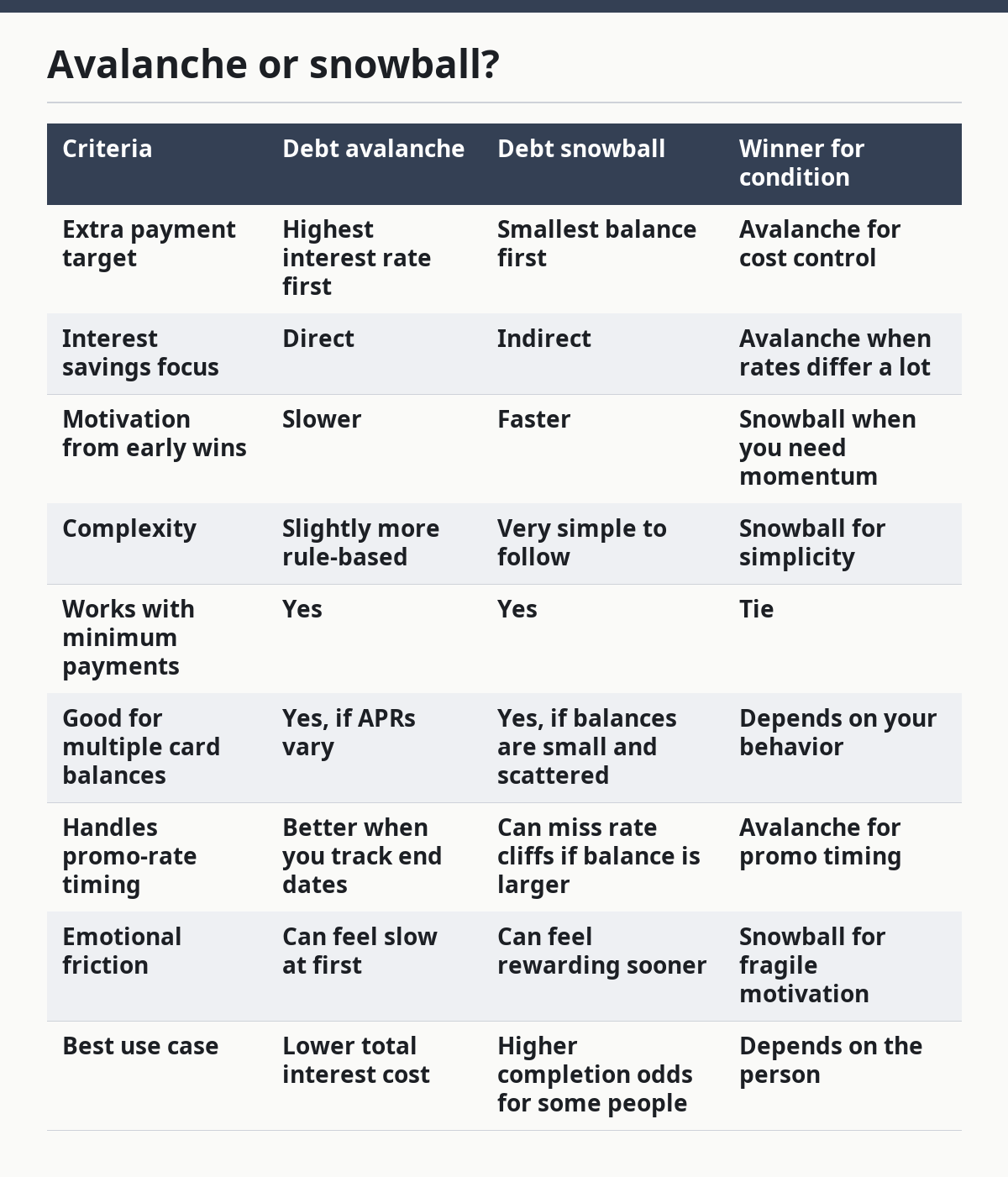
Avalanche is the better mathematical structure because interest rate is the most expensive line item on unsecured debt. If a balance carries a higher APR, each month of delay costs more. A method that attacks that rate first lines up with the actual price of borrowing.
Snowball is the better behavioral structure because small balances close faster. That matters when a reader has quit before, has many accounts, or needs visible progress in the first 1 to 3 months. A closed account can feel like proof that the plan is working, even if the math is not optimal.
The trade-off is plain. Avalanche can save more money in theory, but only if the reader keeps making the extra payment every month. Snowball can feel easier to keep going, but it may leave a higher-rate balance alive longer. The winner depends on which risk is bigger: paying more interest or abandoning the plan.
When does debt avalanche win?
Debt avalanche wins when the highest interest rate is clearly more expensive than the rest and the borrower can stay consistent for months or years. It is the right first pick for people who can follow a written rule without needing a quick morale boost.
This method fits debt structures where APRs vary across cards, personal loans, or store accounts. A 24% revolving balance should usually not sit behind a 7% installment loan if the rest of the budget is stable, because the higher rate is the more expensive debt to carry. The difference in cost is built into the rate, so the method targets the part of the debt that grows fastest.
Avalanche also fits people who already handle their budget in a spreadsheet, app, or list. If you can see the interest rate, minimum payment, due date, and promo end date in one place, avalanche becomes much easier to use. The method is a rules system, and it rewards people who are comfortable with rules.
The weakness is emotional, not mathematical. The smallest balance may stay open for a long time, which can make the plan feel stuck. That matters when someone is already frustrated by debt and needs visible progress to keep making sacrifices. Avalanche is not wrong in that case; it is just harder to follow.
A second weakness is that avalanche can be distorted by fees and penalties if the reader focuses only on APR. A debt with a lower rate but a short promo period or a high late fee can become urgent faster than the rate alone suggests. That is why the method should be checked against the contract, not just the headline APR.
When does debt snowball win?
Debt snowball wins when the reader needs quick psychological wins more than perfect interest efficiency. It is the better choice for people who have stalled before, feel overwhelmed by several balances, or need a simple rule they can explain in one sentence.
Snowball works best when there are many small balances, even if the rates are not identical. Paying off a $500 balance before a much larger one can create a clear sense of movement, especially if the account closes and removes one bill from the monthly list. That can help when the hardest part of debt payoff is not math but follow-through.
The strength of snowball is that the rule is easy to remember: pay minimums on everything, then put extra money on the smallest balance. No one has to rank interest rates every month or think through a complex matrix. A simpler system can reduce mistakes, especially if the borrower is already stressed.
The weakness is cost. If a higher-rate balance is left untouched while a smaller low-rate balance gets the extra payment, interest can keep piling up on the wrong account. That trade-off is real, not theoretical. Snowball can help a person finish, but it may not be the cheapest path to finish.
Snowball is wrong for readers who are highly rate-sensitive and disciplined enough to keep going without emotional milestones. It is also a poor fit when one debt has a short promotional window or a clearly higher rate than the rest. In those cases, a method built around balance size can ignore the most expensive rule in the stack.
How do debt rules change the answer?
Debt rules can override both avalanche and snowball because due dates, promo periods, and penalty terms change the real cost of waiting. If the contract has a special rule, the rule matters before the method.
A 0% promotional rate is a good example. If the promo ends in a known number of months, that balance may need priority even if it is not the smallest or largest. The reason is simple: when the promo ends, the rate can jump and the monthly cost can change fast. That is a structure problem, not a motivation problem.
Minimum-payment rules matter too. Some debts have fixed minimums, while others are tied to a percent of the balance or a formula in the contract. If the minimum payment changes when the balance changes, the payoff order affects future cash flow. That can make one account easier to pay than another, even when the headline rate looks less important.
Variable-rate debt needs extra care as well. If a rate can move with market conditions, the balance may not stay in the same place on your priority list for long. A borrower who only ranks debts once, then never revisits the list, may end up following a stale plan. Reviewing the order every month is safer than treating the list as permanent.
Late-payment rules can also make a smaller debt more urgent than a larger one. A debt with harsh late fees or a credit report penalty can damage the budget faster than a larger balance with softer terms. The payoff method should not be so rigid that it ignores the contract.
For official consumer guidance on debt and repayment planning, the Consumer Financial Protection Bureau has plain-language material on debt collection and debt payoff planning, and the Federal Trade Commission offers consumer guidance on debt help and credit card payment issues. Their pages are useful starting points, but local rules still vary by country and by lender.
What if the debt mix is messy?
A messy debt mix usually means the pure version of either method needs a rule change. That is normal, because real debt lists are rarely neat.
The most common messy mix includes credit cards, installment loans, buy-now-pay-later plans, and a promo-rate balance. In that case, the reader should sort by contract risk first, then by rate, then by balance size. A simple “smallest first” or “highest rate first” rule can fail when one account has a short teaser period or a fee structure that changes the cost of delay.
One useful rule is to treat any debt with a near-term rate change as urgent. Another is to keep every minimum payment current before sending extra money anywhere. A third is to avoid using the payoff method to justify new borrowing. A plan that improves an old debt while adding a new one often leaves the overall problem unchanged.
The chart below shows how the structure changes the choice.
| Debt structure or rule | What matters most | Better default method | Why |
|---|---|---|---|
| Different APRs with no promo period | Interest cost | Avalanche | Highest rate costs the most |
| Many tiny balances | Motivation | Snowball | Quick closes keep the plan moving |
| 0% promo ending soon | Deadline | Avalanche, with deadline override | The rate can jump sharply |
| Variable-rate balance | Rate risk | Avalanche, reviewed monthly | The cost can change |
| Harsh late fees or penalties | Payment discipline | Either, but never miss minimums | Late fees can erase the benefit |
| Very limited extra cash | Simplicity | Snowball or a strict hybrid | Easier to follow under stress |
| Large balance spread and stable budget | Efficiency | Avalanche | Better match for rate control |
A hybrid can make sense when the list is messy. That means using avalanche as the main rule but allowing a small-balance account to be cleared first if it removes a fee, closes a risky promo, or creates a visible milestone. The trade-off is that the plan is no longer pure, so it needs a written rule. Without the rule, the borrower may drift into impulse decisions.
Which method should I choose if I keep switching plans?
Choose one method and keep it long enough to judge the result, because switching too often defeats the point of a payoff plan. Most debt plans need months of consistency, not a new ranking every time stress goes up.
If the reader keeps changing methods, the real issue may not be the method at all. It may be that the debt list has not been mapped correctly, or that the budget does not leave enough room for the extra payment. A method cannot fix a cash-flow shortage by itself. If the monthly surplus is tiny, the plan needs a budget review before a payoff ranking.
A good check is to list each debt with four items: balance, minimum payment, interest rate, and any special rule such as a promo end date. If the list changes every month, the payoff order may need monthly review. If the list is stable, a single method can run longer without much adjustment.
Another reason people switch is guilt. A reader may start with snowball, see the math favor avalanche, then feel they made the wrong choice. That is not a mistake. A method is a tool, not a moral score. If the plan is still getting balances down and keeping payments on time, it is doing useful work.
The one thing that should force a rethink is a debt rule change. A new fee, a promo ending in 30 days, or a rate jump changes the structure of the problem. When that happens, the payoff order should be reviewed right away. Ignoring new terms can turn a decent plan into an expensive one.
Which payoff method is the right call?
Choose debt avalanche if your debts have clearly different interest rates, your budget is steady, and you can follow a rule for more than 6 months. Choose debt snowball if you need early wins, have many small balances, or know that motivation is your weak point. Neither if you are missing minimum payments, adding new debt every month, or ignoring promo end dates and late-fee rules.
That is the clean verdict because debt payoff is part math and part behavior. Avalanche is the better structure when interest cost is the main problem. Snowball is the better structure when follow-through is the main problem. If both are weak, the reader needs a budget reset first, not a different ranking system.
Debt payoff method selection for debt structure and rules — The Complete Guide also has to account for country-specific consumer rules, tax rules, and lender policies. Those details can affect the real outcome, so a qualified adviser should review the reader’s own situation before major changes.
What are the exception scenarios?
The overall verdict flips when a debt contract or behavior pattern changes the usual math. These are the cases that deserve a separate look.
First, if one balance has a promo period ending soon, that debt can jump ahead of both avalanche and snowball. A short deadline matters because the rate change can create a sudden jump in cost. The balance size matters less than the date.
Second, if the reader has a history of quitting plans after the first month, snowball may be the better first move even when avalanche looks better on paper. The reason is practical: a perfect method that gets abandoned is worse than a less efficient one that gets used for a full year.
Third, if the debt list contains a very high-fee or penalty-heavy account, the order may need to change even when the balance is small. A small debt with harsh late terms can do damage faster than a larger debt with softer terms. The contract, not the balance, becomes the priority.
Fourth, if the reader has stable income and multiple high-rate balances, a strict avalanche plan can be the strongest choice even when it feels slow. In that setup, patience is not a weakness; it is the right response to high borrowing costs. The method is boring on purpose.
What should I do before I decide?
Pick the method only after you list every debt rule in writing, because the method is less important than the accuracy of the list. Balance, minimum payment, interest rate, due date, and any promo or penalty term should all be in front of you.
Then ask one question: what is harder for me, math or follow-through? If the answer is math, snowball may keep the plan moving. If the answer is follow-through, avalanche may be the better discipline tool because the rate ranking gives the plan a clear logic.
The right choice is not hidden. It is the one that matches the debt structure you actually have and the rules you must obey. A clean payoff plan starts there, not with the name of the method.
What if I still cannot decide?
If you still cannot decide, use avalanche as the default when interest rates differ and snowball as the default when motivation is shaky. That gives you a simple starting point without pretending every debt list is the same.
The moment a debt has a special rule, check that rule first. A promo end date, penalty fee, or rate reset can change the best order even when the balance is small. If the plan still feels unclear after that, the issue is likely the debt mix or the budget, not the method name.
Is debt avalanche always better than snowball?
No, debt avalanche is not always better, because “better” depends on the goal. If the goal is lower interest cost and the borrower can stay on track, avalanche is usually the stronger structure. If the goal is staying motivated long enough to finish, snowball can be the better fit.
What if my smallest debt has the highest interest rate?
Then both methods point in the same direction, and the choice is easy. Pay that debt first after minimums, because it is both the smallest balance and the most expensive rate. That is one of the few times the structure and the psychology agree.
Should I include promo-rate debts in my payoff order?
Yes, promo-rate debts should be included, and their end dates should be checked carefully. If the promo is about to expire, that account may need priority even when the balance is not the smallest or the rate is not the highest yet. The contract date can matter more than the current balance.
Can I combine avalanche and snowball?
Yes, a hybrid can work when the debt list is messy or motivation is fragile. A common pattern is to use avalanche by default but allow one small balance to be cleared first if it removes a fee or creates a needed milestone. The key is to write the rule down so the plan does not drift.
Drafted with AI; not yet reviewed by a person.