
Last updated: November 20, 2026
Quick answer: if your loans have variable interest rates, use the payoff method that matches your rate risk and review it every time the APR changes. Variable-rate debt can change after a reset, so the method you pick should be easy to revisit when a card, student loan, or home equity line of credit moves up or down. This is information, not financial advice; a qualified adviser should review your own situation.
Key takeaways
- Variable-rate debt can move your payment target, so a payoff plan that works today may need a new order later.
- The snowball method can still work, but it ignores rate changes unless you recast the list when the APR resets.
- The avalanche method is more rate-focused, but a rate that changes can flip which balance deserves the next extra dollar.
- The right plan depends on whether your main risk is payment shock, cash-flow stress, or losing track of due dates.
- A practical choice is often the method you can keep updating every time the APR moves.
What should I look at first?

Because rate resets drive the order, start with the reset rules first. The reset date and the new APR can change your payoff order. Variable-rate debt includes credit cards, adjustable-rate loans, some student loans, and home equity lines of credit, and each can change at a different time and by a different formula.
Start by gathering the current APR, the next reset date, the minimum payment, and the rate cap or floor if the contract has one. For adjustable-rate loans, read the promissory note or account terms. For credit cards, check the statement because the rate may already have changed after a notice period.
If the loan can jump enough to strain your monthly budget, that debt deserves more attention than a fixed-rate loan with the same balance. A fixed-rate loan keeps the interest cost steady, while a variable-rate loan can create payment shock, which means a monthly payment that rises faster than your cash flow.
Useful references for rate mechanics include the Consumer Financial Protection Bureau’s explanation of adjustable-rate mortgages and Federal Student Aid’s material on interest rates for federal student loans:
https://www.consumerfinance.gov/ask-cfpb/what-is-an-adjustable-rate-mortgage-en-199/
https://studentaid.gov/understand-aid/types/loans/interest-rates
How do I choose a payoff method?
Choose the method that matches how often your rates move and how much stress a rate jump would cause. The basic choice is between a balance-first method, a rate-first method, and a cash-flow-first method.
| Method | Main idea | Works best when | Weak point with variable rates |
|---|---|---|---|
| Snowball | Pay smallest balance first | You need motivation and quick wins | A small balance can be cheap today and expensive after a reset |
| Avalanche | Pay highest APR first | You want interest cost to stay as low as possible | The top APR can change, so the order needs regular review |
| Cash-flow-first | Pay the loan most likely to cause payment shock first | One reset could break the budget | It may not minimize total interest over time |
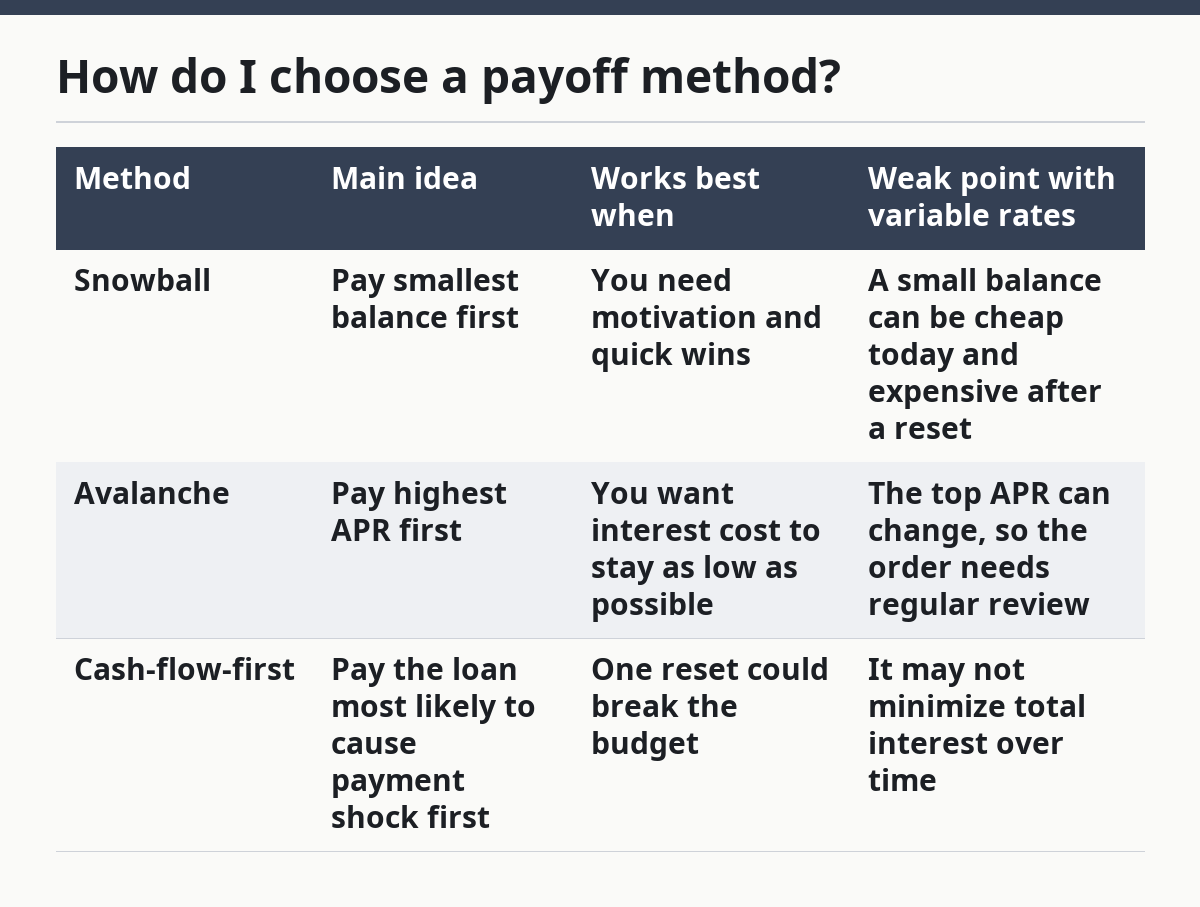
The method itself is not the whole decision. With variable-rate debt, the real choice is whether you can tolerate a changing order. If you hate spreadsheets and rate notices, a simple plan you will actually follow can beat a perfect plan that you abandon.
The best fit is often the method that lets you answer one question every month: has any APR changed enough to move this debt up or down in line? If the answer is yes, the payoff order should be recast.
How do I do it step by step?

You should build the plan around the next rate change, then review it each time the APR resets. Use one sheet, one app, or one notebook page, but keep the same fields for every debt.
- List every variable-rate debt, with current APR, minimum payment, balance, and next reset date, then verify each number against the latest statement or loan portal; a mismatch means you are using stale data.
- Mark the loan type for each account, such as credit card, student loan, adjustable-rate loan, or home equity line of credit, then verify whether the rate can change monthly, quarterly, or on another schedule; a missing reset schedule is a problem.
- Check the contract terms for any rate cap, floor, or margin, then verify how far the APR can move at the next reset; if the contract is unclear, you may be underestimating payment shock.
- Sort the debts by your chosen method, either smallest balance, highest current APR, or greatest payment risk, then verify the list is in that order before sending extra payments; if the order feels random, the method is not clear enough.
- Apply every extra dollar above the minimum to the first debt in line, while paying the minimum on all others, then verify the extra payment posts to principal and not only to future interest; if the servicer misapplies it, the plan slows down.
- Track each APR review date on a calendar 30 days before the reset, then verify the new rate as soon as the notice arrives; if you wait until the next statement, the payoff order can lag behind the change.
- Recast the order after every rate reset by rerunning the list with the new APRs and payments, then verify whether the debt that looked least urgent last month still belongs there; if not, move the extra payment to the new top priority.
- Stress-test the budget with the highest likely payment, then verify that your income still covers housing, food, transport, and the minimums; if one reset would crowd out essentials, the method needs a safer order.
That last step matters most. Variable-rate debt is not a one-time ranking exercise. It is a repeating review, because a rate change can turn a middle-priority debt into the one that deserves the next extra payment.
Which loan should I pay first when the rate changes?
Pay the debt that creates the worst mix of interest cost and payment shock after the next reset. The highest current APR is not always the right answer, because a lower-rate loan with a near-term reset may become more expensive soon.
For example, a credit card with a high current APR but a stable minimum may not be as urgent as a student loan or adjustable-rate loan that is about to reset upward. The decision changes if the reset date is 30 days away versus 12 months away.
A clean rule helps: if two debts are close, give the next extra payment to the one with the earlier reset or the one that would strain the budget more after the jump. If the higher-rate debt also has the more unpredictable payment, it usually belongs ahead of a steadier balance.
When should I stop and rethink the plan?
You should stop and rethink the plan whenever the rate change makes the original order no longer match your budget or your goal. In variable-rate debt, the wrong method is usually the one that ignores a new APR notice.
The minimum payment is rising faster than your spare cash: This means the debt is moving toward payment shock — switch to a cash-flow-first order and protect the monthly budget before sending extra principal payments.
A reset notice shows a much higher APR than before: This means the debt is now more expensive than the list you made last month — recast the payoff order and move the debt higher if the new rate justifies it.
One debt has a teaser or intro period ending soon: This means the current payment may not last — review the contract now and decide whether that account needs priority before the reset hits.
Your minimums are so high that extra payments are impossible: This means the payoff method is secondary to cash flow — focus on meeting all minimums first and consider professional help for a full budget review.
You cannot find the margin, cap, or reset formula: This means you do not know how the rate can move — contact the servicer or lender for the terms before you rank anything else.
One loan has a penalty, fee, or contract term you do not understand: This means the payoff order may have side effects you have not priced in — pause, review the loan documents, and consider a qualified adviser or attorney before changing payment strategy. The CFPB says borrowers should review their loan terms and contact the servicer with questions: https://www.consumerfinance.gov/ask-cfpb/
What mistakes do people make with variable-rate debt?
People usually make the same few mistakes, and each one has a cost. The good news is that every one of them has a clear fix.
First, they use last month’s APR as if it were permanent. That can send extra money to a balance that is already about to reset upward. The fix is to rerun the order on every reset notice, not just once a year.
Second, they treat snowball and avalanche as fixed rules instead of living plans. That makes the payoff order stale after the first rate change. The fix is to keep the method but recast the rankings whenever the APR moves.
Third, they ignore payment shock until the bill arrives. Then a loan that looked manageable can squeeze out the rest of the budget. The fix is to test the plan against the highest likely payment before you commit extra cash.
Fourth, they forget that due dates and minimums still matter. A late fee can derail the payoff plan even when the interest logic is sound. The fix is to pay every minimum on time before any extra payment goes out.
Fifth, they compare a variable-rate loan to a fixed-rate loan as if they respond the same way. They do not. A fixed-rate balance is stable; a variable-rate balance can change the math without warning, so the variable debt needs more frequent review.
What if my debt mix is unusual?
You should adjust the method when the debt mix includes both rate-sensitive and rate-stable accounts. A student loan, credit card, and home equity line of credit do not behave the same way, and a single rule can miss that difference.
If the variable-rate loan has a reset in the next 1 to 3 months, put more weight on that timing than on balance size. If the reset is far away, you can often keep the current method until the notice arrives, then recast the list.
If the rate changes often and the balances are close, the difference between snowball and avalanche may be small in practice. In that case, the better method is the one you will review every month without fail.
If your debts are all variable, the plan needs more frequent checking than a fixed-rate list. If only one loan floats, that loan may deserve more attention than its balance suggests, especially if the payment can jump enough to alter the rest of the budget.
One more useful step is to keep the broader debt-strategy guide nearby. The hub page, “Debt payoff method fit by debt portfolio structure — The Complete Guide,” can help you place this choice inside a wider plan without repeating the same rules here.
FAQ
Should I pay off variable-rate debt first?
You should pay it first when the rate risk is high enough to change your budget or your interest cost soon. A loan with a near-term reset often deserves more attention than a fixed-rate balance with the same size, but the answer changes with your cash flow and contract terms.
How do I prioritize loans when the rate can change?
You should prioritize the debt with the most urgent combination of current APR, reset timing, and payment shock risk. If the rate can change in the next billing cycle, that account may move ahead of a larger but steadier loan. Recheck the order each time a new notice arrives.
Does a variable rate change the snowball or avalanche choice?
A variable rate does not erase either method, but it does make both methods less static. Snowball still favors small balances, and avalanche still favors high APRs, yet a rate reset can change which debt belongs first. That is why recasting the order matters more than the label.
Is there a single best method for variable-rate debt?
No single method fits every borrower, because rate changes affect balance cost and monthly payment in different ways. The better method is the one you can keep updating after each reset. If you need simpler behavior, choose the plan you can follow; if you need lower interest sensitivity, choose the plan you can recast often.
Drafted with AI; not yet reviewed by a person.