
Last updated: November 20, 2026
Quick answer: start with the debt whose required payment changes within the next 1 to 3 billing cycles, then rank the rest by interest cost and balance size. For how to choose a debt payoff method when some debts have balance tiers or step-up payments, the key is to protect the next payment change first, then use your normal ranking rule. When a debt has balance tiers or a step-up payment, the required monthly amount can rise later, so the usual “smallest balance first” or “highest rate first” choice may need one extra rule: avoid letting a scheduled increase surprise the budget.
Who this applies to and what it assumes
This applies to someone who has at least one debt with a payment schedule that changes over time, such as a graduated payment loan, a tiered credit card payment plan, or an installment loan with a planned step-up. It assumes the balances, interest rates, and payment dates are already listed somewhere, even if only on paper or in a spreadsheet.
This guide is for learning how to rank debts, not for changing a loan contract or picking a new product. It is financial information, not financial advice, and a qualified adviser should be consulted for a personal situation that includes tax issues, missed payments, or bankruptcy risk. The right method depends on the loan terms, country rules, and cash flow.
Tiered-payment debt matters because the “minimum due” or required installment is not fixed. A card that asks for 2 different payment levels, or a loan that steps up after a set period, can change which debt is the real pressure point. For more on the broader framework, see the site’s hub on debt payoff methods and the related page on debt payoff order by debt portfolio structure.
Key takeaways

- A debt with a future payment increase can outrank a smaller debt that stays flat.
- A practical debt payoff method is the one that prevents a required payment jump from breaking the plan.
- Interest rate still matters, but it is not the only factor when payment schedules change.
- A payoff plan can fail if the next tier change is only 1 statement cycle away and the budget was built for the old number.
- The wrong choice is any method that ignores payment dates, amortization, or a scheduled step-up.
How do tiered payments change the payoff order?
Tiered payments change the payoff order because the next required payment matters as much as the current balance. A debt with a low balance but a step-up in 3 months may deserve attention before a larger debt with a flat payment, especially if the rise will collide with other bills.
A graduated payment loan uses a payment schedule that starts lower and rises later. In amortization, that usually means the loan balance is expected to be paid down over time with a planned pattern, not a constant minimum. A tiered credit card payment plan can work differently, but the same rule applies: once the payment tier changes, the cash required each month changes too.
The useful question is not “Which debt is smallest?” It is “Which debt creates the next budget shock?” A flat balance with a stable minimum due can be easier to leave in place for a while than a debt that will step up in the next 1 to 3 billing cycles. The schedule, not just the balance, shapes the payoff order.
How do you choose the order step by step?

The right order starts with the debt whose payment schedule can hurt the budget first, then uses interest and balance as tie-breakers. The action is not one single trick; it is a sequence.
- List every debt, its current balance, interest rate, payment date, current required payment, and the next scheduled change. Verify that each account shows a date or trigger for the change. If any debt has no clear schedule, that is a problem and the terms need to be checked before ranking it.
- Mark the debts with balance tiers or step-up payments. Verify whether the change is tied to a date, a balance threshold, or a statement cycle. If the trigger is unclear, the payoff order may be wrong because the payment could rise sooner than expected.
- Separate the debts into “stable payment” and “changing payment” groups. Verify which debt will increase first, not just which debt has the highest rate. If two debts change around the same time, that is a warning sign that the budget needs a buffer instead of a simple ranking.
- Rank the changing-payment debts by urgency before you rank by balance size. Verify whether a step-up within the next 1 to 2 statement cycles creates a larger monthly burden than a slightly higher interest rate. If the answer is yes, the urgency comes first.
- Compare interest rates only after the payment shock is handled. Verify whether a higher-rate debt is still affordable at its next tier. If the debt remains manageable, it can stay behind a more urgent step-up debt; if not, the order should change.
- Place the stable-payment debts into the remaining slots using the usual order you already use for your payoff method. Verify that the list still works if one payment date moves by 1 month. If the plan only works with perfect timing, it is too fragile.
- Test the plan against the next 6 to 12 months of statements. Verify that no required payment increase lands in a month where the plan has no room. If a scheduled step-up would force a missed payment, the order is wrong and should be rebuilt.
The point of the steps is to turn “debt strategy” into a calendar problem. A payoff order that ignores a payment date change can look neat on paper and fail on the due date.
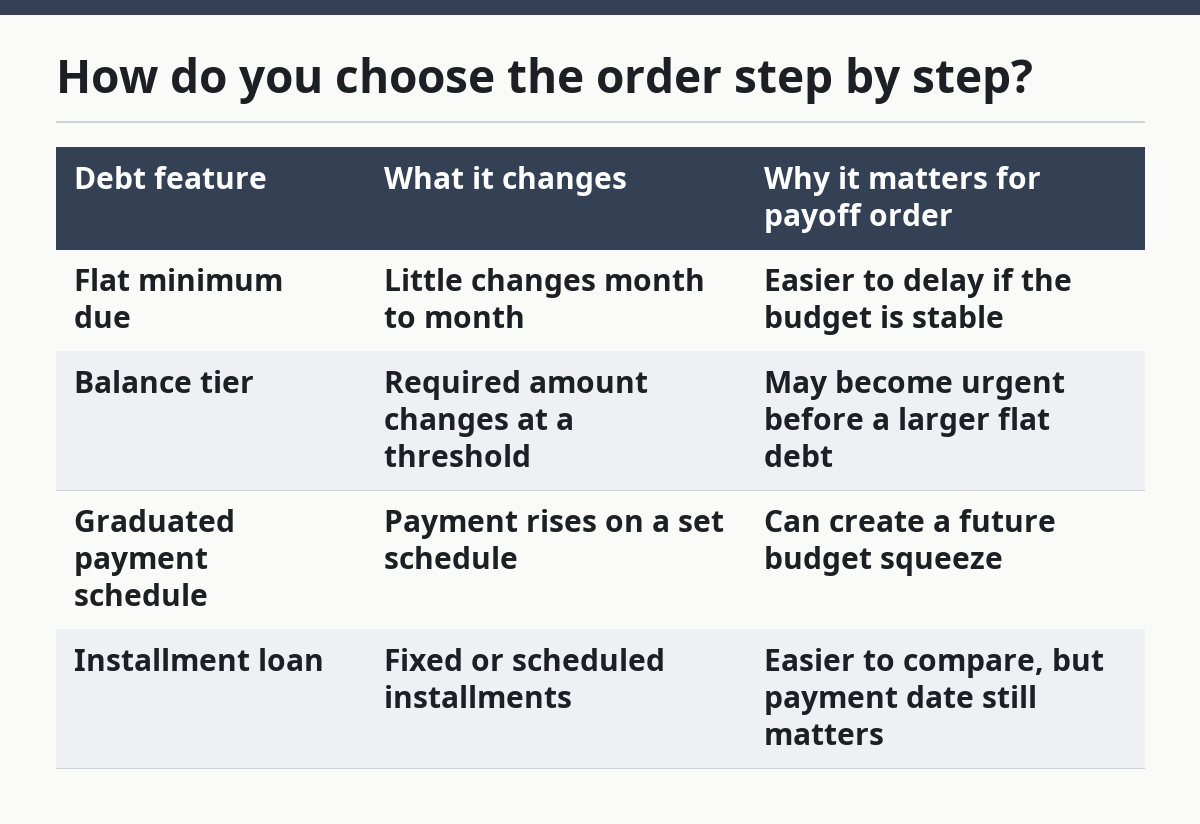
| Debt feature | What it changes | Why it matters for payoff order |
|---|---|---|
| Flat minimum due | Little changes month to month | Easier to delay if the budget is stable |
| Balance tier | Required amount changes at a threshold | May become urgent before a larger flat debt |
| Graduated payment schedule | Payment rises on a set schedule | Can create a future budget squeeze |
| Installment loan | Fixed or scheduled installments | Easier to compare, but payment date still matters |
What should you check before ranking anything?
The first check is whether the next payment change is written in the contract or only shown on a statement. A statement can be easy to miss, while a contract may show the full amortization schedule. If the schedule is missing, the debt should not be ranked by memory.
The second check is the size of the jump. Even without a universal threshold, a small increase and a large increase do not belong in the same bucket. A debt that rises soon by a noticeable amount can deserve priority over a debt with a slightly higher balance but no change for many months.
The third check is timing across the whole month. If one payment date moves earlier, it can squeeze the rest of the month even when the total amount is unchanged. A payoff plan that ignores payment date changes can cause a short cash crunch before the end of the month.
The fourth check is whether the debt has a minimum due change as well as a scheduled step-up. Those are not the same thing. A minimum due amount can move because of balance, fee, or contract terms, while a step-up payment is part of the planned payment schedule. Mixing them up leads to the wrong order.
When should you stop and get help?
Stop using a simple payoff order when the debt terms are no longer simple. A payoff method is the wrong tool when the schedule itself is unstable or hard to verify.
The next payment increase is unclear: If the contract does not show when the payment rises, the debt may not be rankable with confidence — get the schedule in writing from the lender before deciding the order.
Several debts change in the same 30-day window: If two or more required payments rise at once, the budget can fail even if the balances are small — ask a qualified adviser to review the full cash flow.
A balance tier is close and easy to cross: If a payment threshold is near, one extra charge or one extra month can trigger a bigger payment — pause extra payoff and verify the threshold first.
The debt is in default or near default: If missed payments or collection notices are already part of the picture, a normal sequencing rule may be useless — get professional help on the account status before ranking other debts. The CFPB debt collection guidance explains why default and collection status can change the options available.
The plan depends on exact timing you cannot control: If the order only works when every payment posts on time, the method is too brittle — build in a cushion or revise the sequence.
The loan has a complex amortization change: If the payment schedule resets, balloons, or steps up under a special term, the standard “highest rate first” rule may not fit — review the full schedule with a qualified adviser. See also the amortization schedule guide.
What mistakes do people make with tiered-payment debt?
The most common mistake is treating every debt as if the minimum due stays flat. That can leave a step-up payment out of the plan until the month it arrives, which can force a late payment or a rushed transfer. If the terms are unclear, consult a qualified adviser and verify the schedule with the lender before ranking debts. The CFPB amortization schedule explanation is a useful reference point. The better alternative is to read the payment schedule first, then rank the debts.
Another mistake is using only balance size. A small balance with a fast-approaching step-up can be more urgent than a larger debt with a steady installment. The better alternative is to compare balance, payment date, and upcoming change together.
A third mistake is ignoring payment dates because the monthly total looks affordable. That fails when a debt due early in the month crowds out another bill later in the month. The better alternative is to map the calendar, not just the total.
A fourth mistake is assuming an amortization schedule is only for big loans. Some installment loans and graduated payment loans use a schedule that changes the required amount from month to month. The better alternative is to pull the actual schedule and read the next 6 to 12 payments, not the headline rate alone.
A fifth mistake is overpaying one debt while another required payment is about to rise. That can make the plan look aggressive but leave the budget exposed. The better alternative is to reserve enough room for the next step-up before sending extra money anywhere else.
What changes with graduated payment loans and step-up plans?
Graduated payment loans and step-up plans change the payoff method because the required payment is not constant. A graduated payment schedule often starts lower and rises later, which means the debt can look easy at first and then become harder with no warning if the schedule is not tracked.
The practical change is simple: the next payment change becomes part of the ranking rule. A debt with a planned rise in 2 billing cycles may deserve a higher spot than a debt with a stable minimum due, even if the stable debt has a slightly worse rate. That is especially true when the payment date falls near rent, utilities, or another large fixed bill.
Step-up plans can also change the way payoff goals are measured. If a debt is likely to become less affordable over time, the plan should be judged on whether it survives the future payment, not whether it looks tidy today. A method that works only before the step-up is not a complete method.
The wrong move here is to treat every future increase as a bonus problem for later. Consult a professional if the schedule is hard to read, and verify the contract or billing statement before acting. The right move is to treat it as part of the current payoff order. If the loan agreement or billing statement makes the increase hard to read, that is a reason to stop and verify, not a reason to guess. See the CFPB debt collection guidance and the FTC debt collection resources for related consumer debt issues.
How do tiered payments affect payoff order?
Tiered payments affect payoff order by changing which debt is most urgent in the next few months. A debt with a future payment jump can move ahead of a smaller or lower-rate debt if that jump will strain the budget first. The right order is the one that keeps required payments manageable while still using the chosen payoff method. For a broader overview, see debt snowball vs avalanche.
Should I prioritize loans with step-up payments?
Yes, if the step-up payment is close enough to change the budget before the other debts are resolved. A debt that will rise in the next 1 to 3 billing cycles may deserve priority over a flat debt with similar terms. If the step-up is far away and the debt is otherwise stable, it may not need to come first.
What if minimum payments change over time?
A changing minimum due means the old payoff order may no longer fit. The plan should be updated from the new payment schedule, not from the old one, because the order can shift when the required amount rises. If the change is hard to track, the safest next step is to verify the current terms and rebuild the list before sending extra payments.
Drafted with AI; not yet reviewed by a person.