Last updated: August 10, 2026
- You have a 0% balance transfer offer.
- The interest rate is often lower, sometimes 5–8% compared to 20%+ on credit cards.
- UK non-profit debt charity StepChange reported that in 2023, the average client carried £13,896 in unsecured debt — nearly all of it on high-rate products.
- Consolidation loans fail to resolve the problem when the underlying spending gap is not closed first; many borrowers re-accumulate card debt within 12–24 months.
- Minimum payments on a high-interest credit card are typically 1–3% of the balance or a £/$ flat minimum, whichever is greater — designed to maximise lender revenue, not to clear debt quickly.
- On a $5,000 balance at 22% APR, paying only the minimum extends repayment to roughly 17 years and costs approximately $6,300 in interest (Consumer Financial Protection Bureau, 2023).
- UK non-profit debt charity StepChange reported that in 2023, the average client carried £13,896 in unsecured debt — nearly all of it on high-rate products.
- NFCC-member credit counsellors in the US negotiate average interest rate reductions of around 8–11 percentage points on Debt Management Plans.
- Calling a creditor before missing a payment — not after — gives access to hardship programmes unavailable once an account is in arrears.
- Consolidation loans fail to resolve the problem when the underlying spending gap is not closed first; many borrowers re-accumulate card debt within 12–24 months.
- For unrepayable debt, formal insolvency options (IVA in the UK, Chapter 7/13 in the US) exist and a licensed insolvency practitioner can outline them without obligation.
Here’s the math nobody puts on the statement: minimum payments are calibrated to keep you paying as long as possible, not to get you free. You’re not failing at money — you’re caught in a system engineered for exactly this outcome. Understanding what’s actually happening, and what your real options are, matters enormously, because the right path out depends entirely on your specific situation.
One honest note first: what follows is information, not financial advice tailored to your circumstances. For anything significant — especially debt settlement or bankruptcy — talk to a qualified financial adviser or credit counsellor before acting.
What’s Actually Happening When You Pay Only the Minimums on Debt
A minimum payment is typically calculated as a small percentage of your balance — often 1–3% — sometimes a flat fee, sometimes whichever is higher. Because interest accrues on the remaining balance, paying the minimum keeps the principal barely moving; or not moving at all when the interest charge is close to what you paid.
The effect in plain terms: on a balance carrying a 20%+ APR, around half or more of a typical minimum payment goes straight to interest each month. Consider a $3,000 balance at 22% APR with a $60 minimum — roughly $55 of that first payment is interest. Only $5 reduces the principal. Add new charges on top and the balance can actually grow even while you pay faithfully every month.
Not an accident. A revenue structure. That doesn’t mean you’ve been victimised — it means understanding the mechanism is the first step to defeating it.
Quick check: Pull up your last statement. Find the line showing what you paid and how much went to interest. More than half? You’re in the slow-bleed zone.
What Actually Determines the Right Answer for Minimum-Payment Debt

Three questions about your situation need honest answers before any strategy makes sense. Every recommendation below is conditional on these.
1. Is this a cash-flow problem or a balance problem?
A cash-flow problem means you have enough income in principle but timing, irregular expenses, or a short-term setback is squeezing you. A balance problem means your debt is structurally too large for your income to clear, regardless of timing.
2. Is the situation temporary or structural?
Temporary: you lost one income stream, had a medical bill, had a car repair — something with a foreseeable end. Structural: your expenses routinely exceed your income and have for a long time.
3. What is your interest rate environment?
Not all debt is equal. A low-interest personal loan from a credit union is a different animal from a credit card running at 22–29% APR. Strategy differs based on this.
| Situation | Best Path | Why Other Options Often Fail Here |
|---|---|---|
| Temporary squeeze, manageable balance, decent credit | Call creditors now; seek hardship deferral; resume full payments when stabilised | Balance transfers require good credit; debt settlement destroys credit when you don’t need to |
| High-rate debt, stable income, just over-extended | Avalanche or snowball method; consolidation loan if rate is genuinely lower | Minimum-only approach is mathematically self-defeating over time |
| Structural deficit — spending exceeds income | Budget surgery first; credit counselling; possibly a Debt Management Plan | Consolidation without fixing spending just shifts the problem; you’ll re-accumulate |
| Balance so large it’s functionally unrepayable on current income | Formal insolvency options — speak to a licensed insolvency practitioner or equivalent in your country | Minimum payments on unrepayable debt prolong financial paralysis for years |
Quick check: Be honest about which row describes you. Most people want to believe they’re in row one when they’re in row three.
When the Problem Is Temporary, Do This First
A specific event squeezed you — not a chronic pattern. The single most underused tool available to you is calling your creditors before you fall behind, not after.
Most lenders have hardship programmes. Real options: temporary payment reductions, interest freezes, or deferred payments that don’t immediately damage your account standing the way a missed payment does. They’re not widely advertised because they cost the lender money.
- Gather your account numbers and your last few statements before you call.
- Call the main customer service number and ask specifically for the hardship or financial assistance department.
- State clearly and briefly what happened — job loss, medical issue, one-time expense — and that it is temporary.
- Ask what options they have: interest rate reduction, payment deferral, or a temporary hardship plan.
- Get any agreement confirmed in writing — by email or posted letter — before you rely on it.
- Set a calendar reminder to follow up before the hardship period ends, so you’re not caught out when normal terms resume.
The honest limitation: this works better when you call before missing payments. After several months in arrears, the conversation changes and the options narrow considerably.
Quick check: Have you actually called, or are you assuming they won’t help? Most people assume. Most people are wrong about that.
When the Problem Is Structural, Start With the Budget — Not a New Loan
Consolidation is the recommendation you’ll see everywhere — roll all your debt into one loan at a lower rate, make one payment, feel relief. It can work. It also fails frequently, and the reason it tends to fail is that the consolidation didn’t fix the underlying spending pattern.
Consistently spending more than you earn means a consolidation loan gives you breathing room and cleared credit card limits — and many people then re-accumulate on those cards within a year or two, ending up with the consolidation loan and new card debt. That math stops working fast. A 2019 study published in the Journal of Financial Counseling and Planning found that a significant share of debt consolidators re-entered high debt levels within 24 months when underlying spending behaviour was unchanged; that’s reason enough to treat consolidation as a conditional step, not an automatic one. (Always consult a qualified financial adviser or non-profit credit counsellor before consolidating debt.)
The sequence matters enormously:
- Map every fixed and variable expense for the last three months — not estimated, actual from bank and card statements.
- Identify what’s genuinely fixed (rent, utilities, minimum debt payments) versus what’s discretionary, even partially.
- Find the gap: the amount by which spending exceeds income, or the margin you have to redirect.
- Create a realistic revised budget — not punishing, but honest. Cut everything and still can’t close the gap? The income side needs addressing too.
- Only once the budget is stable and you’ve held it for at least four to six weeks, consider whether consolidation makes sense on top of a functioning spending plan.
- Still can’t close the gap through budgeting alone? Contact a non-profit credit counselling agency before approaching any commercial debt company.
Non-profit credit counsellors — in the UK, organisations like StepChange; in the US, NFCC-member agencies; in Canada, Credit Counselling Canada members — offer free or low-cost advice and can administer Debt Management Plans that negotiate reduced interest with creditors. Commercial debt settlement companies charge fees and the approach carries real risks to your credit standing — understand the full picture before signing anything.
Quick check: Can you name, from memory, where your money went last month to the nearest meaningful amount? No? Then the budget step isn’t optional.
The Avalanche and Snowball Methods — Which Fits Your Minimum-Payment Situation
Some room exists in your budget — even a small amount above the minimums. How you direct that extra payment matters.
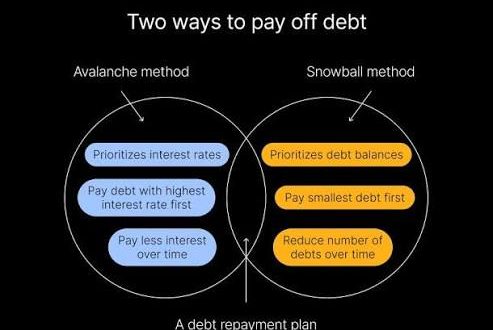
The avalanche method directs all extra payments to the highest-interest debt first, minimums on everything else. Once that’s cleared, the payment rolls to the next highest. Mathematically, this minimises total interest paid. On a typical three-card scenario with balances of $1,500 at 28%, $3,000 at 22%, and $4,500 at 15%, the avalanche saves roughly $800–$1,200 in interest compared with the snowball over a three-year payoff.
The snowball method directs extra payments to the smallest balance first, regardless of interest rate. Once cleared, that payment rolls to the next smallest. Psychologically, it creates quicker wins.
Honestly: the avalanche saves money on paper. The snowball keeps more people on track in practice, because the early wins are motivating. A method you consistently follow for two or three years will outperform the theoretically optimal one you abandon after six months — so choose the approach that fits how you’re actually wired.
One condition worth adding: when one of your high-rate debts has a balance close to your smallest balance, use the avalanche — you lose almost no psychological benefit and save meaningfully on interest.
Quick check: Do you need the psychological wins to stay motivated, or can you track a slower number moving and stay disciplined? Answer honestly; it changes which method fits you.
When the Standard Advice Breaks Down — Six Edge Cases
1. Self-employed with irregular income.
Standard advice assumes a fixed monthly cash flow. Variable income changes the calculation: minimum payments protect you in low months, but the avalanche approach requires surplus months. Because of that variable structure, build a cash buffer first — even one month of minimum payments in reserve — so a bad month doesn’t force missed payments while a good month gets eaten by arrears catch-up.
2. You have a 0% balance transfer offer.
These can be genuinely useful, but watch the transfer fee plus what happens at the end of the promotional period. Clearing the balance before the standard rate kicks in is essential — at typical reversion rates of 20–25% APR, it may not be the deal it appears. Also: opening a new credit account affects your credit score, typically by 5–10 points initially.
3. Your debt is mostly student loans.
In many countries, student loan repayment is income-contingent, with different rules than commercial debt. Strategies designed for credit card debt do not automatically transfer. Country-specific rules govern interest, deferral, and forgiveness — check your national student loan servicer’s guidance directly.
4. You own a home and are considering equity borrowing to consolidate.
Borrowing against your home converts unsecured debt into debt secured against your property — meaning the lender has a legal claim on that property if you default. The interest rate is often lower, sometimes 5–8% compared to 20%+ on credit cards. The risk is categorically higher: defaulting on a credit card is damaging; defaulting on a home equity loan can mean losing the property. This is not a decision to make under financial stress without professional guidance from a qualified mortgage adviser or financial planner. (CFPB: What is a home equity loan?)
5. A creditor is threatening legal action.
Once a creditor is pursuing a county court judgment (UK) or a judgment (US/Canada), the situation has changed. Negotiation timelines compress. Get specialist debt advice — many non-profit services have dedicated teams for this — before responding to legal correspondence.
6. Joint-debt situations after a separation.
Both parties remain fully liable on joint accounts regardless of any private agreement between them. Creditors are not bound by separation agreements. Separating joint debt legally requires the creditor’s cooperation, not just the other person’s promise.
The Honest Summary of What to Do When Minimum Payments Are All You Can Manage
Minimum payments are not a strategy. A holding position — that’s all they are. During genuine short-term crises, holding can prevent worse damage; but treat it as a short-term calculation, not a plan, and discuss your specific circumstances with a qualified debt adviser or credit counsellor before deciding to hold rather than act. (NFCC: The real cost of minimum payments.) Held permanently on high-interest debt, minimum payments become a slow financial bleed that compounds over years.
The path forward depends on which situation you’re actually in. Temporary problem with a foreseeable end: call creditors now, seek hardship arrangements, and protect your credit rating while you recover. Structural problem: fix the budget before you add any new financial product. Unrepayable debt: formal options exist, and speaking to a licensed insolvency professional is not failure — it’s information-gathering.
None of these paths require doing nothing and hoping. The minimum-payment trap has an exit. Finding it starts with being accurate about which trap you’re actually in.