
Last updated: November 20, 2026
If your motivation depends on seeing progress fast, this guide on how to choose a debt payoff method when your motivation depends on seeing progress fast helps you pick a progress-motivated payoff plan that puts small balances and visible milestones first. That does not mean ignoring the math forever; it means picking a plan that you can sustain long enough to finish, because a plan you quit after 2 weeks is worse than one that feels slower on paper.
This is information, not financial advice, and a qualified adviser should be consulted for your own situation. Debt rules, minimum payments, and interest terms differ by country and can change; see the Consumer Financial Protection Bureau’s guidance on debt collection and repayment and repaying debt for general information.
Key takeaways
- Fast motivation comes from visible wins, not from the biggest spreadsheet savings.
- Small balances, milestone tracking, and a debt payoff streak matter when willpower drops after a few days.
- A progress-first plan is a tool for behavior, so it can be the wrong fit if you only care about lowest interest cost.
- In many cases, the most sustainable method is the one you can follow for months, not the one that looks neat in a single comparison chart.
- A plan that hides progress can feel “bad” even when it is mathematically efficient.
What is a progress-motivated payoff plan?

A progress-motivated payoff plan is a debt payoff method that is built around early wins and visible movement, not just interest math. It uses small balances, milestone tracking, and frequent feedback so the brain gets proof that the plan is working within days or weeks, not only after a long stretch.
That matters because debt payoff is partly a behavior problem. If motivation drops when the balance number seems stuck, the plan needs a visible scoreboard: a paid-off account, a crossed-off line, a chart that shortens, or a debt payoff streak that can be kept alive. A method with no visible milestones can be too abstract for a person who needs proof before the next payment is easy.
This does not mean every balance should be treated the same; in some cases, a financial professional can help you decide how to balance motivation, fees, and interest costs. It means the order of payoff should match the way motivation actually works. For many readers, the right choice is the one that creates the clearest “I can see this moving” signal in the first 30 to 90 days.
How do you choose the right method step by step?
You choose the right method by matching the order of payments to the kind of progress your brain notices fastest. The steps below turn that into a simple test.
- List every debt on one page, with balance, minimum payment, and due date, then verify that nothing is missing; if the list feels incomplete, the plan will fail before the first milestone.
- Mark the smallest balances first, then check whether paying one of them off in the next 1 to 3 months would give you an early win; if all balances are large and similar, the motivation boost will be weaker.
- Choose one visible milestone such as “first account closed” or “first balance cut in half,” then verify that the milestone can be reached without changing the budget every week; if the target keeps moving, motivation drops.
- Set a debt payoff streak by choosing a repeatable payment day each month, then verify that the streak is realistic with your cash flow; if you need to skip often, the streak becomes a source of guilt instead of reinforcement.
- Track progress visually with a simple chart, checklist, or account list, then verify that the display shows shrinking balances at a glance; if you need to do mental math each time, the feedback is too slow.
- Prioritize a fast-win order by sending extra money to the balance that will disappear soonest, then verify that the next payoff is close enough to feel real; if the next win is far off, the method will feel flat.
- Review motivation after 30 days and ask whether the visible progress is keeping you on plan, then verify the result by checking whether payments still feel repeatable; if the method is draining you, the structure is wrong.
- Keep the plan flexible enough to handle one missed month, then verify that a single slip does not erase the whole streak; if one missed payment destroys the system, the system is too fragile.
The point of the method is not perfect optimization. It is a payoff order that creates proof early, because proof is what carries the next payment. The right plan gives you something concrete to point to after 1 month, not only a better formula on paper.
Which method gives the fastest visible progress?

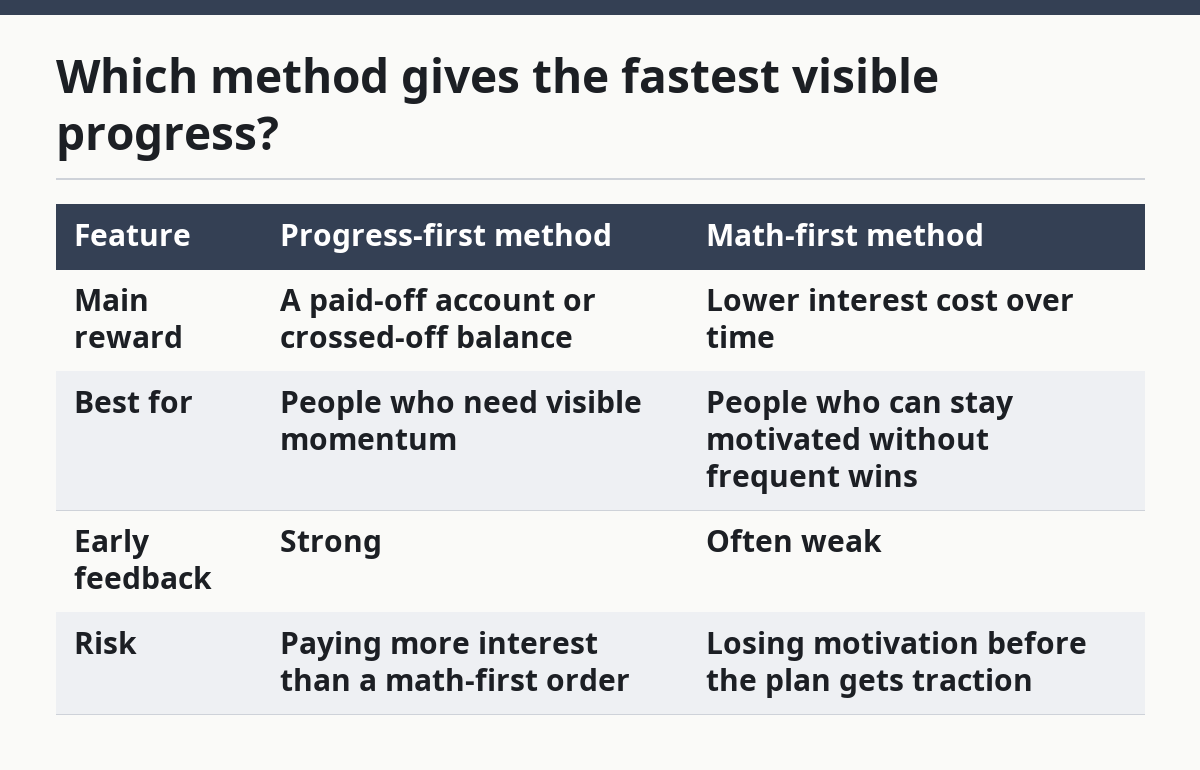
In many cases, the method that clears the smallest balances first gives the fastest visible progress, because closed accounts and zeroed-out lines are easier to feel than a tiny interest-rate improvement. That is why a progress-first plan often favors early wins over abstract efficiency.
Here is the practical difference:
| Feature | Progress-first method | Math-first method |
|---|---|---|
| Main reward | A paid-off account or crossed-off balance | Lower interest cost over time |
| Best for | People who need visible momentum | People who can stay motivated without frequent wins |
| Early feedback | Strong | Often weak |
| Risk | Paying more interest than a math-first order | Losing motivation before the plan gets traction |
A progress-first method is wrong for someone who cannot tolerate even a modest trade-off in interest cost. It is also wrong if the person has no problem sticking to a slower plan and wants the most efficient order only. But if motivation fades when the balance barely moves, fast visible progress is not a luxury; it is the whole engine.
What should you check before you commit?
You should check whether the plan will create feedback often enough to keep you engaged for at least 3 months. The core question is not, “Is this the smartest method in theory?” It is, “Will this method keep me making payments when the novelty wears off?”
Three checks matter most. First, look at the number of small balances. If there is at least one balance that can realistically be removed soon, the plan can produce a strong early win. Second, look at how often you want to see progress. Some people need a weekly visual mark; others only need one big milestone each month. Third, check whether the payoff order will make the debt list shrink in a way you can actually see.
This is also where milestone tracking earns its keep. A plain list with dates and balances is often enough. The list should change in a visible way after each payment, or the brain may treat the effort as invisible; if the pattern of payments is not changing the display, a financial coach or adviser may help you redesign the tracking system. If you cannot see the plan getting shorter, the plan may be too flat to support your motivation.
For more on the broader decision process, the hub on choosing the right payoff strategy goes deeper into fit, structure, and trade-offs, and the page on debt snowball vs. debt avalanche shows how the two common orders compare.
When should you not use a progress-first plan?
You should not use a progress-first plan when the visible wins are too far apart to matter. If every debt is large and the first payoff is many months away, the method may not provide the fast motivation you need, and you may need a different structure.
If the smallest balance is still far from being paid off: the early-win effect will be weak — the plan may feel slow no matter how you arrange it, so a progress-first approach may not solve the motivation problem.
If you cannot keep a simple payment streak: the streak feature will become a guilt trigger — use a plan that does not depend on frequent reinforcement.
If you are tempted to keep changing the order every 2 weeks: the method is too unstable — constant switching breaks momentum and makes progress hard to measure.
If the visible progress makes you ignore the rest of the debt list: the plan is too narrow — you need a structure that keeps the full picture in view, not only the next win.
If your budget only allows irregular payments: milestone tracking will be noisy — choose a simpler tracking system and focus on consistency before speed.
That is the honest trade-off. A progress-first plan can keep you moving, but it is not the right answer when the problem is not motivation. If the real problem is unstable cash flow, a flashy milestone does not fix the underlying issue.
What mistakes do people make with fast-progress plans?
People usually make 4 mistakes, and each one reduces either momentum or clarity. The fix is usually simple, but the cost of the mistake shows up fast.
First, they choose a plan with no visible milestone. The result is that the balance changes, but motivation does not; the better alternative is a chart, checklist, or payoff list that visibly shrinks.
Second, they pick too many tracking tools at once. A spreadsheet, an app, a paper chart, and a notes file can create noise instead of proof; the better alternative is one 2-step system that shows the next payoff and the current streak.
Third, they chase the next win without a full debt list. That can hide a problem balance in the background; the better alternative is to keep every account on the same page, even if only one changes at a time.
Fourth, they treat a missed month as a failed plan. That turns a short gap into a full stop; the better alternative is to resume with the same order and protect the next milestone.
Fifth, they copy a friend’s method because it “worked fast.” A plan that fits someone else’s personality may not fit yours; the better alternative is to choose the method that matches how you respond to visible progress, not someone else’s story.
How do you keep motivation going after the first win?
You keep motivation going by making the next win visible before the first one fades. The first payoff should lead directly to the next milestone, not to a blank gap where progress feels invisible again.
A good setup uses 3 layers of reinforcement: a short streak, a medium milestone, and a long view of the full debt list. The short streak is the next payment date. The medium milestone is the next balance that will hit zero. The long view is the total debt picture, which reminds you that each small win still belongs to a larger plan.
If motivation dips after the first account closes, the problem is usually not the payoff method itself. The problem is that the system stopped giving your brain a visible reward. In that case, tighten the milestone cycle, make the chart easier to see, or move the focus to the next small balance so the plan keeps producing proof.
What if your situation is unusual?
Your plan needs modification if your debt list does not behave like a normal list of separate balances. If one account is much larger than the others, the early-win effect may come from chunking progress into smaller markers, such as halfway points, instead of waiting for full payoff. If payments are irregular, the system may need monthly checkpoints instead of weekly ones.
Another edge case is emotional burnout. If every debt reminder makes you stop looking, a highly visual plan can help or hurt depending on the person. In that case, keep the visual part simple: one page, one date, one next balance. Too much detail can make progress feel heavier, not lighter.
The rule is simple. Change the tracking style to fit the response you get from the debt, not the response you wish you had. If the plan creates shame instead of momentum, the design is wrong.
What payoff method gives the fastest early wins?
The method that pays off the smallest balances first usually gives the fastest early wins because the first closed account happens sooner. That matters when motivation depends on visible proof. The trade-off is that it may not be the lowest-cost order over the life of the debt, so it fits best when progress keeps you engaged.
Should I use snowball if I need motivation?
A snowball-style order is often a strong fit if you need motivation from early wins. It works because small balances disappear faster, which makes progress easy to see and easier to repeat. If you care more about the feeling of momentum than about strict interest optimization, it can be the better behavioral fit. For a deeper comparison, see the debt snowball vs. debt avalanche guide.
How do I stay motivated while paying debt?
Use one visible metric, one milestone, and one repeatable payment rhythm. A payoff plan loses power when progress is hard to see, so make the next win obvious and close enough to matter. If motivation still falls off after 30 days, the issue may be the structure, not your discipline. For example, the CFPB’s debt collection resources can help you understand repayment basics while you keep the plan simple.
Drafted with AI; not yet reviewed by a person.