Last updated: November 20, 2026
Quick answer: If you have a lump sum and no ongoing extra cash, choose the payoff method that either wipes out the highest-interest debt or removes the most damaging minimum payment, while keeping enough cash to cover essentials. In many cases, the decision comes down to one of three moves: pay the highest APR, pay the debt with the biggest minimum payment pressure, or split the money if neither payoff changes your budget enough. This guide on how to choose a debt payoff method when you have a lump sum but no ongoing extra cash shows how to decide.
You have a lump sum and no extra cash coming in, so the wrong payoff order can leave one debt untouched and your budget exposed. Use the method that gives the most relief per dollar while protecting your emergency reserve. This guide will help you choose between paying the highest APR, the highest balance, or splitting the money.
Key takeaways
- A lump sum changes the problem: you are not picking a long-term payoff habit, you are placing one shot where it does the most work.
- The order usually depends on interest cost, minimum payment pressure, and how much cash you must keep back.
- Paying one debt in full can simplify life, but splitting the money can be smarter if no single payoff clears a payment.
- If your emergency reserve is thin, cash protection matters as much as interest savings.
- This is general information, not financial advice; a qualified adviser should be consulted for your own situation.
What this guide is for — and what it assumes
This guide is for you if you already have the lump sum in hand, know the balances and APRs, and are deciding where to send a single payment this week. It assumes you can read your statements, know each minimum payment, and can tell which debts have fixed rates, variable rates, or fees.
Because this is how to choose a debt payoff method when you have a lump sum but no ongoing extra cash, the focus is on one-time allocation, not on building a monthly habit. That means the choice is about impact, not motivation.
Picture this: you have $8,000 sitting in a savings account, three credit cards, and no reliable way to add more next month. You need a plan that fits one-time payment allocation, not a monthly snowball routine. That means the choice is about impact, not motivation.
If your lump sum came from a tax refund, inheritance, settlement, or other windfall, this page still helps with the allocation question. It does not cover how to choose between debt payoff and investing, and it does not cover asset-sale timing or principal-only rules on a mortgage, which belong on other pages in the hub.
- You need the balance, APR, and minimum payment for each debt.
- You need a basic emergency reserve target in mind.
- You need to know whether any debt has a penalty for early payoff or a fee for partial payoff.
- You need to know whether missing a payment would trigger late fees, default, or a higher penalty rate.
How do you choose between highest APR and highest balance in a lump-sum payoff?
You choose highest APR when interest is the clearest drag on the lump sum, and you choose highest balance when wiping out a payment will free the most monthly breathing room. The right answer is often not the same debt.
Picture this: one card has a 29% APR and a $1,200 balance, while another has a 19% APR and a $7,500 balance with a larger minimum payment. The first choice saves more interest per dollar; the second may remove a payment entirely. That trade-off is the whole game.
The basic rule is simple:
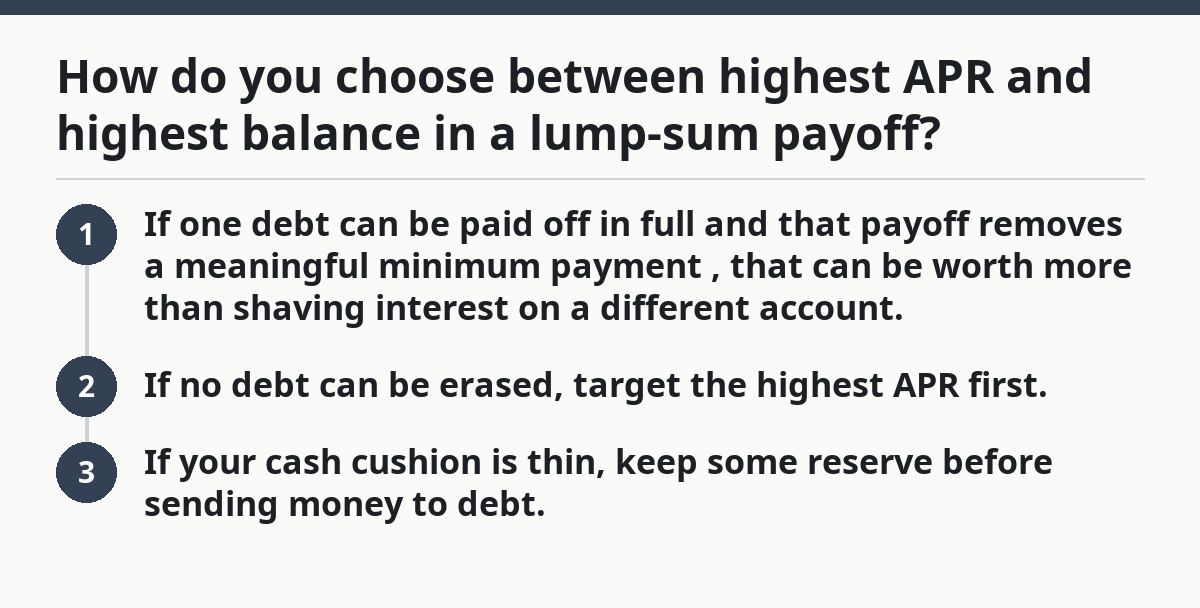
- If one debt can be paid off in full and that payoff removes a meaningful minimum payment, that can be worth more than shaving interest on a different account.
- If no debt can be erased, target the highest APR first.
- If your cash cushion is thin, keep some reserve before sending money to debt.
Use this order of thought:
- Interest rate
- Payment relief
- Cash reserve
- Fees or penalties
- Psychological clarity
Here’s the catch: a balance-only choice can be expensive if the highest-balance debt has a much lower APR than the others. A rate-only choice can be shortsighted if it leaves you with three payments and no breathing room. For a broader framework, see the hub on debt payoff method fit by payoff timing and cash event constraints.
Step by step: how to place a lump sum
The safest method is to rank every debt, keep a cash floor, and send the lump sum where it does the most total work. That means looking at the numbers before you move a dollar.
Picture this: you’re holding $5,000 and your debts all have different APRs, balances, and minimum payments. If you rush, you may overpay one account while leaving a high-rate balance untouched. A 20-minute review can save months of avoidable interest.
- List each debt. Write down the principal balance, APR, minimum payment, and any payoff fee for every account; verify the numbers against the latest statement, and stop if the balance is older than the last billing cycle.
- Protect cash first. Set aside an emergency reserve before payoff so you can cover at least one month of essentials; verify that the amount is still available after the payment, and stop if using all the cash would leave you unable to handle a surprise bill.
- Check payment risk. Identify which debt has the highest chance of late fees or penalty rates if you miss a payment; verify due dates and autopay settings, and stop if the lump sum would cause another bill to bounce.
- Rank by APR. Order the debts from highest APR to lowest APR; verify whether any variable rate can reset soon, and stop if a lower-rate debt has a much larger minimum payment that creates a bigger budget problem.
- Rank by payoff size. Mark any debt that can be wiped out completely with the lump sum or with the lump sum minus reserve; verify the exact payoff quote, and stop if a payoff quote includes interest through a future date you have not covered.
- Compare the two orders. Put the payment into the highest APR debt unless paying off a different debt eliminates a large minimum payment and gives you better monthly stability; verify which choice reduces total future payments more, and stop if the answer changes after fees are added.
- Split only with purpose. If no single payoff is clearly better, split the lump sum between the top debt by APR and the debt with the most damaging minimum payment; verify that each partial payment is allowed and applied to principal, and stop if the split leaves every debt too small to matter.
- Confirm the posting rules. Ask how the lender applies extra money and whether you must label it as principal reduction; verify the instructions in writing, and stop if the payment could be misapplied to next month’s installment instead of principal.
The best part is that this process does not require a fancy payoff app. A spreadsheet and your latest statements are enough. For lender guidance on payoff quotes and posting rules, see the CFPB’s resources on debt collection and account servicing, and for consumer payment protections, review the FTC’s guidance on credit and debt management.
Should I wipe out one debt completely or split the lump sum?
You should wipe out one debt completely when doing so removes a real monthly payment or closes a very expensive account. Splitting the lump sum makes sense when no single payoff changes the budget enough to matter.
Because the choice is about monthly relief as much as interest, the next question is whether a clean payoff creates a visible change. Picture this: one debt can be cleared with the lump sum minus a small reserve, but the rest still have minimum payments you can meet. In that case, a full payoff can simplify your life more than a partial strike across three accounts. On the flip side, if clearing one balance leaves you with tiny leftovers on several cards, you may just be spreading noise.
A full payoff tends to work best when:
- The debt has a high APR and a manageable balance.
- The minimum payment is meaningful relative to your monthly budget.
- The lender will close the account cleanly once paid.
- There is no prepayment penalty.
A split tends to work better when:
- The lump sum is too small to erase any account.
- One debt has a much higher APR but another has a heavier minimum payment.
- You need to reduce total monthly obligations, not just interest.
A common mistake is paying several balances down to near-zero. That often feels productive and changes little. One clean payoff usually beats three tiny wins. For a consumer-facing reference on payoff and budgeting decisions, the CFPB and FTC both provide plain-language guidance on debt management.
What should I check before I send the money?
You should check the payoff quote, the minimum payment schedule, and your emergency reserve before sending anything. Those three checks keep the lump sum from causing a cash crunch.
Picture this: you plan to clear a credit card today, but the lender posts interest through a later date or applies your payment after the next statement closes. That small timing issue can leave a balance you did not expect. A 1-day mismatch is enough to matter.
Check these items first:
- The exact payoff amount as of today.
- Whether the debt charges a payoff fee or early settlement fee.
- Whether the payment can be applied to principal immediately.
- Whether your other bills still fit after the payment.
- Whether your reserve still covers the basics.
If you are deciding between two payoff methods, compare the amount of interest you will avoid and the monthly payment you will remove. If you cannot estimate both, the decision is not ready yet. Pull the statements again. For payoff quotes and billing timing, consult the lender directly; the CFPB also explains how billing and payment posting can affect your balance.
When does the standard approach not fit?
The standard approach does not fit when paying aggressively would create a cash shortage, a fee problem, or a payment failure. In those cases, the order changes, or the lump sum should stay partly parked in cash.
Picture this: you have a large lump sum, but one debt has a settlement fee, another has a minimum payment due in 5 days, and your emergency reserve is nearly empty. The obvious move is no longer obvious. Cash safety comes first.
Your reserve would go to zero: that means one emergency could force you back onto credit — keep cash back and send only the surplus to debt.
A debt has a payoff fee: that fee can erase the value of a clean payoff — compare the fee to the interest you would save before acting.
You cannot cover the next minimum payments: missing one payment can trigger late fees and damage your plan — keep enough money to stay current.
The lender will not post extra principal correctly: misapplied payments waste the lump sum — use the lender’s payoff instructions or ask for written confirmation.
One debt is tied to a legal or tax issue: the payoff order may have side effects outside the math — consult a qualified attorney or tax professional before sending the money, and check IRS guidance or other official agency rules if taxes are involved.
These are not edge cases to ignore. They are the spots where a neat payoff chart can fail.
The mistakes people make with a lump sum
The biggest mistake is treating a lump sum like a bonus and not like a one-time allocation decision. Once the money leaves the account, your chance to optimize it is gone.
Picture this: you split the lump sum evenly because it feels fair, then discover the highest-rate card is still growing fast and your reserve is too small to handle a tire repair. The plan looked balanced. It was not.
Common errors and what they cost:
- Paying small balances first. This can feel tidy, but it may leave high-interest debt compounding longer. Use APR or payment relief instead.
- Draining cash to zero. That creates a new borrowing risk the next month. Keep an emergency reserve.
- Ignoring payoff quotes. Statement balances are not always the real payoff amount; ask for the exact figure.
- Splitting without a reason. If no debt is fully cleared and no payment is removed, the split can waste impact. Put money where it changes the budget.
- Forgetting the minimum payment. A great payoff order can still fail if the remaining payments do not fit. Recheck the whole monthly picture.
The correct move is usually slower than the emotional one. A 15-minute check can prevent a 15-month regret. For further consumer guidance, the CFPB’s budgeting and debt pages are useful starting points.
What does a good result look like?
A good result is one where the lump sum clearly changes your monthly burden, not just your account balances. You should be able to say, in plain language, what got better: lower interest, fewer payments, or a safer cash cushion.
Picture this: after the payment, you still have enough in reserve to handle a basic emergency, your other debts are current, and one of two things happened — a high-APR balance is gone, or a large minimum payment disappeared. That is a useful outcome. A random set of smaller balances is not.
A strong outcome usually has these signs:
- At least one debt is fully gone, or one very expensive debt is sharply reduced.
- Your remaining payments fit your monthly income without strain.
- You know exactly what happens next month.
- You still have cash for a surprise bill.
If the lump sum did not improve any of those four things, the method needs another look.
For a broader framework, see the hub on debt payoff method fit by payoff timing and cash event constraints. This page is the lump-sum piece of that larger decision tree.
Should I wipe out one debt completely or split the lump sum?
Wipe out one debt completely if the payoff removes a monthly payment or eliminates a high APR balance. Split the lump sum only if no single payoff changes your cash flow enough to justify the full allocation.
A full payoff gives you a clean result to track. A split is better when the best full payoff would still leave you with several hard-to-manage balances and no real payment relief.
Is it better to target high APR or small balance with a lump sum?
Target high APR if you want to reduce interest cost, and target the small balance if clearing it removes a meaningful minimum payment. Those are different goals, and they do not always point to the same debt.
If the small balance has a low APR, paying it first can be a weak use of the lump sum. If the high-APR debt is tiny, paying it off may be the cleanest win.
Should I keep some cash back?
Yes, if draining the lump sum would leave your emergency reserve too thin to cover essentials or the next set of minimum payments. Cash back is not wasted money when it keeps you from turning one problem into two.
The amount depends on your situation, and rates and household costs vary by country and change over time. If the reserve decision is unclear, a qualified adviser can help you size it for your own budget.
This is general information, not financial advice. A qualified adviser should be consulted for your own situation.
Drafted with AI; not yet reviewed by a person.