
Last updated: November 20, 2026
Pick the method that turns most choices into rules: a fixed payoff rule, a standing order, and one monthly review. If you want the least decision fatigue, the best fit is usually a low-decision payoff plan, because it cuts daily judgment calls and leaves only one repeatable check-in each month. This is information, not financial advice; a qualified adviser should be consulted for your own situation.
Key takeaways
- The lowest-friction plan is the one with the fewest live decisions, not the fanciest math.
- A written payoff rule beats “I’ll decide later” because it removes the need to rethink the order every week.
- One monthly review is usually enough for a simple plan; more check-ins create more mental load.
- Automatic payments help, but the main goal here is reducing choices, not building a fully automated system.
- A plan that feels easy on day 1 can still be wrong if it ignores fees, late-payment risk, or a debt that changes rate often.
Who this is for

This is for someone who keeps stalling because debt choices feel tiring, even when the numbers are clear. It assumes you already know your debts, your due dates, and which ones are minimum payments versus extra payments, at least roughly.
A low-decision payoff plan is not for someone trying to optimize every basis point or compare several payoff models side by side. It is also not the right tool if your debt picture changes every week, your income is irregular enough that you cannot predict the next 30 days, or you need a plan that depends on a lender’s one-off offer.
The goal is simple: reduce decision fatigue by deciding once, then following the same rule for 3 to 12 months before changing it. That is different from “set and forget.” A monthly review still matters, but it should be short enough to fit into 10 to 15 minutes, not a whole budgeting session.
If you want the broader strategy context, the hub on choosing the right payoff strategy sits above this page. This page stays narrow on one job: making the payoff method easier to carry out.
How do I choose the least tiring payoff method?
The least tiring payoff method is the one with the simplest rule set, the fewest exceptions, and the smallest number of times you must re-decide. In practice, that means choosing a rule-based order and sticking to a standing order for extra payments.
A good rule-based payoff method has three parts: a priority list, a payoff rule, and a monthly review. A priority list is the order in which debts get extra money. A payoff rule is the sentence that explains how you choose that order. A monthly review is the only scheduled time you are allowed to change it.
Here is the decision test I would use for a low-decision payoff plan:
| Option | Decision load | Best feature | Main drawback |
|---|---|---|---|
| Manual reordering every time | High | Maximum flexibility | Easy to stall, second-guess, and quit |
| Rule-based hierarchy | Low | Clear order, fewer choices | Can ignore some non-obvious costs |
| Fully automatic allocation | Lowest | Almost no day-to-day thinking | Can be hard to set up and adjust |
| Mixed plan with monthly review | Low to moderate | Simple and adaptable | Still needs one regular check-in |
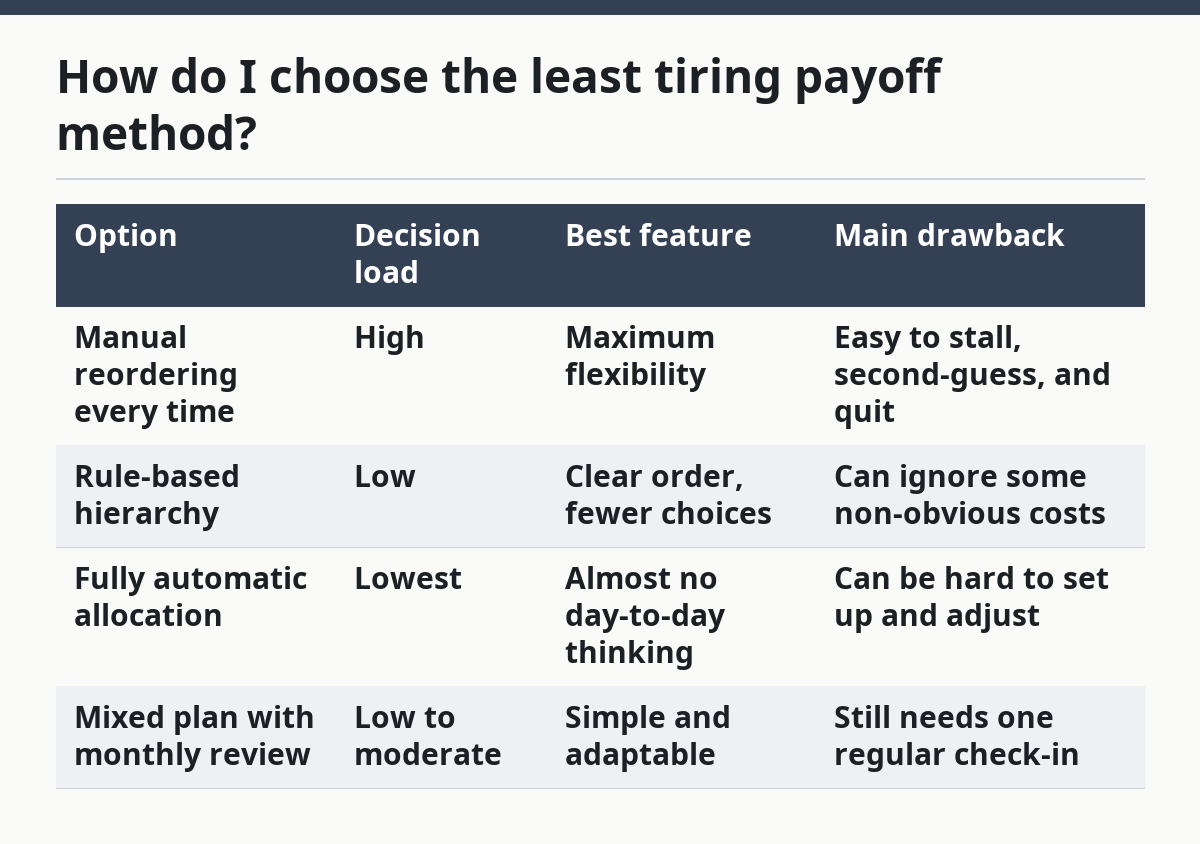
If your main goal is less decision fatigue, the mixed plan with a rule-based hierarchy is usually the best starting point. It keeps the plan simple without forcing you to make a fresh judgment every time money shows up.
How do you set up a low-decision payoff plan?

You set up a low-decision payoff plan by turning your debt list into a fixed sequence and limiting yourself to one monthly review. The setup takes about 7 steps, and each step should reduce choice, not add it.
- List every debt on one page with creditor, balance, due date, minimum payment, and interest rate if you know it; verify that nothing is missing, and flag any debt with a late-fee risk or variable rate that may need a different place on the list.
- Sort the debts into a priority list using one rule, such as smallest balance first or highest rate first; verify that the order is written down in plain language, and stop if you find yourself changing the order more than once before lunch.
- Assign the minimum payment to every debt and note the exact amount for each one; verify that the total minimums still fit your monthly cash flow, and treat any gap as a problem that must be fixed before extra payments begin.
- Choose one debt for every extra dollar and write that payoff rule at the top of the page; verify that the rule has no “depends on how I feel” clause, and revise it only if it creates a clear conflict with due dates or fees.
- Schedule standing orders or recurring payments for the minimums and the extra amount if your bank allows it; verify that each payment date lands before the due date, and correct any date that could cause a late payment.
- Review the plan once each month for 10 to 15 minutes; verify that balances moved in the expected order, and mark the review as a problem if you keep reopening the plan between reviews.
- Update the priority list only after the monthly review if income, rates, or due dates changed; verify that the new order still follows the same rule, and avoid changing the rule itself unless the old one clearly no longer fits.
The point of the setup is not to make the plan clever. It is to make the next action obvious when you are tired, busy, or annoyed.
A simple example of a rule might be: “Pay minimums on all debts, then send every extra dollar to the first debt in my written priority list until it is gone.” That sentence is useful because it can be followed without rethinking the entire budget each time.
What should I check before I commit?
You should check whether the plan reduces decisions without creating payment trouble. A low-decision payoff method is only worth using if it still protects due dates, minimums, and any debt that can change faster than you expect.
First, check your due dates against your cash flow. If your standing order lands after a due date, the plan creates a late-payment risk instead of reducing stress. Second, check whether any debt has a variable rate, a penalty fee, or a special repayment term that changes the math enough to matter. Third, check whether you can tolerate one monthly review without drifting into constant tinkering.
This is also the point to check whether the plan is simple enough for a bad week. A plan that works only when you are highly motivated is not a low-decision plan. If you need a spreadsheet every time you look at it, the plan is probably too complex for the purpose.
You can use a basic standard for the check: if it takes more than one page to explain the rule, it may already be too much. A rule that fits in 2 to 3 sentences is usually easier to keep than one that requires a flowchart.
When should you stop using this approach?
You should stop using this approach when the plan stops being simple, predictable, or safe for your payment timing. That does not mean the idea is wrong in general; it means the version you built no longer matches your situation.
Your income changes week to week: the standing order may overdraw your account or force you to skip minimums — switch to a lighter plan that keeps cash available until your income is easier to predict.
One debt has a special repayment term: the simple hierarchy may miss a fee, penalty, or deadline — move that debt to the top of the priority list and review its terms before making extra payments elsewhere.
You keep changing the rule every month: the method is no longer reducing decision fatigue — freeze the rule for the next 30 days and only revisit it at the scheduled review.
Your minimums no longer fit the month: the plan cannot work if the base payments are already too high — pause the extra-payment part and fix the cash-flow gap first.
You need to coordinate with someone else’s debt decisions: the process now has more than one decision-maker — write the rule down and agree on one monthly review time before continuing.
If any of those situations apply, the problem is not that you failed the method. The problem is that the method no longer matches the level of complexity you are dealing with.
What mistakes do people make with a low-decision plan?
The biggest mistake is pretending that “simple” means “no rules.” A low-decision payoff plan still needs a clear order, or it becomes an open-ended choice every time extra money arrives.
Another common mistake is using too many exceptions. If the plan has a different rule for each debt, decision fatigue comes right back. Keep one payoff rule, then change it only at the monthly review.
People also over-check the plan. Looking at balances every day feels responsible, but it usually adds anxiety without improving the result. A monthly review is enough for most simple plans because the goal is consistency, not constant adjustment.
A fourth mistake is putting every extra dollar toward the debt that “feels worst” that week. That turns the plan into an emotion-based system, which is exactly what decision fatigue feeds on. A written priority list is the fix.
The last mistake is forgetting the standing order date. If payments go out on the wrong day, the plan creates new stress and can undercut the whole point. The correct alternative is to verify each date once, then leave it alone until the monthly review.
What changes in edge cases?
The standard plan needs modification when the debt picture is uneven, the repayment terms are unusual, or the household budget has little room for error. In those cases, the goal stays the same, but the rule may need one extra line.
If a debt has a variable rate, you may want that debt higher on the priority list even if another method would usually rank it differently. If a payment date falls too close to payday, move the standing order earlier by a few days if your bank allows it. If you are managing multiple debts with the same creditor, combine them only if the lender’s terms make that clearly easier to track.
A low-decision payoff plan also changes when the debt count is very small. With one or two debts, the plan may need less structure, not more. With many debts, the priority list matters more, because small choices multiply fast.
For general consumer debt guidance, the Consumer Financial Protection Bureau and the Federal Trade Commission both publish plain-language material on debt and repayment issues; their pages are useful starting points when you want a check on the basics. They do not replace advice tailored to your own numbers.
Should I use a rule-based payoff method?
A rule-based payoff method is a good fit if your main problem is choosing, not understanding. It works best when you want fewer moving parts, one written order, and a short monthly review instead of repeated comparison shopping between methods.
It is not the best fit if you enjoy active optimization or if your debt situation changes so often that the rule would need constant edits. In that case, the rule itself becomes another source of work. The method should make your life smaller, not busier.
The practical test is simple: if you can explain your payoff rule in one sentence and follow it for a month without changing it every few days, the method is probably doing its job. If not, the plan is still too complicated for the level of decision fatigue you are trying to remove.
FAQ
What debt payoff method requires the fewest decisions?
The method with the fewest decisions is the one with a written payoff rule, fixed payment dates, and one monthly review. That setup removes most day-to-day choices because the next move is already decided. If you still need to rethink the order often, the method is not simple enough yet.
How do I make debt payoff easier to maintain?
Make it easier to maintain by reducing the number of times you revisit the plan. Use one priority list, one standing order, and one monthly review window of about 10 to 15 minutes. If the plan depends on constant attention, it will usually feel heavier than it needs to.
Should I use a rule-based payoff method?
Use a rule-based payoff method if you want less mental load and can live with a fixed order for at least a month. It is less useful if your debts have unusual terms or your cash flow changes often. In that case, the rule may need more adjustment than it saves.
Drafted with AI; not yet reviewed by a person.