Last updated: November 20, 2026
Key Takeaways
- Choose the payoff method that fits your debt mix; there is no universal winner.
- Debt portfolio structure means your debts’ count, size, rates, and payment timing.
- Avalanche can suit rate-heavy portfolios, since it targets the costliest interest first.
- Snowball can suit balance-heavy portfolios when momentum matters most.
If your debts are mixed, the right payoff method depends on how your balances, interest rates, and minimum payments are arranged. This Debt payoff method fit by debt portfolio structure — The Complete Guide starts with that idea, and it is information, not financial advice; for your own situation, a qualified adviser can help. The sections below settle which method fits which debt setup, and which one breaks down fast.
Which debt payoff method fits your debt mix?
The best method is the one that matches your debt portfolio’s shape, not the one with the nicest name. If you have one high-rate balance, one method can fit better; if you have many small balances, another can; if you have uneven minimums, a third may be better.
Debt Avalanche usually fits portfolios where the interest rates vary a lot. Debt Snowball fits portfolios where motivation is the main risk. A hybrid method fits people with a messy mix of rates, balances, and due dates.
- Large spread in APRs? Avalanche usually makes the math cleaner.
- Many tiny balances? Snowball can create faster early wins.
- One or two oversized minimums? You may need to sort by cash-flow pressure first.
- Irregular income? The ranking method matters less than payment stability.
Here’s the catch: the “best” method on paper can fail if you stop paying after month two. A plan that keeps you moving is often better than a perfect spreadsheet that dies in a drawer. The right fit is the one you can keep using for months.
What “debt portfolio structure” actually means
Debt portfolio structure is the layout of your debts: how many you have, how large they are, what they cost, and how the payments hit your month. That structure matters because payoff methods are sorting rules, and sorting rules only work if they match the pile.
A simple portfolio might have 3 debts with similar rates and balanced minimums. A harder one might have 8 accounts, one maxed card, two small cards, a personal loan, and a student loan with different due dates. Those are not the same puzzle.
- Balance size: small vs. large principal
- Interest spread: near-equal rates vs. wide gaps
- Minimum payment load: light vs. heavy monthly drag
- Account count: few debts vs. many debts
- Cash-flow shape: steady paycheck vs. variable income
The truth is, most generic debt advice pretends all debts behave the same. They don’t. A portfolio with one 29.99% card and three 0% promotional balances should not be handled like five cards all sitting near 18%.
Debt Avalanche: when the math matters most
Debt Avalanche wins when your portfolio has a clear rate gap, because it attacks the balance costing you the most interest first. If one debt is much pricier than the others, this method usually gives the cleanest payoff path.
That matters most when your debts include credit cards, personal loans, or other revolving balances with different APRs. The larger the rate spread, the stronger the case for avalanche. If the rates are clustered close together, the edge shrinks.
A practical way to think about it:
- List all debts by APR.
- Keep making every minimum payment.
- Put extra money on the highest-rate debt first.
- Roll freed-up cash to the next-highest rate.
What makes avalanche strong is also what makes it hard. The first win can take a while if the highest-rate debt is also the biggest balance. That delay can feel dull, especially when your budget is tight and your progress is invisible for months.
- Best fit: people with wide APR gaps and patience for delayed payoff wins
- Weak spot: people who need visible wins to stay engaged
- Portfolio problem it solves: expensive interest drag
- Portfolio problem it does not solve: motivation collapse
A good example is a portfolio with several cards where one balance is charging far more than the rest. In that case, avalanche is usually the right default because the interest savings come from the structure itself, not from willpower. On the flip side, if your highest-rate debt is also huge and your progress feels flat, you may need a different method to avoid quitting.
Debt Snowball: when small balances control the mood
Debt Snowball wins when your portfolio has lots of small balances and your main risk is losing momentum. It ranks debts by balance size, not interest rate, so the first account disappears sooner.
That early disappearance matters. A portfolio with 6 small debts can feel chaotic even if the rates are not terrible. Clearing one account can make the rest feel manageable, which is the whole point of snowball. The method is psychological, not mathematical.
Use this structure when:
- you have several balances under a few larger ones
- you need quick wins to keep going
- your payments are already organized and you can stay current
- the interest-rate spread is not large enough to make the math dominate
Snowball has a real cost. If a smaller debt has a much higher APR than a bigger one, snowball can keep that expensive balance alive longer than avalanche would. That means more interest paid over time, which is the trade-off.
Who should skip this: a borrower with a wide APR gap and enough discipline to follow a rate-based plan is usually better served by avalanche.
Buy this if: you are the kind of person who needs a debt account gone fast to stay on track.
Skip this if: you have one high-rate balance that is clearly costing more than the rest and you can stick with a slower first win.
Hybrid plans: when your debts are messy
A hybrid plan wins when your debt portfolio is mixed enough that one pure rule feels wrong. This often happens when you have one very expensive card, one tiny balance, and one account with a payment due before your next paycheck.
Hybrid means combining rules instead of worshipping one. You might pay off one tiny balance first for momentum, then switch to avalanche. Or you might order debts by a mix of rate and balance to protect cash flow.
That approach fits portfolios with at least one of these problems:
- a tiny balance that can be eliminated quickly
- one debt with a clearly bad APR
- uneven due dates that create payment stress
- variable income that changes month to month
The upside is flexibility. The downside is decision fatigue. If the rules keep changing, you can stall out. A hybrid only works if the rule is written down before the month starts.
A useful version of hybrid is this: clear one very small account, then switch to highest APR. That gives you a quick psychological win without giving up too much on interest cost. It’s not mathematically pure, but it fits real life better than a rigid script.
- Best fit: people with a mixed portfolio and poor follow-through on strict plans
- Weak spot: people who keep changing the rules every week
- Portfolio problem it solves: mismatch between math and behavior
- Portfolio problem it does not solve: chronic overspending
The truth is, a hybrid plan is often the right answer for real households because real households are messy. It just has to stay disciplined enough to be a system, not a mood.
The honest side-by-side
Avalanche and snowball are not competing ideas in a vacuum — they solve different portfolio problems. Avalanche is a rate optimizer. Snowball is a momentum tool. Hybrid sits between them when the portfolio itself is uneven.
| Criteria | Debt Avalanche | Debt Snowball | Winner for [condition] |
|---|---|---|---|
| Primary sorting rule | Highest APR first | Smallest balance first | Avalanche for high-rate debt |
| Best portfolio shape | Wide rate spread | Many small balances | Depends on structure |
| Early psychological wins | Slower | Faster | Snowball for motivation |
| Interest cost control | Usually stronger | Usually weaker | Avalanche for expensive debt |
| Works with messy accounts | Sometimes awkward | Often simpler | Snowball for simple action |
| Best if you quit easily | Less forgiving | More forgiving | Snowball for follow-through |
| Best if you want math efficiency | Strong fit | Weak fit | Avalanche for rate savings |
| Best if one account is tiny | Not special | Very strong | Snowball for quick closure |
| Best if one debt has a nasty APR | Strong fit | Poor fit | Avalanche for toxic APR |
| Best if you need a compromise | Can be too rigid | Can ignore rates | Hybrid for mixed portfolios |
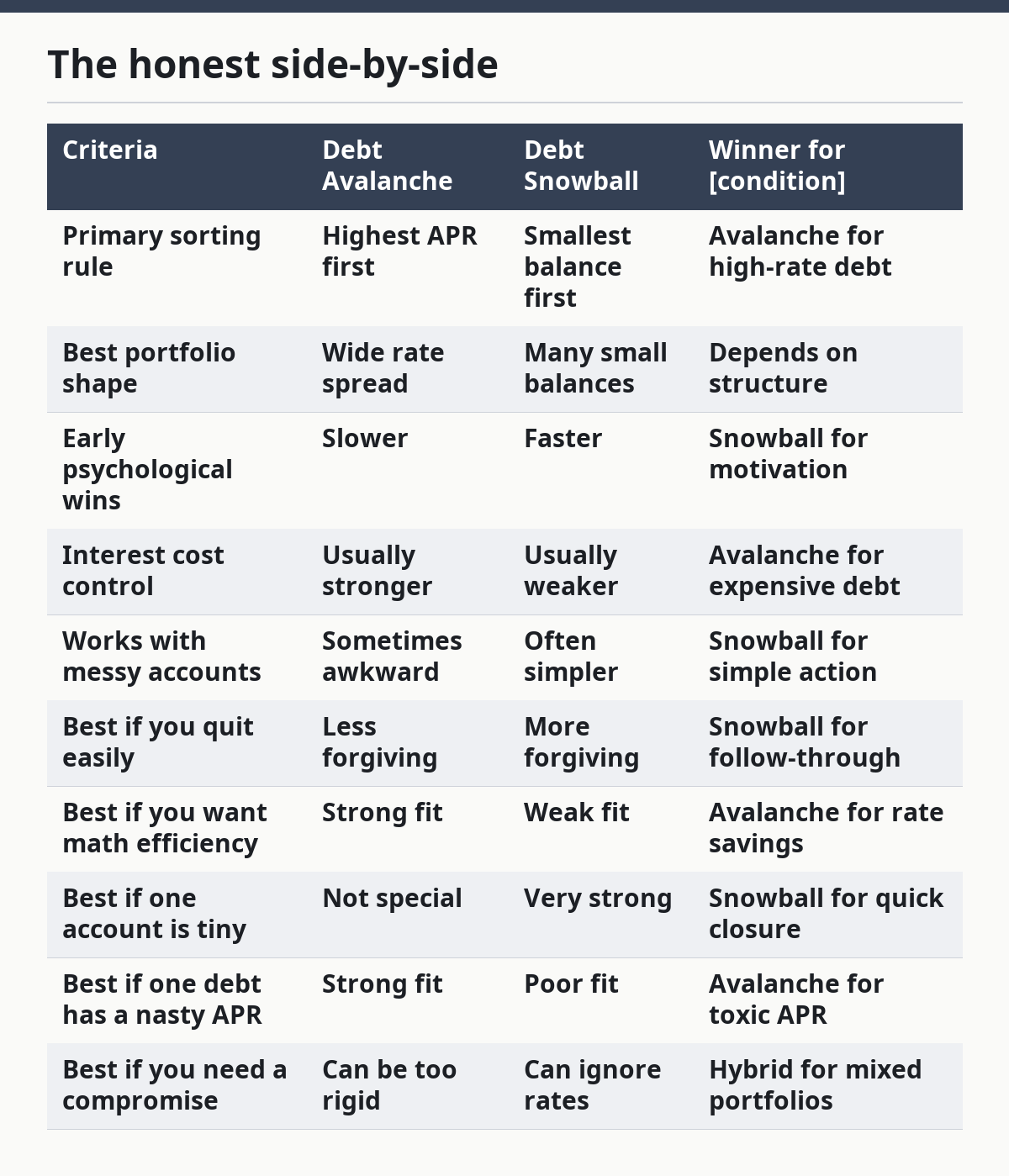
The table only settles the choice if you know your own weak point. If your real problem is emotional drop-off, the “best” method is the one you’ll keep using after the first hard month. If your real problem is a brutal APR, the method that ignores rates can cost you.
Which method fits which portfolio structure?
The best match is simple: avalanche fits rate-heavy portfolios, snowball fits balance-heavy motivation problems, and hybrid fits mixed or uneven portfolios. That is the cleanest rule to use before you start.
Here’s the breakdown by structure:
- Few debts, big APR gap: Avalanche usually fits best.
- Many small debts, similar rates: Snowball can create faster momentum.
- One giant debt and several tiny ones: Hybrid often works better than either extreme.
- Irregular income with due-date stress: Hybrid or a payment-first variant is often less brittle.
- Consistent income, strong discipline: Avalanche is usually the cleanest fit.
People sometimes choose based on personality alone, but the portfolio structure decides the ceiling. A balance-focused portfolio with close APRs is less likely to punish snowball. A rate-skewed portfolio with one punishing card is less likely to forgive it.
That is why the debt list itself should come first. The shape of the portfolio tells you which payoff method fits, and the method should follow that shape.
When avalanche is the wrong fit
Avalanche is the wrong fit when the first payoff takes so long that you lose the plan before it pays off. It also fits poorly when your debts are so close in rate that the math edge is tiny and the mental cost is huge.
That doesn’t mean avalanche is bad. It means the portfolio does not give it enough room to matter. If the rate difference is small, the emotional cost may outweigh the math benefit.
When snowball is the wrong fit
Snowball is the wrong fit when a high-rate balance is large enough to drag your budget for months. It also fits poorly when you are the kind of person who wants the most efficient plan and won’t tolerate paying extra interest for speed.
That doesn’t mean snowball is childish. It means it is a behavior tool, not a cost-minimizing tool.
Exception scenarios that flip the answer
The overall choice can flip when the portfolio has a special twist. Those twists are common enough that a generic rule can mislead you.
-
A 0% promotional balance is ending soon.
The ranking changes fast when a promo period is near its end. That balance can jump to the front because the cost spike arrives on a fixed date, not because it is largest. -
One debt has a much larger minimum payment.
A high minimum can make a debt act like a cash-flow drain even if the balance is not the biggest. In that case, the payment structure matters as much as the rate. -
Your income changes month to month.
Variable income can make rigid payoff ladders brittle. A hybrid plan that keeps minimums safe first may fit better than a pure ranking system. -
You are one missed payment away from fees or default.
Safety of cash flow comes before optimization. A payoff method that ignores due-date pressure can backfire if it pushes you into late fees or account trouble.
These are not edge cases for fancy planners. They are the cases that show up in ordinary households.
How to choose without overthinking it
Choose the method that matches the biggest friction in your debt portfolio, not the one that sounds smartest in a forum. If the friction is interest cost, use avalanche. If the friction is staying engaged, use snowball. If the friction is a weird mix of both, use hybrid.
A simple filter helps:
- If APR spread is the main issue: choose avalanche.
- If motivation is the main issue: choose snowball.
- If your debts are uneven in size and timing: choose hybrid.
- If you can’t keep minimums current: pause and fix cash flow first.
That last point matters. A payoff method is not a substitute for a workable budget. If the monthly system fails, the ranking system doesn’t save it.
The best part is that you do not need the perfect method to make progress. You need the method that fits your debt structure closely enough that you can keep using it for months.
What beginners usually get wrong
Beginners often think debt payoff is about picking the “right” personality style. It’s really about matching the method to the debt pile. That one shift changes the result more than most people expect.
The most common mistakes are:
- sorting by balance when rate differences are huge
- sorting by rate when quick wins are the only reason you’ll keep going
- ignoring minimum payments and due dates
- changing methods every few weeks
- forgetting that taxes, rules, and interest laws vary by country
Those rules and thresholds are not the same everywhere, and they change over time. If your debts involve tax-deductible interest, consumer-protection rules, or local repayment programs, get advice that matches your country.
This is why generic “best method” content falls short. It treats debt like a math worksheet. Real debt is a budget problem with a behavior problem attached. Before you act, consult a qualified professional or your local consumer protection office, since rules vary by country and account type.
For general consumer guidance, the U.S. Consumer Financial Protection Bureau has plain-language debt resources, and the Federal Trade Commission also publishes consumer advice on debt and credit. The Consumer Financial Protection Bureau and the Federal Trade Commission are useful starting points, but they do not replace advice for your own account mix.
FAQ
Is debt avalanche always better than debt snowball?
No, debt avalanche is not always better. It is usually better when your portfolio has a clear interest-rate spread and you can stick with a slower first win, but snowball can work better when motivation is your main risk.
Can I combine methods?
Yes, you can combine methods. A common hybrid is to clear one tiny balance for momentum, then switch to highest APR. That works best when the portfolio has one small account, one high-rate account, and enough cash flow to stay consistent.
What if my debts have similar interest rates?
If the rates are close, the math difference between methods shrinks. In that case, choose the method you are most likely to keep using for a full repayment stretch, because consistency matters more than squeezing out a small theoretical edge.
Does my income pattern change the best method?
Yes, it can. Variable income often favors a simpler, more flexible plan that protects minimum payments first. If your paycheck timing is uneven, a rigid payoff ladder may be harder to maintain than a hybrid setup.
Should I pick the same method for every debt?
No, not if your portfolio is mixed. Different debts can call for different treatment, especially when one has a high APR, another has a tiny balance, and a third has a large minimum payment due at the wrong time.
Drafted with AI; not yet reviewed by a person.