Last updated: November 19, 2026
Debt payoff method fit by psychological and behavior constraints matters because the “best” plan is the one you can follow for months, not the one that looks smartest on paper. The right method is the one that matches your attention span, impulse control, and stress response. In this guide, Debt payoff method fit by psychological and behavior constraints — The Complete Guide stays focused on which method fits which kind of borrower, and which traps make a good plan fail.
Key Takeaways
- If you need quick wins to stay engaged, the smallest-balance-first style usually feels easier to stick with.
- If interest costs make you anxious and you like a clear ranking, the highest-interest-first style is the cleaner fit.
- If you freeze when choices pile up, a fixed autopay system beats a clever spreadsheet.
- If your income jumps around, the method matters less than the cash-flow rules you build around it.
- If shame keeps you from opening statements, a plan you can look at every week is often easier to sustain.
This is general financial information, not personal financial advice. Rates, rules, and limits vary by country and can change; a qualified adviser can help with your own situation. For broader consumer guidance, the Consumer Financial Protection Bureau explains debt basics and repayment choices, and the Federal Trade Commission outlines debt collection and credit-use risks.
I write about debt behavior, budgeting systems, and repayment plans from a personal finance angle, and I pay close attention to what people can realistically sustain.
Picture this: you have several balances, the bills keep arriving, and every month feels like a debate with yourself. The method that fits your brain wins. The wrong one usually fails by month three.
What should fit the person, not just the balance sheet?
The best debt payoff method fit by psychological and behavior constraints is the one that fits your habits, not just your math. A method that is “optimal” on paper can still fail if you avoid tracking, hate delayed rewards, or crack under stress.
Here’s the catch: debt payoff is both a math problem and a behavior problem. The math tells you which balance costs more. The behavior side tells you whether you’ll still be on the plan after the first rough month. In practice, that is why many borrowers benefit from a plan they can review once a month instead of a plan they have to think about every day.
A lot of generic advice gets this wrong by treating everyone like a spreadsheet, so it helps to consult a qualified financial professional if your situation is complicated. Real people are not that neat. One person needs momentum. Another needs fewer decisions. A third needs a system that works when income is uneven.
The real question is not “Which method is best?” It is “Which method will I actually keep doing?” That answer changes with your attention, memory, stress level, and how often you need encouragement.
- If you need proof fast, progress markers matter.
- If you get overwhelmed by many balances, simplicity matters more than optimization.
- If you make one emotional purchase and then spiral, friction matters.
- If you can ignore a plan for weeks, automation matters.
There is also a useful hard rule: if a plan makes you check five apps, move money manually, and think about debt every day, it may be too demanding. A plan you abandon is worse than a plain one you keep.
Which payoff method fits a person who needs motivation fast?
The snowball-style approach wins for people who need visible progress, because early payoff creates a stronger feedback loop than waiting for the biggest balance to move. For someone who feels stuck, that matters more than squeezing out the last bit of interest savings.
Picture this: you open your app, see one balance disappear, and feel a clean finish line. That little win can keep you going for months. The payoff is psychological, not just financial. A closed account is a concrete milestone, and that matters when you need a reason to continue in month two or month three.
This method tends to fit people who:
- lose interest when the first few months look identical
- need a clear “done” signal
- feel discouraged by slow progress on large balances
- do better with simple rules than with constant optimization
The strength is not subtle. A small payoff creates proof that the plan works. That proof can reduce avoidance, which is a real barrier for many borrowers. If you freeze when the numbers look too large, a sequence of smaller victories can get you moving.
The weak spot is also clear. You may pay more interest than you would under an interest-first plan, and that trade-off matters more if your balances are large or your rate spread is wide. If your budget is tight and every dollar of interest hurts, the emotional boost may not justify the cost.
A second drawback is boredom after the first few wins. Once the smallest account is gone, the plan can start to feel slower again. If your motivation depends on frequent completion moments, you may need to add milestones, not just a payoff order.
- Best fit: the person who needs visible wins to keep going.
- Poor fit: the person who will stick with a plan only if it minimizes interest from day one.
- Warning sign: you keep changing strategies every month.
Who Should Skip This: Someone who tracks interest rates closely and hates leaving money on the table should look at the interest-first method instead.
Buy this if: you are a discouraged borrower who needs a quick, concrete success to stay engaged.
Skip this if: you are an optimizer who will abandon the plan as soon as you think the math is not perfect.
Which payoff method fits a person who hates waste?
The avalanche-style approach wins for people who are motivated by efficiency, because it gives the debt list a clear ranking and usually aims at the most expensive balance first. If you like knowing why the next dollar goes where it goes, this fit is strong.
Picture this: you look at three balances, each with a different rate, and you want the most expensive one tackled first. That structure can feel calm. It reduces guesswork. The clearer the ranking, the less mental load you carry from month to month.
This method tends to fit people who:
- like rules that can be ranked
- stay motivated by saving on interest
- can tolerate slow visible progress at the start
- do not need emotional reinforcement from small victories
The strength is discipline with a purpose. You are not just “paying debt”; you are aiming at the balance that costs the most to carry. For people who think in terms of efficiency, that clarity lowers stress. It can also feel more rational when the balances are large enough that rate differences are meaningful.
The weakness is behavioral. Early months can feel dull because the biggest-rate balance may also be the one that takes longest to shrink. That delay can trigger dropout. If your motivation comes from visible account closures, this method can feel like a grind.
It also asks more of your attention. You need to know your rates, keep them current, and avoid moving money around just because another balance feels emotionally annoying. That extra tracking is fine for some people and exhausting for others.
- Best fit: the person who stays motivated by efficiency and clear ranking.
- Poor fit: the person who needs quick emotional payoff.
- Risk: you spend months doing the “smart” thing and lose the urge to continue.
Who Should Skip This: Someone who needs early wins to stay on track should look at the smallest-balance-first method instead.
Buy this if: you are an analytical borrower who can stick with a ranking system and wants the method that usually targets expensive debt first.
Skip this if: you are likely to quit when progress is slow and visually unimpressive.
What if your main problem is not math, but chaos?
A fixed payment system with autopay wins when your main problem is inconsistency, because it removes decisions from the month-to-month process. If you miss due dates, forget deadlines, or get mentally overloaded, simplicity beats cleverness.
Picture this: payday comes, bills are scattered, and your brain is already full. You do not need a perfect theory. You need fewer moving parts. A system that runs on schedule can cover a lot of mistakes before they become fees.
This approach usually means the same bills get paid the same way on a schedule, with extra money sent to one target only after the minimums are covered. That can work well for people who:
- have a busy life and low spare attention
- are prone to missed due dates
- want the plan to run with minimal daily effort
- do better with automation than with repeated choices
The strength is consistency. A system that repeats itself is easier to maintain than one that depends on willpower every week. If the issue is forgetfulness, a method that quietly runs in the background may be the easiest one to sustain.
The weak point is that automation can make you passive. If your income changes, your spending changes, or a balance gets refinanced, a set-it-and-forget-it plan can drift out of date. It also may not feel motivating enough for someone who needs visible progress cues.
A second drawback is that automation does not solve overspending. If new charges keep landing on the card, the payoff method becomes a treadmill. That is not a method flaw alone; it is a behavior problem. Still, the method can hide the problem for a while.
- Best fit: the person who forgets due dates and needs a low-effort default.
- Poor fit: the person with variable income who needs monthly recalibration.
- Warning sign: you rely on memory for everything and miss bills often.
Who Should Skip This: Someone with irregular cash flow and shifting expenses should consider a more flexible system with monthly review, not just autopay.
Buy this if: you are a busy borrower who needs the plan to run with minimal daily effort.
Skip this if: your income swings from month to month and you cannot predict the same payment date twice in a row.
The real difference between motivation, efficiency, and simplicity
The difference is not just “which debt gets paid first.” It is which pain you can tolerate: slow results, slightly higher interest, or ongoing management. The right fit depends on which pain breaks your plan first.
Picture this: two people with the same debt total choose different paths. One quits because the first month feels flat. The other quits because they hate thinking they are paying extra interest. The best fit for one borrower may be the wrong fit for another borrower because the failure points are different.
Here is the head-to-head comparison.
| Criteria | Smallest-balance-first | Highest-interest-first | Winner for [condition] |
|---|---|---|---|
| Early motivation | More likely to create fast wins | Often slower to show visible progress | Smallest-balance-first for people who need momentum |
| Interest control | Can cost more over time | Usually targets the costliest balance first | Highest-interest-first for efficiency-minded borrowers |
| Ease of follow-through | Simple to understand | Also simple, but more rate-sensitive | Smallest-balance-first for people who want the most obvious path |
| Need for tracking | Lower if balances are obvious | Higher if rates change or many balances exist | Smallest-balance-first for low-admin users |
| Emotional stress | Can reduce shame through quick closures | Can feel discouraging before the first payoff | Smallest-balance-first for anxious beginners |
| Cost awareness | Less precise about interest cost | More aligned with cost minimization | Highest-interest-first for cost-conscious planners |
| Risk of quitting | Lower if you need visible proof | Lower if you dislike waste and can wait | Depends on what has stopped you before |
| Fit for changing income | Can still work, but needs monthly review | Can still work, but math must be updated | Neither alone solves cash-flow swings |
| Best use case | Behavior-first payoff | Math-first payoff | Depends on the borrower’s failure point |
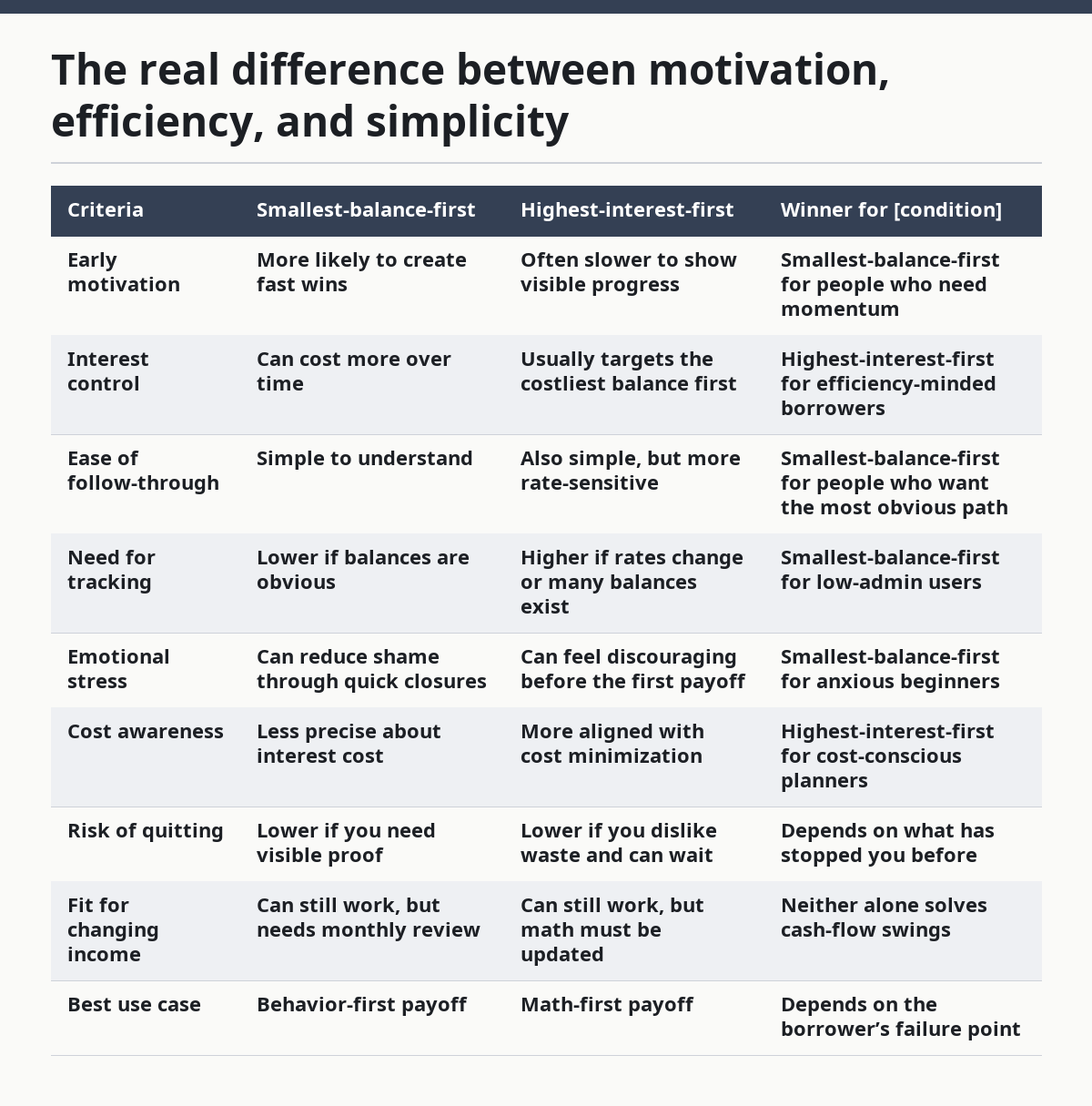
The table points to the core truth: one method helps you keep going, the other helps you optimize cost. A generic article often pretends those are the same thing. They are not.
If your biggest problem is starting and staying started, choose the method that gives you a visible finish line. If your biggest problem is paying extra interest and hating the waste, choose the method that attacks the most expensive balance first.
What if your income changes every month?
A flexible payoff plan wins when income changes, because the method itself matters less than the rules you use when cash is uneven. If your pay is variable, the danger is not the payoff order alone; it is overcommitting in a good month and panicking in a bad one.
Picture this: one month is strong, the next is thin, and the fixed plan starts to feel brittle. You need breathing room. Rigid rules can backfire here, especially if they leave you with no cash buffer.
A borrower with variable income usually needs three things:
- minimums that are protected first
- a cushion before extra payoff money goes out
- a review date, often once a month, to reset the plan
The strength of a flexible approach is survival. It helps you avoid missed payments when income dips. That matters more than optimization because one missed payment can trigger fees, stress, and a fresh round of avoidance.
The drawback is that flexibility can become excuse-making. If every month is “different,” nothing gets paid faster. The plan needs a rule for when extra money gets sent and when it stays parked as cash. Without that, flexibility turns into drift.
A second limitation is emotional. People with irregular income often feel guilty in both directions: guilty when they save cash instead of paying debt, and guilty when they pay debt and then feel exposed. That is why the method must include a buffer decision, not just a payoff order.
- Best fit: the person with uneven income or irregular commissions.
- Poor fit: the person who wants one fixed payment and no thinking.
- Risk: using “flexibility” as a reason to never commit extra money.
Who Should Skip This: Someone with stable pay and a strong routine may do better with a fixed autopay system, because too much flexibility can create drift.
Buy this if: you are paid unevenly and need a plan that can absorb lean months without breaking.
Skip this if: your income is stable and you know you will procrastinate when the plan leaves room for debate.
Which method fits your psychology best?
The best fit is the one that matches the way you fail, because debt plans break at the point of friction. If you fail through boredom, choose momentum. If you fail through waste anxiety, choose efficiency. If you fail through disorganization, choose automation.
Picture this: you already know your weak spot, even if you have not named it. You stop plans when they feel slow, messy, or emotionally heavy. That pattern is the clue.
Use this quick match:
- If you need encouragement, use the method that gives the first closed account fastest.
- If you need cost control, use the method that targets the highest rate first.
- If you need fewer decisions, automate the minimums and keep extra payments on one rule.
- If you need flexibility, build a monthly reset and a cash buffer.
The mistake generic advice makes is assuming discipline is the same as motivation. It is not. Discipline is what you do when motivation fades. The better plan is the one that survives a tired month, a bad week, or a surprise bill.
There is also a shame factor many articles miss. Some people avoid debt work because every statement feels like proof of failure. For them, the right method is the least humiliating one. That could mean a tiny first win, a silent autopay rule, or a monthly review done on a fixed day. The details matter because shame is a behavior cost.
- If shame stops you from looking at balances, keep the system simple.
- If perfectionism stops you from starting, choose the method with the fewest moving parts.
- If impatience stops you, build visible milestones.
- If anxiety stops you, lower the number of decisions.
When should you change the plan entirely?
You should change the plan entirely when your debt problem is really an income problem, a spending control problem, or an organization problem. A payoff order cannot fix a budget that keeps reopening the wound.
Picture this: you keep switching methods, but the balances do not move much. That usually means the problem is upstream. The method is not the bottleneck.
Here are the exception scenarios where the usual recommendation flips:
- If your smallest balance has a very low rate and your highest-rate balance is only slightly higher, the behavior benefit may outweigh the math difference.
- If your income is unstable, a rigid payoff order can fail unless you first build a buffer.
- If you keep missing payments, a method with more automation beats a more “optimal” order.
- If you are already highly motivated and hate waste, the interest-first method may be the cleaner fit even if it feels slower at first.
A generic guide often says, “Just pick one and be consistent.” That advice is half right. Consistency matters, but only if the system is built around the real failure mode. A borrower who is disorganized needs structure. A borrower who is discouraged needs wins. A borrower who is anxious about waste needs a clear cost story.
If you are still changing plans every few weeks, stop optimizing the order and inspect the behavior problem. Are you overspending after payday? Are you forgetting due dates? Are you too ashamed to open the statements? The answer changes the plan more than the debt total does.
- Change the plan when the old one keeps failing for the same reason.
- Keep the plan when the issue is temporary and the system still works.
- Pause the math when the behavior problem is the real leak.
The verdict: which one should you choose?
Choose the smallest-balance-first method if you need visible wins, lose steam fast, or struggle with shame and avoidance. Choose the highest-interest-first method if you are steady, rate-aware, and more upset by wasted interest than by slow early progress. Neither fits if your real problem is missed payments, because then you need automation and cash-flow control before payoff order.
Picture this: you are not choosing a moral path. You are choosing the method that gives you the best chance to keep going for the next several months. That is the only verdict that matters.
The cleanest rule is simple:
- Pick momentum if motivation is your weak point.
- Pick efficiency if waste is your weak point.
- Pick automation if chaos is your weak point.
- Pick flexibility if income swings are your weak point.
That is the complete fit test. Not every borrower needs the same payoff order, and not every payoff order deserves the same amount of attention. The right method is the one that matches your behavior constraints and still leaves you room to breathe.
FAQ
Is one debt payoff method always better than the others?
No. The best method depends on what causes you to quit, miss payments, or ignore the plan. If you need encouragement, a visible-win method often fits better; if you care most about interest cost, a rate-first method is usually the cleaner match.
What if I cannot stick to a budget no matter what method I choose?
Then the budget system is the real issue, not the payoff order. In that case, a simpler setup with autopay, a spending cap, and one monthly review date may work better than any clever ranking method.
Can I switch methods after I start?
Yes, and many people do. Switching is reasonable if the current plan is failing for a behavior reason, such as low motivation, missed bills, or income swings. The key is to switch for a clear reason, not because the plan feels emotionally hard for one week.
Which method is better for people with anxiety?
The better fit is usually the one that reduces the source of anxiety, not the one that looks best on paper. Some people feel calmer with quick wins; others feel calmer when they know they are attacking the most expensive balance first. A monthly review can also reduce uncertainty.
What if my debt balances are all close together?
Then the practical difference between methods may be smaller, and behavior fit matters even more. When the math gap is narrow, choose the method you can follow without constant second-guessing.
Drafted with AI; not yet reviewed by a person.