Last updated: November 19, 2026
Key Takeaways
- Joint debt usually means both names can be held responsible by the lender, so the payoff plan must fit the contract.
- Pick the method that fits control, liability, and payment size rather than a neat-sounding rule.
- Snowball can help when early wins matter and the accounts are hard to control.
- Avalanche can help when lowering interest matters most and extra payments are under your control.
Joint debt account problems need a method that respects who owes the lender, not just who swipes the card. Quick Answer: the best payoff method is the one that fits legal liability, cash flow, and the size of the payment you can actually make. Pick the payoff plan around legal liability first, then cash flow, then interest rate. The steps below show when to use snowball, avalanche, or a hybrid for how to choose a debt payoff method for joint accounts and authorized user debt.
What this guide covers, and what it assumes
This guide applies to joint debt account debt, authorized user credit card debt, and cases where one person wants to clean up balances they can see but do not fully control. It assumes you already know the balances, the minimum payments, and whose name is on each account.
This is information, not financial advice. A qualified adviser should review your own situation, especially if there is an ex-spouse, a co-signer, bankruptcy, or a disputed account. The CFPB says debt collection and billing disputes can turn on account records and contract terms. See the Consumer Financial Protection Bureau and the FTC for general guidance.
If the account is joint, the lender can usually treat both names as responsible, even if only one person used the card. If you are an authorized user, you may be able to spend on the account, but that does not always mean you legally owe the debt. If you are unsure, consult a qualified professional and review the account contract.
- Joint account: two or more people share legal responsibility.
- Authorized user: someone allowed to use the card, but liability depends on the account terms.
- Co-signer: a person who promises to pay if the borrower does not.
- Lender: the company that issued the loan or card.
For background on payoff methods by debt type, the hub on debt payoff methods and strategy selection is the right next stop. See also how to budget for debt payoff, how to lower credit card interest, and debt consolidation basics.
Who is responsible for joint debt?
Joint debt is usually the debt that both names can be held to by the lender, so the payoff method has to fit both the balance and the legal setup. On a joint credit card, either cardholder may be able to make payments, but that does not erase the other person’s liability.
On a joint loan, the payment history may help both credit files, yet one missed payment can damage both. A co-signer is different from a joint borrower, but the result can feel the same: the lender can pursue either party under the contract.
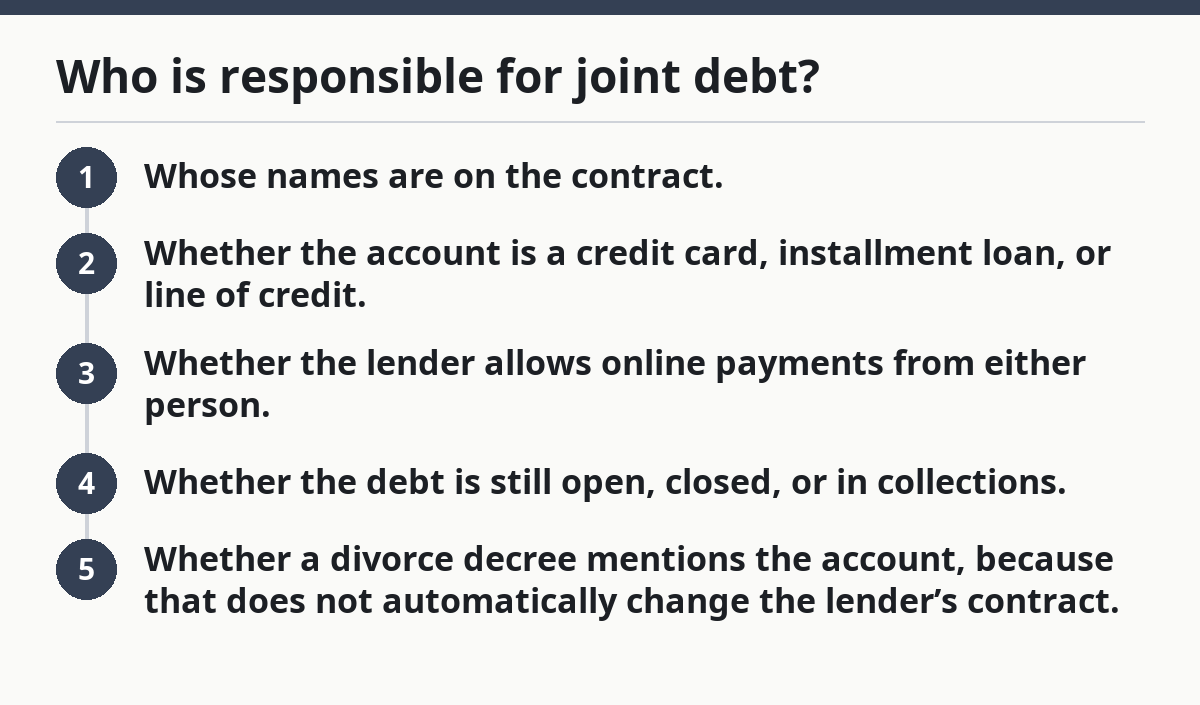
What to check first:
- Whose names are on the contract.
- Whether the account is a credit card, installment loan, or line of credit.
- Whether the lender allows online payments from either person.
- Whether the debt is still open, closed, or in collections.
- Whether a divorce decree mentions the account, because that does not automatically change the lender’s contract.
The legal paper controls the payoff plan.
Why this matters: a payoff method that assumes one person can freely rearrange every balance may fail on a joint account if the other person blocks access, misses a payment, or disputes responsibility. The CFPB explains that billing and debt records matter when accounts are disputed.
How to choose a debt payoff method for joint accounts and authorized user debt
The best method is the one that matches control, liability, and payment size, not the one that sounds neat on a blog. If you can only influence part of the debt, you need a method that works even when one account is shared and another is not.
Use this order:
- List every account by ownership. Mark it as joint, individual, authorized-user-only, or co-signed. Verify the contract, not just the card in your wallet. If the status is unclear, that is a problem.
- Separate what you owe from what you can control. A balance on a joint account is different from a balance where you are an authorized user and not liable. If you cannot control the payment, the method must include communication or lender contact.
- Make minimum payments on all accounts first. This protects the accounts from late fees and credit damage. Verify due dates and autopay settings; a missed payment means the plan is broken.
- Choose avalanche if interest cost is the main problem. Avalanche means extra money goes to the highest-rate balance first while minimums go everywhere else. It is strongest when the lender charges very different rates. The CFPB and FTC both note that high-rate debt costs more over time.
- Choose snowball if follow-through is the main problem. Snowball means extra money goes to the smallest balance first. It can be easier to stick with when the account structure is messy and motivation is low. If the smallest balance is on an account you do not control, it can stall.
- Use a hybrid when ownership blocks the pure method. For example, put extra money on the highest-rate debt you can actually pay down, while making minimums on the joint card until both parties agree on a split. If a method depends on someone else’s habits, it is not really your method.
- Write down who pays what and when. A 1-page split sheet is enough. Include amounts, due dates, and the payment channel. If the other person will not agree in writing, that is a warning sign.
- Recheck monthly. Interest rates, balances, and account access change. A plan that fit in January may be wrong in June.
The truth is, the right payoff method for joint and authorized user debt is often less about math than about authority. If you can’t direct the payment, the cleanest formula in the world won’t save the plan.
When does snowball make sense here?
Snowball makes sense when you need early wins and the balances are spread across accounts you may not fully control. It is a behavior-first method, not a math-first method.
Picture this: you’re looking at a joint card, a shared auto loan, and an account where you’re only an authorized user. The smallest balance is the one everyone can agree to attack. That can reduce arguments fast, and a paid-off account can free up mental space.
Snowball fits best when:
- There are 3 or more debts and one is clearly tiny.
- The highest-rate debt is also the one that is hardest to pay extra on.
- One person is more likely to stay with the plan after seeing a closed balance.
- The lender setup is messy, but minimum payments are manageable.
Its trade-off is plain: you may pay more interest over time than with avalanche. If the joint account has a high rate and a large balance, snowball can be the wrong tool if cost control matters more than morale. The CFPB and FTC both warn that longer repayment often means more interest paid.
Best use case: a household that needs a simple win to keep both people engaged, even if the interest savings are not perfect.
When does avalanche make sense here?
Avalanche makes sense when you care most about reducing interest and you can make extra payments without depending on someone else’s approval. It is the strongest math-based method for many debt stacks.
Picture this: you’re paying on a joint credit card with a high APR and an older installment loan with a lower rate. If the lender lets you make extra principal payments or direct extra card payments, avalanche puts the surplus where it can save the most money over time.
Use avalanche when:
- You have the rates for each debt, and they differ enough to matter.
- You can keep making minimums on every account.
- The joint account holder or co-signer will not block the extra payment.
- You want a plan that is easy to rank by numbers instead of emotions.
Its drawback is clear: the highest rate is not always the smallest balance, so progress can feel slow. If a shared debt is emotionally loaded—like an ex-spouse account you’re still tied to—avalanche may be mathematically neat but hard to live with.
Good fit: a reader who has the full rate list, stable cash flow, and enough control over the payment path to stay consistent for 6 to 24 months. The CFPB’s debt-repayment guidance also favors choosing a method you can sustain.
What if an authorized user is involved?
Authorized user debt changes the payoff question because use and liability are not the same thing. An authorized user can help make payments in practice, but the legal obligation may still sit with the primary cardholder.
Picture this: you’re listed on a card, you can see the balance online, and you want it gone. The first question is not “Which payoff method is best?” It is “Am I actually responsible for this debt, or just able to help pay it?”
Here’s the catch:
- If you are only an authorized user, the lender may not treat you as legally liable.
- If the card was opened as a joint account, that is different.
- If the primary cardholder refuses to pay, the lender may still pursue the account holder, not necessarily you.
- If you are trying to protect your credit, paying the balance may help practically, but it does not change the contract by itself.
A good payoff method here is usually the one that matches the primary borrower’s access and the household’s payment habits. If you cannot make the lender apply payments the way you want, ask for the account terms in writing and verify how payments are credited. The FTC and CFPB both recommend checking how payments are handled.
Watch for this: an authorized user who assumes “my name is on the card, so I own the debt.” That mistake can cause bad payment choices and bad credit assumptions.
When should you stop using the standard payoff playbook?
Stop using a standard snowball-or-avalanche plan when the account structure makes the plan impossible to carry out cleanly. Those are the moments when you need a different payment setup, and sometimes different paperwork.
One person can’t access the account: You can’t verify balances, due dates, or payment posting — switch to a lender-managed payment setup or shared account access if possible.
The debt is tied to an ex-spouse: A court order may assign responsibility between people, but the lender contract may still name both — confirm the contract and payment path before sending extra money.
The account is in collections: The original payoff plan may no longer control the debt as it did before — get the current owner of the debt and the current payoff terms first.
The card is an authorized-user card only: You may not be able to force a payoff strategy through the lender — focus on the primary account holder’s payment route and credit impact.
A co-signer is involved and missing payments: Liability can follow the contract, not the household agreement — do not assume the other person’s promise is enough.
Minimums exceed what one person can cover: The method is failing at the starting line — pause the plan and address the payment shortfall before choosing snowball or avalanche.
The debt is often treated as the contract says, not as the household hopes. These cases change who can pay, how the lender books the payment, and whether the method works at all.
The mistakes people make with shared accounts
The most common mistake is treating a shared debt like a solo debt. That leads to payment plans that ignore the other name on the contract and then fall apart the first time someone misses a due date.
Picture this: you make extra payments on the smallest balance, but the joint card keeps carrying a high rate and the other person keeps using it. The plan looks active and still goes nowhere. That is a structure problem, not a motivation problem.
Common errors:
- Ignoring account ownership. Consequence: the wrong person expects the wrong rights. Better move: read the contract before choosing the payoff order.
- Using snowball on a debt you can’t influence. Consequence: the “small win” never closes. Better move: aim extra cash at the debt you can actually reduce.
- Assuming an authorized user is fully liable. Consequence: you may overstate what you can force through the lender. Better move: separate legal duty from payment help.
- Skipping minimums to speed up one shared account. Consequence: late fees and credit damage can spread across both names. Better move: protect every minimum first.
- Not talking to the lender after a divorce or separation. Consequence: old payment instructions keep causing errors. Better move: confirm the payment path directly with the lender.
- Choosing the plan based only on feelings. Consequence: the method fails when cash gets tight. Better move: base the choice on rate, control, and account type.
If you want one rule, use this: the more shared the debt is, the more the payoff method has to be written down, not just hoped for.
What a good result looks like
A good result is not just a lower balance. It is a payment plan that still works when one account is joint, one is authorized-user-based, and the lender is the only party that matters for posting payments.
Picture this: after 3 billing cycles, every minimum is current, the shared account has a named payment owner, and the extra money is going to either the highest-rate account or the smallest balance with no confusion. That is a good result. If you are still arguing over who owes what every month, the method is not working yet.
Signs the plan is working:
- Each account has a clear owner for payment purposes.
- No due date is left to memory.
- The extra payment target has not changed without a reason.
- The authorized user understands whether they are helping, liable, or both.
- The lender statements match the plan.
If those pieces are missing, the math is not the first problem. The account structure is.
FAQ
Who is responsible for joint debt?
Joint debt is usually the responsibility of everyone named on the contract. That means the lender can typically look to either borrower for payment, even if only one person used the account. A divorce agreement may change who should pay between the two people, but it does not automatically change the lender’s rights.
Can an authorized user pay off a card alone?
Yes, an authorized user can often send money or help pay the balance, but that does not always make them the legally responsible borrower. The account contract controls who owes the lender. If the goal is to protect credit or stop charges, the primary cardholder and the lender’s payment rules matter most.
How do joint accounts affect payoff strategy?
Joint accounts push you to choose a method that fits both liability and control. If both names can be held responsible, you usually want minimums covered first, then a clear choice between avalanche and snowball based on rates, access, and how much coordination is realistic. A shared account that one person cannot manage well may need a simpler payment setup than a solo debt.
Drafted with AI; not yet reviewed by a person.