Last updated: November 20, 2026
Quick Answer: 3 checks for choosing a debt payoff method with closed accounts and charged-off debt
Closed accounts and charged-off debt change your payoff plan because the debt’s status, not just the balance, changes what you should pay first. In choosing a debt payoff method with closed accounts and charged-off debt, start with the account status, the owner, and whether the debt is still collectible. This guide shows how to sort active accounts, closed accounts, and charged-off debts into a payment order that matches your real situation.
Key takeaways
- Closed accounts can still show up on your credit report and still matter in your payoff plan.
- Charged-off debt is usually old debt the lender has written off for accounting, not debt that disappeared.
- A good payoff order depends on whether the debt is still with the original creditor, whether it’s in collections, and whether the account is still open.
- If you have active accounts and charged-off debt, the wrong move is to spread every extra dollar across all debts without a plan.
- This is information, not financial advice.
What closed accounts and charged-off debt change first

Closed accounts and charged-off debt change your order of attack because one is usually still part of the creditor’s books and the other may already be a loss on paper. If you have both, the question is not “which method is best in general?” It is “which method still works when some accounts are no longer active?”
Picture this: you’re looking at a credit report with a mix of open cards, closed cards, and one debt labeled charged off. You need a payoff method that respects the legal status of each account, not just the balances. That means priority order, not guesswork.
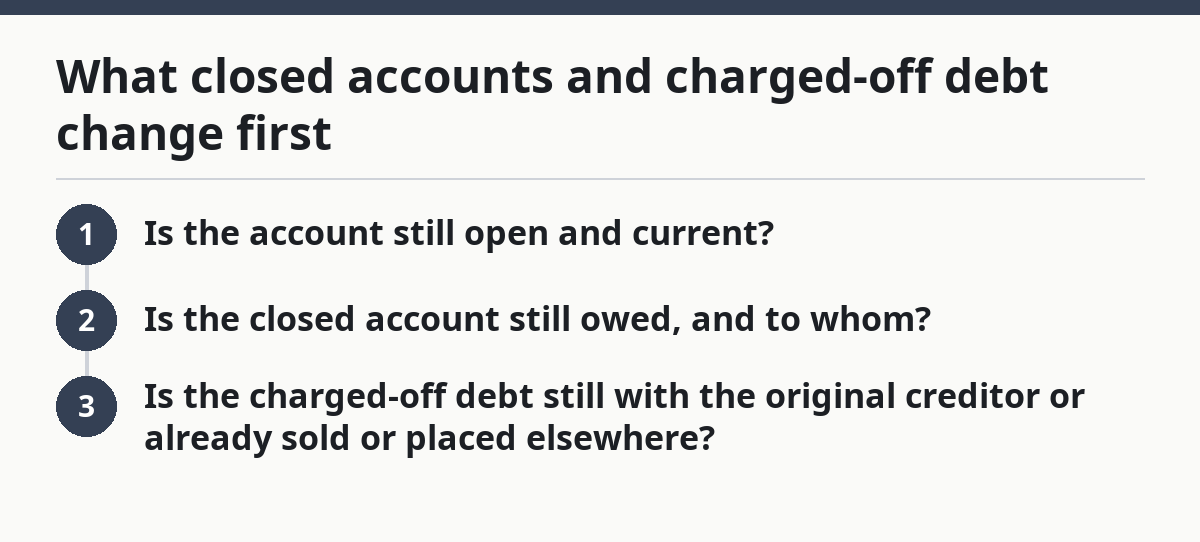
The best fit often comes from three checks:
- Is the account still open and current?
- Is the closed account still owed, and to whom?
- Is the charged-off debt still with the original creditor or already sold or placed elsewhere?
Closed accounts can be paid in full, settled, or left alone if they show a zero balance and no payment is due. Charged-off debt often needs a separate decision because the lender has already marked it as a loss. The action you take can affect collection pressure, credit reporting, and whether you create a new problem by paying the wrong account first.
Here’s the catch: a payoff method that works for ordinary delinquent debt can fail when the account is already closed or charged off. You need a method that starts with status, not emotion.
How do I choose a payoff order when some debt is closed?
You choose the payoff order by ranking debts in this order: active accounts that can still become a problem fast, closed accounts with a live balance, and charged-off debt that still has a clear owner and payoff path. That order is usually more useful than a pure “smallest balance first” or “highest rate first” plan when the file includes old accounts.
Therefore, if your paycheck arrives and you can spare only one extra payment this month, you want that money to do the most damage to the right problem. The method below helps you decide where each dollar goes.
- List every debt by status. Write down whether each account is open, closed, charged off, or in collections, and note the current balance and creditor name. Verify the status on the latest credit report and the most recent bill or notice. If a balance appears on one source but not the other, that is a sign to stop and reconcile the file.
- Mark who owns the debt now. Note whether the original lender still owns it or whether it has been sold or assigned. Verify the name that appears on the statement, letter, or credit report. If you cannot identify the current owner, do not guess; a payment sent to the wrong place can create delays and disputes.
- Separate active accounts from closed ones. Put open accounts with required monthly payments at the top of the list. Verify due dates and minimums. If an account is closed but still reports a balance or monthly payment, that means it is still an active debt obligation and should not be ignored.
- Check charged-off accounts for timing and status. A charge-off means the creditor has written the balance off for accounting, but the debt may still be collectible. Verify the date of charge-off and whether the account has been transferred. If the debt is near the edge of your state’s statute of limitations, do not make assumptions before you act.
- Choose your payoff method by goal. If you want fewer moving parts, use a priority plan that puts active accounts first and charged-off debt second. If you want the fastest psychological win, a snowball-style plan can work if you keep active accounts current. Verify that the method will not starve minimum payments on anything still open.
- Decide whether settlement is on the table. For charged-off debt and some closed accounts, settlement may be an option if the creditor accepts less than the full balance. Verify the settlement terms in writing before paying a cent. If the deal is only spoken, it is not a deal.
- Test the plan against your cash flow. Confirm that your monthly budget can cover all required minimums plus the extra amount you assign to the target debt. If the plan depends on missing a payment elsewhere, it is too aggressive. Rework the order before you start.
- Set one rule for every payment. Send each payment to a single account in the order you chose and keep records of date, amount, and confirmation number. Verify that the statement updates the way you expected. If a creditor applies a payment in an unexpected way, follow up right away in writing.
The main trade-off is simple: a snowball gives you momentum, while a status-based priority plan gives you control over old accounts with messy histories. On charged-off debt, control usually matters more than speed.
Should charged-off debt be treated like any other debt?

Charged-off debt should be treated as a separate category, not as ordinary revolving debt, because its credit and collection life are different. If you are unsure how to treat it in your own file, consult a qualified adviser or consumer law professional and review the Consumer Financial Protection Bureau’s debt collection guidance. The balance may still be owed, but the account has already moved through a major status change. That changes the decision tree.
Picture this: one account is current, one is closed, and one has a charge-off notation. A generic “pay the smallest balance first” plan does not tell you whether to settle the charged-off debt, pay it in full, or leave it for later. The status does.
Here’s how the three common approaches behave:
- Snowball focuses on the smallest balance first. It can help if you need quick wins, but it can also ignore the difference between a closed account and a charged-off account with a long reporting trail.
- Avalanche focuses on the highest interest rate first. That works best when all debts are active and straightforward. It is less helpful if a charged-off account is already in a different stage of collection or negotiation.
- Priority order by status puts active accounts first, then closed balances, then charged-off debt, unless a written settlement or collection strategy changes the order.
A status-based plan does not force you to choose one method for every account. You can use avalanche for active cards, then switch to settlement or payoff for a charged-off account that is still being reported.
A charge-off also raises re-aging risk, which is the risk that a payment or account action changes how old the debt appears in a way that hurts your reporting or dispute position. The exact rules vary by country and by local law. If you are unsure whether a payment could affect the age or reporting of the account, get qualified help before you send money.
What should I check before paying a closed account or settling charged-off debt?
You should check the account’s owner, balance, reporting status, and written payoff terms before you pay anything. That is the difference between a clean payoff and a payment that creates confusion on your credit report.
Picture this: you want the account off your mind, so you pay fast. The letter arrives later and says the balance was applied differently than you expected, or that the creditor still reports the debt as unpaid. That is avoidable if you check a few details first.
Use this short review:
- Confirm the owner: original creditor, assignee, or debt buyer.
- Confirm the balance: current amount, fees, and any interest still being added.
- Confirm the status: open, closed, charged off, or in collections.
- Confirm the reporting: what appears on the credit report right now.
- Confirm the settlement language: full payoff, partial settlement, or paid as agreed.
Two outside references are worth keeping handy: the Consumer Financial Protection Bureau’s debt collection information and the Federal Trade Commission’s credit report guidance. Both are broad, public resources that help you check how debt reporting and collection notices are supposed to work. The CFPB explains debt collection rights, and the FTC explains how to get and review credit reports.
If the debt is charged off but still with the original creditor, a full payoff may fit better than a settlement if your goal is to reduce dispute risk and clean up the account language. If the debt has been sold, settlement may be a realistic path. That depends on the paperwork, not on the balance alone.
When should you stop and get help before paying?
You should stop when the account file is unclear, the debt is disputed, the timing is risky, or a payment could restart a problem you thought was old. In those cases, the wrong payment can create more damage than doing nothing for a few days.
Picture this: you are ready to clear a debt, but the records do not line up. The statement, the credit report, and the collection letter all tell a slightly different story. That is not a reason to panic. It is a reason to pause.
The creditor can’t be identified: you do not know who owns the debt — do not send money until you have the current owner in writing.
The balance looks wrong: fees, interest, or payments do not match — request itemization and reconcile the account before paying.
The account is disputed: you believe the debt is not yours, already paid, or misreported — follow the dispute process before any payoff decision.
The debt may be time-barred: older debt can have different collection limits depending on where you live — do not make a payment until you understand the local rule and the risk of re-starting collection efforts.
The settlement offer is verbal only: there is no written release or terms — do not pay until the agreement spells out the amount, the reporting language, and what happens after payment.
Minimum payments on active accounts are slipping: your current plan is too aggressive — protect active accounts first, then revisit the charged-off debt.
If any of those are true, the next step is not “pay faster.” It is “slow down and verify.” For a debt file with legal or reporting complications, a qualified adviser or consumer law professional is the right next stop.
Which payoff method fits each account type best?
The best fit is usually snowball for behavior, avalanche for cost, and status-based priority for messy files with closed and charged-off debt. That is the simple answer, but the right answer depends on which accounts still matter every month.
Because of that, if you have one closed card with a balance, two open cards, and one charged-off account, a single method may not fit all four. The stronger plan is to assign a role to each debt type.
Use this guide:
- Open accounts: avalanche if interest cost is the main issue; snowball if you need visible progress.
- Closed accounts with balances: pay according to the creditor’s current terms, because the account can still need active management.
- Charged-off debt: consider settlement or a separate payoff path if the creditor still owns it and the paperwork is clear.
- Collections tied to a charged-off account: do not mix this page’s job with collection-specific rules; that is a different decision path.
A pure snowball plan can work if the closed and charged-off debts are small and all active accounts stay current. A pure avalanche plan can work if every debt is straightforward and still active. The problem starts when the file is mixed and the oldest debt has already been charged off. Then the method has to account for status, not just math.
The truth is, closed accounts and charged-off debt make a generic list look neater than it is. A smart plan keeps the active accounts protected, handles closed balances with care, and treats charged-off debt as a separate negotiation or payoff decision.
What mistakes cost the most with charged-off debt?
The biggest mistakes are paying the wrong account first, paying without written terms, and using a one-size-fits-all method on a mixed file. Those errors cost time, credit repair effort, and sometimes extra fees.
Picture this: you are trying to clean up your finances, and a fast payment creates a new mess. That happens more often than people expect, especially when an account is closed but still reported or charged off but still collectible.
Common mistakes to avoid:
-
Ignoring the account status.
Consequence: you may pay a debt that was already closed out or fail to protect an active account.
Better alternative: sort by status before you pay. -
Assuming charged-off means gone.
Consequence: the balance can still be pursued, reported, or negotiated.
Better alternative: verify who owns it and what the current paperwork says. -
Sending partial payment without terms.
Consequence: the creditor may take the money without agreeing to your payoff expectation.
Better alternative: get settlement terms in writing first. -
Using snowball on every debt without checking minimums.
Consequence: active accounts can slip behind while you chase a small closed balance.
Better alternative: keep required payments current, then direct extra money to the chosen target. -
Not checking the credit report after payment.
Consequence: errors can linger for months.
Better alternative: review the report and dispute clear mistakes with documentation.
A good payoff method is not just the one that feels simple. It is the one that still works when the file is messy.
Drafted with AI; not yet reviewed by a person.