Last updated: November 20, 2026
Debt payoff method fit by debt type and account structure works best when the method matches the debt type and the account structure, not when it sounds tidy on paper. Avalanche usually fits high-interest revolving debt; snowball fits people who need early wins; targeted payoff fits student loans, medical bills, and mixed accounts. The sections below settle when each method makes sense and when it doesn’t.
Quick answer: for most high-interest debt, avalanche is the default fit; for many small balances, snowball can work better; for mixed or unusual accounts, targeted payoff is often the safest starting point.
Key takeaways
- Revolving balances and installment loans behave differently, so one payoff plan rarely fits all accounts.
- High-rate debt usually belongs at the front of the line if the goal is to reduce interest cost.
- Small-balance accounts can justify a momentum-based plan when motivation keeps slipping.
- Federal student loans, secured debt, and debt in collections can need different handling than credit cards; if your situation is unusual, a qualified professional or servicer can help you sort it out.
- If the account structure is unusual, the safest first step is often to sort the debt before choosing a payoff method.
Debt rules, interest rules, collections rules, and tax treatment vary by country and change over time, so a qualified adviser should review your own situation. For federal student loans, the U.S. Department of Education explains repayment options and service rules; for collections, the Consumer Financial Protection Bureau outlines how debt collection works.
I write about consumer debt, credit reports, and repayment planning for readers who need the plain-English version before they make a costly mistake.
Which payoff method fits which kind of debt? Debt payoff method fit by debt type and account structure
The right payoff method depends on interest rate, payment flexibility, and account structure more than on the debt label alone. A credit card at 0% promo interest, a federal student loan in repayment, and a medical bill in collections all need different handling because the balance grows, the minimums work, and the consequences of missed payments are not the same. For example, a promo balance can change after the promotional period ends, federal loans can have multiple repayment paths, and medical collections can involve dispute or verification questions.
Use this basic matching rule:
- High-interest revolving debt: avalanche usually fits best.
- Many small balances: snowball can fit if motivation is the weak link.
- Installment debt with fixed due dates: targeted extra payments often work better than a pure snowball.
- Mixed debt: group accounts by type first, then choose one method for each group.
Avalanche vs. snowball: what changes in real life?
Avalanche is the better math choice for most high-interest debt, while snowball is the better behavior choice for people who need visible progress fast. The difference is simple: avalanche attacks the highest rate first; snowball attacks the smallest balance first. That distinction matters more once the balances and rates stop lining up neatly.
Picture this: you have four debts, each with a minimum payment, and one of them carries a much higher rate than the others. Avalanche tells you to send every extra dollar to the costly balance first. Snowball tells you to wipe out the smallest balance first, even if its rate is lower. One can lower total interest more. The other can keep you in the plan.
The method that saves the most on paper is not always the method a real household can follow for 18 months. If a plan fails in month two, the “best” method was the wrong fit.
| Criteria | Avalanche | Snowball | Winner for… |
|---|---|---|---|
| Main sorting rule | Highest interest rate first | Smallest balance first | Lower total interest cost |
| Best fit debt type | Credit cards, personal loans with varying APRs | Mixed balances with small accounts | Behavioral follow-through |
| Speed of first payoff | Often slower | Often faster | Early momentum |
| Interest saved | Usually more | Usually less | Cost control |
| Emotional payoff | Delayed | Quick wins | Motivation |
| Complexity | Needs APRs listed correctly | Needs balances listed correctly | Simplicity |
| Good for disciplined budgets | Yes | Yes | Either, if you keep paying |
| Good for fragile motivation | Sometimes no | Often yes | Snowball |
| Risk if you quit early | High if high-rate debt stays open | High if the biggest rate stays open | Neither is magic |
| Works well when debts are similar | Yes | Yes | Tie, based on habit |
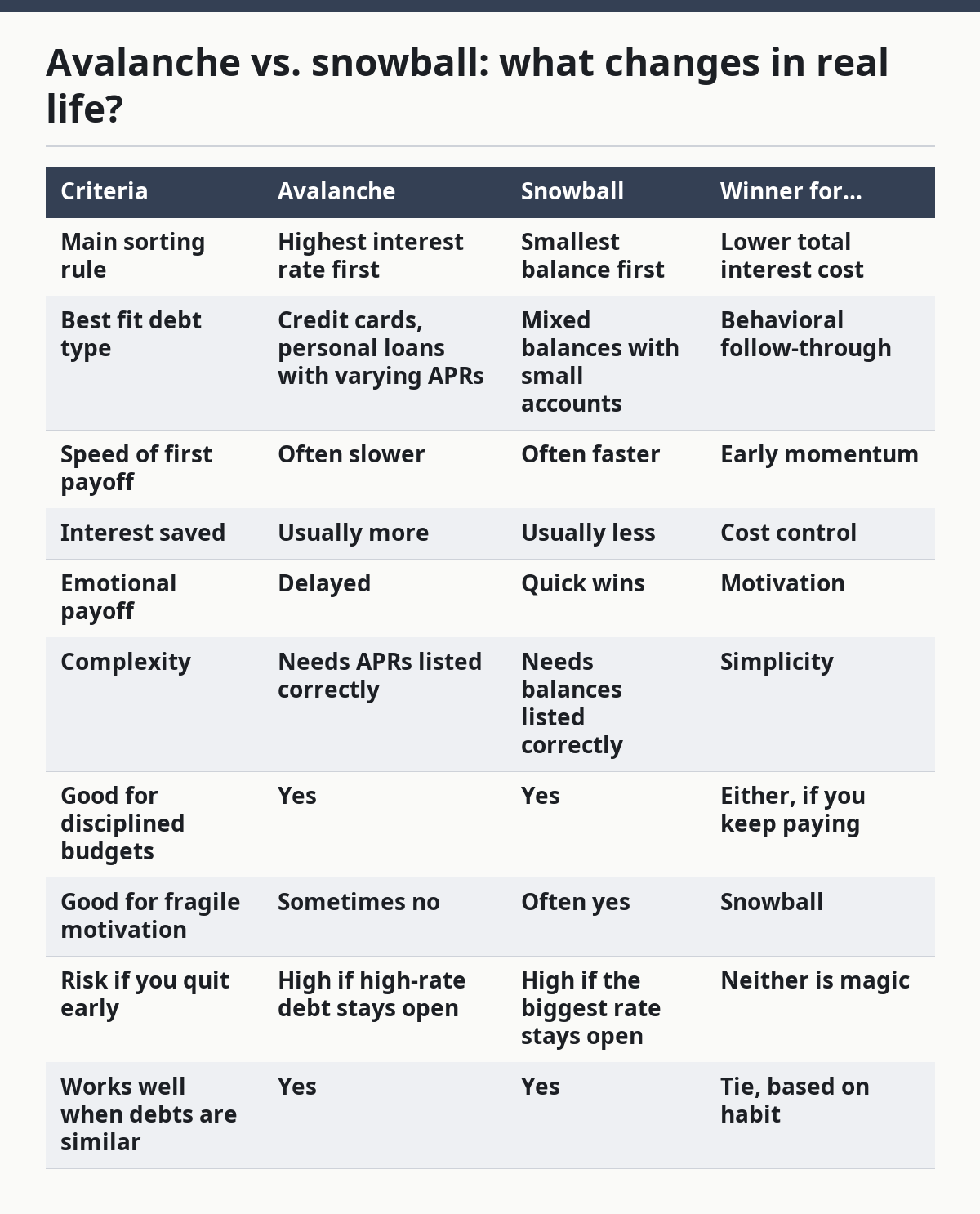
Avalanche wins for anyone who can stay steady, because rate differences compound against you month after month. Snowball works better for the person who has tried and stopped before, because a cleared account can change the pace of the whole plan.
Credit cards, personal loans, and store cards: how account structure changes the choice

Credit cards and similar revolving accounts usually favor avalanche, but the account structure matters just as much as the rate. Revolving debt resets each month, minimums can be small, and new charges can undo progress quickly. Personal loans and store cards can look similar on the surface, yet the payment rules and rate structures may differ enough to change the order.
Picture this: you have one store card, one credit card, and one personal loan. All three have balances. The right move is not “pay the ugliest one” or “pay the newest one.” It is to check whether the debt is revolving, whether the APR is fixed or variable, and whether new spending can reopen the hole.
On the flip side, a 0% promotional card needs extra care. If the promo ends later, the leftover balance can become expensive all at once. That means the payoff plan has to respect the promo end date, not just the balance size.
Use this sorting logic:
- List every revolving account separately.
- Mark any promo rates and their end dates.
- Put the highest APR revolving debt at the top if you can stay consistent.
- If a promo expires soon, treat it like a near-term deadline.
- Stop new charges if the plan depends on the card balance falling.
Federal student loans, private student loans, and medical debt: why one method can fail here
Student loans and medical debt often need a targeted repayment plan, not a pure avalanche or snowball. The reason is account structure: federal student loans may have repayment plans, deferment options, or forgiveness paths that change the math, while private student loans and medical bills can behave more like ordinary installment debt or collections balances. The U.S. Department of Education and the Consumer Financial Protection Bureau both outline rules that can change how these accounts should be handled, so checking the account type first is important.
Picture this: you’re staring at a federal loan, a private student loan, and a hospital bill. A simple balance list is not enough. You need to know whether the loan is federal or private, whether the medical bill is still with the provider or already in collections, and whether missing a payment changes the status of the account in ways you can’t undo.
The truth is, debt type changes the stakes. A medical bill in collections may involve settlement discussions. A federal loan may have plan options that are more important than raw balance order. A private student loan may have fewer flexibilities and higher consequences if the terms are missed.
Authoritative starting points:
- U.S. Department of Education information on federal student loans
- Consumer Financial Protection Bureau guidance on debt collection and medical debt
- Your loan servicer or original creditor for account-specific rules
Practical handling guide:
- Federal student loans: check the repayment plan first, then decide whether extra payments should go to the highest-rate loan or the smallest remaining balance.
- Private student loans: treat them like installment debt with a close eye on APR, fees, and prepayment rules.
- Medical debt: verify the bill, dispute errors if needed, and confirm whether the account is still with the provider or has moved to collections.
- Mixed medical plus credit card debt: separate the accounts before choosing a payoff order.
Secured debt, collections, and mixed-family household debt: what gets missed
Secured debt, debt in collections, and household-shared accounts can make a normal payoff method look neat while hiding the real risk. A car loan, for example, is secured by the vehicle. A credit card is not. That difference matters because a missed payment can trigger very different consequences even if the balance is smaller.
Picture this: you and a spouse or partner both use the same card, or one account is in one name but the payments come from a shared budget. The clean “highest rate first” chart stops being enough. You need to know who is legally responsible, whose credit report is hit, and whether paying one account faster creates a cash squeeze somewhere else.
Here’s the catch: debt payoff is not just a ranking exercise. It is a cash-flow plan.
What deserves special handling:
- Secured debt: protect the asset first if losing the asset would be a bigger problem than extra interest.
- Collections debt: confirm the collector, the balance, and whether the debt is still within the enforceable period in your jurisdiction.
- Joint accounts: one person’s payoff plan can leave the other exposed if the account remains open.
- Authorized user accounts: the payment history may affect a report differently from legal liability.
If a debt is secured or shared, the “best” payoff method can change because the downside is not just cost. It can be loss of the asset, damage to two credit files, or a payment dispute inside the household.
The honest side-by-side on fit by debt type and account structure

The clear winner for most high-interest revolving debt is avalanche, while the clearest fit for scattered small balances is snowball. The middle ground is target-based payoff, where the order changes by debt type, promo end date, legal status, or household structure. That middle ground is where most real readers land.
Picture this: your debt list has more than one kind of account, and one method starts feeling too rigid. That is common. Real budgets have rent, food, irregular income, and surprise bills. A method that ignores all of that will fail in the real world.
| Criteria | Avalanche | Snowball | Targeted payoff | Winner for condition |
|---|---|---|---|---|
| Best use case | High-rate revolving debt | Small-balance motivation | Mixed debt structures | Depends on debt mix |
| Requires APR data | Yes | No | Usually yes | Snowball if data is incomplete |
| Handles promo deadlines | Only if tracked carefully | Poorly | Very well | Targeted payoff |
| Handles federal loan options | Sometimes | Poorly | Best fit | Targeted payoff |
| Handles medical collections | Poorly alone | Poorly alone | Best fit | Targeted payoff |
| Handles secured debt | Can miss asset risk | Can miss asset risk | Best fit | Targeted payoff |
| Works with shaky motivation | Sometimes not | Often yes | Depends on design | Snowball |
| Best for lowest interest cost | Yes | No | Sometimes | Avalanche |
| Best for cash-flow flexibility | Moderate | Moderate | High | Targeted payoff |
| Best for simple execution | Moderate | High | Lower | Snowball |
Targeted payoff wins when the debt list is messy. That means promo cards with expiration dates, student loans with separate repayment rules, medical bills that need verification, and household accounts that need legal sorting before extra payments begin.
When to choose avalanche, snowball, or a mixed plan
Choose avalanche if you can track APRs, avoid new debt, and stay on the plan long enough for the interest difference to matter. Choose snowball if you need quick wins to keep paying, especially when you have several small balances and your biggest problem is follow-through. Choose a mixed plan if your debt types do not fit one clean order.
Picture this: you want the plan that will survive a normal month, not the perfect spreadsheet plan. That means the right answer may be “one method for cards, another for loans,” not a single universal rule.
Use this decision rule:
- If you have mostly credit cards and personal loans, start with avalanche.
- If you have five or more small balances and you keep quitting, start with snowball.
- If you have student loans, medical debt, or collections mixed in, separate those first.
- If any account has a promo end date, move it up the list.
- If paying extra on one debt would cause new missed payments elsewhere, the plan is too aggressive.
A mixed plan is still a real plan. It is not a cop-out if it matches the account structure.
What changes the answer entirely?
The answer flips when the debt structure is unusual enough that the usual ranking breaks. That happens with promotional rates, collections status, secured collateral, and legal ownership. It also happens when the budget is so tight that the payoff method matters less than stopping new borrowing.
Picture this: you are trying to choose between two neat methods, but the debt itself is telling you the chart is wrong. That is where a generic article stops helping and a file-by-file review starts.
Exception scenarios:
- A promo rate ends soon: a lower balance may need attention before a higher-rate balance if the promo jump is coming fast.
- A secured loan is near default: keeping the asset may matter more than reducing interest on an unsecured loan.
- A debt is in collections: verification and settlement questions can come before payoff order.
- Your income is unstable: a smaller extra payment plan may beat a strict method you cannot sustain.
If one of those applies, the method choice is secondary to account triage. That is the right order.
The verdict: which method fits which debt type?
Choose avalanche if your debts are mostly credit cards, personal loans, or other balances with clearly different APRs and you can keep paying consistently. Choose snowball if you need fast wins and your main problem is quitting before the first account disappears. Choose targeted payoff if you have student loans, medical debt, collections, promo balances, secured debt, or shared household accounts that need sorting first. Neither if you are still adding new debt every month and have not built a basic payment plan yet.
Can I use one payoff method for all my debts?
Yes, but one method is not always the best fit for every account. A single rule works best when the debts are similar, like several credit cards or a stack of personal loans with known rates.
If the mix includes student loans, medical bills, or collections, one method can miss the real risk. In that case, sort the debt first and then choose the payoff order.
Is snowball always slower than avalanche?
Not always in real life, but it is usually slower on interest cost. Snowball can feel faster because you clear small balances sooner, and that can keep you paying.
The trade-off is simple: avalanche tends to reduce interest more, while snowball tends to help people stay consistent. The faster plan is the one you keep following.
What if my debt has a 0% promo rate?
Treat the promo end date like a deadline, not just the balance size. A 0% balance can jump in cost when the promo ends, so the remaining amount and the expiration date both matter.
If you can’t pay it off before the promo ends, it may need higher priority than a higher-balance account with no near-term rate change. Check the terms carefully, because promo rules differ by issuer and country.
Should I pay off medical debt the same way as credit cards?
Not usually. Medical debt often needs verification first, and the rules can differ if the bill is still with the provider or has moved to collections.
A credit card payoff method ranks by rate or balance. Medical debt may require dispute checks, payment plan review, or collection-status review before payoff order even makes sense. That’s why a targeted plan is often better.
What if I have both federal student loans and credit cards?
Separate them before choosing the method. Federal student loans may have repayment options that change the cash flow, while credit cards usually need a rate-based or balance-based payoff order.
If the loans are federal, check the servicer’s terms and any official repayment option before throwing extra money at the credit cards. If the loans are private, the analysis looks more like other installment debt, but the contract still matters.
Drafted with AI; not yet reviewed by a person.