Last updated: November 20, 2026
Quick Answer: choose the debt payoff method that matches your cash flow and your payment dates; for many people, that means avalanche if you want to minimize interest, or snowball if you want faster motivation. You want the debt plan that runs on autopilot without breaking your bank account. Choose the method that matches your cash flow, not your mood. The steps below will show how to set up an automated debt payoff plan with autopay, scheduled transfers, and bill pay, and how to tell when a method is a bad fit.
Key Takeaways
- Automation works best when payment dates match your paycheck timing and your bank balance stays predictable.
- Avalanche and snowball both can be automated; the difference is which balance gets the extra money first.
- Bill pay, autopay, and scheduled transfers solve different parts of the job, so the right setup often uses all three.
- If your income swings hard or your account balance gets tight near due dates, a full set-and-forget plan can backfire.
This guide on how to choose a debt payoff method when you want to automate everything is general information; a qualified adviser can help with your own situation.
Who this works for — and who should slow down
This works for someone who has steady income, a checking bank account, and at least one debt that accepts electronic payment. It also assumes you already know your monthly bills, even if you do not track them in a spreadsheet.
Because the balance, dates, and predictable payments all line up, you can picture a setup that runs on its own without creating overdrafts or missed due dates. That means you need a plan that fits your pay cycle, autopay rules, and the way your lender handles extra principal.
- Best fit: fixed paycheck dates and fixed debt due dates.
- Good fit: a checking account with a small buffer.
- Poor fit: freelance income that lands on random days.
- Poor fit: debts that charge fees for card-style payments or do not accept autopay.
- Poor fit: a plan that depends on manual memory.
According to the Consumer Financial Protection Bureau’s guidance on automatic payments and account alerts, and the Federal Trade Commission’s page on automatic bill payments, auto-debits can go wrong if the account balance is too low.
The catch is simple. Automation removes friction, but it does not remove math. If your surplus changes every month, the method has to handle that.
How do I choose the method if I want everything automated?
You choose the method by asking which debt gets the extra money when the system is running by itself. If you want the least interest cost, the debt avalanche method fits automation best. If you want the quickest early win, debt snowball is easier to see, but it is still automatable.
Because the balance gets attacked in a fixed order, you can picture three debts on minimum autopay and one extra transfer scheduled from your checking account every payday. The decision is mostly where that extra payment goes and how often it moves.
- List every debt and write down the balance, APR, minimum payment, and due date.
- Set autopay for each minimum payment from the same checking account.
- Schedule transfers from payday to checking so the money arrives before due dates.
- Choose avalanche if you want the extra payment aimed at the highest APR first.
- Choose snowball if you want the extra payment aimed at the smallest balance first.
- Use bill pay if a lender accepts it and you want one bank to send the payment for you.
- Add a 3- to 7-day buffer before each due date so bank processing time does not cause a late payment.
- Keep one rule for spare cash: any extra money over the minimum goes to the same target debt until it is gone.
- Review the setup monthly until the payment order and bank balance stay steady for at least 2 cycles.
Verification matters at every step. Check that the lender posts the payment the way you expect, and confirm whether an extra payment lowers future minimums or only reduces principal. If the statement still shows a past-due amount after an autopay, something in the setup is wrong.
The problem signal is usually obvious: a payment posts late, a transfer lands after the due date, or the bank balance dips below the autopay amount. If any of those happen once, the plan needs a timing fix, not more willpower.
Which automation tool does what?
The right setup uses the right tool for the right job. Autopay pays the required minimum on a set schedule, scheduled transfers move money between accounts, and bill pay sends money from your bank to the lender without you logging in each month.
Because the payment order and the account balance are both part of the system, the tool choice is less about the payoff method itself and more about how the money moves.
- Autopay is best for minimums and due-date protection.
- Scheduled transfers are best for moving savings or income into checking before payment day.
- Bill pay is best when your bank can send one payment to several creditors from a single interface.
- Manual extra payments are only for odd months, like tax refunds or bonuses.
Here’s the catch: some lenders apply extra money to the next installment unless you specify “principal only.” That phrase matters. If you skip it, the lender may simply advance your due date instead of shrinking the balance.
On the flip side, some banks make bill pay slower than a same-day debit. That is why a 3- to 7-day buffer is safer than paying on the due date itself. A late-fee policy can turn a tidy system into an expensive one.
According to the CFPB and your lender’s own payment terms, those are the two documents that matter most here. If the lender has a separate autopay discount, keep the terms in writing before assuming the discount stays after you change payment methods.
What should I check before I let it run on its own?
You should check due dates, payment posting rules, and your bank buffer before you trust the plan. A set-and-forget debt payoff plan only works when the account can absorb the debit without going negative.
Because the automatic payment is only as safe as the timing, one debt posting on the 1st while your paycheck lands on the 3rd is not a true autopay solution. That is a setup that waits to fail.
- Check due dates against paydays, not against your memory.
- Check processing times for autopay and bill pay.
- Check minimum payment rules after a balance change or a rate change.
- Check whether extra payments go to principal or to the next due date.
- Check your checking buffer so the account can cover all scheduled debits.
A simple rule helps: keep enough cash in the account to cover at least the next scheduled payment cycle, plus a small cushion for timing delays. The exact amount depends on your bills, so there is no universal number here.
If you cannot hold that buffer, the problem is not the payoff method. The problem is timing. In that case, moving payment dates or using a different account for scheduled debits may work better than changing from avalanche to snowball.
The best result is usually boring: payments land on time, the same debt gets the extra money every month, and the bank balance never dips into overdraft territory.
When does automation stop being the right tool?
Automation stops being the right tool when your cash flow is too uneven for fixed debits. In that case, the method is not wrong; the setup is.
Because the day-by-day cash flow is unstable, one month can look fine and the next can get expensive fast. If your income changes every month, one creditor changes the minimum after a statement closes, and your checking account runs close to zero before payday, that is a fragile setup even if the payoff method itself is sound.
Income arrives irregularly: Gig work, commission pay, or seasonal hours can leave the account short — use a manual review before each autopay date or move the due date if the lender allows it.
Your balance already runs tight: A small timing slip can trigger overdrafts — keep a larger buffer or route the payment through a different account.
The lender misapplies extra payments: The balance may not fall the way you expect — switch to a principal-only instruction if the lender supports it, and consider checking with the lender or a qualified adviser.
The account has frequent holds or pending card charges: The available balance may not match the ledger balance — use a separate bill-payment account for debt debits.
The payment amount changes often: A fixed debit can become wrong after a rate change or fee — review the payment amount each statement cycle.
You cannot track one backup date: Missed debits become likely — automation needs at least one human check-in each month.
That last point matters more than people think. Full automation still needs a monthly glance, even if the system is otherwise self-running. A 5-minute review beats a late fee.
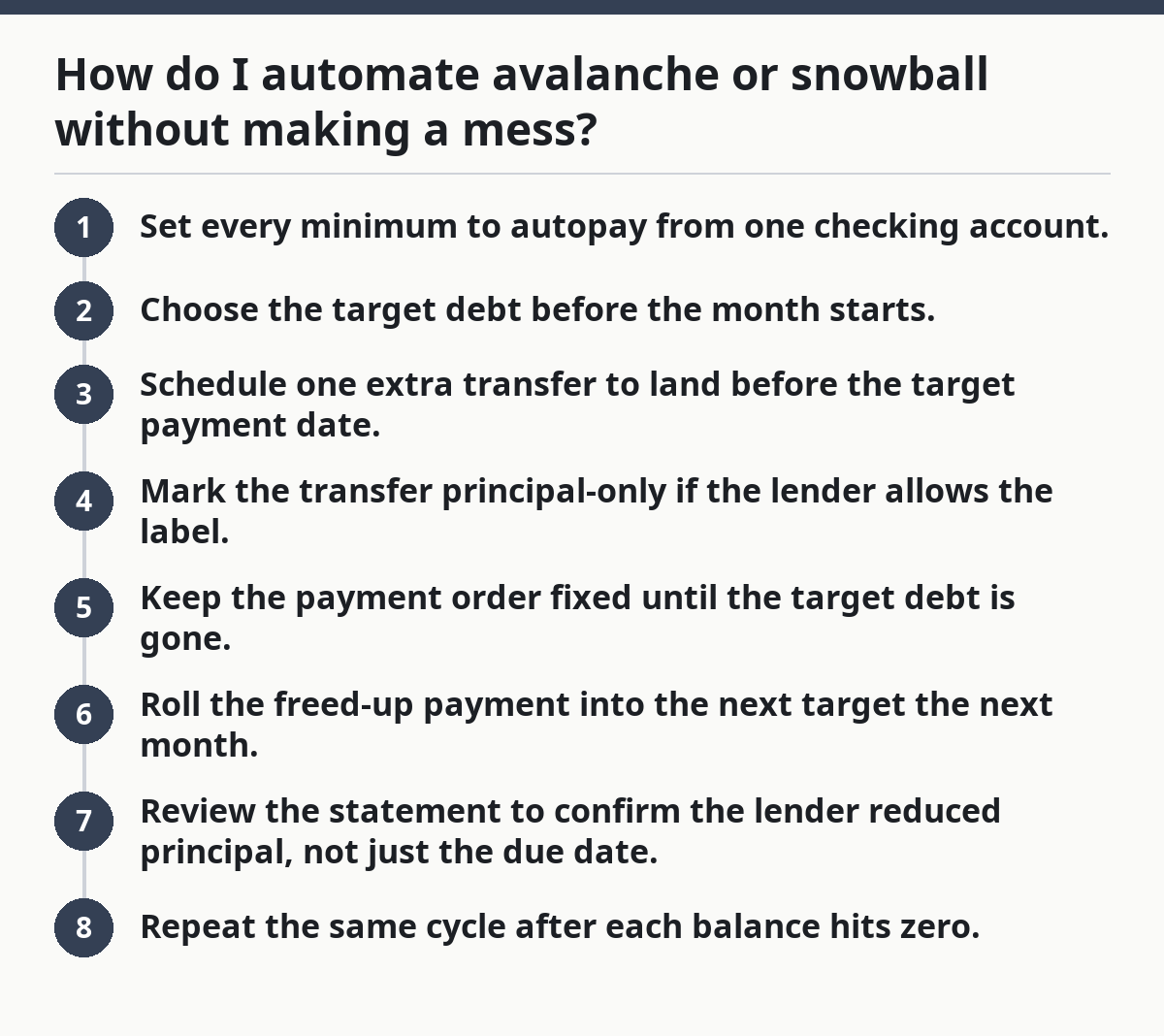
How do I automate avalanche or snowball without making a mess?
You automate avalanche or snowball by making one debt the target and keeping the rest on minimum autopay. The method changes only the order of the extra money; the plumbing stays the same.
Because the automatic payments stay fixed until a balance is paid off, you can keep the debt order from changing every time you feel stressed. That is what makes the system stable.
- Set every minimum to autopay from one checking account.
- Choose the target debt before the month starts.
- Schedule one extra transfer to land before the target payment date.
- Mark the transfer principal-only if the lender allows the label.
- Keep the payment order fixed until the target debt is gone.
- Roll the freed-up payment into the next target the next month.
- Review the statement to confirm the lender reduced principal, not just the due date.
- Repeat the same cycle after each balance hits zero.
Avalanche is the more mathematical choice because it attacks the highest APR first. Snowball is the more visible choice because small balances disappear sooner. Both can be automated, and both can fail if extra payments are not applied as intended.
The practical question is not “Which is morally better?” It is “Which method can I run for 12 months without touching it every week?” For many people, the answer is avalanche because the target stays rational even when motivation drops.
What mistakes do people make with an automated debt payoff plan?
People usually make five mistakes, and each one creates the same kind of pain: a missed payment, an overdraft, or a balance that does not fall the way they expected. The fix is usually a timing change, not a different payoff philosophy.
Because the day can turn expensive fast when a rent payment or card hold lands before autopay, the setup may work for 2 months and then break. That is a setup problem, not a personal failure.
-
Mistake: Paying on the due date.
Consequence: processing delays can make the payment late.
Correct move: set the debit 3 to 7 days early. -
Mistake: Assuming extra payments hit principal automatically.
Consequence: the lender may move the due date forward instead.
Correct move: label the payment principal-only if allowed. -
Mistake: Using one account for every bill without a buffer.
Consequence: a single hold can affect several payments.
Correct move: keep a dedicated payment account. -
Mistake: Changing the target debt every month.
Consequence: the system loses its logic and slows down.
Correct move: keep one order until a debt is gone. -
Mistake: Ignoring balance changes after a rate or fee change.
Consequence: the autopay amount may stop matching the statement.
Correct move: check each statement and adjust the scheduled amount. -
Mistake: Treating automation as “set and forget forever.”
Consequence: the plan can drift without warning.
Correct move: do a 5-minute monthly check and, if needed, talk with a qualified adviser or lender.
The real win is not perfection. It is fewer decisions. If the system makes you think about debt every day, it is not automated enough.
What should I do if my situation is not standard?
You should slow the plan down and add a human check if your income or balances are unstable. Automation is a tool for steady cash flow, not a cure for uneven cash flow, so consider checking with a qualified adviser if your numbers are tight.
Because the buffer has to survive variable income, tax bills, and shifting minimums, a modified automation plan is often better than a blind one.
Use a modified setup when any of these show up:
- You are paid weekly, biweekly, or on commission: Match scheduled transfers to payday, then let autopay run after funds land.
- You have a large annual bill: Keep that money out of the payment account so it does not steal from debt debits.
- You have several debts with the same due date: Stagger the payment dates if the lender allows it.
- You are using a checking account with low balance alerts: Turn those alerts on so you can catch a miss before it happens.
- You cannot get principal-only treatment: Use the payoff method, but expect slower balance reduction, and confirm the approach with the lender or a qualified adviser.
One good outside reference is the Consumer Financial Protection Bureau’s guidance on automatic payments and account alerts. Another is your lender’s payment rules. Those sources tell you more than a generic internet template ever will.
If the numbers still feel too tight, this is the point where a qualified adviser can help you fit the debt plan to your own cash flow.
Can I automate avalanche or snowball?
Yes, both can be automated. The difference is only where the extra payment goes after the minimums are on autopay. Avalanche sends the extra money to the highest APR first, while snowball sends the extra money to the smallest balance first.
What happens if my balance changes?
The payment amount may no longer match the statement, so you need to check the next cycle. If the lender changes the minimum, the scheduled transfer or autopay amount may need to change too. A monthly review catches that before a payment fails.
How do I automate without overdrafting?
Keep a buffer in the checking account and set the debit before the due date, not on it.
Drafted with AI; not yet reviewed by a person.