Last updated: November 20, 2026
Key Takeaways
- Keep minimums current and protect cash until the settlement clears.
- Match your payment choice to two clocks: due dates and the settlement timeline.
- Check whether any extra payment harms your cash bridge more than it helps your debt.
- Stop extra payments if they could put future due dates at risk.
Waiting on a settlement payout changes the whole debt payoff method picture. The cleanest move is simple: cover minimum payments first, then make a lump-sum payoff only after the settlement is actually in hand. Do not tie up your full balance before the money arrives; that is how a short delay turns into a real problem. Below, the choice comes down to minimums, deferral, or a timed lump-sum payoff.
Information only, not financial advice. Settlement timing, debt terms, and your legal rights can vary by country and by contract, so a qualified adviser should review your own situation. See also the Consumer Financial Protection Bureau and National Foundation for Credit Counseling.
The right move depends on the payout date you do not have yet
Pending settlement payout? Treat it as uncertain cash, not spendable cash. That mindset keeps every account current with the least strain while the money works its way through the system. And if the contract or claim is unclear, a qualified professional should look at it.
Picture a stack of bills, one or more debts, and a settlement payout that may land soon but has no firm deposit date. You need a method that keeps late fees, default notices, and overdrafts off the table while still leaving room for the payout to slip. This guide fits that exact setup. It assumes you already know your balances, due dates, and the rough size of the settlement.
Here’s the catch: seven days and 45 days are not the same thing. A payoff that looks tidy on paper can turn messy fast if you empty temporary savings too early. The hub for this topic, Debt payoff method fit by payoff timing and cash event constraints — The Complete Guide, sits above this page and gives the wider framework.
How do I choose a debt payoff method while waiting for settlement payout?
Start with two clocks: the debt due date and the likely settlement timeline. If the payout is close and reliable, a short bridge with minimum payments may work. But when the payout is uncertain, a reserve-first plan is safer. The Consumer Financial Protection Bureau and the National Foundation for Credit Counseling both recommend keeping essential bills current while you work through debt problems.
1. List each debt, due date, and minimum payment
Write down the creditor, the due date, the minimum payment, and any late fee or penalty language for each account. Check the next due date on the current statement, not memory. If any account is already past due, consult a qualified adviser, because that changes the whole plan.
2. Separate settlement money from spendable money
Keep the pending settlement payout in a separate mental bucket from your checking balance and temporary savings. Make sure you can cover at least the next round of minimum payments without touching money meant for rent, food, transport, or taxes. If you cannot, you need a bridge plan, not a payoff plan.
3. Protect the smallest cash bridge first
Use your temporary savings as a bridge only for the time before the payout should arrive. Confirm the bridge covers the gap between today and the latest realistic settlement date, not just the hopeful one. If the bridge is too thin, paying extra toward debt now can create a missed payment later.
4. Pay minimums on time
Make the minimum payment on each debt by the due date, even if you plan to wipe the balance after the settlement clears. Make sure each payment posts before the cutoff time shown by the lender. If one payment is likely to miss, that debt gets priority over any extra payment idea.
5. Ask about payment deferral or hardship options
Call the lender before the due date and ask whether temporary payment deferral or a reduced minimum is available. Check how the account is reported, whether interest keeps running, and whether a deferred payment will be added later. If the lender will not confirm the terms in writing, consult a qualified adviser and treat the option cautiously.
6. Decide whether to make only minimums or a token extra payment
If the settlement payout is still uncertain, keep to minimums and hold cash. If the payout is nearly certain and the bridge is wide enough, a small extra payment can reduce interest on the most expensive balance. Make sure the extra payment will not leave you short for the next due date. If it will, skip it.
7. Set the payoff trigger in advance
Choose the exact condition that releases the lump-sum payoff, such as the settlement funds hitting your account and all urgent bills being covered. Lock in the trigger before the money arrives so you are not deciding under pressure. If the trigger is fuzzy, you may spend too soon and have to borrow again.
8. Recheck the plan when the payout clears
When the settlement payout lands, confirm the final amount after any fees, holds, or deductions. Then pay the selected debt or debts in the order your plan set. If the deposit is smaller than expected, your next move should be to preserve minimum payments first.
What should I check before I make any extra payment?
Check whether the extra payment weakens your cash bridge more than it helps your debt. The real question is not “Can I spare this today?” but “Can I still make every due date if the settlement slips by 2 weeks?”
Picture this: your checking account looks healthy, but a few bills are due in the next 10 to 14 days and the payout has not been scheduled yet. This is where people make the wrong call. A debt method only works if it survives a delay.
Use this short check before any extra payment:
- Next due dates: Can you cover every minimum payment on time?
- Bridge length: Does your temporary savings cover at least one delay cycle?
- Penalty risk: Would a late fee, default notice, or rate jump cost more than the extra interest you’d save?
- Payout certainty: Is the settlement date confirmed, or still an estimate?
- Cash access: Will the money be immediately available, or could the deposit be held or split?
If one answer is shaky, hold the cash. That is not being passive; it is keeping the plan alive.
When should I stop paying extra and wait?
Stop paying extra whenever the payment would threaten your ability to stay current. If the settlement payout is delayed, the debt payoff method has to bend around the delay, not the other way around.
The payout date is only an estimate: the timeline can move — stick to minimum payments and preserve cash.
Your temporary savings cover less than one full billing cycle: the bridge is too short — stop extra payments and protect the next bill date.
Any account is already past due: consult a qualified adviser, because the priority has shifted — cure the delinquency before doing anything extra.
The lender will not confirm deferral terms in writing: the risk is unclear — keep paying the minimum and avoid relying on a vague promise.
Your settlement may be reduced by fees or liens: the final deposit could be smaller — wait until the net amount is known before any lump-sum payoff.
The math turns weird here. A debt method that works with steady income can fall apart when cash shows up in one uncertain chunk.
What mistakes do people make with a pending settlement payout?
The biggest mistake is spending the settlement before it exists in your account. That can leave you short on a due date and force a second round of borrowing, which defeats the point of the payoff.
Another common error is paying one debt aggressively while ignoring another account with a closer due date or harsher penalty terms. That can trigger fees or collection action on the wrong bill. A third mistake is forgetting that some lenders apply payments differently, so an extra payment may not reduce the next minimum the way you expect.
Here are the main traps:
- Using the payout estimate as cash: consequence — you drain your reserve too soon; better move — keep minimums only.
- Skipping one payment to make a bigger payoff later: consequence — late fees and credit damage can start; better move — protect due dates first.
- Ignoring interest accrual during the wait: consequence — the balance grows while you wait; better move — compare the extra interest cost to the cash risk.
- Not calling the lender early: consequence — you lose the chance to arrange a short deferral; better move — ask before the due date.
- Paying the wrong account first: consequence — the account with the hardest penalty stays exposed; better move — sort by due date and penalty terms, not just balance size.
How does temporary savings change the decision?
Temporary savings buys time, but only when it is sized for the delay and not for optimism. If your reserve covers 4 weeks and the payout usually takes 6, the reserve is not a safety net — it is a countdown.
Picture this: you have enough cash to cover minimum payments, but not enough to cover minimums plus living costs if the settlement is delayed. In that case, your debt payoff method should shift from attack mode to preservation mode. That usually means minimums only, tight spending, and no extra principal payments until the funds clear.
Separate three pots:
- Living cash for rent, groceries, transport, and essential bills.
- Debt minimum cash for the next due dates.
- Settlement cash that you do not spend until the deposit is final.
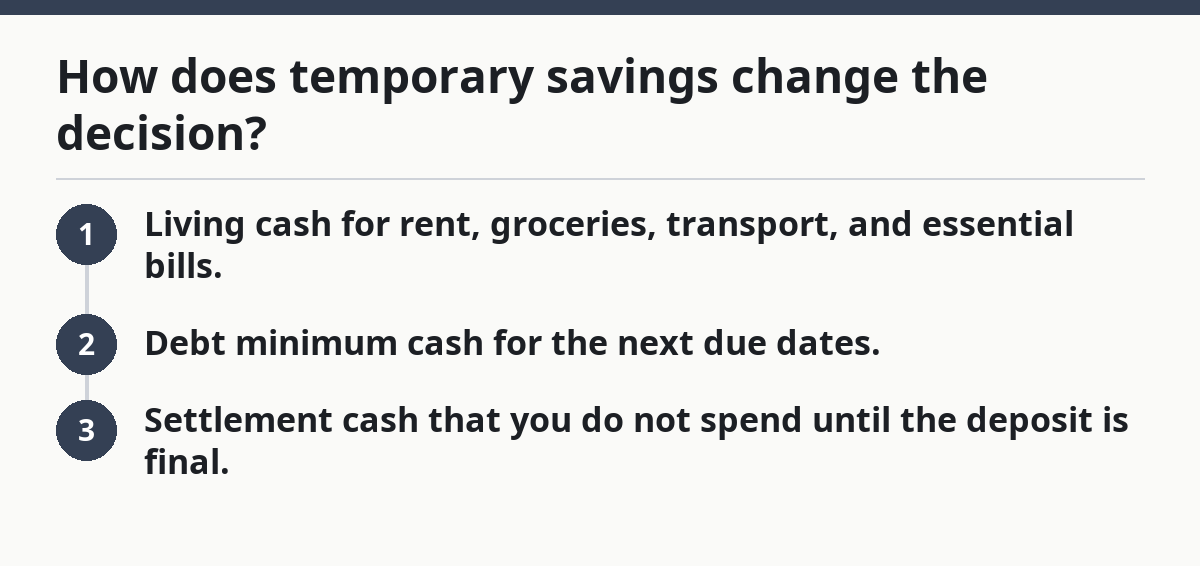
If those pots blur together, the method becomes guesswork. The cleaner the split, the easier it is to time the payoff without creating a shortfall.
Which payoff method fits this waiting period best?
Usually, the best fit is a temporary minimum-payment plan with a timed lump-sum payoff, not an aggressive payoff method based on current income. That keeps you current now and lets you act fast when the settlement payout lands.
If the payout is highly likely and close, you can aim the settlement at the highest-cost debt after minimums are covered. If the timeline is loose, keep the plan simple: minimums now, lump sum later. Debt snowball and debt avalanche both rely on regular extra payments; waiting for a settlement often means those extra payments should pause until the cash arrives.
That does not mean you are choosing forever. It means you are choosing a bridge strategy for a short, uncertain stretch. Once the money clears, you can reassess with a fuller picture and decide how to use any remaining balance.
What if the settlement comes in smaller than expected?
Fall back to minimums and re-rank the debts if the settlement is smaller than planned. A reduced payout changes the whole payoff order, especially if fees, liens, or deductions came out before the deposit reached you.
Picture this: you expected enough to clear one balance, but the final net amount is short by a few hundred dollars. That is not a reason to force the payoff and hope for the best. It is a sign to preserve cash, keep every account current, and decide whether a partial payoff still helps more than holding the funds.
If the payout is smaller, check three things in this order:
- Can every minimum payment still be made?
- Which debt has the nearest due date or harshest penalty?
- Does a partial payoff reduce enough interest to be worth using the cash?
If the answer to the first question is no, stop and protect liquidity first.
FAQs
Should I pause extra payments while waiting?
Yes, if pausing them is the only way to protect your minimum payments and living costs. A pending settlement payout is not money in hand, and a delay of even 2 weeks can matter. Keep the account current first, then use the settlement for the payoff once it actually clears.
How do I avoid late fees before the payout arrives?
Pay at least the minimum by each due date and contact the lender before a payment is missed. Ask whether a short payment deferral, temporary reduction, or due-date change is available, and get the terms in writing if you can. If the settlement date is uncertain, do not rely on a future lump sum to catch up.
Should I target one debt now or wait for the payout?
Wait if targeting one debt now would leave you short on another due date. A timed lump-sum payoff usually fits a pending settlement payout better than a partial attack today. If one debt has a much higher penalty risk, though, that debt may need attention first so you avoid fees or delinquency.
Drafted with AI; not yet reviewed by a person.