Last updated: November 20, 2026
Quick Answer: In most cases, the right method is the one that lets your servicer post the lump sum directly to principal, in writing, with no delay; if the rules are unclear, confirm them with the servicer and a qualified adviser before you pay. A one-time principal-only payment changes which debt payoff method makes the most sense, because the best match is the one that sends that lump sum to the loan balance with the least friction. Choose the method that your servicer will apply to principal without delay or misposting. The sections below settle how to check that, what method fits, and what can go wrong in how to choose a debt payoff method when you will make a one-time principal-only payment.
Key takeaways
- A principal-only payment is not the same as just paying more than the minimum.
- The right payoff method depends on how your servicer posts extra money, not on the math alone.
- Loans with high interest and daily interest charges usually benefit most from a clean principal reduction.
- A lump sum can miss the mark if it lands as an early monthly payment or as an unapplied balance.
- If the loan documents or servicer rules are unclear, get written instructions before you send the money.
This is information, not financial advice. Your own situation can depend on loan type, servicer policy, and local rules, so a qualified adviser is worth consulting for your case. For payment-posting rules, see the CFPB’s mortgage servicing guidance and your loan contract.
What a principal-only payment changes
A principal-only payment reduces the loan balance directly, which can lower future interest on loans that calculate interest from the current balance each day. That is the core advantage, and it is why the payment method matters more here than in a normal extra-payment plan.
Picture this: you have a loan statement, a due date, and one lump sum ready to send. You want the money to shrink the balance, not sit as advance credit or get split across fees and interest. That means the loan servicing rules matter as much as the amount when you choose how to choose a debt payoff method when you will make a one-time principal-only payment.
Here’s the catch: a lender can only apply money the way its system allows, and those rules differ by loan type and country. Some loans accept extra principal cleanly. Others need a phone call, a note, or a separate payment screen.
- Principal is the amount you borrowed, before interest.
- Loan balance is what you still owe right now.
- Servicer is the company that processes payments for the lender.
The method you choose should answer one question first: will the payment hit principal the same day it arrives, or will it be treated as the next monthly installment? If you are unsure, consult the servicer, review the loan agreement, and check the CFPB or your local consumer-protection guidance.
Which payoff method fits a one-time lump sum?
The best fit is often the payoff method that lets you direct the lump sum to principal without disturbing your normal payment schedule, but the exact fit depends on the loan terms and the servicer’s posting rules. For many borrowers, that means making the regular payment separately and then sending a dedicated extra-principal payment with clear instructions.
Picture this: you are comparing avalanche, snowball, and straight extra principal. Only one of those methods is really built around a one-time lump sum. A principal-only payment is not a full strategy by itself; it is a payment application rule.
- Debt avalanche means extra money goes to the highest-interest debt first.
- Debt snowball means extra money goes to the smallest balance first.
- Extra principal means any extra money goes straight to the balance, not future interest or the next bill.
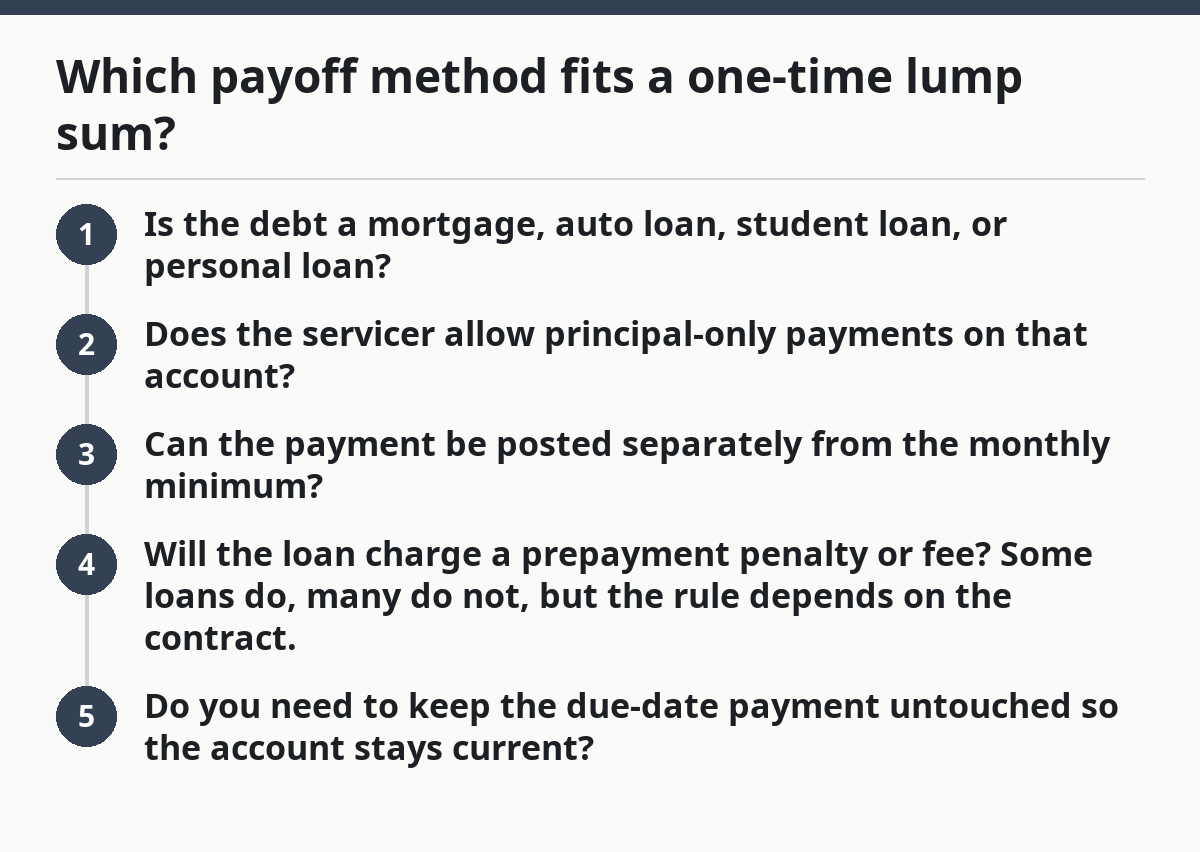
For a single lump sum, the practical choice usually comes down to these questions:
- Is the debt a mortgage, auto loan, student loan, or personal loan?
- Does the servicer allow principal-only payments on that account?
- Can the payment be posted separately from the monthly minimum?
- Will the loan charge a prepayment penalty or fee? Some loans do, many do not, but the rule depends on the contract.
- Do you need to keep the due-date payment untouched so the account stays current?
The best part is that you do not need a full payoff calendar to use a lump sum well. You need the payment to land in the right place, once.
How do I make sure a payment goes to principal?
A payment goes to principal when the servicer posts it that way, and the safest method is to give the servicer written instructions before you pay, while also checking the loan terms and seeking professional help if the process is unclear. That usually means checking the loan portal, the promissory note or mortgage note, and the payment allocation policy. See the CFPB for mortgage servicing and payment-allocation guidance, and consult a qualified adviser if your account has special rules.
Picture this: you are on a servicer website and the payment screen offers “monthly payment,” “extra payment,” and “principal only.” If the option exists, use it and keep a screenshot or confirmation number. If it does not, call the servicer and ask how to submit a principal-only payment.
- Read the account terms first. Look for payment allocation, prepayment, and escrow language in the note or loan agreement. Verify that extra payments are allowed and that no fee applies. If the terms are vague, stop and ask the servicer for written instructions.
- Make the regular payment separately. Pay the scheduled monthly amount in the normal way if the loan is still active. Verify the account shows the month covered. If the lump sum is mixed into the regular payment, the servicer may apply it to interest, fees, or the next due date instead.
- Use the principal-only channel if the servicer offers one. Choose the portal field, payment type, or checkbox meant for extra principal. Verify the label says principal, extra principal, or principal curtailment. If it says “advance payment” or “future payment,” that is a different thing.
- Add a clear memo or instruction. Use plain language such as “apply to principal only on account ending in 1234.” Verify the payment screen accepts notes or comments. If the system strips the note, call and ask for a manual note on the account.
- Ask for confirmation before the due date. Request written proof by secure message, email, or mailed letter, depending on the servicer’s process, and consult the servicer or a qualified adviser if you cannot get it. Verify the confirmation says the payment reduces principal balance. If it says “applied to next installment,” the instruction was not followed.
- Check the next statement line by line. Compare the beginning balance, principal reduction, and remaining balance. Verify the interest charge falls only in the way the statement math supports. If the balance did not drop by the amount you expected, contact the servicer right away.
- Keep records for the life of the loan. Save the receipt, screenshot, and statement in one folder for at least the time the loan remains open. Verify you can show what you requested if the account is later disputed. If records are missing, fixing a posting error gets harder.
On the flip side, do not assume “extra payment” means principal-only. In some systems, it does, in others it does not.
Which debts benefit most from extra principal?
Loans with interest calculated on a declining balance usually benefit most from a one-time principal-only payment, because every dollar removed from the balance stops future interest from accruing on that dollar. That effect is strongest when the loan has a long term or a relatively high rate.
Picture this: you have a mortgage, an auto loan, or a student loan, and the balance is still large enough that interest is a daily or monthly charge. A one-time principal payment can change the loan math right away, even if the payment is not large enough to erase the debt.
- Daily interest loans often show the clearest effect from principal reduction.
- Long-term loans give the extra principal more time to work.
- Amortizing loans use a payment schedule that front-loads interest, so principal reduction can matter more early in the term.
Some debts do not fit this logic as well. Credit cards are often better handled as revolving debt with minimum payments and high APRs, not as “principal-only” in the same sense as a term loan. The servicing rules may still allow extra payments, but the account structure is different.
A small but useful distinction: if the debt has an escrow account, taxes, or insurance attached, the principal-only part of the payment should not be confused with those other charges. The payment may need to be split in the servicer’s system.
When should you stop and ask for help?
You should stop and get qualified help when the loan contract, servicer process, or debt type makes the posting rules unclear. In money matters, a wrong posting can cost interest, trigger fees, or leave the account looking current when it is not.
Picture this: you are about to send a large payment and one detail is off — a payoff quote, a fee line, or the way the servicer handles allocation. That is the point to pause, not push through.
- The loan has a prepayment penalty: The payment may reduce principal but still cost you a fee — ask the servicer or a qualified adviser how the penalty works before you send it.
- The servicer cannot confirm principal-only posting in writing: The payment may be misapplied — do not rely on a phone promise alone.
- The account is in forbearance, deferment, or modification: The payment may be handled under special rules — check the current status first.
- The loan has escrow, fees, or past-due amounts: The money may go to those items before principal — ask for a payment breakdown.
- The debt is part of a settlement, bankruptcy, or legal dispute: The payment could affect rights or account status — get case-specific advice before paying.
- You need the loan closed by a certain date: The payoff amount can change with daily interest — ask for a written payoff quote with an expiration date.
The rule is simple: if the servicer cannot tell you exactly how the payment will post, do not treat the transaction like a normal extra payment.
The mistakes people make with one-time principal payments
The most common mistake is sending the lump sum without explicit principal-only instructions, which can leave the money posted as an advance payment or next month’s bill. That defeats the point, and it can delay the interest reduction you wanted.
Picture this: a borrower pays $2,000, sees the account marked “paid ahead,” and assumes the balance fell by $2,000. In some systems, it did not. The cash is there, but the balance is not lower in the way the borrower expected.
- Mixing the lump sum with the monthly payment. The servicer may apply it according to its default rules. Use a separate transaction if you want clear principal reduction.
- Skipping the written request. A verbal request can be missed. Put the instruction in the payment memo and follow with secure message or email if possible.
- Ignoring interest timing. If you pay after interest has already accrued for the period, the reduction may start later than you think. Check whether the loan uses daily interest.
- Forgetting about fees or past-due amounts. Those can absorb part of the payment first. Ask for the posting order before paying.
- Assuming every loan works the same way. Mortgage servicing, auto loans, and student loans can follow different rules. Read the account terms.
- Not checking the next statement. A wrong posting can sit unnoticed for months. Reconcile the statement right away.
The correct alternative is plain: verify the posting rule before you pay, then verify the statement after the payment posts.
What if the standard approach does not apply?
The standard approach changes when the loan is already in a special status or when the servicer’s system does not support a clean principal-only payment. In those cases, the best method may be a payoff quote, a manual posting request, or a separate payment to a different account component.
Picture this: you have a student loan in deferment, a mortgage with escrow, or an auto loan with a payoff letter that expires in 10 days. The lump sum still matters, but the path changes because the account rules are not ordinary.
- Deferred or paused loans: Payments may not reduce the balance the way you expect. Check whether the account is accruing interest and how the servicer posts voluntary payments.
- Mortgages with escrow: Principal-only money should not be confused with tax and insurance funds. Ask for the principal curtailment process.
- Loans near payoff: The best move may be to request a written payoff figure instead of a principal-only payment, because daily interest can change the exact amount owed.
- Loans with payment caps or restrictions: Some servicers limit extra principal or require a specific form. Follow that process exactly.
- Multiple debts with different terms: A lump sum that helps one loan may be less useful on another if the payment rules are messy. Compare posting rules, not just interest rates.
The truth is, the “best” method is the one the servicer can carry out correctly. If the system cannot do that, the math does not matter yet.
What should you check before the money leaves your account?
You should check the payment channel, the posting order, and the written confirmation before you send the money. Those three checks do more for you than chasing a generic payoff method name.
Picture this: you are ready to click submit. The amount is right, but the payment type is not. A five-minute pause can save a month of waiting for the balance to correct itself.
- Does the account allow principal-only or extra principal payments?
- Is there a separate box for notes, and does it keep your instructions?
- Will the regular monthly payment still be made on time?
- Does the servicer provide a payoff quote or receipt you can save?
- Are there fees, prepayment penalties, or special rules in the contract?
If the answer to any of these is unclear, stop and get the servicer to clarify in writing. That is not overcautious. It is basic payment control.
FAQ
How do I make sure a payment goes to principal?
A payment goes to principal when the servicer records it that way, so the safest move is to use the servicer’s principal-only payment option or written instructions. If the portal does not show that option, contact the servicer before you pay and ask for the exact posting method in writing. Save the confirmation and check the next statement.
Which debts benefit most from principal-only payments?
Loans with daily or amortized interest usually benefit most, because cutting the balance reduces future interest charges on that same balance. Mortgages, auto loans, and some student loans often fit that pattern, but the loan contract still controls how the payment is posted. If the debt has special fees or restrictions, the benefit can shrink.
Can any payoff method use a one-time principal payment?
Most payoff methods can include a one-time principal payment, but not every debt setup handles it the same way. The right answer depends on the loan terms, the servicer’s posting rules, and whether the account allows extra principal without changing the regular payment.
Drafted with AI; not yet reviewed by a person.