
Last updated: November 20, 2026
Debt payoff method selection for money behavior and execution — the complete guide — is about choosing the debt payoff method that matches your follow-through, not your math alone. If a small early win keeps you paying for 12 months straight, the snowball method can beat a stricter plan that you abandon after 2 months. If you can stick with a plan that attacks the highest APR first, the avalanche method usually saves more interest.
This is information, not financial advice. Debt laws, interest rules, minimum payments, and tax treatment differ by country and can change often, so a qualified adviser should be consulted for your own situation. For official consumer guidance, see the Consumer Financial Protection Bureau and MoneyHelper.
Key takeaways
- Pick the method that fits your money habits first, because a plan you quit has no payoff value.
- Snowball rewards momentum by clearing the smallest balance first, even when the APR is not the highest.
- Avalanche attacks the highest-interest balance first, which is the cleaner math choice when payments stay on track.
- A simple table can help: if motivation breaks easily, lean snowball; if discipline is steady, lean avalanche.
- Revisit the plan if a minimum payment jumps, a balance goes to 0%, or a new debt appears.
- If you want a step-by-step checklist, our debt payoff checklist can help you organize balances, APRs, and minimums in one place.
What debt payoff method should you choose?

Choose the method that you are most likely to keep using for months, not the one that sounds smartest in a spreadsheet. That is the whole decision.
The two most common payoff systems are debt snowball and debt avalanche. Snowball targets the smallest balance first while making minimum payments on everything else, and avalanche targets the highest APR first. Both use the same core rule: keep every account current, pay at least the minimum on each debt, and send extra money to one chosen target.
This choice is less about theory than execution. A plan that matches your behavior can prevent missed payments, random extra spending, and “I’ll start again next month” drift. In plain terms, the right method is the one that makes the next payment easier to make.
A useful clue is your past 3 to 6 months of behavior. If you need visible wins, fast progress on one balance may matter more than pure interest savings. If you like strict rules and can ignore short-term emotion, the interest-first route usually makes more sense.
What is the difference between snowball and avalanche?
The difference is simple: snowball pays balances in size order, and avalanche pays them in APR order. That one choice changes both the emotional feel and the amount of interest you are likely to pay.
With snowball, the smallest balance gets every extra dollar after minimums are covered. When that balance is gone, its payment rolls into the next smallest one, so the monthly attack amount grows like a snowball rolling downhill. This method gives earlier account closures, which can matter more than the exact interest math to someone who needs visible progress.
With avalanche, the highest-interest balance gets the extra money first. That means a credit card at 24% APR gets attacked before one at 18% APR, even if the 18% balance is smaller. The math is usually more efficient because high-interest debt has less time to compound, but the first payoff can take longer to arrive.
A reader who wants a quick rule can use this: if seeing one balance disappear in the first few months keeps the plan alive, snowball is the better behavior tool. If the budget already runs on rails and the goal is to reduce total interest cost, avalanche is the cleaner execution tool.
The most common mistake is treating the method as a moral choice. It is not about discipline versus laziness. It is about which setup produces steady payments for 6, 12, or 24 months without drama. For more on debt collection and account handling, the FTC debt guidance is a useful reference.
Which method fits money behavior better?

Snowball fits unstable money behavior better, and avalanche fits steadier execution better. That is the blunt answer.
Snowball works well when the problem is not math but follow-through. People who get discouraged by slow progress, who need a visible finish line, or who have a hard time staying focused on a plan with no quick wins often do better when the smallest debt disappears first. The emotional reward arrives sooner, and that can keep the monthly payment habit alive.
Snowball is weaker for people who can stay consistent without needing frequent wins. Its main drawback is opportunity cost: a lower-balance debt can have a lower APR, which means higher-interest debt keeps accruing longer than necessary. If the debt list includes one card at 28% APR and another at 12% APR, snowball may feel nicer while costing more in interest than necessary.
Avalanche fits people who can treat the budget like a rulebook, but it is still worth checking the numbers with a qualified professional if rates, taxes, or account terms are unusual. If extra payments happen on time every month, if the household cash flow is stable, and if the reader does not need a motivational pop every 30 days, avalanche is usually the more efficient structure. The drawback is psychological: the first balance to disappear may be far away, and that can make the plan feel slow even when it is working.
A simple self-check helps. If a plan that is 5% less emotionally satisfying is likely to get abandoned, choose snowball. If the reader can keep going for 12 months without needing a visible win, choose avalanche.
The honest side-by-side
Snowball wins on motivation, while avalanche wins on interest efficiency. The real choice is whether motivation or math is the bigger risk.
| Criteria | Debt snowball | Debt avalanche | Winner for [condition] |
|---|---|---|---|
| Payoff order | Smallest balance first | Highest APR first | Snowball for people who need early wins |
| Main strength | Builds momentum from quick closures | Reduces interest cost more effectively | Avalanche for steady executors |
| Main weakness | Can leave high-APR debt untouched longer | First payoff can take longer | Snowball if discouragement is the bigger risk |
| Best emotional fit | People who need visible progress | People who can wait for long-term payoff | Snowball for motivation-heavy users |
| Best math fit | Simpler to stick with when behavior matters most | Stronger on pure cost control | Avalanche for number-driven users |
| Risk if abandoned | Medium, because a small win may keep things moving | High, because slow early progress can kill follow-through | Snowball if dropout risk is high |
| Minimum payment rule | Pay all minimums, extra to smallest balance | Pay all minimums, extra to highest APR | Tie, if minimums are the same |
| Good when balances are close | Can feel satisfying even if APRs differ | Usually still better if APR gap is large | Avalanche if APR gap matters |
| Good when balances are very different | Often creates a fast first victory | May delay the first finished account | Snowball for confidence building |
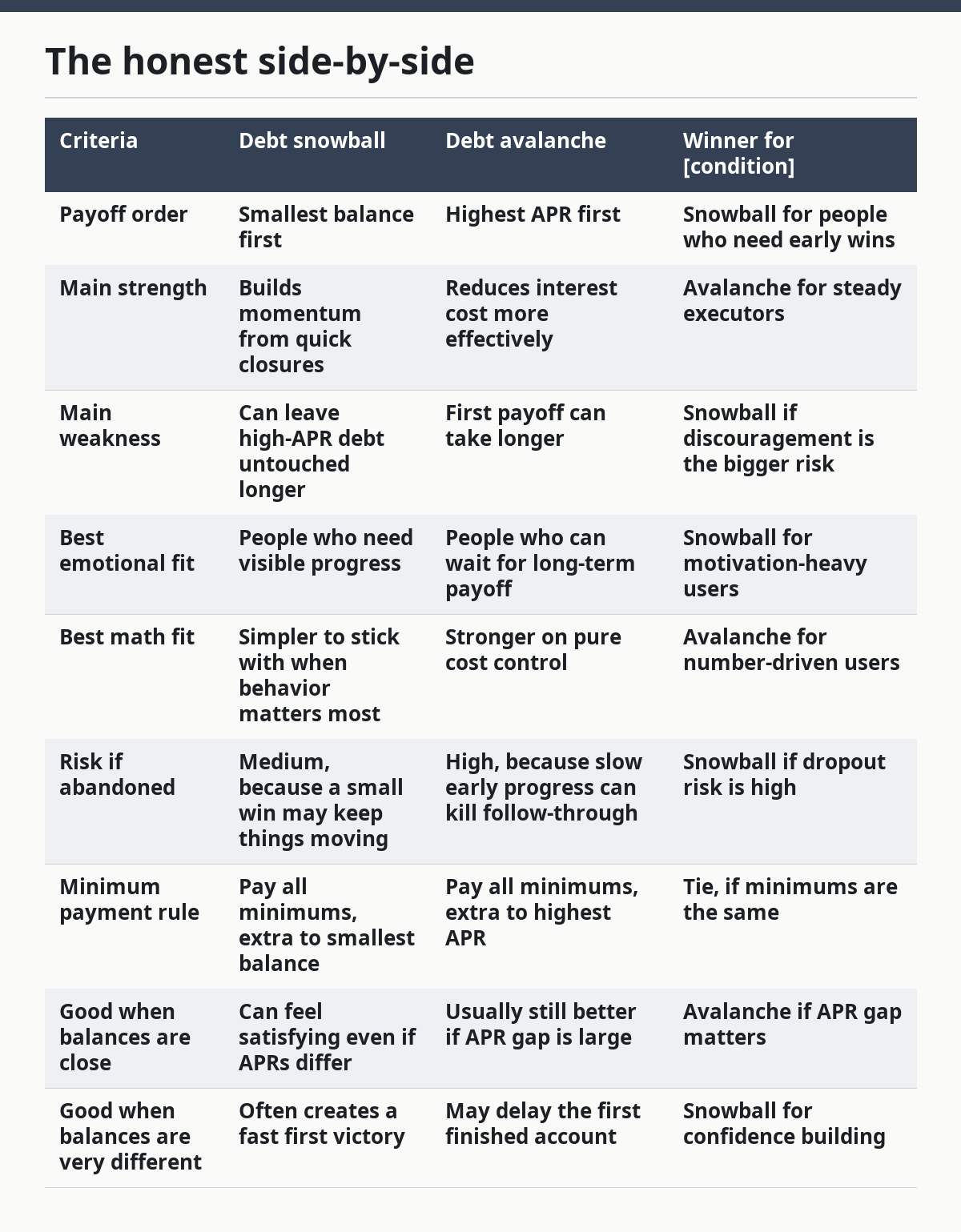
The table makes the trade-off plain. Snowball is a behavior method first, and avalanche is a cost method first. If the reader’s real problem is inconsistency, a method with slightly weaker math but stronger follow-through can be the smarter execution choice.
When does the snowball method make more sense?
Snowball makes more sense when behavior is the main risk and the debt list has several small balances. That is the case for many people who need a plan that feels alive in the first 1 to 3 months.
The biggest strength of snowball is visible progress. When a small account is wiped out, one payment disappears from the monthly list, and that free cash can be redirected to the next target. That creates a clear chain of wins, which helps when the reader has tried and quit before. For someone whose budget already feels tight, that first closed account can be the difference between “I’m doing this” and “I guess I’ll try another plan later.”
Snowball also works well when the reader gets overwhelmed by too many accounts. A list of 5 or 6 debts can feel messy, and the smallest-balance-first rule removes one decision point: pay the minimums, then attack the smallest balance until it is gone. The simplicity helps execution, especially for people who do not want to recalculate every month.
A concrete example makes the behavior benefit easier to see. Suppose someone has three debts: $600 at 19% APR, $2,400 at 23% APR, and $7,500 at 11% APR. Snowball starts with the $600 balance, so the first win may arrive quickly. Once that payment disappears, the freed-up amount rolls into the next target, which can make the plan feel faster even before the overall debt load has changed much.
The drawback is real. Snowball can leave the highest APR balance hanging around longer, which means interest keeps piling up on the wrong account. If the debt stack includes one card at a much higher APR than the others, snowball may cost more than needed. It is not the best choice for someone who has strong discipline and a clear dislike of paying extra interest.
Snowball is not the right fit for someone who wants maximum financial efficiency and can stay steady without emotional reinforcement. It is also weaker when the debt list has one especially expensive balance that should not be left alone for long.
If the reader wants to compare this with other structured payoff approaches, our debt snowball guide and credit card payoff guide cover the mechanics in more detail.
When does the avalanche method make more sense?
Avalanche makes more sense when the reader can keep a strict payment routine and wants the cleaner mathematical route. That is especially true when the debt list includes one or two high-APR balances that are clearly more expensive than the rest.
The main advantage is simple: high-interest debt gets attacked first, so less interest has time to build. Over months of consistent payments, that can improve the overall cost of the payoff plan. A reader who already has enough motivation to keep paying for 12 months or longer may not need the extra emotional boost snowball offers.
Avalanche also works well for people who dislike inefficient systems. If a reader prefers to know that every extra dollar is going to the most expensive account, avalanche gives that certainty. It reduces second-guessing because the rule is based on APR, not balance size.
That certainty can matter in real budgets. If a household has one debt at 7% and another at 24%, the interest-first method directs attention where the cost of delay is highest. If the budget can handle a slower first payoff, the long-run result is often easier to justify.
The weakness is motivation. A high-interest balance may also be a large balance, which means the first payoff can feel far away. If that delay causes the plan to stall, the better math choice becomes a bad execution choice. A method that looks ideal on paper but fails in month 4 is not ideal in real life.
Avalanche is not always the best choice for someone who needs frequent psychological wins. It is also not always the best choice if the reader tends to stop tracking after the first sign of slow progress. The method assumes the budget is already stable enough to support patience.
A sensible next step is to review the full debt list, not just the biggest number. Our APR comparison worksheet can make that easier.
What changes the decision in real life?
Three things can flip the choice: behavior, balance structure, and cash flow shocks. If any of those shift, the “best” method can change too.
First, behavior can override the math. If the reader has quit prior payoff plans after 60 days, snowball may be the better first attempt even if avalanche looks superior on paper. The reason is practical: a slightly less efficient method that gets finished beats a more efficient method that dies early.
Second, balance structure matters. If one debt is both small and high-interest, the two methods point in the same direction and the decision gets easy. If the smallest debt has a low APR and the largest debt has a high APR, the methods split. That is when the real trade-off appears, and the reader has to choose between motivation and cost.
Third, cash flow shocks can change the plan. A job change, a medical bill, or a minimum payment increase can make the current target harder to keep paying. In that case, the plan may need to be paused or rearranged so the budget stays current. The method should serve the budget, not the other way around.
A fourth exception is a temporary zero-interest or promotional-rate balance, where the rate can change later. In that case, the timing of the rate change matters more than the name of the method. The reader should check the terms carefully and, if needed, ask a qualified adviser about the impact before making a move.
Because of that, the plan should not be treated as permanent. A yearly review, or a review whenever a rate changes, keeps the payoff method aligned with the real accounts instead of last month’s assumptions.
How should the plan be set up so it actually works?
The plan should be set up so the monthly payment happens first and the extra money goes to one target second. That order matters more than the exact label of the method.
Start with every minimum payment. Missing a minimum can create fees, hurt a credit history, or trigger collection activity depending on the account type and local rules, so the safest approach is to protect due dates before chasing the extra payoff. After the minimums are covered, every extra dollar should go to the chosen target only. Splitting extra money across several debts weakens the method and slows the payoff.
A simple setup can help execution: list each debt, its balance, its APR, and its minimum payment. Then sort the list by either smallest balance or highest APR, depending on the chosen method. That one page of notes is often more useful than a 20-tab spreadsheet.
It also helps to create a rule for new debt before it appears. If a new balance shows up, decide in advance whether it gets folded into the current order or handled separately. Without that rule, the payoff plan can turn into constant re-deciding, which burns energy fast.
The most useful habit is automation where possible. Automatic minimum payments reduce the risk of a missed due date, and manual extra payments can still go to the chosen target. The point is not perfection; the point is making the method hard to abandon on a busy month.
How do you decide if the math gap is actually worth it?
The math gap matters most when the APR difference is large and the payoff horizon is long. If the rates are close, the behavior difference can matter more than the interest difference. If the rates are far apart, avalanche usually becomes harder to beat.
A simple way to think about it is this: the more expensive the debt, the more costly each month of delay becomes. That is why high-APR balances matter so much in avalanche. A card at 29% APR and another at 14% APR are not interchangeable just because the balances are similar.
But the reverse is also true. If the smallest balance is tiny and could be wiped out in a few weeks, the motivation benefit can be large relative to the interest saved by going strictly in APR order. In that situation, the behavioral payoff may outweigh the small efficiency loss.
An example helps. Imagine two debts: one is $500 at 20% APR, and the other is $4,000 at 22% APR. The math gap is modest, so a reader who needs motivation might reasonably choose snowball if the $500 win keeps the plan alive. If the higher rate were 35% instead of 22%, the cost of delaying that balance would be much more significant, and avalanche would deserve more weight.
This is why the decision is not just about “best” in the abstract. It is about the size of the APR gap, the size of the balances, and the reader’s odds of following through.
What if the plan feels too hard to start?
If the plan feels too hard to start, the issue is usually not the method name. It is the size of the first action.
The first action should be small enough to happen today. That may mean listing the debts, checking APRs, or setting up minimum payments before deciding the extra-payment target. Starting with a clean list is often enough to reduce the mental friction that keeps people stuck.
If the reader is still unsure, snowball can be a lower-friction starting point because it creates the earliest visible win. That early win can create evidence that the process is working, which is useful when confidence is low. If the reader already feels calm and organized, avalanche may be the better starting method because it aligns with a more consistent routine.
In either case, the system should be simple enough to repeat. If the payoff plan requires daily recalculation or constant judgment calls, it is probably too complicated to survive a busy month. A plan that is easy to explain is usually easier to keep.
The verdict: which one should you choose?
Choose snowball if you need early wins to stay engaged and you have already struggled to keep a payoff plan alive for more than a few months. Choose avalanche if you can keep paying consistently and want the method that usually reduces interest cost more efficiently. Neither if you cannot make the minimum payments now, because the plan needs a stable budget before any payoff order will work.
That is the decision in plain terms. Snowball is for behavior that needs reinforcement. Avalanche is for execution that can handle delayed payoff results.
For a deeper comparison with consolidation and refinancing options, our debt refinance guide explains when a different strategy may be more suitable.
FAQ
Is snowball always worse than avalanche?
No. Snowball is not worse if the reader needs quick progress to stay committed. A method that keeps someone paying for 12 months can beat a more efficient method that gets dropped after 2 months.
Does avalanche always save more money?
No. Avalanche usually helps with interest cost when the plan is followed, but “usually” is not “always.” If the reader stops after a few payments, the theoretical savings never get realized.
What if the smallest debt has the highest APR?
Then both methods point to the same account, and the decision becomes easy. Pay the minimums on everything else and target that debt first.
Can the method change later?
Yes. A plan can be switched if the budget changes or the original choice stops working. If a new balance, a rate change, or a cash flow shock appears, the payoff order should be reviewed.
What if the debt list feels too messy to sort?
Start with the minimum payment on every account, then write down balance and APR for each one on a single page. A clear list is enough to choose a payoff order, and it is often better than trying to remember everything from memory.
Drafted with AI; not yet reviewed by a person.