
Last updated: November 19, 2026
Key Takeaways
- Use a two-phase budget: one for now, one for after the raise.
- Choose the method you can start now, then speed up later.
- Don’t count the raise as available until it actually hits.
- If future income is uncertain or delayed, use a cautious plan and get professional advice.
A future income change can make the right debt payoff method look different, but you should not wait passively for the raise to arrive. How to choose a debt payoff method when you expect a pay raise starts with your current cash flow, then a step-up plan when the higher pay actually hits your account. This is information, not financial advice; a qualified adviser can help with your own situation.
Who this applies to, and what you need first

This applies to someone who expects a pay raise, bonus, or other windfall within the next few pay cycles or months and wants to know whether to start now or wait. It assumes you already know your debt balances, minimum payments, due dates, take-home pay, and the month your income is likely to change. It also assumes your job is stable enough that the raise is realistic, not just hoped for. For a broader consumer-credit overview, see the CFPB’s guidance on budgeting and debt at https://www.consumerfinance.gov/consumer-tools/debt-collection/ and the FTC’s debt help pages at https://consumer.ftc.gov/debt.
The key question is not “Which debt payoff method is best in general?” It is “Which method still makes sense if my income rises soon?” That future income change matters because it changes how much room you have for extra principal payments, but it does not erase interest, due dates, or cash-flow pressure today.
This guide is for a person who can cover essentials and minimums without scrambling every month. If you cannot reliably cover basic bills, or if your debt has already triggered collection action, court action, or constant missed payments, a standard payoff method may be the wrong starting point. In those situations, a qualified credit counsellor, financial planner, or attorney may be the better first call, depending on the debt type and country.
To keep the decision concrete, think in terms of a temporary budget, step-up payments, and payment acceleration. A step-up payment is a planned increase in your monthly debt payment once your raise arrives. Payment acceleration means sending extra money to principal faster than the required minimum, without creating a new cash-flow crisis.
If you want the broader framework behind method selection, the hub page on debt payoff methods and strategy selection can sit alongside this guide. The question here is narrower: how a known or likely raise changes the order of operations.
How do I plan debt payoff around future income?
You plan it by making a two-phase budget: one budget for now, and one for the month after the raise lands. Start with today’s income, because the bill cycle you are living in now is the one that can break your plan. Then decide how much of the future increase is already committed to rent, insurance, taxes, retirement contributions, child care, or other fixed costs. What remains is the amount that can safely be redirected to debt.
Use this order:
- List every debt, minimum payment, and due date. Write each balance and required payment on one page or spreadsheet, then sort by due date and interest rate. Verify that every account is current. If you are missing a statement or do not know the exact minimum, stop and get the current figure before choosing a method; guessing will distort the plan.
- Build a 1-month temporary budget from current income. Cover housing, food, transport, insurance, and minimum debt payments first, then see what is left. Verify that the result is nonnegative at the end of the month. If the budget goes negative, a future raise does not fix the current gap, and the plan needs a tighter spending cut or outside help.
- Estimate the raise conservatively. Use the after-tax amount if you know it, or a cautious estimate if you do not. Do not base the plan on gross pay alone, because withholding and benefit deductions change the amount that actually reaches your account. If you cannot estimate the take-home change within about 10% to 15%, do not hard-code the raise into the plan yet.
- Decide how much of the raise is already spoken for. Mark any increase in rent, commute costs, premiums, tax withholding, or retirement contributions. Verify the leftover amount before assigning it to debt. If the “extra” is already fully absorbed, your payoff method should not depend on it.
- Choose a base method that works before the raise. This is usually the method that fits your current cash flow and your tolerance for complexity. If you prefer quick wins and need motivation, a smaller-balance-first approach can feel easier to sustain. If interest cost matters more and you can stay disciplined, a higher-rate-first approach may fit better. If consolidation is being considered, separate that decision from the timing issue; this page is about using future income, not about comparing payoff methods against consolidation.
- Create a step-up rule in writing. Example: “Starting with the first full pay period after the raise, increase my debt payment by the net amount of the raise minus 20% reserved for irregular costs.” Put the trigger on a calendar date or pay period, not in vague language like “when I can.” If the rule is too loose, the money tends to disappear into ordinary spending.
- Assign the extra payment to one target debt. Keep paying minimums on every other debt, then direct the added amount to one account at a time. Verify that the extra payment is credited to principal, not held for a future due date. If the lender is applying it oddly, ask for principal-only application or check the payment instructions.
- Recheck the plan after the first raise paycheck. Compare the actual deposit with the estimate and adjust the step-up amount within one pay cycle. If the raise is smaller than expected, scale the extra payment down immediately rather than borrowing from groceries or rent to keep the original plan alive.
The point of this structure is simple: the payoff method should fit your present budget first and your future income second. A method that only works once the raise arrives is not a method; it is a guess.
Which payoff method makes sense if the raise is coming soon?

The best fit is often the method you can start now without stress, then speed up with the raise later. The future raise should change the pace of repayment more than it changes the basic strategy.
If your extra money will be modest, a method that is easy to stick with may beat a more elegant one that you abandon in month two. If the raise is large enough to cover one or more debts quickly, a method that lets you funnel the new cash flow into a single account can create visible progress. That is why timing matters: the right method is the one that survives the gap between “today” and “after the raise.”
One useful filter is to ask whether the raise changes your problem from “I need structure” to “I need acceleration.” If the answer is yes, then a method with a built-in step-up payment is often a better fit than a method that assumes your monthly payment stays flat. In practice, that means you pick a method you can maintain now, then increase the monthly payment as soon as the higher income is stable.
The trade-off is discipline. A future raise can make you overconfident, which leads to a plan that counts on money that is not yet in hand. It can also tempt you to delay action until the raise arrives. Both choices are risky. Interest keeps accruing, and a one- or two-month delay can cost you more than the convenience of waiting.
A disciplined middle path is usually better: start the plan now, build a temporary budget that works on current income, and pre-decide the exact way the raise will change your payment. That keeps the method from becoming a moving target. For related guidance, the CFPB’s budgeting tools and debt pages can help you pressure-test the numbers before you commit: https://www.consumerfinance.gov/consumer-tools/budgeting/ and https://www.consumerfinance.gov/consumer-tools/debt-collection/.
For a broader overview of method selection, the debt payoff methods and strategy selection hub can help you compare the larger framework, but the timing rule here stays the same: current cash flow first, future income second.
What mistakes do people make with a future pay raise?
The most common mistake is treating the raise as if it were already in the bank. That can lead to overspending for two or three months, then scrambling when the actual paycheck is smaller after taxes or deductions. The fix is to use the current budget until the raise is deposited and verified. If you are unsure how your paycheck will change, a payroll or financial professional can help you check the net amount before you commit.
A second mistake is increasing every spending category at once after the raise. That drains the very money meant for debt payoff. A temporary budget works only if the extra income gets assigned before lifestyle creep claims it.
A third mistake is picking a payment target without checking the account rules. Some creditors apply extra payments in ways that do not match the borrower’s intent unless instructions are clear. If the added money is not reducing principal the way you expect, the plan will look busy but progress will be slower than it should be.
A fourth mistake is choosing a payoff method that is too rigid for a raise that arrives in steps. A bonus paid once a year is not the same as a permanent salary increase. A bonus can support a one-time lump-sum principal payment, while a raise may justify a lasting step-up payment. Mixing those up can create a plan that is either too aggressive or too timid.
A fifth mistake is waiting for the “perfect” method instead of starting with the one that fits today. Delay has a cost. Even if the future raise will let you accelerate faster, starting now keeps the account balances from growing unchecked and gives you a baseline to measure progress against.
The correction is practical: write the plan, set the date, and protect the extra payment from ordinary spending.
When should I not use the standard approach?
The standard approach should not be used unchanged if the future income change is uncertain, delayed, or tied to a job situation that could reverse. In that case, build the plan around your current income and treat the raise as a bonus until it is real. If you are not sure how much extra income is dependable, a qualified financial professional can help you set a safer payment target.
The raise is not approved in writing: The income increase is still a possibility, not a fact — Do not build a debt plan around it yet; use current income only.
The raise depends on commission, overtime, or performance metrics: The amount may vary month to month — Base the plan on the lowest dependable amount and treat any extra as irregular income. For workers whose pay changes with hours or sales, check a payroll source or financial adviser before raising fixed payments.
The raise arrives after a large expense month: Tuition, insurance, moving costs, or seasonal bills may absorb it — Keep a larger cash buffer before increasing debt payments.
A bonus is one-time, not recurring: It can help with a lump-sum payment but not a permanent monthly commitment — Use it for a defined principal reduction or emergency cushion, not as the basis for a new fixed payment unless the bonus pattern is reliable.
Your current budget is already breaking: Minimum payments, essentials, and ordinary expenses do not fit — The problem is cash-flow instability, not method choice; seek qualified help and address the shortfall first.
Your debt has penalties, default notices, or legal action attached: The stakes are no longer just about optimization — Get professional advice specific to your debt type before deciding how to accelerate payments.
A standard payoff plan assumes you can execute a plan across several months without constant reversals. If that assumption is false, the method can become a source of pressure instead of progress.
The mistakes people make when they expect more money
The first mistake is assuming any future income change should push the debt plan into fast-forward immediately. That can make a borrower choose an aggressive payment pace that leaves no room for surprises. A better approach is to keep one month of breathing room in the temporary budget, even if that means the first step-up is smaller than expected.
The second mistake is ignoring timing. A pay raise that starts on the 15th does not help a payment due on the 5th. If the due dates fall before the increase, you still need enough current cash to cover them. The fix is to map the raise against the calendar, not just the monthly total.
The third mistake is using a windfall and a raise the same way. A windfall is usually one-time money; a raise is ongoing income. A one-time windfall can reduce a balance immediately, while a raise usually works best as a permanent increase to the monthly payment. If you confuse the two, you can commit recurring money to a debt plan that only had one-time support.
The fourth mistake is failing to check whether the extra money is already earmarked for taxes or benefits. That is especially common with salary changes that affect withholding or retirement contributions. The result is a plan built on gross pay instead of spendable pay, which is the wrong base for debt acceleration.
The fifth mistake is changing methods every time the numbers shift. Method-hopping can feel active, but it often slows progress because the plan never settles long enough to work. Once the numbers change, review the plan after the raise has actually shown up for at least one full pay cycle.
The correction is not cleverness. It is timing, restraint, and a written rule for what happens when the higher income becomes real.
How do I know the plan is working after the raise?
The plan is working if the extra payment is hitting principal on schedule, your minimums stay current, and your monthly budget still closes without borrowing from next month. That is the standard to watch after the first one or two pay cycles.
Check three things within about 30 days of the raise:
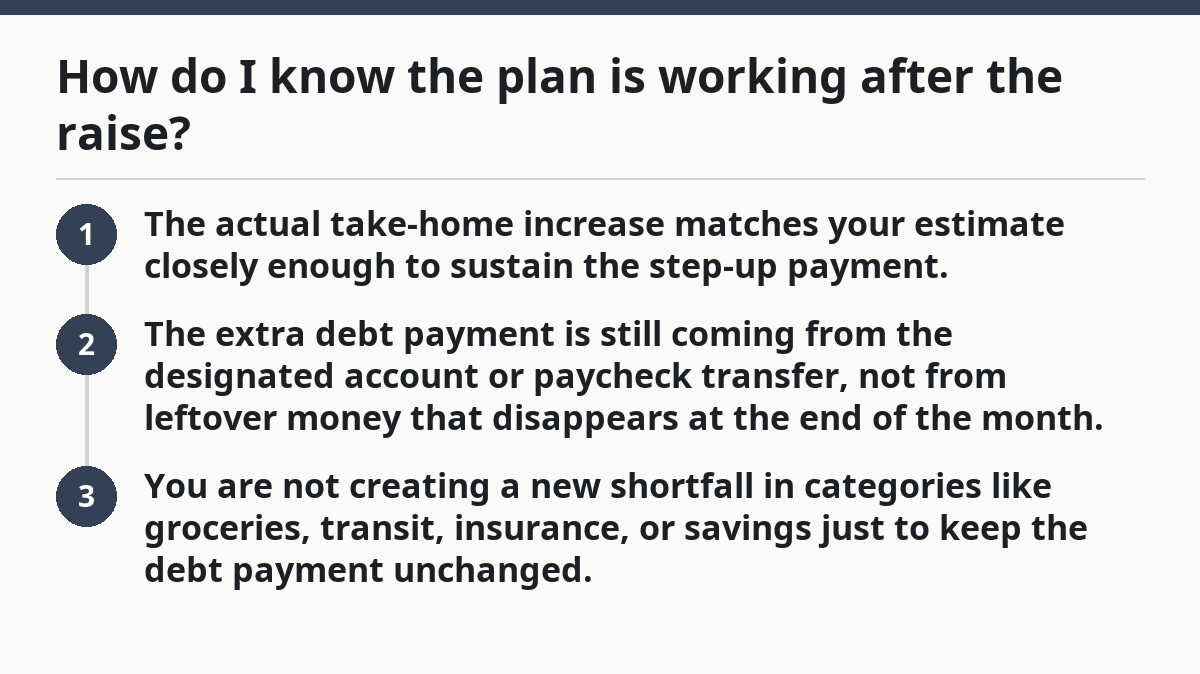
- The actual take-home increase matches your estimate closely enough to sustain the step-up payment.
- The extra debt payment is still coming from the designated account or paycheck transfer, not from leftover money that disappears at the end of the month.
- You are not creating a new shortfall in categories like groceries, transit, insurance, or savings just to keep the debt payment unchanged.
If any of those fail, the problem is not that you chose the wrong headline method. It usually means the step-up amount is too high, the budget is too tight, or the raise was overestimated. Adjust the payment, not just the attitude.
A good result looks boring: the payment increase happens automatically, the balance declines faster than it did before, and the temporary budget still has a small cushion. If the plan only works in a month with perfect timing, it is not yet stable.
What if the raise arrives in pieces, not all at once?
Then the payoff plan should rise in stages, not all at once. A staged increase is often more realistic when a raise is spread across several pay periods, tied to probation completion, or followed by a delayed bonus.
Use a simple rule: increase the debt payment by the amount of the confirmed net increase each time the higher amount appears, but do not lock in a permanent payment level until the full change is verified. If the raise comes in three pieces, each piece can fund part of the step-up. If the final amount is still uncertain, keep the base payment tied to current income and review the plan after each pay cycle.
That keeps the plan from getting ahead of the actual paycheck. It also prevents the common problem of raising fixed bills before the new income is steady enough to support them.
Drafted with AI; not yet reviewed by a person.