
Last updated: November 19, 2026
Quick answer: if your debts are all the same rate, choose the debt payoff method you can follow every month for 6 months or 12 months without missing minimum payments. The best debt payoff method is the one you can keep using.
If your debts all have the same APR, the interest rate no longer decides the order. In how to choose a debt payoff method when your debts are all the same rate, the payoff method is the one you can follow every month without missing minimum payments or losing track of the debt balance and payment order.
Key takeaways
- When APR is tied, the real choice is about structure, not interest savings.
- Smallest balance first can help you see progress faster, but it may not feel best if the difference between balances is tiny.
- Due date order is useful when you want a simple schedule that fits your calendar.
- The method that works is the one that keeps every minimum payment current and leaves one clear rule for extra payments.
- This is general information, not financial advice. A qualified adviser should review your own situation before you change a payoff plan.
Who this is for

This applies if your debts have the same APR, or close enough that the rate does not help you choose a winner. It assumes you already know each debt’s balance, minimum payment, due date, and whether the APR is fixed or variable. If one debt has a promo rate that ends soon, or one account has fees or penalty terms, the rate tie may not really be a tie.
This is information, not financial advice, and a qualified adviser should be consulted for your own situation. That matters because country rules, lender terms, and tax treatment can differ, and even a small change in APR math can change the best order. The practical question here is not “Which method is smartest in theory?” It is “Which payment order can I follow for 6 months, 12 months, or longer without mistakes?” For background on the broader framework, the hub page on debt payoff method fit by debt portfolio structure is the right place to start.
How do you choose when the APR is tied?
You choose the method by matching it to your main goal: speed of payoff, clear progress, or simple scheduling. When rates are equal, the tie-breaker is usually a rule you can repeat every month, such as smallest balance first or due date first.
Use the choice below as a practical sorting tool, not as a universal rule.
| Tiebreaker | What it does | Best when | Main drawback |
|---|---|---|---|
| Smallest balance first | Pays the lowest debt balance first after minimum payments | You want visible wins early | Bigger balances may stay on the list longer |
| Due date first | Pays the soonest due account first after minimum payments | You want a calendar-based system | The order may ignore balance size |
| Fixed payment order | Keeps the same list order every month | You want the least decision-making | It can feel arbitrary if the list never changes |
| Hybrid rule | Uses one rule until a trigger, then switches | You have mixed debt sizes and dates | You must define the trigger in advance |
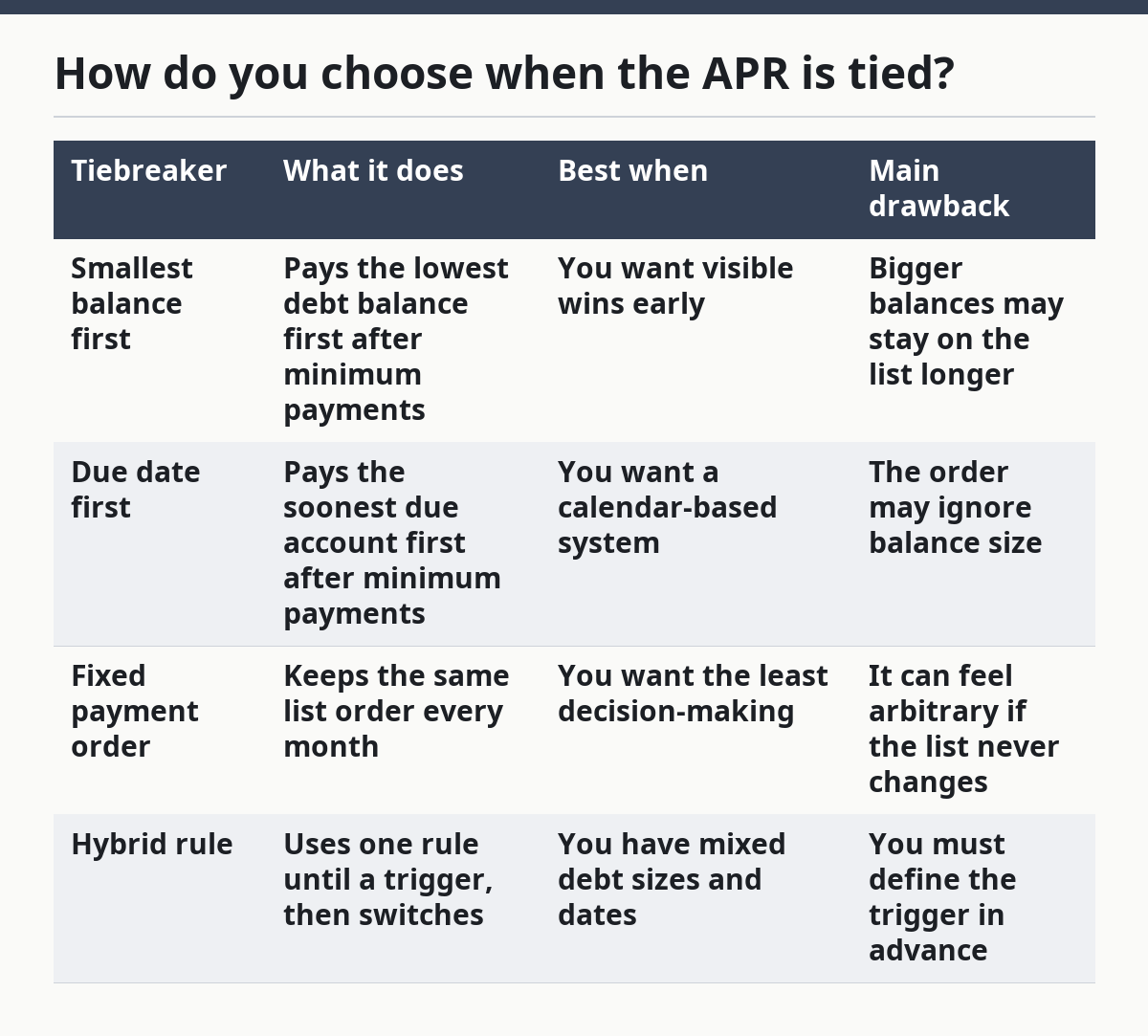
The right answer is the one that prevents missed minimum payments and reduces the chance you will abandon the plan. A payoff method that looks elegant but is hard to run is the wrong method for a real household budget.
Use one rule for extra payments

Use one rule for extra payments and apply it to every debt after minimum payment is covered. The rule can be smallest balance first, due date first, or any fixed payment order, but it must be written down before the month starts.
Start by listing each account’s minimum payment, due date, and current debt balance in one place. Then choose the order for any extra dollars you have beyond the minimums. If you pay extra to the wrong account one month and a different one the next month, the plan gets messy fast and you lose the benefit of having a rule.
A simple test: if you can explain your order in one sentence, it is probably usable. If you need a new judgment call every time you sit down to pay bills, the method is too loose. The problem is not the math; it is the friction. A good payment order should survive a busy Tuesday and a low-energy Friday.
Should you use smallest balance first?
Smallest balance first is the cleanest tiebreaker for many people with same-rate debts. It gives you a quick closed-account feeling, which can help when motivation matters more than tiny differences in the debt balance.
This method works best when the balances differ enough that closing one account is realistic within a short stretch, such as a few months, rather than years. If the balances are nearly the same, the emotional payoff may be weaker because the “win” takes longer to show up. In that case, due date order or a fixed payment order may feel simpler.
The downside is that smallest balance first can delay larger debts even though the rates are equal. That does not change the APR cost, but it can make the middle of the plan feel long. If you are someone who needs visible checkpoints, this is a strong tiebreaker. If you dislike the feeling of leaving a larger balance untouched, it may not fit you.
Can due dates decide the order?
Due dates can decide the order when your main goal is to keep the schedule clean and avoid missed minimum payments. This is especially useful if several debts have the same APR and the same general payment size, but different billing cycles.
A due-date rule works like this: pay the current minimums on everything, then send any extra money to the next debt that comes due soonest. That keeps the calendar, cash flow, and payment order lined up. It can be easier to remember than balance-based sorting because the next task is visible on the bill itself.
The trade-off is that due date order does not care which balance is smallest. A large debt with an early due date can jump ahead of a small one, even if that feels less satisfying. Use this method when your problem is organization, not motivation. If your cash flow is uneven, due-date prioritization can also help you keep enough room for bills that land before payday.
What to check before you start
Check the details before you set the order, because a same-rate plan only works if the numbers are actually comparable. Confirm the APR on each account, the minimum payment, the current debt balance, and the exact due date. A fixed APR and a variable APR are not the same thing if the rate can change later.
Also check whether any account has a fee, a penalty rate, or a promotional rate ending soon. Those features can break the tie in a way that a simple list does not show. If the debt terms are complicated, or if you are not sure whether a rate is fixed or variable, pause and get help from a qualified adviser or from the lender’s written terms. The Consumer Financial Protection Bureau and the Federal Trade Commission are useful starting points for checking terms and consumer guidance.
Two consumer resources that explain debt basics are the Consumer Financial Protection Bureau and the Federal Trade Commission. Their guidance can help you check account terms and understand what different payment arrangements mean before you choose a method. If you are trying to sort a real stack of accounts, the paperwork matters as much as the payoff idea.
When should you stop using a tie-breaker?
Stop using a simple tie-breaker when it stops matching the accounts in front of you. A same-rate rule is only useful while the rates stay truly equal and the payment order is still easy to manage.
One account has a promo rate that can change: that account may stop being a tie later — recheck the terms before you keep the same order.
Minimum payments are no longer similar in practice: the schedule may get harder to maintain — switch to the page that fits varying minimum due amounts.
You keep missing a due date: the current rule is too hard to follow — move to due-date-first or a more visible calendar system.
The smallest balance is barely smaller than the others: the progress benefit is weak — use a simpler fixed order instead.
A lender changes terms or adds fees: the payment order may no longer be neutral — review the new terms before sending extra payments.
You are not sure the APRs are equal anymore: the tie may be fake — verify the statements before relying on a same-rate method.
The consequence of ignoring these changes is not just confusion. It can lead to missed minimum payments, broken schedules, and a payoff plan you stop using after a month or two.
The mistakes people make with same-rate debts
The most common mistake is treating same-rate debts as if no order matters at all. The consequence is a messy plan that changes every month, which makes it harder to keep up. The better alternative is to choose one rule and keep it until the facts change. If you are unsure, a qualified adviser or the lender’s written terms can help you check the setup first.
A second mistake is putting extra payments toward whatever bill feels urgent that day. That feels responsive, but it destroys consistency. The better alternative is to assign extra dollars to one named account in advance.
A third mistake is forgetting to compare the minimum payment, balance, and due date together. If you look at only one of those numbers, you can pick a method that is awkward to run. The better alternative is to review all three before you set the order.
A fourth mistake is using smallest balance first without checking whether the balance gap is meaningful. If the balances are close, the emotional payoff is small and the order may not motivate you. The better alternative is a fixed payment order or due-date-first approach.
A fifth mistake is changing the rule every time a new statement arrives. That turns a simple system into a moving target. The better alternative is to revisit the order only when APR, due date, or account terms change.
What if the standard rule does not fit?
The standard rule does not fit when the plan is driven by something other than rate, balance, or due date. If your budget is tight enough that one late payment would cause a fee, the schedule may need more attention to timing than to balance size. If your accounts are all the same rate but one has a special term, that account may deserve separate treatment, and a qualified adviser should review the terms before you decide.
A hybrid rule can help when two debts have the same APR but one is much smaller and one is due earlier. For example, you might choose due-date-first for the accounts that land before payday, then use smallest balance first for the rest. That keeps the system practical without pretending every account is identical.
If your debt list is long enough that you cannot keep track of it in your head, write the order down on one page or in one app. A written rule beats a mental rule when the list reaches 4, 5, or more accounts. The goal is not elegance; it is a payment order you can repeat without guesswork.
FAQ
If the rates are equal, does the order matter?
The order matters for behavior more than for interest. If the APR is truly the same on every debt, the tie-breaker mainly affects how easy the plan is to follow, how quickly you see progress, and how much mental energy the system takes each month.
Should I use smallest balance as the tiebreaker?
Smallest balance is a good tiebreaker when you want a quick win and a clear finish line. It is less useful when the balances are almost identical or when you care more about calendar order than visible progress. The right choice is the one you can stick with.
Can I use due dates to decide the order?
Yes, due dates can be a clean and practical way to rank same-rate debts. This works well if you want a bill-paying system that fits your calendar and helps protect minimum payments. It is a weaker choice if your main motivation comes from closing small accounts first.
Drafted with AI; not yet reviewed by a person.