Last updated: November 19, 2026
Quick answer: for many people, a starter emergency fund of $500 can be a practical first step while paying off debt, but the right amount depends on your budget and risk level. If money is tight, the goal is to stop one unexpected expense from throwing the debt plan off track. This is information, not financial advice; for your own situation, a qualified adviser can help you balance debt repayment with savings rules that apply where you live.
Who this is for, and what I’m assuming
This page on how to set up an emergency fund while paying off debt applies to someone who has revolving debt or installment debt and wants a simple way to keep one surprise bill from becoming a bigger mess. I’m assuming you already have a monthly budget, know your minimum debt payments, and can find at least a little room in cash flow even if it is only $25 or $50 at a time.
This is not for someone choosing between rent and food, or someone whose payments are already missing the due date by more than a few days. In that case, the first priority is stability, not building savings on a schedule. It is also not the right fit if your finances are complicated by a legal issue, a collections threat, or a formal debt arrangement; those situations can change what “safe” cash reserves even means.
The core idea is simple: keep a small, separate savings account for unexpected expenses while you continue debt repayment, but do not treat that fund like a second checking account. A real emergency fund is there for shocks such as a car repair, a medical copay, or a broken appliance. It is not for planned annual bills, holiday spending, or routine maintenance. For practical guidance, see the Consumer Financial Protection Bureau’s savings guidance and the Federal Trade Commission’s advice on debt management and budgeting.
If you want a broader framework for organizing the rest of the plan, the hub on debt payoff strategy setup can sit alongside this page, but the question here is narrower: how much cash protection is enough while debt is still on the table?
How much emergency fund is enough right now?

A starter emergency fund is usually enough at first, not a large reserve. For many people, the first usable target is a small month of basic expenses or a fixed starter amount that covers a common shock, such as a tire repair or urgent copay. The exact number depends on your income, your risk of surprise bills, and how much debt pressure you’re carrying.
The point is to buy breathing room without starving your debt payments. If you save too much too soon, the debt balance may keep growing through interest while the fund sits idle. If you save nothing, every unexpected expense lands on a credit card, overdraft, or missed payment.
A practical rule is to think in layers:
- Layer 1: starter fund. Enough to handle a modest surprise without borrowing again.
- Layer 2: full emergency fund. Built later, after the debt load is more stable.
- Layer 3: budget buffer. A small amount in checking that prevents timing problems between paychecks and bill due dates.
The right size for the first layer is the smallest amount that keeps one ordinary setback from becoming a crisis. That might be a few hundred dollars for one household and much more for another, depending on car dependence, family size, and insurance deductibles. I am not giving a universal number because there isn’t one that fits every country, income level, or debt profile.
What matters is this: if your fund cannot cover a likely surprise in your life, it is too small. If building it first means you cannot keep up with debt payments, it may be too large for the first stage.
How do you build the fund without slowing debt payoff too much?
You build it by giving every dollar a job before the month starts. That means splitting surplus money between the emergency fund and debt payments in a deliberate order, instead of saving only “whatever is left.” A savings account works best here because it keeps the money separate from daily spending and makes the balance easy to verify. The CFPB recommends this kind of separation for savings goals.
1) List your bare-minimum monthly expenses
Write down housing, food, transportation, utilities, insurance, and required debt payments. Leave out nonessential spending. Verify that the list is truly bare minimum, not your usual month. If the list is inflated by dining out or subscriptions, the fund target will be too high and the debt plan will stall.
2) Pick a starter target you can reach in 1 to 6 months
Choose a number that feels reachable from your current cash flow. A target you can hit without skipping debt payments or emptying your checking account is usually the safer choice. If you cannot see a path to the target within a few months, the target is probably too aggressive for this stage.
3) Open or designate one separate savings account
Use one account only for this purpose. Verify that it is easy to access but not so easy that you will tap it for routine spending. If the money lives in your main checking account, it will disappear into groceries, subscriptions, and impulse spending. Banks and credit unions often offer basic savings accounts, and the FDIC and CFPB both explain how separate accounts can help with money management.
4) Automate a transfer on payday
Move a fixed amount on the same day income arrives, even if it is small. A set transfer of $10, $25, or $50 is often more workable than waiting for a larger “extra” amount. If the transfer causes an overdraft or forces a skipped bill, the amount is too high.
5) Keep making minimum debt payments first
Treat debt minimums as nonnegotiable unless a qualified adviser has told you otherwise. Verify that the emergency fund transfer never causes a late payment. If it does, the order is wrong and the savings amount needs to drop.
6) Pause the fund when a true cash crisis hits
If an unexpected expense arrives and you use the fund, stop contributing until the immediate situation is stable again. Then rebuild the starter fund before sending extra money to debt. If you keep saving while the fund is still empty, you are not actually protected.
7) Refill the fund after every withdrawal
Replace what you used before you increase extra debt payments again. Verify the balance is back to the starter target. If you skip refilling, the next surprise expense will land on debt again, which defeats the whole point.
8) Upgrade only after the first target is reliable
Once the starter fund stays intact for several months and your payments are steady, raise the target toward a larger cash cushion. Do this in steps, not in one jump. If raising the goal would crowd out necessary debt payments, stop at the starter level for now.
What should go into the fund, and what should stay out?

The fund should cover real surprises, not predictable bills with known timing. A broken alternator, a dental copay, or a last-minute travel emergency may qualify. A birthday gift, oil change, school fee, or annual registration fee does not belong there unless your budget has no separate place for those items yet.
This distinction matters because many people think they have an emergency fund when they really have a messy catch-all account. That weakens both the savings side and the debt side. If you drain the account every few weeks for predictable costs, the balance will never be there when the actual emergency happens.
A useful test is the 30-day question: if you can reasonably see the cost coming within 30 days, it probably belongs in the budget, not the emergency fund. That is not a hard legal rule; it is a practical filter that keeps the account from becoming a substitute for planning.
One technical term worth knowing is liquidity: how quickly money can be accessed without delay or penalty. A savings account usually gives good liquidity. That is one reason it is favored over tying the money up elsewhere. The downside is that liquidity can also make the money too easy to spend, which is why separation matters.
If a bill is annual but predictable, the right tool is often not the emergency fund. It is a budget line for irregular expenses. That keeps the emergency fund reserved for the things you truly did not plan for.
When should you stop saving and change the plan?
You should stop the current approach and get qualified help when the debt problem is no longer just a budgeting problem. The emergency fund is a cash tool, not a fix for every kind of financial stress. For debt and money problems that are more complex, the CFPB and FTC both recommend getting guidance early.
You are behind on essential bills: This means the household budget is already unstable — the priority shifts to keeping housing, utilities, and required payments current. If you cannot do that, a larger savings target is the wrong tool for the moment.
Your debt payments are already late or inconsistent: This means the plan is not absorbing reality — the first fix is to stabilize cash flow and payment timing, not to build savings on top of a broken schedule.
Your income changes week to week: This means a fixed transfer may be too rigid — use a smaller, variable transfer tied to actual deposit timing so the fund does not trigger overdrafts.
You are facing a collections call, lawsuit, or formal repayment arrangement: This means the stakes go beyond ordinary budgeting — get qualified advice before moving money between debt and savings.
Your emergency fund is being used every month: This means the target is too low or the budget is too tight — raise the cash buffer only after identifying why the same shortfall keeps happening.
You are tempted to save instead of paying a minimum due: This means the order has broken down — minimum debt payments and essential bills come first, because a missed payment can cost more than the cash you set aside.
The practical lesson is simple: if the account is solving the same problem over and over, the real problem is somewhere else in the budget or the debt structure. That is where outside help can matter.
The mistakes people make with debt and savings
The most common mistake is building a too-large fund before there is any cash cushion at all. The consequence is slower debt reduction and more time paying interest. The better alternative is a starter fund first, then a larger reserve later.
Another mistake is keeping the emergency money in the same account as daily spending. The consequence is leakage: small purchases quietly eat the balance. The better alternative is one separate savings account with a clear purpose.
A third mistake is treating all surprise costs as emergencies. The consequence is that the fund disappears on expected expenses, and real emergencies still get borrowed onto a card. The better alternative is to split predictable irregular bills into the budget and leave the fund for genuine shocks.
A fourth mistake is saving only after debt payments are made, with no fixed amount. The consequence is that the fund never grows because there is never “leftover” money. The better alternative is to automate a small transfer right after payday.
A fifth mistake is refusing to touch the fund even when a true emergency happens, because the person wants to protect the balance. The consequence is new debt or a missed payment. The better alternative is to use the fund for its intended purpose and then rebuild it.
A sixth mistake is trying to make the fund do too much, such as covering a month of spending, a vacation, and future insurance bills. The consequence is a bloated cash target that competes with debt repayment. The better alternative is to keep the first fund narrow and specific.
What a good setup looks like after 30 to 90 days
A good setup looks boring. The minimum debt payments go out on time, the savings account balance rises in small increments, and one surprise bill no longer forces a new credit-card balance. That is the right sign that the buffer is doing its job.
In the first 30 days, the fund may be tiny. That is still useful if it is separate, growing, and protected from routine spending. By 60 to 90 days, you should be able to see whether the amount you chose is realistic. If the balance is always being wiped out, the target is too small or the budget is too loose. If the balance never moves, the transfer amount is too ambitious or too irregular.
The healthy middle ground is a fund that grows slowly while debt still moves down. That balance is the whole point. The fund is not meant to be impressive; it is meant to prevent one flat tire, medical bill, or repair invoice from derailing the next several months.
If you want a larger framework for the rest of your debt plan, the hub on debt payoff strategy setup can help organize the next steps. This page stays focused on the savings side because that is the piece most people underbuild.
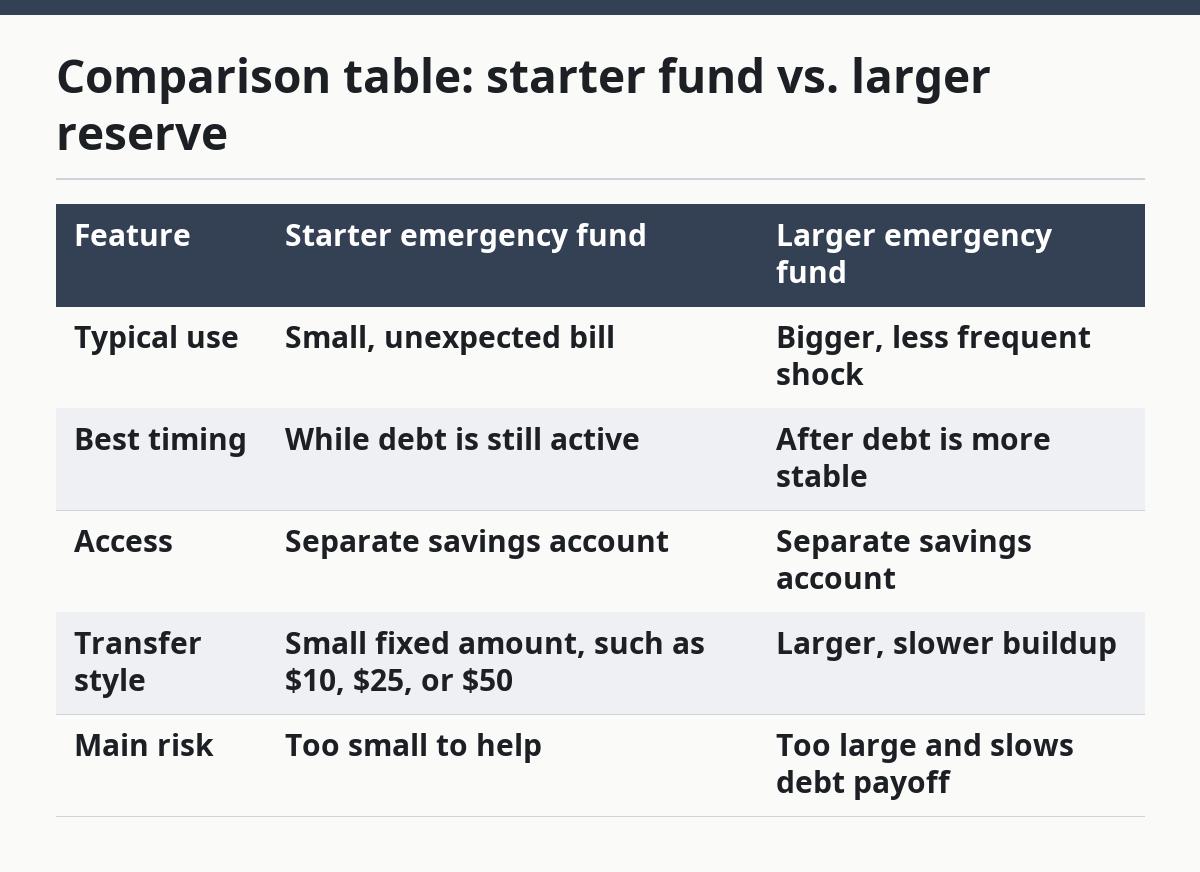
Comparison table: starter fund vs. larger reserve
| Feature | Starter emergency fund | Larger emergency fund |
|---|---|---|
| Typical use | Small, unexpected bill | Bigger, less frequent shock |
| Best timing | While debt is still active | After debt is more stable |
| Access | Separate savings account | Separate savings account |
| Transfer style | Small fixed amount, such as $10, $25, or $50 | Larger, slower buildup |
| Main risk | Too small to help | Too large and slows debt payoff |
Key takeaways
- Start with a small cash cushion, not a huge reserve, if debt is still active.
- Keep the fund in a separate savings account so it is visible and not easy to spend.
- Automate a modest transfer on payday so savings happens before leftovers disappear.
- Use the fund for true surprises, not planned or predictable costs.
- Refill the account after any withdrawal before increasing extra debt payments again.
Should you build an emergency fund before paying off debt?
Yes, but usually as a starter fund rather than a large one. A small cash buffer can prevent a single surprise expense from turning into more debt or a missed payment. The size should fit your budget and risk level, and a qualified adviser can help if your finances are unusual or constrained.
How big should an emergency fund be during debt payoff?
Big enough to handle the kinds of surprises you actually face, but not so large that debt payments stall. For many people, that means a small starter fund first, then a larger reserve later. There is no universal amount because expenses, income stability, and debt terms vary by household and country.
Can you save and pay off debt at the same time?
Yes. The usual method is to make required debt payments first, then send a small, fixed amount to a separate savings account on each payday. The key is not to let savings interfere with essential payments. If cash flow is too tight, a qualified adviser can help assess the order of priorities.
Drafted with AI; not yet reviewed by a person.