Last updated: November 19, 2026
Key Takeaways
- The goal is not perfect symmetry; every payment should have funds ready 1 to 5 business days early.
- A payment calendar works when each payday gets specific bills, dates, and a balance check.
- A due date that lands 3 to 10 days before payday is a timing gap, not a math error.
- The biggest mistakes are usually timing mistakes, and they can trigger direct fees.
If you are looking for how to plan debt payments when you are paid twice a month and due dates do not line up, the fix is a payday-driven payment schedule: line up each payment with the paycheck that can cover it, then use autopay timing and a small cash buffer to keep due dates from hitting before cash arrives. This is information, not financial advice; a qualified adviser should review your own situation if the gaps are tight or your debts are already behind.
Who this applies to, and what you need before you start
This applies to someone who gets paid on a semi-monthly schedule, usually 2 paychecks a month on fixed dates such as the 15th and last day, and has debt bills due on dates that do not line up cleanly. It also assumes you can see your minimum payments, due dates, and pay dates in one place, even if only on paper or in a spreadsheet.
The payoff schedule for how to plan debt payments when you are paid twice a month and due dates do not line up is not about changing the debt itself. It is about deciding which paycheck funds which bill, so a due date on the 3rd does not accidentally drain the same account that must also cover rent, groceries, and another payment on the 15th. That matters because a late fee or overdraft fee can turn a small timing problem into a recurring one.
This approach is not for someone who is already missing multiple minimums every month, has collection calls, or cannot tell whether a payment will clear. In that case, the timing problem is no longer just scheduling; the cash flow itself needs a more formal review. A credit counselor, debt adviser, or qualified financial professional can help assess whether a forbearance, hardship option, or different repayment structure is more realistic.
For the rest of this article, I assume you know your basic debt list, your net pay dates, and whether each creditor allows automatic payments, manual payments, or both. I also assume you can look up your bank’s cutoff times, because a payment made at 6 p.m. may post differently from one submitted before noon. That detail matters when a due date and payday sit only a day apart, and the Consumer Financial Protection Bureau notes that payment timing can affect whether a charge posts before the deadline.
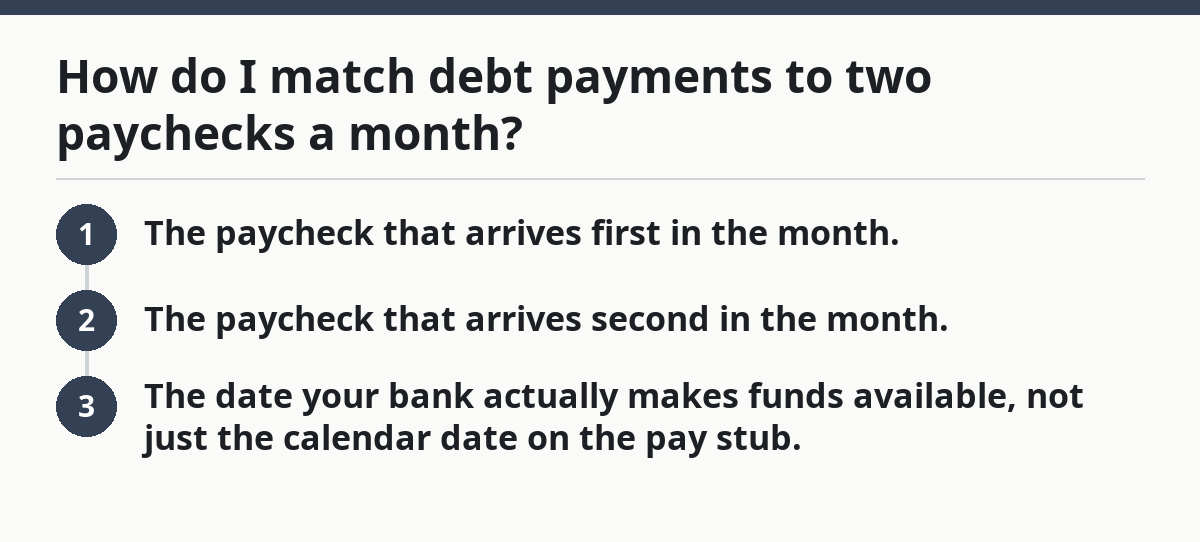
How do I match debt payments to two paychecks a month?
You match debt payments to two paychecks a month by assigning each bill to the paycheck that arrives before its due date, then keeping a small cushion in the account that pays them. The goal is not perfect symmetry; the goal is that every scheduled payment has money available 1 to 5 business days before the due date.
Start by listing every debt payment in due-date order: credit card minimums, personal loans, student loans, auto loans, and any other recurring debt obligations. For each one, write down the due date, minimum amount, autopay status, and whether the creditor drafts from checking or pulls from a card. Then match each bill to the paycheck that lands earliest enough to cover it without using money reserved for the next fixed expense.
A practical payday-driven payment schedule uses three anchors:
- The paycheck that arrives first in the month.
- The paycheck that arrives second in the month.
- The date your bank actually makes funds available, not just the calendar date on the pay stub.
If a bill is due on the 5th and payday is the 15th, that bill belongs to the previous paycheck or to a cash buffer built from prior months. If a bill is due on the 20th and payday is the 15th, the 15th paycheck can usually cover it, but only if other fixed obligations do not consume the same dollars first.
This is where bill prioritization matters. Essential debt payments with late fees or credit reporting consequences usually sit ahead of extra principal payments, because missing the minimum changes the whole plan. Extra payments, by contrast, are flexible; they can move to the next paycheck if cash gets tight. That flexibility is what makes the schedule workable.
The big mistake is to divide each paycheck in half and hope the math works out. A semi-monthly paycheck is not a promise that every month behaves the same. Some months have 31 days, some 30, February has fewer, and due dates rarely line up with that pattern. The schedule has to be built around dates, not around a monthly average, and the CFPB recommends that consumers understand timing before setting up automatic payments.
A step-by-step payment calendar you can actually follow
A payment calendar works when each payday is assigned specific bills, specific dates, and a verification check that shows the money will still clear after other fixed costs. Use a one-month view first; a 3-month view helps once the pattern is stable.
- Write down every debt due date and minimum payment. Put each creditor on one line with the due date, minimum amount, and autopay status. Verify that you have the exact due date from the statement, because grace periods and statement dates are not the same thing. A problem shows up if a bill has no confirmed due date or the minimum changes month to month.
- Mark both paydays and the bank’s posting cutoff. Add the 2 paycheck dates to the same calendar, then note whether your bank posts same day, next business day, or later for transfers. Verify that a payment will clear at least 1 business day before the creditor’s due date. A problem exists if payday lands after the cutoff and you are counting on same-day movement.
- Assign each debt to a paycheck. Put the earliest-due bills on the earlier paycheck and later-due bills on the later paycheck, but do not overload either side. Verify that the sum of assigned payments does not exceed the net paycheck after rent, utilities, food, and transport. A problem appears if one paycheck is already fully spoken for.
- Build a 7-day buffer for the first bill in the cycle. Keep enough cash in checking to cover the earliest debt payment at least 7 days before it leaves. Verify that the account balance stays above that number after groceries or gas. A problem appears if one debit card swipe can wipe out the payment reserve.
- Set autopay for the minimum on debts that allow it. Use autopay for the minimum payment 3 to 5 days before the due date when the creditor supports that timing. Verify the draft date on the creditor portal, not just the bank. A problem shows up if autopay is scheduled after the due date or on a weekend without clear posting rules.
- Schedule manual extra payments only after the minimums are covered. Place extra principal payments 2 to 4 days after payday, once the minimums and fixed expenses are safe. Verify that the extra payment will not drop your balance below the next bill’s reserve. A problem appears if an extra payment forces the next minimum to rely on a future paycheck.
- Recheck the calendar for every month with 31 days, holidays, or a leap-day February. Adjust for weekends and bank holidays, because due dates that fall on nonbusiness days may move, while paycheck dates may not. Verify the exact posting date on the creditor’s rules page. A problem appears if a due date lands on a holiday weekend and the payment posts late.
- Review the schedule after one full month. Compare planned dates with actual draft dates and remaining balances. Verify whether any payment created a cash gap of more than a few days. A problem shows up if you had to borrow from the next paycheck to cover an earlier bill.
A clean result looks boring: no overdraft alerts, no late fees, and no last-minute transfers between accounts. It does not have to be elegant. It just has to clear on time.
For background on how debt-payoff choices differ by method, the debt payoff method decision tree can help compare the options without turning this timing problem into a strategy problem. The CFPB also has guidance on managing credit card payments and due dates, and the Federal Trade Commission explains how late and overdraft fees can add up.
What if my bills are due before payday?
If bills are due before payday, the fix is usually to move the payment earlier only if cash is already present, or to use a buffer account that holds the money from the prior paycheck. A due date that lands 3 to 10 days before pay day is a timing gap, not a math error, but it does require a different cash flow setup.
The first step is to separate timing from affordability. If the bill is affordable but badly timed, a small reserve can cover the gap. If the bill is not affordable even when due dates are spread out, the problem is larger than scheduling. That is the point where a debt counselor or qualified adviser can help assess whether hardship options or a restructuring conversation is appropriate.
A useful rule is to protect the earliest due debt first. If two debts are due before payday and you cannot fund both from the same paycheck, the one with the harsher consequence usually gets priority. That can mean the higher late fee, the loan with a stricter delinquency policy, or the payment whose missed draft would cause an overdraft cascade.
Autopay timing matters here more than almost anywhere else. If a creditor drafts on the due date and your paycheck lands the same day, there is a real risk that the payment hits before the deposit posts. The practical fix is often to move the draft date earlier by 2 to 5 days if the creditor allows it, or to hold enough money in checking that the timing no longer matters. The exact lead time depends on the creditor and bank rules.
This is also where a monthly budget and a payment calendar part company. A budget tells you what you can afford over the month. A payment calendar tells you whether the money is there on the exact Tuesday the bill leaves the account. When due dates come before payday, the calendar is the more important document, which is why the Federal Trade Commission and CFPB both stress watching payment timing closely.
The mistakes that cause fees, overdrafts, and stress
The biggest mistakes are usually timing mistakes, not spending mistakes, and each one has a direct cost.
-
Treating both paychecks as if they were interchangeable. That can leave the first half of the month short and the second half crowded. The result is overdraft risk or a late payment. The alternative is to assign each debt to a specific paycheck and stop mixing the two.
-
Setting autopay for the due date instead of the draft window. If the creditor drafts exactly on the due date, a weekend or bank delay can make the payment post late. The cost is usually a late fee or a missed minimum. The alternative is to use a 3- to 5-day lead time when the creditor allows it.
-
Sending extra principal payments before minimums are protected. That can make the debt look smaller while creating a cash shortfall on the next bill. The cost is a missed payment or a transfer that empties the checking account. The alternative is to pay minimums first and schedule extra payments only from money that has already cleared.
-
Ignoring weekends and bank holidays. A payment scheduled on Friday may not post until Monday, and a due date on a holiday can behave differently by creditor. The cost is a payment that was “on time” on your calendar but late in the creditor’s system. The alternative is to check posting rules for each lender and move dates earlier when needed.
-
Using one checking account for every bill without a reserve. That makes one grocery trip or gas fill-up capable of breaking the whole schedule. The cost is a chain reaction of bounced payments. The alternative is to keep a dedicated buffer for the earliest debt drafts, even if it is only enough to cover one minimum payment.
A good payment plan does not require perfect discipline every day. It requires fewer places for one mistake to spread.
When the standard approach does not apply
The standard payday-driven payment schedule does not fit every situation, and forcing it can make things worse.
Your pay dates vary by 1 to 2 weeks: irregular pay makes fixed due-date planning unreliable — use a larger buffer and ask the creditor about alternate draft dates, or get a professional review if the schedule keeps breaking.
One debt already has missed payments or collections activity: the timing problem is no longer the main issue — prioritize getting current and ask about hardship or rehabilitation options before adding more scheduled payments.
Your checking balance is regularly near zero before payday: there is no room for a timing cushion — a calendar alone will not solve it, and a qualified adviser should help assess whether the monthly fixed expenses exceed stable cash flow.
The creditor will not change the draft date and charges on a fixed day: you have to work around the creditor’s rules — keep the payment in a separate account or set the draft earlier than the due date if possible.
Your bank processes transfers slowly or unpredictably: the money may not move in time even when the calendar looks fine — test the transfer lead time with a small amount first, then set the schedule with that delay built in.
You are carrying debt across multiple institutions with different posting rules: one lender may clear same day and another may not — each account needs its own timing note, not one universal rule.
In each of these cases, the issue is not simply “budget better.” The issue is that the timing structure itself needs a different tool.
How do I keep this working month after month?
You keep it working by reviewing the plan once a month, preferably the day after the second payday, and by updating it any time a due date changes by even 1 day. The plan stays alive only if it reflects reality, not last month’s guess.
Check four things at the review:
- Did every minimum payment leave the account on time?
- Did any account fall below the reserve amount?
- Did a holiday, weekend, or bank cutoff change the posting date?
- Did one paycheck have more slack than the other?
If the answer to any of those is yes, adjust the assignment of bills to paychecks. Sometimes the change is tiny: moving a utility bill from the 15th paycheck to the last-day paycheck, or moving an extra principal payment from one month to the next. Sometimes the change means the plan is too tight to keep without a buffer, which is a signal to pause and get qualified advice.
The most useful target is not perfection. It is repeatability. If the same 2-paycheck pattern works for 3 months without overdrafts or late fees, the schedule is probably aligned well enough for your cash flow. If it breaks every month, the schedule is telling you something important.
Drafted with AI; not yet reviewed by a person.