Last updated: November 19, 2026
Key Takeaways
- Equal debt payments are the steadier default for people who want a predictable monthly bill.
- Equal debt payments suit bills that act like rent: same date, same amount, fewer surprises.
- Variable debt payments fit lumpy cash flow when the goal is to stay current without overcommitting.
- Equal payments favor predictability; variable payments favor flexibility.
Equal debt payments are better if you want a predictable routine and one monthly number you can count on. Variable debt payments fit better when your income or cash flow changes a lot, because they let you pay more in some months and less in others. So the real question is simple: which structure matches your own situation?
The choice comes down to debt payment structure — fixed payments, variable payments, or a minimum-payment setup with extra money added on top. I write about consumer debt and repayment planning, so here’s the plain version: pick the setup that fits your cash flow without setting you up for missed payments.
What is the real difference between equal and variable debt payments?
Equal debt payments are the steadier default for anyone who likes a predictable monthly bill. Variable debt payments make sense only when your budget can absorb swings without putting the account at risk.
With equal payments, the amount stays the same each month, or close to it, until the debt is gone. That makes planning around rent, utilities, childcare, and the rest much easier. Automation is simpler too, since the transfer amount does not need constant tweaking.
Variable payments work differently. One month can be higher; another can be lower. In practice, they usually sit on top of a required minimum payment, which is the lender’s floor. Miss that floor, and the whole setup can unravel fast.
The difference is not just comfort. It is control. Equal payments make the debt itself easier to budget for; variable payments leave more room to adapt, but they also make it easier to underpay by accident if you are not watching closely. For many people, that trade-off matters more than the interest math.
For broader repayment framing, this page fits into the debt payoff method decision tree. That larger decision is about method; this one is about payment structure.
Equal debt payments: who should actually use them?
Equal debt payments win for anyone who wants a bill that behaves like rent: same date, same amount, fewer surprises.
That structure works best when your income is steady and your spending does not lurch from one month to the next. Salaried workers, people with predictable commissions, and households with a stable base budget often do well with fixed payments because the plan is easy to keep going for 12 months or longer. The upside is not flashy; it is dull in the best way. Boring is useful when debt is trying to become a monthly emergency.
Equal payments also help if you are juggling multiple debts. One fixed transfer is easier to track than three or four amounts that shift every cycle. That matters, because repayment plans usually fail from friction, not bad intentions. A fixed setup cuts down the number of decisions you have to make.
But there is a catch. Equal payments can feel too rigid in a month when cash gets tight. If you lock in an amount that is too high, you may short other essentials or fall back on credit again. That is the main reason equal payments are wrong for people whose income has frequent gaps, seasonal drops, or uneven timing.
There is a quieter downside, too. If you like adjusting your payment based on free cash, fixed payments can start to feel like a box instead of a tool. Need room to vary? Then a rigid amount can become a cage.
For people whose income arrives on a regular schedule, equal debt payments usually reduce stress more than they reduce interest. That is the right trade if consistency is the real problem.
Variable debt payments: when do they make more sense?
Variable debt payments make sense when cash flow is lumpy and the main goal is to stay current without overcommitting in a thin month.
This setup fits people who get paid on commission, hourly work with irregular hours, freelance income, seasonal pay, or bonus-heavy compensation. A variable plan lets the payment follow reality instead of forcing reality to match a calendar. In a lean month, that flexibility can keep a payment from turning into a bad stretch that lasts for 6 months.
It also helps if you keep a reserve in your checking account and want to send extra money toward debt only when the account looks healthy. In a strong month, you can pay more. In a weak one, you can drop back toward the minimum payment without rebuilding the whole plan. Sometimes that is the difference between staying organized and blowing up your budget.
The downside? Variable payments are easier to mismanage. If you do not set a floor, “variable” can quietly become “inconsistent.” The risk is not only slower payoff; it is also the chance that a larger payment in one month makes you overconfident, followed by a smaller one later that leaves you short on the balance. Miss the minimum payment, and the structure has failed, no matter how generous the strong month was.
Variable payments are also harder to automate. A fixed autopay setting is simple; a variable plan usually needs more review. More monitoring, more chances to forget, and more room for a bad month to snowball.
If your income swings by season or project, variable debt payments can be the healthier structure. If your money is steady, they often add moving parts without enough payoff.
The honest side-by-side
Equal payments are better for predictability; variable payments are better for flexibility. The table below shows which one matches your situation more closely.
| Criteria | Equal debt payments | Variable debt payments | Winner for this condition |
|---|---|---|---|
| Monthly predictability | Same amount each cycle | Amount changes with cash flow | Equal for fixed-bill budgeting |
| Ease of automation | Simple autopay setup | Usually needs manual review | Equal for low-maintenance planning |
| Protection against overcommitting | Stronger, if the amount is set correctly | Weaker if you pay too much in strong months | Equal for steady earners |
| Fit for irregular income | Can strain a tight month | Adjusts to uneven pay | Variable for freelancers or seasonal workers |
| Ease of tracking | Easier to follow over 12 months | Harder to compare month to month | Equal for people managing several debts |
| Ability to send more in good months | Limited unless you make extra payments | Built in | Variable for flexible cash flow |
| Risk of payment drift | Lower | Higher | Equal for people who need structure |
| Stress during a bad month | Lower if the fixed amount is realistic | Lower if the payment can shrink safely | Variable for income volatility |
| Best use with minimums plus extra | Works well if the extra is consistent | Works well if extra money comes and goes | Tie, depending on cash flow stability |
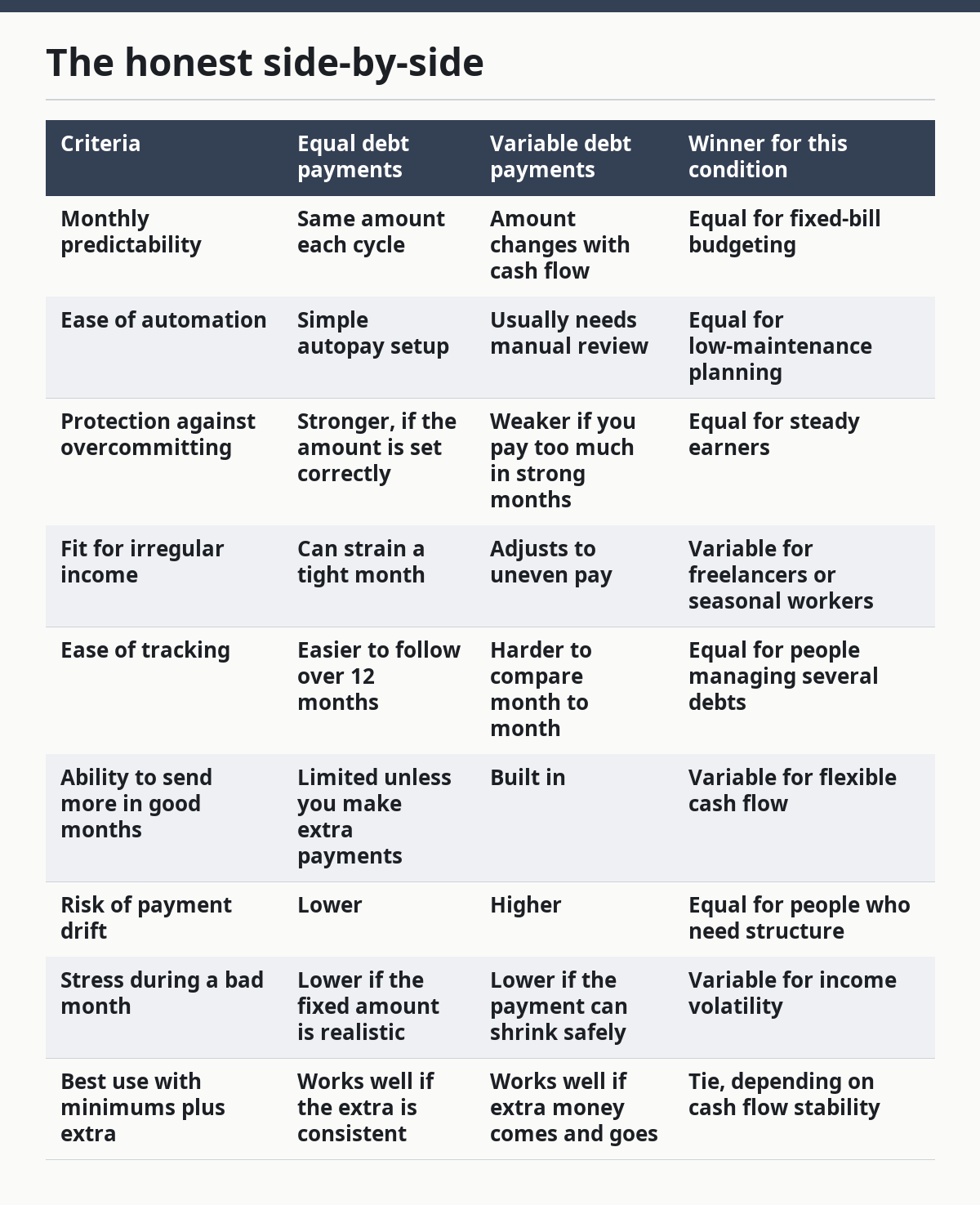
The pattern is clear. Equal payments win on structure. Variable payments win on adaptability. Neither is always “better,” because the real issue is which failure you are trying to avoid: overcommitting or underplanning.
One point matters here: minimum payments are not a strategy by themselves. They are the floor. Both equal and variable plans can sit above that floor, but the structure only works if the minimum is always covered first and the extra amount is deliberate, not accidental.
For official repayment terminology, consumer guidance from the Consumer Financial Protection Bureau is a good place to check how minimums and interest charges are described in general terms. The Federal Reserve and NerdWallet also explain repayment basics in plain language. Debt terms still vary by lender, country, and product type, so the exact rules on your account can differ.
The minimum-payment plus extra approach: where it fits
The minimum-payment plus extra structure is the middle ground, and it fits best when the debt is manageable but the budget is not perfectly steady.
Here’s how it works: you pay at least the required minimum every month, then add more when your cash flow allows. In a fixed-payment setup, that extra amount may be the same each month. In a variable setup, it may change depending on what is left after essentials. The appeal is easy to see — the account stays current, and any surplus cash still goes toward principal reduction.
Honestly, this is often the most realistic choice for people who do not want a rigid plan but also do not want chaos. A minimum-plus-extra plan gives you a hard floor and a flexible ceiling. It can work well for someone with a stable base paycheck plus occasional overtime, side income, or seasonal bonuses.
But the weak spot is vagueness. If “extra” is never defined, the amount can shrink every time life gets inconvenient. That is how a plan that looked responsible turns into a string of small, uncoordinated payments. Another drawback: it can tempt you to make only the minimum for too long if the extra piece never gets specified.
This approach is not ideal if you need a fully automatic system, and it is not ideal if your income is too unstable to predict even a small extra amount. In those cases, the structure is either too loose or too demanding.
Used well, minimum plus extra is a cash-flow smoothing tool. It lets the debt payment absorb normal month-to-month variation without forcing you to redesign your whole budget every time a bill arrives.
When does the choice flip?
The verdict flips when the payment itself is no longer the main problem. That happens in a few specific cases.
First, if your required minimum payments are already too high for your cash flow, neither equal nor variable payments solve the underlying issue. The structure matters less than the gap between income and fixed obligations.
Second, if your income is regular but your expenses are chaotic because of medical bills, childcare swings, or travel costs, an equal payment can still work — but only if the fixed amount is conservative. A rigid debt payment that ignores real-world spending pressure is the wrong setup.
Third, if you have several debts and different due dates, equal payments across all of them can be easier to manage than one debt on a variable schedule and another on a fixed schedule. Mixed systems create errors. Simplicity matters.
Fourth, if your lender charges fees or has terms that make changing payments awkward, a variable plan may create more friction than benefit. The account agreement matters. Loan and credit-card terms differ, and those terms can change the practical answer.
The common thread is simple: choose the structure that reduces the most likely failure in your life. And if the trade-off is still murky, get advice from a qualified adviser.
The verdict: which one should you choose?
Choose equal debt payments if your income is steady, your bills are predictable, and you want the easiest structure to maintain month after month. Choose variable debt payments if your income changes often and a rigid monthly amount would raise the risk of missing a payment. Neither works well if the payment amount is so high that you are relying on luck instead of a workable budget.
That is the cleanest call. Equal payments are the default for stability. Variable payments are the exception for volatile cash flow. If you can keep the minimum covered and still leave room for essentials, either can work; if you cannot, the setup needs to be reconsidered before the repayment plan does more harm than good.
Are fixed debt payments better than variable ones?
Fixed debt payments are better for people who want a clear, repeatable monthly bill. Variable payments are better when income changes enough that a fixed amount would feel tight in some months and wasteful in others. The better structure is the one that keeps you current without constant adjustment.
What is the safest payment structure for irregular income?
For irregular income, a variable structure with a firm minimum payment is often the safest fit. It gives you room to pay more in strong months and scale back in weak ones. Protect the minimum first, because that is what keeps the account in good standing.
Can I change debt payment amounts each month?
Yes, if the lender allows it and the account terms make it practical. Some accounts are easy to adjust, while others work best with a fixed autopay and occasional extra manual payments. Check the rules on your specific debt before you build a variable plan around changing amounts.
Drafted with AI; not yet reviewed by a person.