Last updated: November 19, 2026
Key Takeaways
- The method works by sorting spending into needs, wants, savings, and debt payments.
- You use the 20% bucket to prioritize extra debt payoff after minimums are covered.
- The plan works best when the 20% bucket has one clear monthly job and all payments are made on time.
- The 20% bucket can fall short when minimums, savings, and extra payoff all compete for the same money.
A 50/30/20 debt payoff plan can handle debt payoff if the 20% bucket is split on purpose instead of by habit. Put essentials in the 50%, keep wants inside the 30%, and use the 20% for savings and debt payments according to a fixed rule that fits your balances, deadlines, and cash flow.
Who this works for — and who should use a different plan
This works for someone who already has a rough handle on monthly income, fixed bills, minimum debt payments, and a basic 50/30/20 budget. The method assumes you can classify spending into needs, wants, savings, and debt payments without building a custom spreadsheet. It is a good fit when you want structure, not a total budget overhaul.
The 50/30/20 budget is designed to be simple: about half of take-home pay goes to needs, about 30% to wants, and about 20% to savings and debt. That last bucket is the part that matters here. The plan below turns that 20% into a debt payoff system without asking you to invent a new framework from scratch.
This is not the right tool if your minimum debt payments already exceed what fits comfortably in the 20% slice. It is also a poor fit if your housing, food, transportation, or medical costs are unstable from month to month, because the budget categories stop behaving predictably. In those cases, a broader cash-flow reset is needed before payoff math helps.
For readers comparing debt strategies, this approach sits alongside other methods in the debt payoff method decision tree. The difference is that it keeps the familiar 50/30/20 structure and uses it to organize debt payments, instead of replacing the whole budget. See also the debt avalanche method, the debt snowball method, and our guide to how to budget with irregular income.
This is financial information, not financial advice. A qualified financial adviser or credit counselor can help with your own situation, especially if you have variable income, tax questions, or several high-interest balances. The Consumer Financial Protection Bureau and the Federal Trade Commission both publish consumer guidance on debt and budgeting.
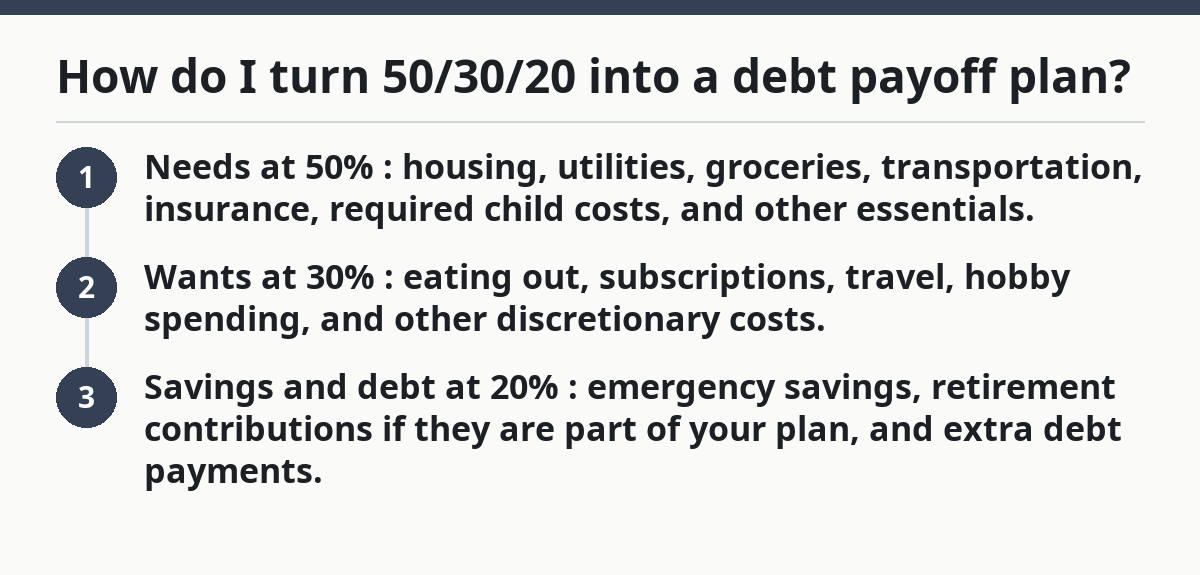
How do I turn 50/30/20 into a debt payoff plan?
You turn it into a debt payoff plan by assigning the 20% bucket a job, then deciding which debts get the minimums and which get the extra payment. The basic rule is: all required minimum payments are non-negotiable, then any remaining money inside the 20% slice goes to one debt at a time until it is gone.
Start with your take-home pay, not gross income. The 50/30/20 budget is built from what reaches your account after payroll deductions, because that is the money you can actually direct. If your income changes from paycheck to paycheck, use a conservative monthly average based on recent months rather than the best month.
Next, list each debt with four details: balance, minimum payment, interest rate, and due date. Those details tell you whether a debt is simply being maintained or actively attacked. If you do not know the minimums and due dates, you cannot build a reliable monthly plan.
Then separate your budget into three working pools:
- Needs at 50%: housing, utilities, groceries, transportation, insurance, required child costs, and other essentials.
- Wants at 30%: eating out, subscriptions, travel, hobby spending, and other discretionary costs.
- Savings and debt at 20%: emergency savings, retirement contributions if they are part of your plan, and extra debt payments.
A practical debt payoff plan usually means the 20% bucket is not shared evenly. It should be split between a small savings line and extra debt payments, unless your emergency fund is already in place. Without that split, one flat tire or medical copay can push the plan off track and create more debt.
One simple rule is to keep minimum debt payments outside the 20% calculation, if they are already part of your 50% needs or are otherwise funded in your monthly budget. Then use the 20% only for the extra payoff amount and a modest savings cushion. The exact split depends on your risk tolerance and current debt pressure, which is why this page explains the structure rather than telling you a universal percentage.
Build the plan in 7 steps
You build the plan by making the 20% bucket do one clear job each month and by checking that every debt payment is covered before the due date. Use the steps below in order.
- Calculate your monthly take-home pay. Use one month of net income or a 3-month average if your pay varies. Verify that the number excludes taxes, retirement deductions, and other payroll withholdings. If the result is uncertain by more than a few hundred dollars, the budget will wobble.
- Set the 50/30/20 dollar amounts. Multiply take-home pay by 0.50, 0.30, and 0.20. Verify that the three figures add back to the full monthly income. If they do not, you are mixing gross and net pay.
- List every debt with its minimum payment. Include credit cards, personal loans, student loans, auto loans, and any other fixed obligation. Verify the minimums against your statements, not memory. A wrong minimum can cause a late fee or make the plan look stronger than it is.
- Protect the minimums first. Assign each minimum payment to your needs line if it is already a fixed monthly obligation, or reserve it inside the debt bucket if that is how your budget is organized. Verify that all required payments fit before any extra principal payment is added. If they do not fit, the 50/30/20 framework is too tight as written.
- Choose one payoff order for extra money. Use either the debt avalanche method, which targets the highest interest rate first, or the debt snowball method, which targets the smallest balance first. Verify that you are using one method consistently for at least 3 months. If you switch every payday, progress becomes hard to see.
- Split the 20% between savings and extra debt payment. A common structure is a small emergency fund first, then the rest to debt. Verify that the savings piece is large enough to cover the kind of surprise that tends to derail your budget, such as a copay or car repair. If savings is set at zero and every surprise becomes new debt, the plan is fragile.
- Assign the extra payment to one debt only. Send all extra principal to the chosen target, while making minimums on the others. Verify that the payment is coded correctly with the lender so it reaches principal and not only future installments. If the lender misapplies it, the payoff timeline stretches out.
- Repeat the plan at the start of each month. Re-check income, due dates, and balances after every statement cycle. Verify that the next month still fits the same 50/30/20 split. If a balance drops faster than expected, move the freed-up extra payment to the next debt without expanding wants.
A concrete example helps. If take-home pay is $4,000 for the month, the 50/30/20 structure gives $2,000 for needs, $1,200 for wants, and $800 for savings and debt together. If minimum debt payments total $350, the remaining $450 in the 20% bucket can be split between a savings buffer and extra principal. If the minimums alone exceed the amount you planned for debt, the numbers do not work and the budget needs revision.
The Consumer Financial Protection Bureau is a good place to check budget guidance and consumer debt basics, and the Federal Trade Commission also publishes debt and credit information for consumers. Those pages are useful for definitions and consumer rights, but they do not replace advice tailored to your own liabilities and income pattern. You can also compare the method with our debt avalanche calculator and our debt snowball calculator.
What should go in needs, wants, savings, and debt payments?
Needs should contain costs that keep your household functioning, wants should contain discretionary spending, savings should reduce the chance of new debt, and debt payments should be separated into required minimums and extra payoff money. That classification is the heart of the 50/30/20 budget, and the payoff plan works only if the categories stay clean.
Needs are not everything that feels necessary. They are the bills and purchases you would still have even if you were trying to spend as little as possible for a month: rent or mortgage, basic groceries, utilities, transportation to work, insurance premiums, and required child-related costs. If you put streaming, takeout, or premium phone upgrades into needs, the budget stops being a budget and becomes wishful accounting.
Wants are where the 30% often leaks. People often treat extra dining out, apps, hobby gear, and impulse shopping as small because each item is under $50, but the category can still swallow the room needed for debt payoff. If the wants line is always overspent, the 20% bucket gets raided to cover it, and debt payoff slows down.
Savings in this setup is not decorative. Even a modest emergency fund can keep a single surprise from becoming a new balance on a card. If you have no cash buffer, the plan can still work, but it is more brittle and will usually need more monthly attention. That is the trade-off: less savings today can mean more debt later.
Debt payments should be split mentally into two pieces. Minimums are the price of staying current. Extra payments are the tool that shortens the debt timeline. If you blur the two, you may think you are paying off debt aggressively when you are only staying afloat.
What if the 20% is not enough?
The 20% bucket is not enough when minimum payments, emergency savings, and any planned extra debt payment cannot all fit inside it without raiding essentials. That is a sign the framework needs adjustment, not a sign that you failed at budgeting.
The first test is simple: can you cover every minimum payment on time while still keeping the 50% needs category realistic? If the answer is no, the problem is usually not the payoff order. It is the size of the fixed obligations relative to income. In that case, the 50/30/20 split may be too rigid for the moment, and the month needs a survival budget rather than a standard one.
The second test is whether the debt balance structure itself is causing strain. A few low-rate installment loans behave differently from several high-interest revolving balances, especially when due dates are clustered. If the monthly minimums are heavy and inflexible, the 20% may only be enough for minimums plus a token amount of savings. That still counts as a plan, but it is not an aggressive payoff plan.
The third test is volatility. If income changes every pay period, or if utilities and medical costs swing sharply, a fixed 20% allocation can become too neat to be useful. In that case, the method should be adapted by giving the debt and savings buckets more room in higher-income months and by protecting the minimums in lean months. The framework still helps, but the numbers cannot be locked too tightly.
This is also where the standard approach does not apply. If you are facing delinquency, collections, garnishment, or a legal notice, the main job is not optimizing a budget category; it is responding to the debt problem directly and getting qualified help if needed. A budget can support that response, but it should not be the only tool.
The mistakes people actually make, and what they cost
The most common mistake is treating the 20% as “extra cash” instead of a fixed assignment. That usually means the money disappears into wants, irregular spending, or account balance drift. The better alternative is to name the savings amount and the debt amount before the month starts, then move it automatically if possible.
A second mistake is paying extra to several debts at once. That feels productive, but it slows visible progress and can reduce motivation. The correct alternative is to direct extra principal to one target while making every other minimum payment on time.
A third mistake is using gross income instead of take-home pay. That makes the whole 50/30/20 structure look larger than it really is. The result is shortfalls late in the month and a plan that only works on paper. Always use net income for the allocation.
A fourth mistake is forgetting that due dates matter. Even if the math is right, a payment that arrives after the due date can trigger fees or interest consequences. The fix is to map each debt to its due date and set reminders or automatic payments at least 2 to 3 business days before the deadline.
A fifth mistake is setting savings at zero for too long. That can accelerate debt payoff in theory, but in practice it often creates new debt when an ordinary surprise arrives. A small emergency buffer is usually the more stable choice unless you already have cash reserves.
A sixth mistake is not adjusting the budget when a debt disappears. Once a balance is paid off, the freed-up minimum should be redirected immediately to the next target or to savings, not absorbed by lifestyle creep. If that happens, the payoff plan stalls right when it should accelerate.
When should I stop using this approach?
You should stop using this approach when the numbers no longer fit your real life or when another debt response is more urgent than a monthly budget. A 50/30/20 payoff plan is a tool, not a rescue vehicle.
Minimum payments do not fit inside your monthly cash flow: this means the standard split is too tight — use a temporary survival budget and seek qualified debt or credit help if needed.
Your income varies so much that a fixed monthly allocation breaks down: this means the framework needs a flexible version — base it on the lowest predictable month or an average, and reassess each cycle.
You are missing due dates or seeing late fees: this means the plan is not operational — switch to automatic payments or a simpler due-date-first system.
You keep pulling from savings to cover wants: this means the categories are bleeding into each other — cap discretionary spending more tightly before trying to increase debt payments.
You are in collections, default, or facing legal action: this means budgeting alone is not enough — get qualified help and address the debt issue directly.
Your emergency fund is completely empty and every surprise becomes new debt: this means a pure debt-only push is too fragile — rebuild a starter cushion before increasing extra payoff.
Drafted with AI; not yet reviewed by a person.