Last updated: November 19, 2026
Quick answer: Use the payoff method that matches your goal for the refund. If the refund can erase one account, that often gives the clearest result. If one balance has the highest APR, that usually saves the most interest. In this guide to how to choose a debt payoff method when you will use a tax refund, the choice comes down to interest, minimum payments, and cash-flow risk.
A tax refund can make debt feel simpler, but the wrong payoff method can waste the lump sum. Use the method that matches your interest rate, minimum payments, and cash-flow risk. The steps below help you choose between paying one debt, splitting the refund, or using it as a partial payoff.
Key takeaways
- A refund is a one-time lump sum, so the right move depends on what your debt account needs most: lower interest, fewer payments, or less risk.
- If one balance has a very high rate, focused payoff usually saves more interest than spreading the money thin.
- If several debts are close in rate, a split payment can help with momentum and still lower balances.
- Before you send money, check whether your lender treats extra payments as principal-only and whether a partial payoff changes the next bill. For many borrowers, it is worth checking the lender’s payment instructions or a qualified adviser.
- If your refund is small compared with your debt, the method matters less than timing and making sure the payment lands where you expect.
Start with the debt, not the refund
A tax refund should be directed by the debt account that hurts you most, not by the size of the refund itself. If you already know your balances, rates, and due dates, you have enough to choose a method without guesswork.
Here’s the catch: a lump sum can do one of three jobs. It can cut interest, erase one account, or reduce payment pressure. Those are not the same goal, so the “best” method changes with the debt mix and your cash flow.
To make the choice clear, look at these factors first:
- Interest rate: the annual percentage rate, or APR, on each account
- Minimum payment: the amount due each month to stay current
- Balance size: the total left on each debt account
- Due date timing: whether the payment can land before the next statement closes
- Penalty rules: whether your lender charges extra for early payoff or partial payoff
If you want a wider framework for method selection, the debt payoff methods hub and debt payoff strategy selection guide fit here. This page just handles the tax refund case.
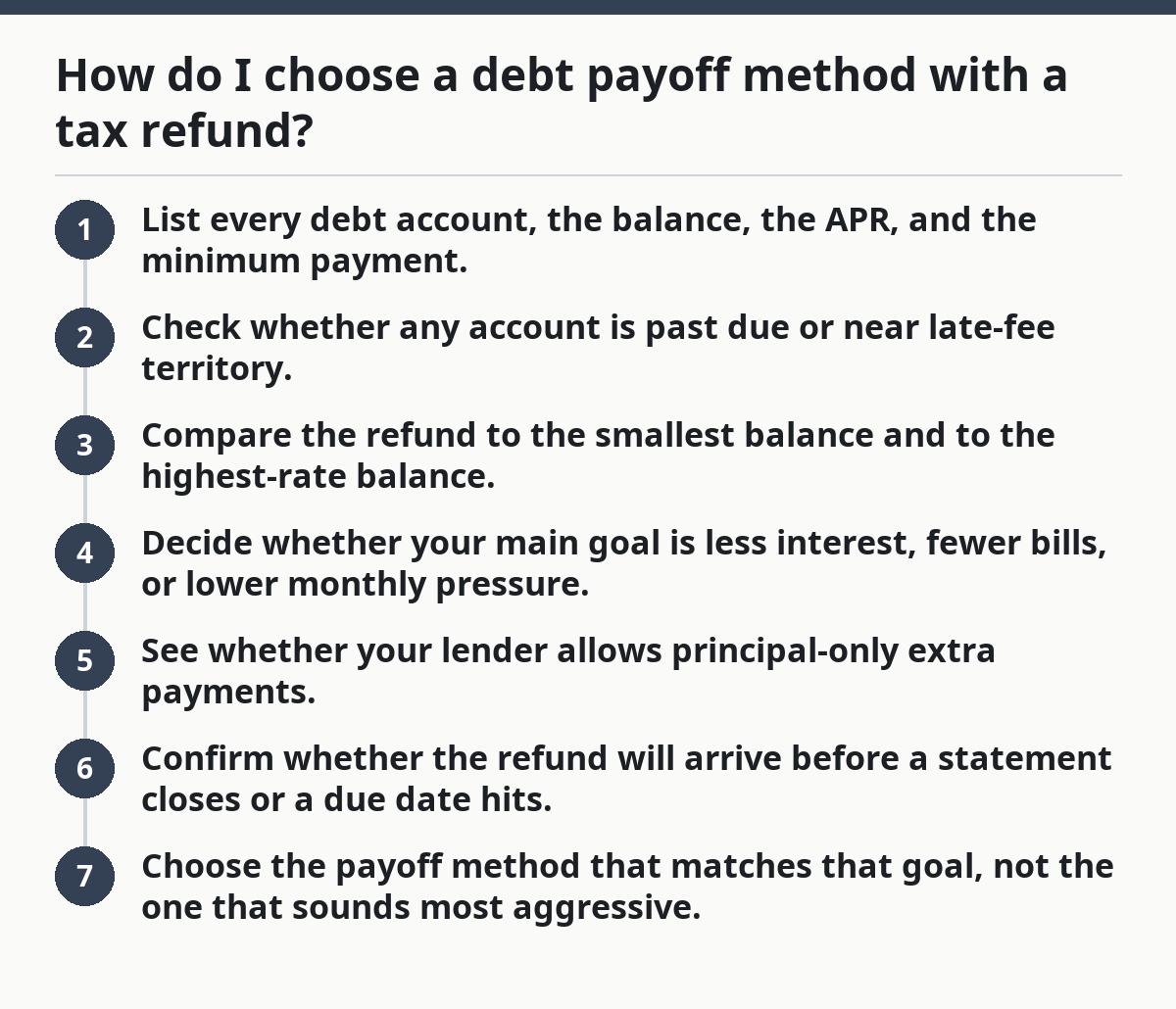
How do I choose a debt payoff method with a tax refund?
You choose by ranking the refund against the debt accounts you already have. The right method is usually the one that gives the clearest gain in interest saved, monthly breathing room, or account count reduced.
Picture this: you’re staring at a refund notice and three debt accounts on your phone. One has a high APR, one has a small balance, and one has a payment that keeps throwing off your budget. The right use of the refund depends on which problem you want to fix first.
Use this order of thought:
- List every debt account, the balance, the APR, and the minimum payment.
- Check whether any account is past due or near late-fee territory.
- Compare the refund to the smallest balance and to the highest-rate balance.
- Decide whether your main goal is less interest, fewer bills, or lower monthly pressure.
- See whether your lender allows principal-only extra payments.
- Confirm whether the refund will arrive before a statement closes or a due date hits.
- Choose the payoff method that matches that goal, not the one that sounds most aggressive.
What you verify at each step:
- The APR is current, not an old promotional rate.
- The payment gets applied to principal, not held for the next cycle.
- A partial payoff will not leave a stranded balance with interest still accruing.
- Your checking account can absorb the payment without causing an overdraft.
If any of those checks fail, the problem is not the refund size. It is the timing or the account rules.
Which payoff method fits your refund size?
A focused payoff works best when the refund can fully clear one account or almost clear one high-rate balance. If the refund is too small for that, a split approach can still be useful.
The three common choices are plain:
- Snowball: pay the smallest balance first. This is a cash-flow and motivation method.
- Avalanche: pay the highest APR first. This is an interest-saving method.
- Split payoff: divide the refund across several accounts. This can reduce multiple balances at once.
Use the method that matches the shape of your refund:
- If the refund can erase a small debt account, that can simplify your monthly list fast.
- If one debt has a much higher APR, directing the full refund there usually makes more mathematical sense.
- If two or three balances are close together and none is clearly dominant, a split can reduce several minimums at once.
The truth is, a tax refund changes the math less than people expect. A one-time payment does not replace your long-term method; it just gives that method a boost. If you normally use the avalanche method, a refund usually lands best on the highest-rate debt. If you use the snowball method, it often goes to the smallest balance you can wipe out.
What should I check before I send the refund?
You should check how the lender handles extra payments before you submit the refund. A payment that posts the wrong way can leave you with less benefit than you expected.
Picture this: you send the refund, the balance drops, and then the next statement still shows interest you did not expect. That usually means the payment timing or allocation rules did not match your plan.
Check these items before you pay:
- Principal-only option: ask whether you can direct the extra amount to principal.
- Payment posting time: ask how many business days the payment needs to post.
- Statement cycle: check whether the payment lands before the next cycle closes.
- Partial payoff rules: confirm whether the lender recalculates future interest right away.
- Minimum payment status: make sure the account still gets its required monthly payment if the refund is not enough to close it.
If the lender does not make principal-only treatment easy to set, call and ask for written confirmation or look for the option in the online payment screen. If you are unsure how the payoff will be applied, consult a qualified financial professional or review the lender’s payment instructions before sending the refund. If you skip this check, the refund may still help, but not in the exact way you planned.
How should I split a tax refund across debts?
A split works when no single debt deserves the entire refund, or when the refund is too small to change one account meaningfully. The split should follow a rule, not a gut feeling.
A simple rule is this:
- Put the full refund on the highest APR debt if interest is the main goal.
- Put the full refund on the smallest balance if account closure is the main goal.
- Split only when the balances and rates are close enough that no single account clearly wins.
Use a split only if it has a reason. A random 50/50 split can weaken the impact of the refund by leaving multiple balances barely changed.
A better split often looks like this:
- Cover any late or near-late account first.
- Put the rest on the debt with the highest APR.
- If two debts have similar rates, send the larger share to the one with the smaller balance.
That approach keeps the refund tied to a clear payoff method. It also avoids the common mistake of spreading $500 across five accounts and seeing very little change in any one balance.
When should I not use the refund the usual way?
You should pause the usual payoff plan when the refund would create a cash problem or trigger a bad account rule. In those cases, the refund’s timing matters more than the method.
One or more debts are past due: That changes the priority order — catch up on the overdue account first so fees and credit damage do not keep growing.
Your refund will arrive after a due date: A late payment can cost more than a smart allocation saves — make the minimum payment from current cash, then use the refund when it posts.
The lender does not accept principal-only extra payments: Your payment may not reduce interest the way you expect — ask how the account applies overpayments before sending the refund.
A partial payoff would leave a tiny balance with ongoing interest: That can be awkward to manage — either clear the account fully or leave enough to avoid a stranded penny balance.
Your budget is tight for the next 30 days: The refund may be needed for basic bills — if so, do not force a debt move that creates overdraft fees or missed essentials.
The debt has a penalty or special payoff rule: Some accounts have specific payoff instructions — follow the lender’s payoff quote or payment instructions exactly.
On the flip side, if none of those apply, the standard method usually works fine. That means you can focus on rate, balance, and your chosen debt payoff order.
The mistakes people make with refund payoffs
The biggest mistake is treating a refund like free money with no assignment. A tax refund is still your cash, and it should be placed with intent.
Common errors and what they cost:
- Skipping the minimum payment: This can trigger late fees and credit reporting damage. Keep minimums current unless the refund will arrive in time to cover them.
- Choosing the smallest debt by habit: That may feel good, but it can ignore a much higher APR elsewhere. Use the smallest balance only when the motivation benefit matters more than interest.
- Not checking posting rules: A payment can land after the statement closes and miss the month’s interest benefit. Confirm posting time first.
- Splitting the refund too many ways: Five tiny payments often do less than one meaningful payoff. Use a simple rule.
- Ignoring tax refund timing: If the refund is delayed, the plan can collapse. Keep the current month’s bills covered until the money arrives.
The correct alternative is dull but effective: rank the debts, confirm the rules, and send the money where it does the most work. That is not flashy. It is how a lump sum actually changes the debt picture.
What does a good result look like?
A good result is one where the refund changes the debt map in a visible way. You should be able to see either one fewer account, a lower APR balance reduced, or a smaller monthly burden within the next billing cycle.
Picture this: you log in after the payment posts and one debt is gone, or the balance on a high-rate account is meaningfully lower. That is what good allocation looks like. It is not just “I paid something.” It is “I changed the next 3 to 12 months.”
Signs the method worked:
- One debt account is fully paid off.
- The highest-rate balance is clearly smaller.
- Your minimum payments are easier to manage.
- You know exactly what to do with the next extra dollar.
If the refund only shaved a little off every account, that is usually a weaker result unless you needed broad reduction for cash-flow reasons. The best result is the one that lines up with the goal you named before paying.
A quick way to decide
A tax refund should go to the debt account that best matches your goal: highest interest, smallest balance, or biggest cash-flow relief. If the refund can erase one account, that usually beats scattering it across several. If the refund is small or the debts are close in rate, a simple split can still work.
That said, this is information, not financial advice. A qualified adviser can help with your own tax situation, debt terms, and cash needs.
Should I use a tax refund to pay the highest APR debt?
Usually, yes, if your main goal is to reduce interest. Paying the highest APR debt first often saves more over time than focusing on balance size alone. The exception is when another account is past due or when the refund can fully wipe out a small balance and simplify your monthly budget.
How should I split a tax refund across debts?
Split it only when there is a clear reason. If one account has the highest APR, a full payment there usually makes more sense than a scattershot split. If several debts are close in rate or balance, use a written rule, such as paying late accounts first and then sending the rest to the highest-rate balance.
Does using a tax refund change the best payoff method?
No, it usually just changes the size of the payment. The same payoff method still applies, but the refund may let you clear one account sooner or reduce a high-rate balance faster. The timing of the refund and the lender’s payment rules matter more than the refund label itself.
Drafted with AI; not yet reviewed by a person.