Last updated: November 19, 2026
If your debt plan depends on a 401(k) distribution or rollover, this guide on how to choose a debt payoff method when you plan to roll over a 401(k) or retirement distribution helps you match the payoff method to the taxes, timing, and withholding on that retirement money. Do not pick a debt strategy before you know how much cash will actually land in your account. The sections below sort out what to check, what to avoid, and when a different payoff method makes more sense.
Key takeaways
- A rollover and a taxable distribution are not the same thing, so the debt plan has to start with that split.
- Tax withholding can shrink the cash you expected to use, sometimes by a lot.
- A payoff method works best when it matches your net distribution, not the headline balance in the account.
- If the distribution is not final yet, the debt plan should stay flexible.
- This is information, not financial advice; a qualified adviser can help with your own tax and retirement setup.
Who this applies to, and what has to be true first
This applies to someone who expects money from a retirement distribution and is trying to decide how to use that money against debt, especially if a 401(k) is involved. You need to know whether the money is going directly to another retirement account, going to you, or being split between the two.
Here’s the catch: a rollover is usually not money you can spend on debt at all. A taxable distribution can be spent, but it may come with tax withholding, which changes the amount you really have.
Before comparing payoff methods, confirm these 3 things:
- Is this a direct rollover, an indirect rollover, or a cash distribution?
- Is any withholding already scheduled or required?
- Will the money arrive in one payment, or in stages?
If you can’t answer those yet, the debt payoff choice is premature. A method that looks smart on paper can fail if the cash never reaches your checking account.
What does the distribution actually do to your debt plan?
A retirement distribution changes your debt plan because it changes the size, timing, and tax cost of the money you can use. Since that matters, the decision is not simple.
A direct rollover moves retirement money from one account to another qualified retirement account, so it usually does not create spendable cash for debt payoff. An indirect rollover sends the money to you first, and that route can trigger withholding rules and strict timing requirements. A taxable distribution is different again, because it may count as income and can affect your tax bill later.
That means the debt payoff method should be chosen after you answer one question: how much cash will remain after taxes and withholding?
Use this quick filter:
- If the money is staying in retirement: debt payoff methods should come from other cash, not the rollover itself.
- If the money is coming to you: choose a payoff method based on the net amount, not the gross amount.
- If taxes are still unclear: keep the debt plan temporary until the distribution is settled.
On the flip side, a big balance can tempt you into a lump-sum payoff when the distribution will not actually be that big after withholding. That is how people overcommit.
How to choose a debt payoff method step by step
The right method is the one that matches the distribution mechanics, your debt rates, and the amount left after withholding. Start with the cash that will truly be available, then rank the debts.
-
Identify the distribution type in writing. Ask whether the transfer is a direct rollover, indirect rollover, or taxable distribution, and verify who is sending funds to whom. If the paperwork does not say, the plan is incomplete.
-
Check withholding before the money moves. Look for federal or state withholding rules that apply to your distribution type and plan. If you cannot confirm the withholding amount, assume the spendable cash is lower than the headline amount.
-
Separate spendable cash from retirement money. Put the expected net amount on paper and leave the rest off the debt plan. If the debt method requires more cash than the net amount, that method is not realistic.
-
List debts by rate, fee, and timing. Note the interest rate, minimum payment, and any penalty for paying off early. If you have a 0% promotional period ending in a few months, timing matters as much as rate.
-
Match the method to the net distribution. A small net distribution may only support minimums plus one extra payment. A larger one may support a focused payoff on one account. If the numbers do not fit, do not force a lump-sum plan.
-
Protect the tax side first if needed. If the distribution could create a tax bill later, set aside money for that before sending every dollar to debt. If you spend the full amount and owe taxes later, the debt plan backfires.
-
Choose a payment style you can keep up for 3 to 6 months. A debt plan that lasts one month is a windfall plan, not a method. If the distribution is delayed, use a temporary method that keeps minimum payments covered.
-
Recheck the plan when the money actually lands. Compare the deposited amount with the estimate. If the net is lower by even a few hundred dollars, adjust the payoff order instead of guessing.
A good fit is often one of these:
- Avalanche method if the money is enough to target the highest-rate debt first.
- Snowball method if you need a cleaner, faster win on a small balance.
- Minimums plus one lump sum if the distribution is too small for a full payoff.
- Wait and reassess if the rollover is still in motion.
Which payoff method fits a retirement-based payout?
The best payoff method is the one that matches the size and timing of the retirement money, not the one with the nicest label. A one-time payment works only when the net distribution is already in hand and the debt you want to clear fits inside that amount.
If your net distribution is enough to wipe out one high-rate balance and leave the rest manageable, the avalanche method usually makes the most sense because it attacks the highest cost first. If the payout is smaller and you need momentum, the snowball method can help because it clears a small account and frees a minimum payment fast. If the distribution is uneven or delayed, a hybrid plan often fits better: cover minimums, then send one lump sum where it does the most good.
The truth is, a retirement-based payoff plan should be boring in one way: it should survive tax changes. If your distribution is delayed by 2 weeks or arrives in multiple checks, a plan that assumes one exact date can break.
Consider these 4 matching patterns:
- High-rate debt, enough net cash: avalanche.
- Several small balances, modest net cash: snowball.
- Tax bill or withholding uncertainty: hold back part of the money.
- Rollover still pending: do not choose a permanent payoff method yet.
What can go wrong with withholding and timing?
Withholding can make your payoff plan too aggressive if you use the gross distribution number instead of the net cash. That is the most common mistake, and it is expensive because it leaves you short later.
Here are the 5 problems that change the plan:
- Mandatory withholding: your spendable amount is lower than expected, so the payoff may need to shrink.
- State tax rules: depending on where you live, the net amount may differ from the federal estimate.
- The 60-day clock on indirect rollovers: missing the deadline can turn rollover money into taxable money.
- One-time payment delays: if the money arrives after your debt due date, you may need a bridge plan.
- Multiple distributions: each payment may have different withholding, so the payoff order can change.
The consequence is simple: a plan built on the wrong number can force you back into debt, missed minimums, or a tax bill you did not budget for. That is why the distribution itself is part of the debt method choice, not just a source of cash.
When you should stop and reassess
Stop and reassess when the distribution mechanics no longer match the debt plan. That is the clean line.
The money is still in a direct rollover: it is not spendable debt money — use a different payoff source or wait until a taxable distribution exists.
Withholding is unknown: your net cash is not reliable — pause the payoff choice until the tax side is clear.
The plan depends on every dollar arriving on one date: timing risk is too high — shift to minimums plus a smaller lump sum.
You would need to skip minimum payments to make the plan work: the plan is too tight — reduce the payoff amount or change the order.
The distribution is part of a larger retirement decision: one move can affect taxes and future savings — get qualified help before moving the money.
The wrong tool here is a hard, all-or-nothing payoff. Retirement money is not the same as a bonus or a savings sweep. It comes with rules.
The mistakes people make with retirement money and debt
The biggest mistake is treating a retirement distribution like free cash. It isn’t. It may be partly locked up by rollover rules, tax withholding, or both, so consult a qualified tax or retirement professional and review guidance from the IRS before you act.
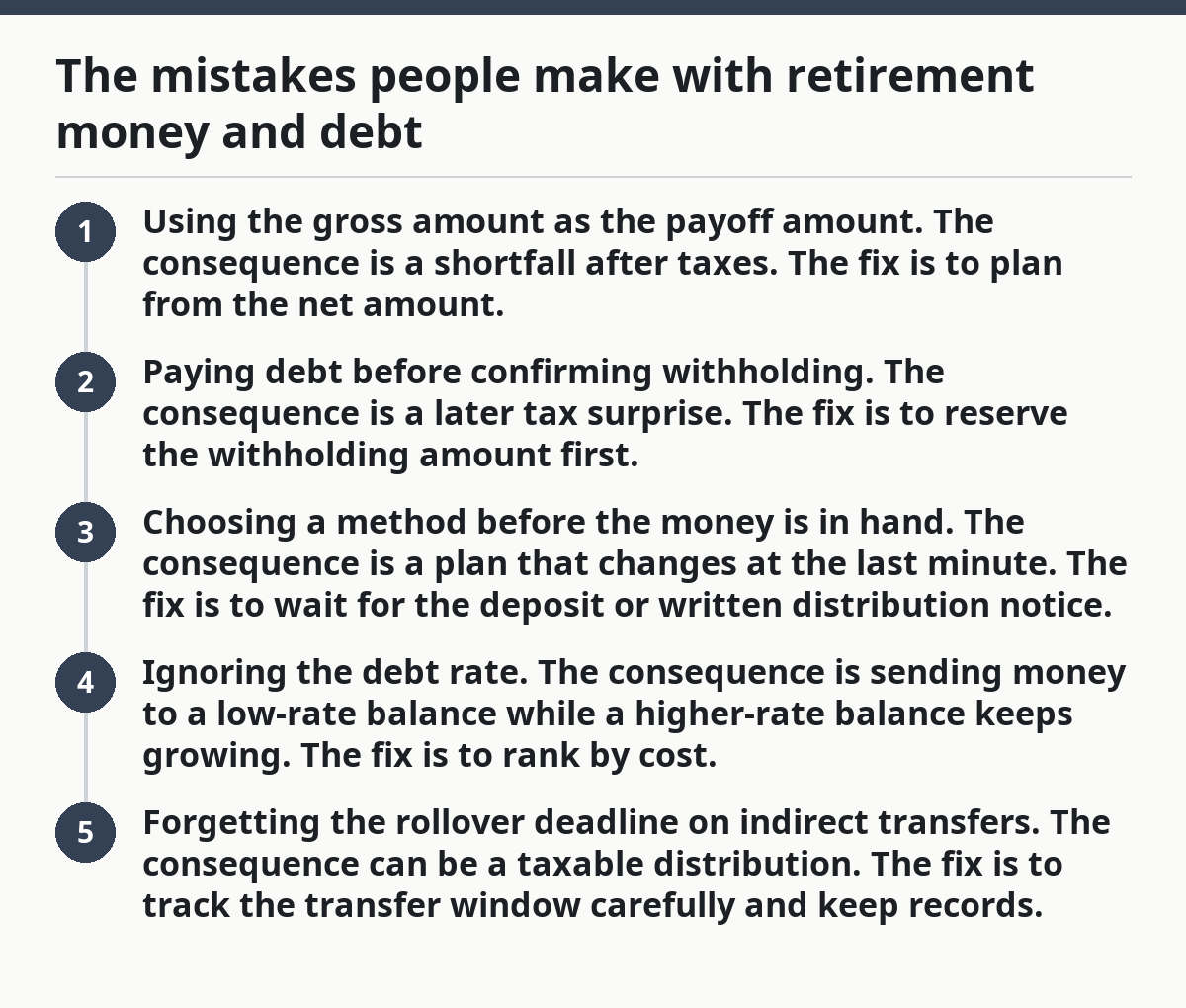
Five errors show up again and again:
- Using the gross amount as the payoff amount. The consequence is a shortfall after taxes. The fix is to plan from the net amount.
- Paying debt before confirming withholding. The consequence is a later tax surprise. The fix is to reserve the withholding amount first.
- Choosing a method before the money is in hand. The consequence is a plan that changes at the last minute. The fix is to wait for the deposit or written distribution notice.
- Ignoring the debt rate. The consequence is sending money to a low-rate balance while a higher-rate balance keeps growing. The fix is to rank by cost.
- Forgetting the rollover deadline on indirect transfers. The consequence can be a taxable distribution. The fix is to track the transfer window carefully and keep records.
A cleaner choice is usually the one that leaves room for taxes and timing. If you want the rules behind that choice, the IRS has guidance on rollovers and withholding.
How this connects to your larger debt strategy
A retirement distribution should change your debt strategy only after you know whether it is usable cash. If it is not usable, it should not steer the plan at all.
The simplest way to think about it is this: ordinary debt payoff methods work on cash you already control, while retirement distributions may still be in transit. That difference matters. A 401(k) distribution can create withholding and tax consequences, while a direct rollover can remove the money from your spending power entirely.
If you want the broader framework for choosing between payoff methods across different payment sources, the hub on Debt payoff methods and strategy selection sits above this page. This page is for the retirement-money branch only.
FAQ
Is it smart to use retirement money for debt payoff?
It can be, but only when the distribution is actually available as spendable cash and the tax side is clear. A direct rollover is not debt money, and a taxable distribution can create a later bill. The smarter question is whether the net amount fits your debt plan without creating a new cash gap.
How do taxes affect a retirement-based payoff plan?
Taxes can shrink the amount you have left to pay debt, and they can also create a later bill if the distribution is taxable. That means the payoff plan should be built from the net amount, not the headline amount. If withholding is involved, leave room for the difference.
Should a retirement distribution change my payoff strategy choice?
Yes, because it changes the amount and timing of the money you can actually use. A direct rollover means no payoff cash at all, while a taxable distribution may favor a smaller or staged payoff. The method should still work after withholding and timing are counted.
Drafted with AI; not yet reviewed by a person.