Last updated: November 19, 2026
If you’re preparing for bankruptcy, the right payoff method is usually the one that protects cash, treats priority debts first, and avoids transfers or payments that could complicate your filing. This guide shows how to choose between stopping, slowing, or targeting payments before you file, and what that means for creditor treatment. It is about how to choose a debt payoff method when you are preparing for bankruptcy, and it should be read as a planning guide, not a substitute for case-specific advice.
This is information, not financial advice. Bankruptcy rules, means test rules, and creditor treatment vary by country and by case, so a qualified bankruptcy attorney or licensed insolvency professional should review your own situation. See the U.S. Courts bankruptcy pages and the U.S. Department of Justice’s U.S. Trustee Program for basic terms and filing guidance.
Key takeaways
- The main goal before bankruptcy is not “pay everything off”; it’s to avoid mistakes that drain cash or create legal trouble.
- Priority debts and protected assets matter more than balance size in many cases.
- A payment made today can change which creditor gets paid, what the trustee can question, and how much money is left for filing costs.
- A simple rule helps: keep housing, food, transport, and filing prep money first; then sort debts by legal risk, not by stress level.
- If one debt is tied to collateral, wage garnishment, tax debt, or a lawsuit, the payoff method needs more care than a normal snowball or avalanche plan.
Who this is for, and who should do something else
You should use this framework if you already know bankruptcy is on the table and you’re trying to avoid paying the wrong debt first. It assumes you have a list of creditors, a rough monthly budget, and at least a basic sense of your filing timeline, even if that timeline is still fuzzy.
Picture this: you’re behind on several bills, there may be a filing in the next few months, and every dollar you send out now reduces your cushion. A better bankruptcy payoff method is usually the one that keeps you from harming your case.
A few people should stop and get case-specific help before making payments. If you are already being sued, if wages are being garnished, if you have a tax debt, or if a car lender or mortgage lender has a lien, the payoff order can affect more than your budget. Bankruptcy law may give those debts different treatment, and payment timing can matter, so ask a bankruptcy professional before you move money.
Before you pick a payoff method, check these basics:
- Do you expect to file under Chapter 7 or Chapter 13, or are you not sure yet?
- Are any debts secured by a house, car, or other collateral, and if so, should a professional review them first?
- Are any debts priority debts, such as some tax debts, support obligations, or recent government claims?
- Do you need to preserve cash for filing fees, attorney fees, or moving costs?
- Are you within a lookback period where payments to one creditor could be reviewed?
Here’s the catch: the “best” method before bankruptcy is often the one that looks least exciting on paper. That can mean paying nothing extra on general unsecured debt and keeping money for the filing. A standard debt payoff guide may push momentum; this one is about damage control.
How do I choose a debt payoff method when bankruptcy is likely?
You choose the method by ranking debts by legal consequence first, then by cash-flow pressure, then by whether the debt is secured, priority, or unsecured. That order matters more than the usual snowball or avalanche debate.
Picture this: you have credit cards, a medical bill, a past-due utility account, and a tax balance. If you throw extra money at the smallest card because it feels good, you may leave a priority debt unpaid and keep the wrong creditor calm. That is backward for a bankruptcy prep plan.
Use this order:
- Identify the filing path first. Chapter 7 and Chapter 13 treat debts differently, so the payoff method should fit the likely chapter. Verify whether your income, assets, and debt mix point toward one path. If you do not know, that is a sign to pause before sending extra payments.
- List secured debts separately. Secured debt is tied to collateral, like a car or home. Verify whether you’re current, behind, or at risk of repossession or foreclosure. If the collateral matters to you, that debt usually gets different treatment than an unsecured card.
- Mark priority debts. Priority debt means a debt the bankruptcy code gives special treatment, often because the law puts it ahead of general unsecured debt. Verify whether you owe taxes, support, or another category that can survive bankruptcy or need special handling. If yes, that debt needs closer review.
- Stop treating all unsecured debts the same. Credit cards, personal loans, and many medical bills are often general unsecured debts. Verify whether any creditor is already in collection or litigation. If not, extra payments may not help enough to justify the cash loss.
- Protect filing cash. Set aside money for the filing process, records, and basic living costs. Verify that the amount you reserve is real, not wishful. If paying a creditor means you cannot file when you need to, the method is hurting you.
- Avoid unusual transfers. Large lump-sum payments, paying one family lender back, or moving money around can raise questions. Verify whether the payment is ordinary and well-documented. If it is not, stop and ask before you act.
- Choose the simplest method that fits the legal order. In many cases, that means making minimum required payments on debts that protect essential property and pausing extra paydown on the rest. Verify that the plan still leaves enough for rent, food, medicine, and transport. If it doesn’t, the plan is too aggressive.
A useful check: if a payoff method changes only your mood, but not your legal risk, it is probably the wrong method for bankruptcy prep.
What should I pay first before filing bankruptcy?
You should pay first what keeps you housed, working, and within the filing rules. That usually means current housing costs, essential utilities if they are not already covered, and debts tied to property you still plan to keep.
Picture this: you have a car loan, a landlord email, and a credit card due in the same week. The card may feel urgent because collection calls are loud, but the car or housing payment may matter more because missed payments can trigger repossession or eviction steps.
Use this priority stack:
- Housing costs and secured debts linked to essentials
- Priority debts
- Debts with a live lawsuit, garnishment, or repo risk
- General unsecured debts
- Old collection accounts with no current action
The stack is not a promise of what to pay. It is a way to see the real cost of each dollar. A credit card paid today may still be discharged later, while a missed secured payment can have a faster consequence.
What to check before you send any payment
You should check three things before paying a single extra dollar: whether the debt is priority or secured, whether the payment could be treated as unusual, and whether the money would be better kept for filing. That check takes about 15 minutes per creditor, and it can save far more than that in trouble.
Picture this: you’re holding a bill in one hand and your online banking app in the other. The instinct is to pay the loudest creditor. The better move is to verify the debt type, the timing, and the paper trail first.
Check these items in order:
- Debt type: unsecured, secured, or priority.
- Current status: current, 30 days late, in collections, sued, garnished, or in repo/foreclosure stage.
- Payment history: whether the creditor has received unusual lump-sum payments or last-minute transfers.
- Lookback risk: whether the payment could be reviewed later by a trustee.
- Cash reserve: whether you still have enough for filing costs and bare-bones living expenses.
If you cannot classify a debt in 10 minutes, that itself is useful data. It means the debt may be more complicated than a normal payoff spreadsheet can handle.
One good source for plain-language bankruptcy basics is the U.S. Courts’ bankruptcy information pages, and many readers also check the U.S. Department of Justice’s U.S. Trustee Program for means test and filing guidance. Those pages won’t choose a payoff method for you, but they can help you confirm terminology before you meet a bankruptcy attorney. For chapter-level differences and filing basics, the Bankruptcy Basics page is also useful.
A simple rule for payment timing
You should avoid making emotional payments in the last stretch before filing. The timing of payments matters because bankruptcy looks at recent financial moves, not just balances.
Picture this: a creditor is calling every day, and you want the call to stop. If you send one last payment to quiet that creditor while ignoring the rest, you may create a preference issue or drain money you need for the petition.
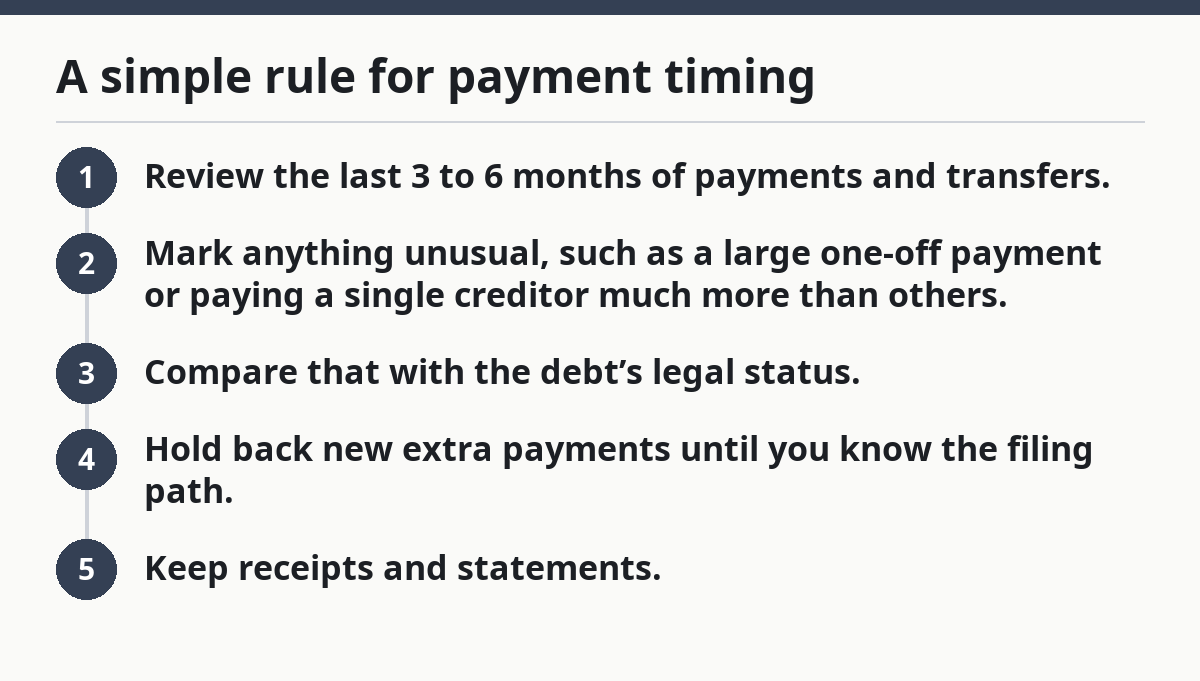
Use this timing check:
- Review the last 3 to 6 months of payments and transfers.
- Mark anything unusual, such as a large one-off payment or paying a single creditor much more than others.
- Compare that with the debt’s legal status.
- Hold back new extra payments until you know the filing path.
- Keep receipts and statements.
If the payment looks like a special favor, not ordinary bill management, it may be the wrong move.
When to stop paying extra and get qualified help
You should stop extra payoff planning and get qualified help when the payment choice could change your bankruptcy outcome. That is not about fear; it is about the fact that some debts and payments carry legal consequences that a normal budget plan does not see.
Picture this: you have enough money for one extra payment, but that payment could go to a creditor that later gets challenged, or it could keep a critical bill current. The wrong choice can cost more than the debt amount.
Stop and get case-specific guidance if any of these are true:
- You are within months of filing and have limited cash: this can make extra payments pointless or harmful — focus on preserving filing money.
- A creditor is suing you or garnishing wages: this changes urgency and may change the order of payment — ask about creditor treatment right away.
- You owe taxes, child support, or spousal support: priority debt rules often apply — do not treat these like card balances.
- You have a car or home you want to keep: secured debt payment timing can affect repossession or foreclosure risk — review the collateral rules first.
- You made a large payment to one creditor recently: this can matter under bankruptcy review rules — keep records and ask before sending more.
- You are thinking about moving money to family or friends instead of paying creditors: this can create a different legal issue — pause before transferring anything.
The truth is, the right move may be to stop chasing payoff entirely and shift to documentation, filing prep, and protecting exempt property. That can feel passive. It isn’t. It is a decision.
The mistakes people make before bankruptcy, and what they cost
You can avoid the biggest errors by treating bankruptcy prep like a legal budget, not a motivational challenge. The common mistakes are simple, but their costs are not.
Picture this: you’re tired, calls keep coming, and a “small win” looks good. That is when people make the wrong debt look like the right debt.
Common mistakes include these:
- Paying the smallest balance first because it feels tidy. The consequence is that you may starve a priority or secured debt of cash. The better alternative is to rank debts by legal treatment first.
- Ignoring filing money to keep paying creditors. The consequence is that you may delay filing or make the filing harder. The better alternative is to reserve cash for the case before extra payments.
- Making one big payment to quiet a single creditor. The consequence is possible lookback questions and less cash for necessities. The better alternative is to keep payments ordinary and documented.
- Treating all debts as equal. The consequence is wrong payoff order and false confidence. The better alternative is to separate priority, secured, and unsecured debts on day one.
- Using debt payoff advice meant for people not filing bankruptcy. The consequence is that a snowball or avalanche plan may work against your legal posture. The better alternative is to use a bankruptcy-aware order.
- Forgetting about collateral. The consequence is losing a car or home because the payment plan missed the secured debt. The better alternative is to identify every lien and decide whether the property is worth keeping.
A generic debt guide says “attack debt aggressively.” That can be fine when bankruptcy is off the table. Here, aggressive paydown can be the wrong tool.
What if my situation is not standard?
You need a modified plan if your debt mix, income, or assets make the usual payoff order too simple. The standard method assumes ordinary unsecured debt and a clear timeline. Real life is messier.
Picture this: one account is in collections, one is a student loan, one is a tax bill, and you have a car you depend on for work. A single payoff method will not fit all of that cleanly.
Adjust the plan this way:
- If you have mostly general unsecured debt: keep payments minimal and preserve cash.
- If you have a secured debt you need to keep: prioritize the current payment on that debt first.
- If you owe priority debts: separate them from everything else and review their treatment before making extra payments elsewhere.
- If your income may push you through the means test: keep careful records of income and spending, because the filing path can change.
- If you have assets you may need to protect: review exemptions before selling, transferring, or paying down debt.
A good adjustment is not always “pay more.” Sometimes it is “pay differently,” or “stop paying extra until the filing plan is clear.” That is a better use of limited cash than trying to outpace a legal process with a normal payoff strategy.
For a broader overview of method choice outside the bankruptcy context, the hub guide on debt payoff methods and strategy selection can help you compare basic payoff logic before you apply the bankruptcy filter. You can also compare chapter basics and filing steps on the U.S. Courts site before deciding whether to keep paying.
FAQ
Should I keep paying debts before bankruptcy?
You should keep paying only the debts that help protect essential property or satisfy a legal priority. Extra payments on ordinary unsecured debt often do less good than people expect once bankruptcy is likely. If you’re unsure which debts fit that category, the debt type and filing timeline should be reviewed before you send more money.
Which debts matter most before filing?
Priority debts, secured debts, and any debt tied to current legal action usually matter most.
Drafted with AI; not yet reviewed by a person.