Last updated: November 19, 2026
Quick answer: In most cases, the best way to choose a debt payoff method when you want to protect your credit mix is to keep at least one installment account and one revolving account open while you pay down balances. This guide shows how credit mix, credit utilization, and account age interact so you can choose a payoff order that fits your profile.
Key takeaways
- Credit mix matters, but it is only one part of a credit score.
- Paying debt down can help or hurt different score factors at the same time.
- Closing an account can change your credit profile faster than paying it off.
- The right payoff order depends on which accounts are open, old, or near zero.
- For a personal reading of your file, speak with a qualified adviser.
Who this is for — and who should do something else
If you are choosing how to choose a debt payoff method when you want to protect your credit mix, this is for you if you have a few debts, some credit history, and do not want a payoff plan that makes your credit profile thinner than it needs to be. This applies if you are choosing between avalanche, snowball, or balance-priority payoff and you want to keep your credit mix intact.
This article assumes you already know your accounts, balances, and whether each one is an installment account, revolving account, or open account. It also assumes you can check your credit reports and see which accounts are open, closed, or paid as agreed. The exact score impact varies by country and scoring model, so use this as a framework, not a universal rule. For a broader scoring overview, the Consumer Financial Protection Bureau explains that scores are built from several factors, not one alone: https://www.consumerfinance.gov/consumer-tools/credit-scores-and-reports/
Who should slow down and get qualified help: if you are behind on payments, in collections, in a debt management plan, or facing foreclosure or bankruptcy. Those situations change the math fast. They also change what “protecting credit mix” means in practice. If that is your situation, consult a qualified credit counselor or attorney before changing payoff order.
- Installment account: a loan with fixed payments and an end date, such as a car loan or student loan.
- Revolving account: a line of credit, such as a credit card, where balances can move up and down.
- Open account: an account that is paid in full each billing cycle, which is less common on consumer credit reports but still a real category in some systems.
The truth is, you are not trying to “maximize” every score factor at once. You are trying to avoid creating a weak spot while you pay debt off. That is a different job.
How credit mix fits into a payoff decision
Credit mix is the variety of credit types on your report, such as installment loans and revolving accounts. A lender may look at that mix as one small sign that you can handle more than one kind of obligation. It is usually not the biggest factor, but it can matter when the rest of your file is thin. FICO says credit mix is one of the factors in a score, alongside payment history, amounts owed, length of credit history, new credit, and credit mix: https://www.myfico.com/credit-education/what-is-a-fico-score
Here’s the catch: payoff methods do not affect credit mix in the same way. Paying down a balance usually helps utilization, which is the share of revolving credit you are using. Closing an account can shrink your active mix. Paying off an installment loan can change the age and type of open accounts, even if the account remains on your report for years. In Experian’s explanation of credit mix, having both installment and revolving accounts can help a score, but only as one factor among several: https://www.experian.com/blogs/ask-experian/what-is-credit-mix/
That means the question is not “Which method is best for credit?” It is “Which method changes my profile the least in the wrong places?” A plan that wipes out one whole category of credit may be fine for one borrower and a mistake for another.
Use the standard credit-factor lens:
- Payment history is still the biggest driver in most scoring models.
- Credit utilization matters most on revolving accounts.
- Account age can soften or sharpen the effect of payoff choices.
- Credit mix matters most when your file has very few active account types.
If you want the broader strategy context, the hub on Debt payoff methods and strategy selection is the right place to compare payoff styles at a higher level.
Which payoff method protects credit mix best?
The method that best protects credit mix is usually the one that pays debt without closing your only remaining installment or revolving account. That often means a payoff order that is a little more selective than pure balance-busting.
The right choice depends on what you already have open. If you have one car loan and three credit cards, paying the cards first may reduce utilization without removing your only installment account. If you have only one credit card and one personal loan, paying off the loan early could leave you with a thinner mix even if your debt load falls.
| Method | What it changes | Good fit | Credit-mix risk |
|---|---|---|---|
| Avalanche | Targets highest interest first | Reader focused on cost control | Low to moderate, depending on which account is paid off first |
| Snowball | Targets smallest balance first | Reader who needs quick wins | Low to moderate, because order can close the wrong account type early |
| Balance-priority | Targets the account with the largest balance | Reader with one large revolving balance | Moderate, because it may ignore account type |
| Mixed order | Chooses by type, age, and balance | Reader protecting credit mix | Lowest when planned carefully |
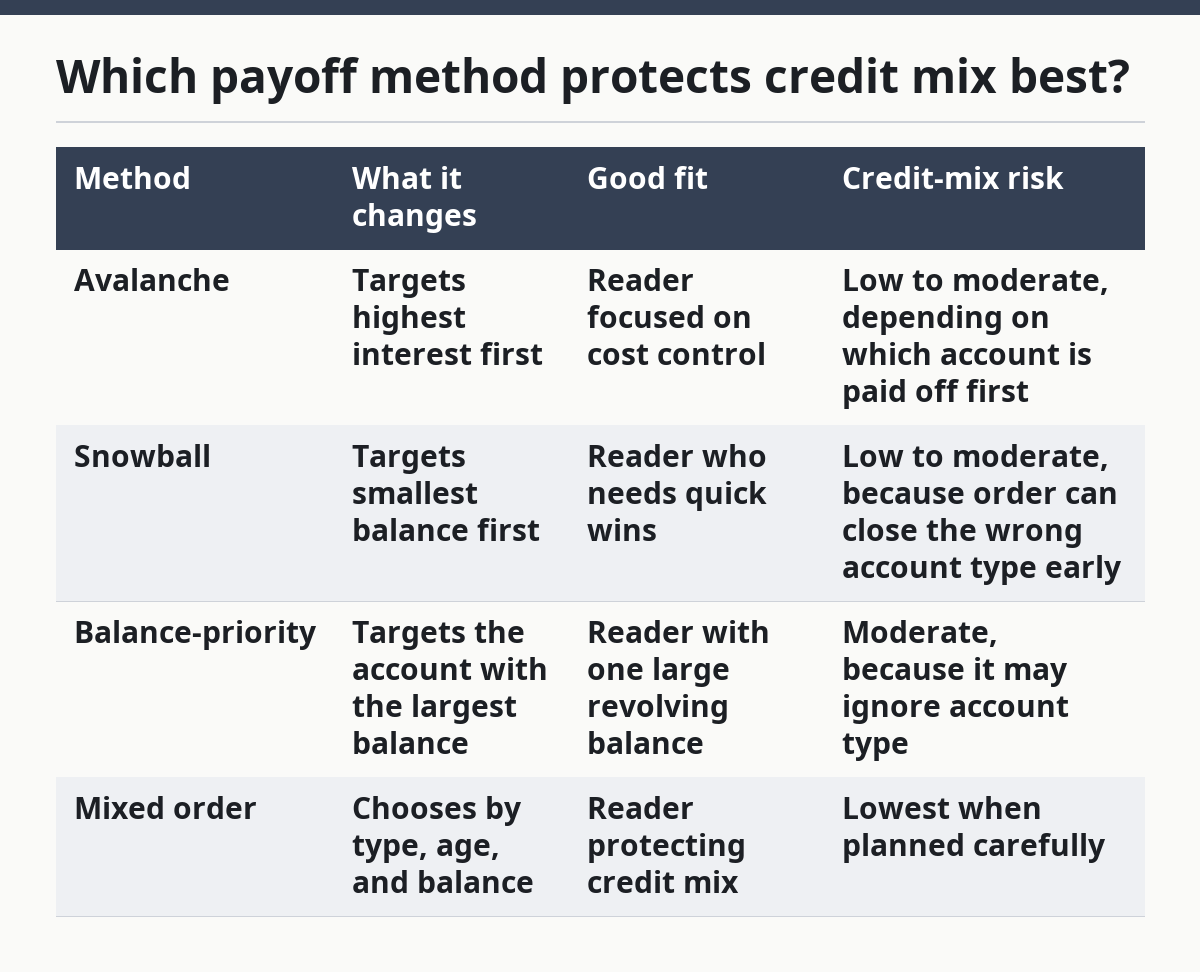
The best part is that you do not need a new system. A mixed order is often just a modified version of a standard method. Pay the debt that helps cash flow, but keep an eye on which account type you are removing from the file.
How do I choose a payoff order without losing my credit profile diversity?
You choose a payoff order by ranking accounts by type, balance, age, and whether closing them would leave you with only one credit category. The steps are simple.
-
List every debt with its type. Write down whether it is revolving, installment, or open account, plus the current balance and minimum payment. If any account type is unclear, pull the credit report entry and verify it before moving on. A wrong label can send you toward the wrong payoff order.
-
Mark which accounts are oldest. Note the open date or approximate age of each account in months or years. If two accounts are close, the older one usually matters more for account-age history. A problem shows up if you are about to close your oldest active account just because the balance is small.
-
Identify your only account types. Circle any category that appears only once on your report, such as a single installment loan or a single credit card. If paying it off will close it, your profile may become less varied. That does not mean “never pay it off.” It means pause and check the trade-off.
-
Check utilization on revolving accounts. Divide each card balance by its limit and note the ones above 30%. If a payoff method lowers utilization on several cards at once, that often helps more than focusing on one installment balance. A red flag is a method that pays a low-impact loan first while a card stays near maxed out.
-
Separate payoff from closure. Paying a debt to zero is not the same as closing the account. If the lender leaves the account open, the credit profile may keep more variety. If the account closes, your available credit and active mix can change. Lender policies vary, so check the account terms before you assume either outcome.
-
Choose the debt that helps two factors at once. Look for the account that improves utilization, lowers payment stress, or reduces risk without stripping your file of its only remaining category. This is often a revolving balance with high utilization, not the oldest installment loan. If two choices are equal, prefer the one that keeps more account types open.
-
Check the post-payoff picture before sending extra money. Ask: after this payment, will I still have at least one installment account and at least one revolving account open if I need them? If not, the method may be too aggressive for your goal. That is the point where a different order makes more sense.
-
Recheck after each payoff. Credit profiles change as accounts close, report zero balances, or age further. A plan that made sense at the start of the year may not fit after two or three accounts disappear. If the mix becomes too thin, slow the pace on the next account type.
A good payoff plan does not just erase balances. It leaves your credit file with enough shape to keep working for you.
What should I check before paying off the next debt?
You should check account status, reporting timing, and whether payoff will close the account before you move a dollar. Those details can matter more than the payoff method label.
Picture this: you are ready to clear a balance, but the lender reports paid-off status, closed status, or zero balance on a different schedule than you expected. That can change your profile for a month or more, depending on the bureau and the creditor. The number to watch is not only the balance; it is also whether the account stays open. According to the Consumer Financial Protection Bureau, lenders generally report credit information on a monthly cycle, so timing can matter: https://www.consumerfinance.gov/consumer-tools/credit-reports-and-scores/
Use this short checklist before the next payoff:
- Confirm whether the account is closed upon payoff or stays open.
- Check whether the debt is revolving or installment.
- Look at the account’s age in months or years.
- Review the current utilization rate on every credit card.
- Make sure at least one other account can carry the same credit type if this one closes.
If the answer to any of those is unclear, do not guess. A false assumption about account closure is one of the easiest ways to damage a credit profile while trying to improve it.
When should you stop and rethink the plan?
You should stop and rethink the plan whenever payoff would remove your only useful account type, push utilization the wrong way, or conflict with a bigger debt problem. Credit mix matters, but it should not override basic stability.
Your only installment loan is nearly paid off: If paying it to zero would leave you with only revolving credit, your mix becomes thinner — consider a slower payoff order or leave that loan for later if cost and cash flow allow.
Your only credit card is the next target: If closing it would leave no revolving account on the file, your active mix narrows — keep the account open if the lender allows and the fees make sense.
Several cards are already at high utilization: If the cards are crowded, paying a loan first may not help the score much — target revolving balances before shifting to installment debt.
An account closes automatically at payoff: If the lender shuts it down, your credit profile may lose variety — check the lender’s policy and compare other payoff options.
You are missing payment history elsewhere: If your file is thin and short, losing one active account type can matter more than on a mature file — slow the payoff pace and preserve open accounts where possible.
You are choosing between debt and delinquency: If the payment plan is stretching you toward late payments, the credit-mix question is the wrong one — protect the accounts first, then refine the order.
On the flip side, if you already have several open installment and revolving accounts, the mix issue may be minor. Then the cleaner payoff method is often the one that saves the most interest or simplifies the monthly budget.
Common mistakes that hurt the wrong part of your credit file
The biggest mistake is treating all debt the same and ignoring what type of account is being removed. That can leave you with a paid-off balance and a thinner credit profile at the same time.
-
Paying off the only installment loan first. The consequence is a narrower mix and fewer active tradelines. The better alternative is to compare that loan with high-utilization revolving debt and see which payment changes more than one factor. If your file is thin, consider a qualified credit counselor or financial professional before you decide.
-
Closing a credit card right after paying it off. The consequence is lower available credit and a smaller revolving segment. The better alternative is to ask the issuer whether it can stay open with a zero balance.
-
Ignoring utilization while chasing account type. The consequence is that the score can stay under pressure even after the debt shrinks. The better alternative is to clear the cards that improve utilization fastest.
-
Assuming every payoff improves credit mix. The consequence is disappointment when the file becomes less diverse. The better alternative is to check whether the payoff removes the last account of its type.
-
Using an old account only as a mental win and then shutting it down. The consequence is loss of age and history on the active file. The better alternative is to keep mature accounts open if they have no fee problem and are not a spending trap.
-
Forgetting that open accounts can be rare. The consequence is that you may not notice you have only one active line left of a certain type. The better alternative is to map the whole file before you make a final payment.
The right fix is rarely dramatic. It is usually a smaller change in order, timing, or closure decisions.
What if my credit file is thin or mixed in unusual ways?
You need a more careful order if your file is thin, newly rebuilt, or built from nonstandard accounts. A 2-account profile and a 12-account profile do not react the same way.
If you have very few accounts, every payoff has a larger effect. Losing one installment loan when you only have one can matter more than a similar payoff on a thick file with several cards, a mortgage, and another loan. If your report includes an open account, such as a charge card or utility-style account that reports differently, verify how that lender reports before you count it as part of your mix.
Special cases to watch:
- Thin file: Keep at least one account of each common type open where possible.
- Rebuilt file: Prioritize on-time payment history over perfect payoff order.
- Student loan-heavy file: Paying off a student loan can change installment mix, but the larger issue may be payment history and utilization elsewhere.
- Secured card or starter credit card: These accounts often carry more value than the balance suggests because they may be one of your only revolving lines. If you are unsure how closing it affects your report, consult a qualified credit professional and review the issuer’s reporting policy.
- Paid-off auto loan with no other installment debt: The file may already be leaning too hard toward revolving credit.
When the file is unusual, the standard “smallest balance first” or “highest interest first” rule needs adjustment. Credit mix is not the only factor, but in a thin file it can be the factor you notice most after the fact. For credit-file basics and reporting guidance, see the Consumer Financial Protection Bureau: https://www.consumerfinance.gov/consumer-tools/credit-reports-and-scores/
FAQ
Does paying off one type of debt hurt credit mix?
It can, if that payoff removes your only account of that type. Paying off a debt does not always hurt your credit profile, but closing the last installment or revolving account can make your mix thinner. The effect depends on what else is still open and how the account is reported.
Drafted with AI; not yet reviewed by a person.