
Last updated: November 20, 2026
Quick Answer: In most cases, the best debt payoff method fit by legal and credit-report consequences depends on the debt’s status; for many people, paying current accounts in full and on time is the cleanest route, while settlement, hardship plans, bankruptcy, or a credit counseling plan can make more sense when delinquency, collections, or court risk already exist. The sections below sort that out, so you can see what each method does to collections, late marks, settlements, and your credit file.
The wrong payoff method can change what shows up on your credit reports and what a creditor can still do legally. The best fit is usually the one that matches your debt type, your cash flow, and the legal rules in your country.
The sections below sort that out, so you can see what each method does to collections, late marks, settlements, and your credit file.
Key takeaways
- The method that feels fastest is not always the one that leaves the cleanest credit file.
- Paying a debt in full, settling for less, and entering a hardship plan can all be reported differently.
- A charge-off, collection, judgment, or bankruptcy can change the legal picture more than the payoff method itself.
- Federal rules in the U.S. do not erase every entry when you pay; the reporting code and account status still matter.
- If you have a lawsuit, wage garnishment, tax debt, or secured debt, the legal path matters as much as the math; consider getting help from a qualified professional because rules vary by jurisdiction. See the CFPB on debt collection and credit reporting basics: https://www.consumerfinance.gov/consumer-tools/credit-reports-and-scores/ and https://www.consumerfinance.gov/ask-cfpb/category-debt-collection/.
- This is information, not financial advice. A qualified adviser should look at your own facts before you act.
Which debt payoff method fits your legal and credit-report situation?
The right method is the one that matches the debt’s status, because credit reporting and collection rights do not work the same way for every account. If a debt is current, late, charged off, in collections, or already in court, the payoff method changes what the file shows and what the creditor can still do.
Picture this: you have three accounts, one credit card that is current, one collection account, and one old medical bill. You want the fastest clean-up, but you also want to avoid making the wrong move on the account that can still be collected through a lawsuit. The answer depends on the stage of each debt, not just the dollar amount.
In the U.S., lenders and collectors often report to the credit bureaus under the Fair Credit Reporting Act, and debt collection rules can fall under the Fair Debt Collection Practices Act. Similar rules exist elsewhere, but the details, time limits, and court steps differ by country. That means the same payoff move can have different legal and credit results in different places.
A practical fit looks like this:
- Current debt with no missed payments: standard payoff or extra principal payments usually have the cleanest reporting path.
- Late but not charged off: catching up may stop new delinquency marks, but earlier late payments usually stay on the report.
- Charged-off account still owned by the original lender: paying in full or settling may update the balance, but the charge-off history often remains.
- Collection account: payoff can close the account, yet the collection entry may remain for a reporting period set by local law.
- Debt in lawsuit or judgment stage: settlement can reduce exposure, but the paper trail and court effect matter as much as the balance.
The legal and credit answer is rarely “one best method.” It is “one best method for this stage of debt.”
That’s the whole game.
What the methods actually mean
The words matter because creditors and bureaus do not treat every payoff the same way, so it helps to check local rules or consult a qualified professional if the account is disputed or legally sensitive. See the CFPB’s credit report and debt collection resources for general background: https://www.consumerfinance.gov/consumer-tools/credit-reports-and-scores/ and https://www.consumerfinance.gov/ask-cfpb/category-debt-collection/. Paid in full means the debt was satisfied for the full amount owed, though the account can still keep older negative history. Settled means the creditor accepted less than the full balance. Reinstated means a defaulted loan was brought back into good standing under its contract terms. Bankruptcy discharge wipes out personal liability on many debts through a court process, but it has its own reporting and legal effects.
Here’s the catch: a consumer often hears “paid off” and assumes the file will look clean. That is not how reporting usually works.
- A late payment already reported may stay reported.
- A charge-off may still show even after payment.
- A settlement can be reported as “settled” or “paid settled,” which is not the same as “paid in full.”
- Some debts can be removed from credit reports after a time limit, while others remain in public court records.
If the debt is secured, the collateral adds another layer; because the legal effect can vary by contract and location, consider a qualified professional before acting on a mortgage, auto loan, or secured personal loan. A mortgage, auto loan, or secured personal loan can trigger repossession or foreclosure rights if you stop paying. Paying off the loan can clear the lien or security interest, but the release process may take extra paperwork.
That paperwork matters.
What changes on your credit report when you pay different kinds of debt?
The short answer is that payment changes the balance and status, not always the history. Credit reports usually keep the payment pattern, the delinquency dates, and the collection or charge-off label even after the balance hits zero.
Picture this: you finally scrape together enough cash to clear a collection account. You expect the file to look as if the debt never happened. Instead, the account still shows the old late marks, plus a note that it was paid or settled. That is normal in many reporting systems.
A few common outcomes matter:
- Paid in full: often best for the status field, but the late history may remain.
- Settled for less than full balance: usually better than an unpaid collection, but weaker than full payment for future lenders.
- Paid collection: the balance may show zero, yet the collection event itself can remain.
- Charge-off paid after charge-off: the charge-off entry often stays until the normal reporting window ends.
- Re-aged account: if a collector or servicer changes dates the wrong way, that can violate reporting rules in some places.
The reporting window is one of the biggest traps. In the U.S., many negative items can stay on a consumer report for a period set by law and bureau practice, but that period varies by item type and jurisdiction. A paid item does not automatically disappear the day you pay it.
That leads to a useful distinction:
- Credit score effect — the model used by a lender may improve, stay flat, or change slowly.
- Credit report effect — the tradeline may still show the old event.
- Legal effect — the creditor may still have collection rights until the debt is satisfied, settled, discharged, or time-barred under local law.
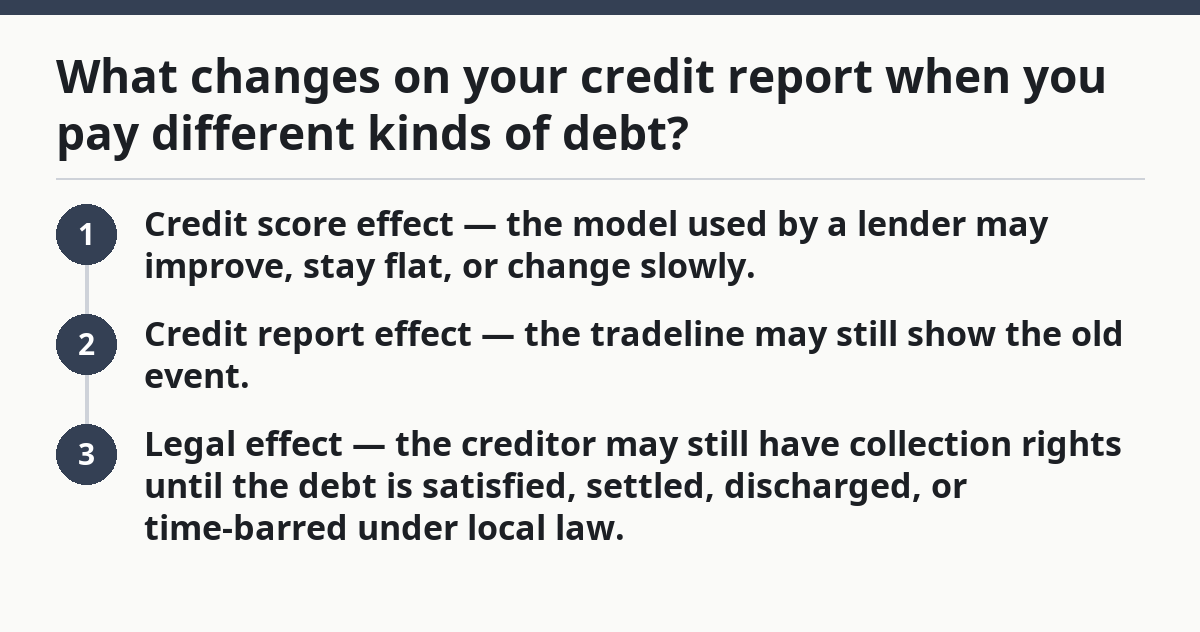
Those three are related, not identical.
Confusing them causes expensive mistakes.
How each common payoff method usually reports
Different payoff methods send different signals to future lenders. The exact code depends on the creditor and bureau, but the broad pattern is stable.
- Snowball method: You pay the smallest balance first while making minimums on the rest. Credit reporting usually improves where the smallest debt gets closed, but the method itself does not change how late marks are reported.
- Avalanche method: You attack the highest interest rate first. Reporting works the same way; the credit benefit comes from balances shrinking and delinquencies being avoided, not from the label “avalanche.”
- Debt management plan: A nonprofit or similar service may negotiate lower rates or one monthly payment. Some creditors may close or restrict accounts, which can affect the report while the plan is active.
- Debt settlement: The creditor accepts less than the full amount. This often leaves a settlement code or wording that future lenders may dislike more than a full payoff.
- Bankruptcy: The legal outcome can be stronger than any payoff plan for dischargeable debt, but it has major credit consequences and long reporting effects.
- Direct pay in full: Usually the cleanest from a reporting-label perspective, assuming the creditor reports it correctly.
The same method can look different depending on whether the debt is already delinquent. Paying a current card in full is not the same as paying a collection in full.
That difference matters.
Which payoff method is the least harmful if you care about your credit file?
The least harmful method is usually the one that keeps accounts current, because new late marks often hurt more than the payoff label helps. If you can maintain minimum payments while making extra payments on one debt, that often protects the report better than skipping payments to chase the “perfect” payoff order.
Picture this: you are choosing between rushing a settlement and keeping every other account current. The report can punish a fresh 30-day late mark harder than it rewards a fast payoff. On the flip side, keeping a debt current may cost more interest if the rate is high.
For many borrowers, the practical ranking looks like this:
- Stay current and pay extra on one account — best for report stability.
- Pay in full on time — usually strongest clean-up signal.
- Enter a hardship plan with preserved on-time reporting — sometimes helpful if the creditor agrees.
- Settle after delinquency — may stop collection pressure, but the report label is weaker.
- Ignore the debt until charge-off or collection — usually the most damaging report path.
That ranking is about reporting, not moral judgment. A debtor with no cash cushion may need a different path than a debtor with stable income. The report does not care about your reasons; the ledger does.
Here’s the catch: the “best credit move” may not be the “best legal move.” If a debt is old enough to be time-barred in your jurisdiction, making a payment or written promise can sometimes restart the clock in some places. That is why a collector’s request for a token payment can have legal consequences that outlast the payment itself.
Also, a debt that is close to dispute or identity fraud should not be handled like a normal payoff. If the account is not yours, has wrong dates, or has a disputed balance, paying too soon can muddy the record.
What to check before you choose a payoff path
Before you send money, check the facts that control the result. The list may feel tedious, but it can be the difference between a clean close and a mess.
- Who owns the debt now? Original creditor, collector, or buyer.
- Is it current, late, charged off, or in court?
- What does your country’s reporting law say about time limits?
- Is the debt secured by collateral?
- Does any payment restart a limitation period where you live?
- Will the creditor report “paid in full,” “settled,” or something else?
- Do you have the amount in writing before you pay?
If the answer to any of those is unclear, the payoff method is not the first issue. The file status is.
And that is where you should start.
How do legal consequences differ between payoff methods?
Legal consequences differ because a debt can be collectible even when it is ugly on credit reports. A reporting label does not erase a contract right, a collection right, a lien, or a court order.
Picture this: two people both have old unpaid cards. One account is already in a lawsuit; the other is just sitting in collections. They may look similar on a credit report, but the legal risk is not the same. The sued debtor faces deadlines, defenses, and possible judgment. The other debtor may only face phone calls, letters, or an eventual settlement offer.
The legal outcomes that matter most are these:
- Collection activity: calls, letters, and settlement demands may continue until the debt is resolved or the legal deadline passes.
- Lawsuit risk: some creditors can sue within the applicable limitation period.
- Judgment risk: if a creditor wins, it may gain stronger collection tools under local law.
- Lien or security enforcement: secured debts can affect property rights.
- Discharge: bankruptcy can eliminate personal liability on many debts, but not all.
The legal effect of payment depends on what you pay and how you document it. Paying in full on a simple unsecured debt usually ends the creditor’s claim for that balance. Settling can end the claim too, if the agreement clearly says the creditor accepts the lesser amount as full satisfaction. Paying without getting terms in writing can leave room for disputes about the remaining balance.
The truth is, some debts are not just “owed money.” They are a stack of rights, dates, and procedures. A payoff method that ignores that stack can leave you exposed.
When legal status changes the right answer
These are the situations where the standard “just pay it off” advice breaks down.
- A lawsuit has already been filed: court deadlines may matter more than payoff speed.
- A judgment already exists: the creditor may have stronger collection tools than a normal collector.
- The debt may be time-barred: a payment or written promise may have legal effect in some places.
- The account is disputed for identity or amount: paying can complicate the record.
- The debt is secured: repossession, foreclosure, or lien release issues come into play.
If any of those apply, the payoff method is not just a budgeting choice. It is a legal event.
Treat it that way.
How do you choose between snowball, avalanche, settlement, and bankruptcy?
You choose by matching the debt’s legal stage, the cash you have, and the reporting trade-off you can live with. Snowball and avalanche are repayment order methods; settlement and bankruptcy are legal outcome methods. Mixing them up leads to bad decisions.
Picture this: you have $500 extra each month and four debts. One is current, one is 90 days late, one is in collections, and one is a federal tax debt or similar public claim. The right path may not be “the highest rate first” if the legal exposure on one debt is already bigger than the interest cost on another.
Use this rough decision frame:
1) If the debt is current
Use a standard repayment order, usually snowball or avalanche, based on whether you need motivation or interest savings. Your report stays cleaner if you keep accounts current.
That part is simple.
2) If the debt is late but not yet in court
Focus on catching up or negotiating a hardship plan before the account moves deeper into negative status. The earlier you stop new late marks, the better the reporting outcome is likely to be.
Timing matters.
3) If the debt is already in collections
Ask for the settlement terms in writing before paying. A paid collection is better than an unpaid one, but the entry may still stay on the report for the applicable reporting period. Settlement can make sense if cash is tight and the alternative is no payment at all.
4) If the debt is in court or likely headed there
The legal process starts driving the decision. A lawsuit, default judgment, garnishment, or property lien can change the cost of waiting.
This is not the stage for guesswork.
5) If the debt is unmanageable across the board
Bankruptcy may be the legal tool that matches the problem, depending on the debt type and local law. It is not a credit-cleaning trick. It is a formal legal remedy with serious reporting and eligibility effects.
You do not need to guess which category you are in. The account status, collection letters, court papers, and credit report all give clues.
Check all four.
How to compare the methods on the same page
Use the same questions for every method:
- Does this stop new late marks?
- Does this change the amount owed?
- Does this change the legal right to sue or collect?
- Does this improve, worsen, or simply preserve the report status?
- Do I need written proof before I pay?
If a method helps the balance but harms the legal posture, it may not fit. If it helps the legal posture but creates a worse report label, it may still be the right compromise. The right answer is not always the prettiest answer.
What mistakes do people make with payoff methods?
The most common mistakes are legal and reporting mistakes, not math mistakes. A wrong payment can still be a wrong move even when the balance drops to zero.
Picture this: you pay the collector first because the calls are annoying, then discover the original creditor still owns the account, or the payment restarted a clock you did not know existed. That is how a clean-sounding payoff turns into a record problem.
The errors I see most often are these:
-
Paying without written terms.
Consequence: the creditor may treat the payment as partial, not final.
Better move: get the settlement or payoff amount in writing before sending money. -
Assuming “paid” means “deleted.”
Consequence: the account may still stay on the credit report with a negative history.
Better move: expect a status change, not a disappearance. -
Ignoring the age of the debt.
Consequence: a payment can sometimes affect limitation periods or revive collection risk where local law allows it.
Better move: check the applicable legal rules before you pay an old account. -
Settling a debt that was already disputed.
Consequence: you may lose leverage if the amount, ownership, or dates were wrong.
Better move: resolve the dispute first, then talk settlement. -
Using the wrong payoff order for secured debt.
Consequence: repossession or foreclosure risk can stay in place while you are busy attacking smaller unsecured balances.
Better move: prioritize debts with collateral risk if the legal timeline is tight. -
Forgetting that a zero balance is not the same as a clean file.
Consequence: you may miss old delinquencies, charge-offs, or public records that still affect lending.
Better move: review the report after payoff and dispute only factual errors.
These mistakes cost time, fees, and sometimes legal leverage. They also make people think the system is random when it is usually just rule-driven.
The rules are annoying, not mysterious.
When does the standard advice not apply?
The standard advice does not apply when a debt has court risk, secured collateral, tax treatment, or reporting disputes that change the result. Those cases need a different sequence, not just a different payment amount.
Picture this: you are comparing two loans and one is ordinary consumer debt while the other is tied to a home, vehicle, or tax authority. The normal “pay highest interest first” method may ignore a legal deadline, lien, or reporting code that matters more than interest for the next 30 days.
Modify the standard approach in these cases:
- Secured debt: check the collateral rules first. A loan tied to property can trigger different remedies than an unsecured card.
- Tax debt: public tax claims often follow separate legal procedures and can carry collection powers that are not like private debt.
- Student loans: repayment and default rules can differ sharply by loan type and country.
- Medical debt: reporting and collection rules may be different from card debt, and billing errors are common.
- Mixed-age debt: some accounts may be close to or beyond a reporting window, which changes the value of payment versus dispute.
- Identity or fraud issues: if the debt is not clearly yours, payment may be the wrong first move.
When the standard playbook does not fit, the key question is not “Which payoff method is best?” It is “What right or risk changes if I pay now?”
That question saves money.
A simple way to sort edge cases
Use three filters:
-
Can the creditor still sue or enforce?
If yes, legal timing is active. -
Will payment change how the account reports?
If yes, get the exact wording in writing. -
Does the debt have special rules?
Secured, tax, student, or disputed debts usually do.
If you cannot answer all three, you do not yet have a payoff plan. You have a payment idea.
That is not enough.
What should you do before you send a payoff or settlement payment?
You should verify the owner, balance, terms, and reporting promise before any money moves. One written agreement beats five phone calls.
Picture this: you are ready to press send on a bank transfer or mail a check. That is the moment to slow down, not speed up. A 10-minute review can prevent a 10-month reporting dispute.
Use this step-by-step checklist:
- Pull the latest credit report for the account. Verify the creditor name, balance, status, and last reported date. If the account is not listed the way you expect, the mismatch is a problem.
- Confirm who owns the debt. Match the collector’s name with the party that can legally accept payment. If the debt has been assigned or sold, paying the wrong party can leave the balance open.
- Check the debt age. Look at the first missed payment date, default date, or other date used in your jurisdiction. If the dates are unclear, the legal status is uncertain.
- Ask for the exact payoff or settlement amount in writing. The letter should say whether the amount satisfies the debt in full or only partially. If the wording is vague, do not pay yet.
- Verify what will be reported after payment. Ask whether the account will be coded as paid in full, settled, closed, or something else. If the collector will not say, assume the report may still show a negative status.
- Check for collateral, liens, or court papers. If the debt is secured or already in litigation, make sure the payment does not ignore another legal claim. A payoff to the wrong layer can leave the larger problem untouched.
- Keep proof of every transaction. Save the letter, receipt, bank record, and final statement. If the amount or status is later wrong, those documents are your evidence.
If any step fails, pause. A debt payoff that lacks paper is just a hope.
Hope is not documentation.
How long does the credit and legal fallout last?
The fallout lasts as long as the law and the reporting system say it does, which is why a paid debt can still matter for years. A balance can hit zero in a day, while the report entry, court record, or collection history lasts much longer.
Picture this: you pay a debt today and expect the next month’s report to erase the scar. Sometimes the balance updates fast. Sometimes the old delinquency still sits there until the normal reporting period runs out or until a factual dispute is corrected.
A few time-based points matter:
- Reporting updates can take one or two billing cycles, sometimes longer.
- Late marks may remain for the full reporting window allowed by law or bureau practice.
- Collection entries can stay even after payment, though the balance should show zero.
- Court records and judgments can last under separate public-record rules.
- Bankruptcy records have their own reporting and court timeline.
That means the result of a payoff is not just “done” or “not done.” It is a sequence:
- payment is sent,
- the creditor updates its books,
- the bureaus receive a file update,
- the report changes,
- old negative history ages off later.
If the creditor reports incorrectly, the update can stall at step three. If the legal paperwork is wrong, the problem can jump to a dispute or court issue.
Neither is rare.
The best outcome is usually simple: the debt is satisfied, the file is accurate, and no extra legal step remains open. That is not the same as instant score repair. It is cleaner than that, and slower.
Patience matters.
FAQ
Is paying off a collection account the same as deleting it?
No, paying off a collection account is not the same as deleting it. The account can still remain on the credit report with a status such as paid or settled, and the negative history may still be visible for the applicable reporting period. Deletion usually requires a reporting error, a successful dispute, or a specific agreement that says the collector will remove it.
Does settling a debt hurt credit more than paying in full?
Settling a debt usually gives a weaker credit signal than paying in full. The report may show that less than the full amount was accepted, which can matter to future lenders even if the balance is zero. If full payment is impossible, settlement can still end collection pressure, but the reporting trade-off is real.
If I pay an old debt, can it restart the clock?
It can, depending on the law where you live and the type of debt. In some places, a payment or written promise can affect the limitation period for collection or a lawsuit. Because those rules vary by country and state, an old account needs a careful check before you send even a small payment.
What is the best payoff method if I want the cleanest credit report?
The cleanest report usually comes from keeping accounts current and paying in full, because that avoids new delinquency marks and avoids the weaker “settled” label. If the debt is already damaged, the best legal and reporting result depends on whether the account is in collections, in court, or secured by collateral. There is no single method that fits every file.
Should I pay a debt that I think is wrong?
No, not until you verify the debt and resolve the error. If the balance, owner, dates, or identity are wrong, paying too early can complicate the dispute and weaken your position. Ask for documentation first, and if the debt is disputed in a legal sense, get qualified help for your situation before paying.
Drafted with AI; not yet reviewed by a person.