Last updated: November 19, 2026
Quick Answer: If you have secured debt and unsecured debt, keep the secured minimums current first, then choose avalanche or snowball for the unsecured balances based on your budget and follow-through. You have secured debt and unsecured debt, and the payoff method that fits one can backfire on the other. The safest default is usually to protect collateral first, then compare snowball and avalanche on the unsecured balances, but a qualified financial professional can help you confirm the order for your own contracts. The sections below will help you sort that out without guessing.
Key Takeaways
- Secured debt can cost you an asset if payments slip, so it changes the order of attack, and a qualified debt or financial professional can help you apply the right order to your accounts.
- Unsecured debt usually gives you more freedom to choose between balance size and interest rate, and a qualified adviser can help you match the method to your numbers.
- A “best” payoff method depends on payment timing, penalty terms, and which account puts property at risk.
- If a loan is tied to a home or car, missing even a few payments can have consequences that a credit card does not.
- This is information, not financial advice; a qualified adviser can help with your own numbers and contracts.
How to Choose a Debt Payoff Method with Secured and Unsecured Debt
How to choose a debt payoff method when you have secured debt and unsecured debt starts with your minimum payments, your collateral, and your due dates. This guide applies if you have secured debt and unsecured debt at the same time, and you want a sensible payoff order, not a slogan. It assumes you already know your balances, minimum payments, and due dates for each account. It also assumes you can tell which debts are tied to collateral, such as a mortgage or car loan, and which are not, such as a credit card or personal loan.
Picture this: you’re staring at three accounts and one paycheck, and the wrong choice could put a car or home at risk. You need a method that respects the collateral first and still gives you a plan for the rest. That is the real decision.
Here’s the catch: a generic “smallest balance first” or “highest interest first” rule is not enough when one missed payment can lead to repossession or foreclosure. Secured debts often have a different consequence ladder than unsecured debts, even when the interest rate looks similar. For general background on debt strategies, the hub page on Debt payoff methods and strategy selection sits above this guide, and the CFPB debt collection guide explains why missed payments can escalate differently. For secured-loan foreclosure and repossession basics, see the FDIC consumer guide and the FTC vehicle repossession guidance.
A few terms matter here. Collateral is property pledged to back a loan. Repossession means a lender can take a vehicle or other pledged asset under the loan contract. Foreclosure is the legal process tied to a home loan in many places; the exact process and timing differ by country and lender.
- If your secured loan is already delinquent, this article still helps you think, but you may need direct help from the lender or a qualified debt professional.
- If you only have unsecured debt, this is the wrong page; a pure snowball-versus-avalanche comparison fits better.
- If your debts include student loans, this page is not the right match for that mix.
How should I choose a debt payoff method with both secured and unsecured debt?
You should choose a method that keeps the secured account current first, then uses either avalanche or snowball for the unsecured accounts based on your cash flow and discipline. That means the “best” method is often a hybrid, not a single rule applied to every balance.
Picture this: you’re deciding between a credit card at 24% and a car loan that could cost you the car if you miss payments. The math matters, but the consequence of default matters too. That is why collateral changes the order.
Start with the secured debt’s minimums. A mortgage, car loan, or other secured loan usually deserves the first claim on your monthly budget because the lender has a direct route to the asset if the account goes unpaid. After that floor is covered, the unsecured debts become the main place to optimize.
Then choose your second rule:
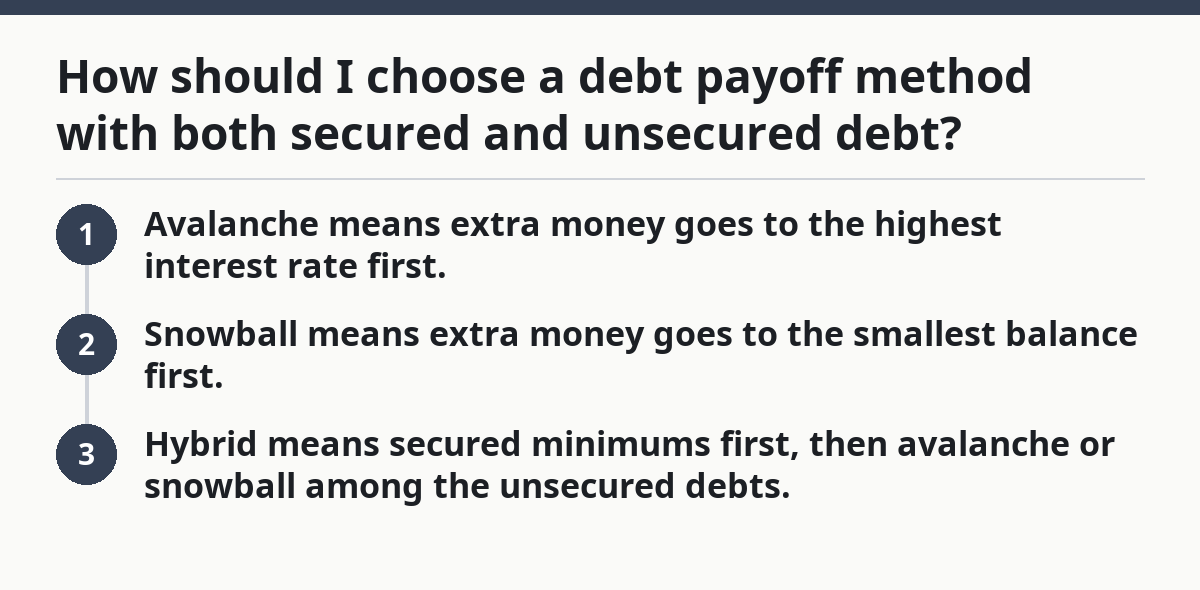
- Avalanche means extra money goes to the highest interest rate first.
- Snowball means extra money goes to the smallest balance first.
- Hybrid means secured minimums first, then avalanche or snowball among the unsecured debts.
You do not have to treat every debt the same. That is the point.
- Use avalanche when you can stick with a plan by numbers and want to cut interest cost over time.
- Use snowball when you need quick wins from closing small balances.
- Use a hybrid when your secured debt makes the stakes uneven.
A personal loan can sit on either side of the line depending on whether it is secured. If the loan is secured by a vehicle, savings account, or other asset, treat it with the same caution you’d give a car loan. If it is unsecured, it stays in the comparison pool with credit cards and other unsecured accounts.
What to check before you pick a payoff order
You should check the loan contract, payment status, and penalty terms before you send a single extra dollar. A payoff method is only useful if it fits the way your lenders actually behave. A 30-day late mark, a grace period, or a prepayment clause can change the result.
Picture this: you’re tempted to throw every extra payment at the highest APR, but one secured account has a late fee schedule and a short cure window. The wrong account can turn a good spreadsheet into a bad month. Read the paper first.
Look for these items on each debt:
- Is it secured or unsecured?
- What asset, if any, is collateral?
- What is the minimum payment and due date?
- Is there a grace period?
- Are there late fees, default fees, or penalty interest?
- Can you make extra principal payments without a fee?
- Does the lender apply extra payments to principal unless you say otherwise?
A car loan and a mortgage are both secured, but they are not identical in risk or timing. A mortgage is usually slower to move through default steps than a car loan, but the process and timing vary by jurisdiction and servicer. A credit card is unsecured, which changes the consequence, but missed payments still hurt your budget and credit file.
- Put every due date on one calendar.
- Mark the secured debts that would hurt the most if missed.
- List every extra-payment rule in plain English.
- Verify whether “extra” means principal-only or just an early next bill.
If you cannot tell from the statement, call the servicer and ask for the payment allocation rule in writing. That is boring work.
Why collateral changes the payoff method
Collateral changes the payoff method because the cost of missing a payment is not just a fee; it can be loss of property. A credit card can damage your credit and trigger collection action, but a secured loan can move toward taking the asset tied to it. That makes the risk profile different, even when the balances are similar.
Picture this: you owe $8,000 on a credit card and $8,000 on a secured personal loan backed by a car. The balances match, but the consequences do not. One debt threatens a score; the other threatens wheels. That is not the same problem.
For that reason, payment prioritization usually follows this logic:
- Keep all secured debts current.
- Build a small cash buffer if your budget is tight, so one surprise bill does not force a late payment.
- Attack unsecured debt with the method you can sustain.
- If a secured account is already behind, shift from payoff optimization to damage control.
The truth is, the “best” mathematical payoff order can be the wrong human order if it leaves a mortgage or car loan exposed. Even a lower-rate secured debt may deserve priority over a higher-rate unsecured balance because the consequence of default is sharper. That does not mean extra payments should always go to secured debt. It means the minimums on secured debt are non-negotiable in the plan.
A common mistake is treating all minimum payments as equal. They are not. A $50 minimum on a credit card and a $400 minimum on a car loan do different things to your risk if they are missed. The size of the payment matters, but so does the legal structure behind it.
What if the secured debt already feels stretched?
If the secured payment already takes too much of your income, the method changes. The first question becomes whether you can keep the account current at all, not which debt to kill first. In that case, a payoff plan may need help from a qualified debt counselor or lender hardship team.
- If a secured account is current, protect it and optimize around it.
- If it is barely current, build slack before sending large extra payments elsewhere.
- If it is delinquent, the payoff method alone is not enough.
When should I stop using a standard payoff method?
You should stop using a standard payoff method when the debt mix or account status makes a simple snowball or avalanche too risky. In those cases, the better move is to change the plan or get qualified help. This is where many generic articles fail.
Picture this: you’ve built a clean payoff order, but then you notice a loan is in default, another has variable terms, and your car is the only way you get to work. A tidy method can become the wrong tool very fast. Stop and reassess.
A secured loan is already past due: This means the asset may be closer to repossession or foreclosure than your spreadsheet suggests — contact the lender and ask about hardship options before sending extra to unsecured debt.
Your mortgage or car payment consumes most of your monthly cash: This means a single unexpected bill could trigger a missed payment — pause aggressive payoff and protect the current account first.
Extra payments are being applied incorrectly: This means the lender may be sending your extra money to future interest or the next due date — ask for principal-only allocation in writing.
Your unsecured debt has a 0% promo or a short promotional period: This means timing matters more than balance size — note the end date and compare it with your secured minimums before choosing avalanche or snowball.
Your income changes from month to month: This means the “extra” payment may not exist every cycle — choose a method that still works when the extra is $0 for one month.
You cannot tell which loan is secured: This means you may mis-rank the debt and expose collateral — get the loan agreement and identify the security interest before you choose a method.
On the flip side, if every secured account is current and your extra cash is reliable, the standard methods work fine. You just apply them in the right order.
Common mistakes when you mix secured and unsecured debt
The biggest mistake is putting all extra money toward the smallest unsecured balance while a secured loan is barely current. That can create a short-term win and a long-term mess. The fix is to protect the secured account first, then choose the payoff style for the rest.
Picture this: you close a $600 credit card, feel great for 2 weeks, and then miss a car payment. The emotional win was real, but the financial trade was bad. That is the trap.
Other mistakes show up a lot:
- Ignoring collateral — Consequence: a missed payment can threaten an asset. Correct move: sort debts by legal structure before balance size.
- Chasing only interest rates — Consequence: you may starve a secured loan that has harsher default terms. Correct move: cover secured minimums first.
- Not checking payment allocation — Consequence: extra money may not hit principal. Correct move: confirm how the servicer applies overpayments.
- Using snowball on everything without checking risk — Consequence: unsecured wins can leave the secured debt exposed. Correct move: use snowball only after the secured floor is safe.
- Skipping the emergency buffer — Consequence: one flat tire or medical bill can force a late payment. Correct move: keep a small cash cushion if your budget is fragile.
A personal loan is a good example of why labels matter. If it is unsecured, it competes with the credit card balance. If it is secured by an asset, it belongs in the same protection lane as the car loan or mortgage. The loan name alone does not tell you enough.
What does a practical mixed-debt plan look like?
A practical mixed-debt plan keeps secured debt current, then directs extra payments to either the highest interest unsecured debt or the smallest unsecured balance. The choice between those two comes down to whether you need the fastest mathematical reduction or the fastest visible progress. Both can work.
Picture this: you have a mortgage, a car loan, a credit card, and a personal loan. The mortgage and car loan stay on autopay; the unsecured debts become your target list. That is a workable structure.
A simple 3-part structure looks like this:
- Tier 1: secured minimums, paid on time every month.
- Tier 2: unsecured debts, ordered by interest rate or balance.
- Tier 3: extra payments, sent only to one target at a time.
If your budget is thin, use the method that you are most likely to keep following for 6 to 12 months. A plan that looks elegant on paper but collapses in month 2 is not a good plan. Consistency beats theory.
If you are comparing methods and want the broader decision frame, the hub on Debt payoff methods and strategy selection can help you place this guide in the larger picture. This page’s job is narrower: it helps you account for collateral risk before you choose the method.
How do I decide between snowball and avalanche once secured debt is covered?
You decide based on whether you need momentum or math once the secured debts are safe. Avalanche usually lowers interest cost faster if you can stay with it, while snowball often feels easier because balances disappear sooner. The right choice is the one you can keep for many months.
Picture this: all mortgage and car minimums are handled, and now you’re choosing between a $400 card at a high rate and a $3,000 card at a lower rate. One route saves more interest; the other may give you a faster win. That is the real fork in the road.
Use avalanche if:
- you like working from the numbers,
- your budget is stable,
- and you will not quit when progress feels slow.
Use snowball if:
- you need visible progress,
- your motivation fades when balances stay large,
- or you know small wins keep you on track.
Neither method is a moral test. They are tools. The wrong choice is not “snowball instead of avalanche” or the other way around; the wrong choice is ignoring the secured debts, the contract terms, or the payment schedule that sits in front of you.
For more on debt strategy basics, see the CFPB debt collection guide, the FDIC consumer guide, and the FTC vehicle repossession guidance.
Drafted with AI; not yet reviewed by a person.