Last updated: November 19, 2026
Quick Answer: for Debt payoff method fit by payment source and transfer mechanics — The Complete Guide, the best fit depends on where the money comes from, and a common range is one monthly payment plus any extra cash that clears. Debt payoff choices change when your money comes from a paycheck, irregular income, a balance transfer, or a lump sum. The right method is the one that matches where the money comes from and how fast it can move. This guide sorts that out so you can stop guessing and start matching the method to the mechanics.
I’m writing this as financial education, not personal financial advice; for your own situation, a qualified adviser can help. Debt sources differ by country, lender, and transfer rules, so the details below are a framework, not a universal rulebook. For general consumer-credit guidance, see the CFPB on debt collection and payments and the FTC on balance transfer offers.
Key takeaways
- Paycheck money works best with a fixed monthly plan because the cash shows up on a schedule.
- Irregular income needs a method that can survive lean months without breaking the plan.
- Balance transfers help only when the transfer fee, promo window, and payment discipline all line up.
- Lump sums are best used where the transfer or payment reaches the debt fastest with the least friction.
- If the payment source is unstable, a simple method beats a clever one.
Which debt payoff method fits your money source?
Picture this: your debt is the same, but the money you use to attack it is not. One month it comes from a salary deposit, next month from freelance work, then a tax refund or a balance transfer offer. The best fit changes with the source, not just with the balance size.
The best way to sort this is to match the payment source to the transfer mechanics: direct payment, balance transfer, extra principal payment, or a scheduled sweep. That is what determines speed, fee exposure, and the risk of missing a step.
| Payment source | Best-fit method | Why it fits | Main risk |
|---|---|---|---|
| Regular paycheck | Snowball or avalanche with automated extra payments | Predictable timing makes fixed monthly attacks easy | Missing a payment if automation is not set |
| Irregular income | Sinking-fund style payoff plan with buffer cash | You can size payments around cash flow swings | Plan collapses if the buffer is too thin |
| Tax refund or bonus | Lump-sum principal payment | One payment can cut interest fast without monthly strain | Spending the money before it posts |
| Balance transfer offer | Promo-rate transfer plan | A transferred balance can lower interest while you pay down principal | Fee, promo expiry, and new spending traps |
| Side-hustle income | Split-payment method: minimums first, then surplus to one target debt | Extra cash can be directed without starving essentials | Surplus is often uneven and easy to overpromise |
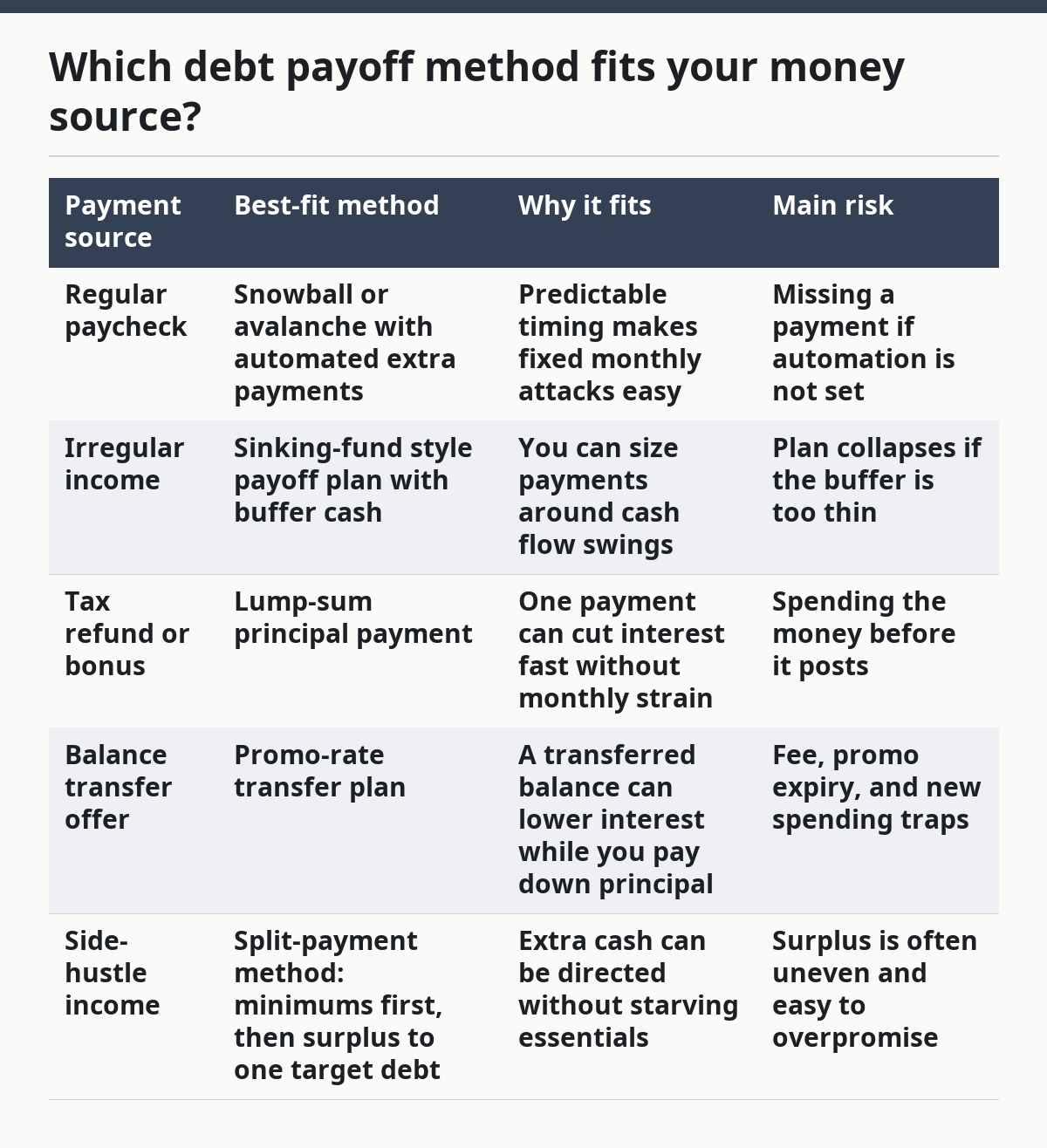
The truth is, the source matters as much as the method. A person with a stable paycheck can run a very different payoff system than someone who gets paid in bursts, and the wrong match causes late payments, fee creep, or stalled progress.
The Consumer Financial Protection Bureau notes that payment timing and account rules can affect fees and interest, which is why matching the source to the method matters.
What changes when your money comes from a paycheck?
A paycheck favors a method with fixed dates, fixed amounts, and automatic movement of money. That makes avalanche or snowball with auto-pay the cleanest fit, because the payment source is predictable and the transfer step is simple.
Here’s why this works: salary money arrives on a schedule, so you can set a baseline minimum and one extra amount that repeats every month. If your lender allows autopay from checking, the movement is direct, which lowers the odds that the money sits around and gets spent elsewhere. A regular paycheck also makes a 30-day plan easier to keep.
That said, paycheck plans fail when the checking balance gets too low before the draft date. If you also have rent, child care, or variable utility bills, the plan needs a cash buffer so the debt payment does not collide with a short week.
The CFPB’s budgeting guidance supports keeping enough cash available to avoid overdrafts and missed payments.
- Best fit: people with fixed pay dates and steady take-home pay.
- Weak fit: people who frequently dip below the payment amount before payday.
- Useful detail: if your debt has a fixed minimum due date, align the extra payment to the day after payday, not the end of the month.
- Common mistake: making the extra payment manually and forgetting it once the month gets busy.
A paycheck-based payoff plan is strong because it reduces decision fatigue. Big mistake if your checking account runs close to zero. Then the “simple” plan becomes overdraft territory.
How do irregular income and freelance pay change the plan?
Irregular income needs a buffer-first payoff method, not a rigid monthly promise. If your money arrives in chunks, the better fit is to set aside a base living reserve and use whatever remains after each deposit for debt, rather than forcing a calendar-only schedule.
This is where the transfer mechanics matter most. Some lenders want one monthly payment, some allow multiple extra principal payments, and some process transfers or sweeps in a way that can lag by a few days. If your income is uneven, the method has to survive timing gaps between deposit date and due date. The IRS also reminds taxpayers that refunds and similar windfalls can arrive on different dates, which is one reason not to assume one big month repeats.
A common mistake is to treat a high-income month like the new normal. That works until the next slow month, when the debt payment becomes a scramble. A better structure is to create a “minimum-safe” debt amount you can pay from even a weak month, then send additional money only after essentials and a small reserve are covered. A qualified adviser can help if your income swings sharply from month to month.
- Best fit: freelancers, commission earners, seasonal workers, tipped workers.
- Weak fit: anyone who cannot keep a cash buffer equal to at least one billing cycle.
- Useful detail: make payments only after the money clears, not when the invoice is sent.
- Common mistake: setting one aggressive debt target and assuming every month will support it.
On the flip side, irregular income can still pay debt down fast if the method is flexible. The right move is not the fanciest formula — it’s the one that won’t break when a client pays late.
Balance transfers: when the transfer mechanics do the real work
A balance transfer fits only when the promo terms, fee, and payment discipline all line up. This method is not about “getting rid of” debt; it is about moving a balance to a new card or account so more of each payment hits principal during the promo period.
The transfer mechanics are the whole point. You may have a transfer fee, a promo rate for a limited time, and rules about which balances qualify. Some issuers do not let you transfer between cards from the same bank, and some treat new purchases differently from transferred balances. Those rules vary by country and issuer, so the card’s terms control everything. The FTC says to read balance transfer terms carefully, including fees and the length of the introductory rate.
The benefit is simple: if interest is reduced for a set period, each payment can do more work. The catch is that a promo window is not a finish line. If the balance is still there when the promo ends, the remaining debt may move to a higher rate. That is where this method turns from help to hazard. An example is a 0% offer for 12 months: if the balance remains after month 12, the rate can jump.
- Best fit: people with a clear payoff schedule and enough income to clear the transferred balance before the promo ends.
- Weak fit: people who keep adding new charges to the same card.
- Useful detail: a transfer fee can erase some of the rate benefit, so the fee and timeline both matter.
- Common mistake: assuming the transfer alone solves the debt problem.
Here’s the catch: balance transfers are a transfer mechanic, not a behavior fix. If spending stays high, the promo just becomes a short pause.
Should you use debt avalanche or debt snowball with transfers?
Debt avalanche wins on math when your payment source is steady and you can tolerate slower early wins. Debt snowball wins on momentum when you need fast account closures to stay engaged, especially if your money source is already stretched.
With a balance transfer, the question changes slightly. If the transfer gives you a promo rate and your payment source is stable, avalanche usually fits best because you want the highest-rate debt cleared first before the promo ends. If you are likely to lose motivation, snowball can still work, but it may leave higher-rate balances around longer.
The payment source determines which method is realistic. A paycheck can support avalanche more easily because the monthly attack is predictable. Irregular income may need snowball-like small wins to keep the plan alive, but only if the minimums stay current on every account. The CFPB and FTC both stress making sure payments are manageable before you choose a repayment plan.
| Criteria | Avalanche | Snowball | Winner for condition |
|---|---|---|---|
| Interest savings | Targets the highest rate first | Can leave higher-rate debt in place longer | Avalanche when rates differ a lot |
| Motivation | Slower early visible wins | Faster account closures | Snowball when morale is the problem |
| Fit for paycheck income | Strong | Strong | Tie |
| Fit for irregular income | Works if buffer is solid | Works if payment amounts stay small and regular | Snowball for fragile cash flow |
| Fit with balance transfer promo | Strong if promo end date is tracked | Useful if small wins keep you on track | Avalanche for promo management |
| Transfer mechanics complexity | Lower if payments are automated | Lower if multiple small debts are easier to track | Depends on number of accounts |
| Risk of drift | Medium if progress feels slow | Medium if new spending restarts balances | Avalanche for disciplined planners |
| Early payoff visibility | Weak | Strong | Snowball for emotional momentum |
The truth is, both methods can work. The better fit is the one your payment source can support without drama. If the cash flow is thin, a method that looks elegant on paper can still fail in month three.
How do lump sums fit into debt payoff?
Lump sums fit best when they go straight to principal on the debt with the hardest terms or the highest friction. A tax refund, bonus, inheritance, or sale proceeds can make a real dent, but only if the payment path is clear and the lender applies it the way you expect.
The transfer mechanics here are basic but important. Some lenders let you submit an extra principal payment online, some require a phone call, and some apply extra funds to the next scheduled payment instead of principal unless you ask otherwise. If you do not control that step, the lump sum may not work as hard as you think. The IRS notes that tax refunds can be substantial enough to matter for a debt plan, which is why the posting rule matters.
Lump sums are best used with debts that have high rates, awkward minimums, or promo deadlines. They are also the easiest source to waste, because the money feels “extra.” Once it lands in checking, it competes with rent, travel, and everything else.
- Best fit: one-time windfalls with no immediate bill pressure.
- Weak fit: windfalls that are already needed for emergencies or taxes.
- Useful detail: ask the lender how extra principal is applied before you send the money.
- Common mistake: splitting a small lump sum across too many debts, which blunts the effect.
The best part? A lump sum does not need a clever strategy to matter. It needs a clean landing point. If the payment path is messy, the impact shrinks.
When should you keep the money in savings instead of sending it to debt?
Keep the money in savings when the payment source is unstable enough that one surprise bill could force new debt. A debt payoff plan fails fast when every spare dollar is sent out and nothing is left for repair costs, fees, or a missed paycheck.
This is not a call to abandon debt reduction. It is a call to protect the transfer mechanics. A debt payment that creates a bank overdraft, a late fee, or a cash advance can make the overall position worse. That is especially true when income is irregular or when a transfer promo has strict timing.
A small reserve can also help with payment timing. If your checking account regularly hits zero before the due date, a buffer lets the debt payment clear without stress. That buffer is not “lazy money.” It is what keeps the plan from breaking on a random Tuesday.
- Keep cash aside if your income changes month to month.
- Keep cash aside if one missed work week would trigger late fees.
- Keep cash aside if your lender’s payment posting time is slow.
- Do not drain savings for debt if it means you will re-borrow within days.
A plan that ignores cash flow is not disciplined — it is brittle. On the flip side, a modest reserve can make a debt payoff method actually survive long enough to work.
Exception scenarios that flip the usual answer
The usual answer flips when the transfer mechanics are unusual or the payment source has a deadline. A stable paycheck does not automatically mean avalanche is best, and a balance transfer does not always beat a direct principal payment.
- The promo window is short. If a balance transfer has a limited period and your balance is too large to clear in time, a direct extra payment to the current lender may be cleaner than moving the debt.
- Your income is lumpy but large. If you get paid in bursts and can cover several months at once, a “manual avalanche” can work even without automation.
- The lender misapplies extra payments. If extra funds get routed to the next due date instead of principal, the payoff method is weaker unless you can correct the instruction every time.
- You keep using the same card after a transfer. If new charges continue, the transfer can turn into a revolving trap. In that case, a spending freeze matters more than the payoff method.
These flips matter because the mechanics can overpower the math. A strategy that looks best on paper loses fast if the money cannot move where it needs to go.
The verdict: which payoff method fits which source?
Choose avalanche with autopay if your income is steady, your due dates are predictable, and you can make extra principal payments without touching your emergency cushion. Choose snowball or a buffer-based plan if your income swings and you need small, durable wins to keep the system alive. Neither if your current cash flow cannot support minimum payments without borrowing again.
That is the real decision point. The best payoff method is not the one with the nicest name; it is the one that matches your payment source and the way money actually moves through your accounts. If those two do not fit, even a good method can fail.
What should I do if I get paid on different dates every month?
Use a buffer-based plan and anchor payments to cleared cash, not the calendar. If payday moves around, the due date should not be your only guide; the money has to be in the account first. That is especially true when the lender takes payments automatically.
The practical fix is to treat each deposit as a pool with jobs: essentials first, then minimum debt payments, then extra payoff money if anything remains. That keeps one late paycheck from blowing up the whole month.
Is a balance transfer better than paying the card directly?
A balance transfer is better only if the promo terms and transfer fee still leave you ahead and you can clear the balance before the offer ends. If you are likely to keep charging the card, the transfer can become a pause instead of progress.
Paying the card directly is often simpler when the balance is small, the rate is manageable, or the transfer rules are messy. Simpler is not always cheaper, but it is often easier to finish. The FTC’s balance transfer guidance is a good place to compare the numbers before you decide.
What if I have one lump sum and several debts?
Send the lump sum where it has the most impact and where the lender applies it to principal, not just the next bill. If one debt has a promo deadline, a high rate, or a bad minimum payment structure, that is often the first place to look.
Splitting the money across every balance can feel fair, but it often weakens the result. A focused payment usually changes the shape of the debt faster.
Can I mix methods?
Yes — and that is often the real answer. You can use autopay for minimums, avalanche for extra salary money, and a separate rule for windfalls like tax refunds or bonuses. That mix works well when each source has a different cadence.
The danger is too many rules. If you cannot explain the system in one minute, it may be too complicated for real life.
Drafted with AI; not yet reviewed by a person.