Last updated: November 20, 2026
Quick answer: if your payoff dates are uneven, use the debt payoff method you can keep funding for 30 days without missing minimums. Uneven payoff dates change how to choose a debt payoff method when you expect uneven payoff dates, because cash timing can matter as much as interest rate or balance. The steps below show how to keep a payment plan working when debts, due dates, and balance payoff dates won’t line up neatly.
How debt payoff timing changes the method you should pick
Debt payoff timing means the order and dates of your payments, payoff milestones, and due dates. If your cash comes in unevenly, the safest method is usually the one you can keep funding without missing minimums or scrambling every month.
This guide is for someone who already knows the debts, the due dates, and the monthly minimums. It also assumes you’re choosing between common payoff order methods such as debt avalanche, debt snowball, or a custom sequence plan. For your own situation, a qualified adviser can help, and the Consumer Financial Protection Bureau explains that payment planning starts with knowing your obligations and due dates. CFPB
Key takeaways
- Uneven payoff dates can change the best order because cash may not be ready when a debt becomes available to close.
- A method that ignores timing can force missed payments or repeated rework.
- The right plan uses a payment calendar, temporary payment changes, and an intermediate milestone for each debt.
- If timing is unstable, keep the plan simple enough to execute in a 30-day cycle.
Top things to check before you choose
- Which debts have fixed due dates and which have flexible payoff dates.
- Whether you can cover every minimum payment on the normal cycle.
- Which balance will clear first under each method.
- Where an early balance payoff creates room for the next step.
- Whether a lender charges a fee for extra principal payments.
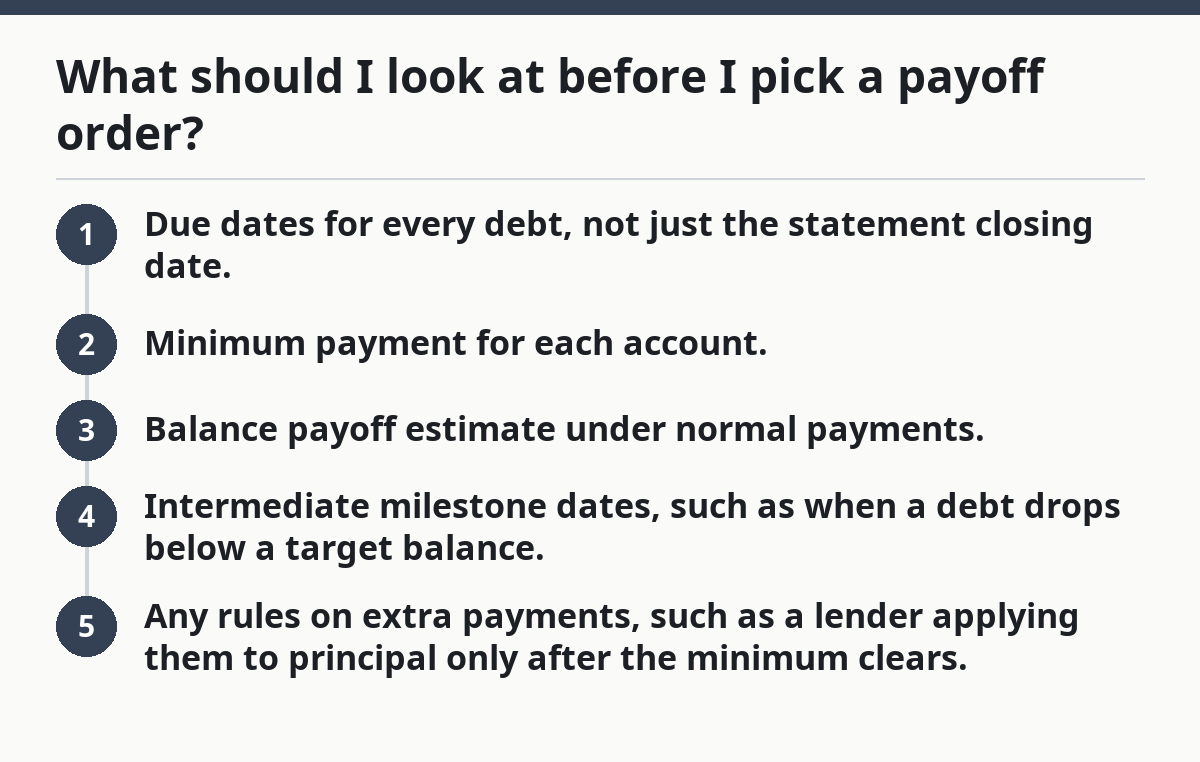
What should I look at before I pick a payoff order?
You should look at due dates, minimums, and the next 30 to 60 days of cash before you pick any payoff order. The point is not to pick the “best” theory; it’s to pick the method that survives your actual calendar.
Picture this: you’ve got three debts, one payment coming in late one month, and a balance payoff date that may shift by a week. That’s where a simple ranking by interest rate or balance can break down, because the plan fails if cash arrives after the due date.
Before you rank anything, gather these items:
- Due dates for every debt, not just the statement closing date.
- Minimum payment for each account.
- Balance payoff estimate under normal payments.
- Intermediate milestone dates, such as when a debt drops below a target balance.
- Any rules on extra payments, such as a lender applying them to principal only after the minimum clears.
If one debt will be paid off in 3 weeks but another due date lands before your cash arrives, that debt may need temporary protection even if it isn’t first in your preferred method. The problem is timing mismatch, not effort.
The Federal Trade Commission recommends tracking balances, due dates, and payment instructions so you can avoid missed payments and fees. FTC
Check this now
- Can every minimum be covered on the due date?
- Is any debt close enough to zero that a small extra payment would clear it?
- Will one payoff date fall before the next cash event?
- Does any creditor need a separate payment instruction for extra principal?
How do I choose the right debt payoff method when dates don’t line up?
Choose the method that keeps minimums safe first, then ranks the remaining balances by the best fit for your timing. If the dates are uneven, the “right” method is usually a hybrid: protect due dates, then follow either avalanche, snowball, or a milestone-based sequence.
Here’s the catch: a pure debt snowball or pure debt avalanche only works cleanly when your payment calendar is steady. If your payoff dates are uneven, the sequence has to bend around the cash flow.
- List every debt with its due date, minimum payment, balance, and interest rate; verify that each account has a known next payment date, and flag any unknown due date as a problem.
- Build a 30-day payment calendar; verify that all minimums fit inside the month, and treat any gap as a problem before ranking payoff order. The CFPB also recommends using a budget and bill calendar to match due dates to income. CFPB
- Mark the next balance payoff date for each debt; verify which account can realistically hit zero in the shortest time, and flag any estimate that depends on a payment you can’t yet fund.
- Choose your ranking rule—highest interest first, smallest balance first, or the nearest payoff date first; verify the rule still leaves minimums covered, and reject it if it forces a late payment.
- Assign temporary payment changes only to the debt that will clear soonest or create the largest timing win; verify the lender accepts extra principal, and stop if it triggers fees or payment posting delays.
- Set one intermediate milestone for each debt, such as the next target balance or date; verify the milestone is reachable within 1 statement cycle, and treat a 3-cycle target as too far out to guide the order. If you are unsure how to set milestones, consult a qualified financial professional and use the creditor’s payment rules as your source. CFPB
- Review the sequence every month; verify that a payoff date still matches the cash calendar, and change course if a new due date, skip, or payment delay breaks the plan.
This method keeps the plan real. You are not betting on a perfect month; you are matching debt payoff timing to the cash you actually expect.
Should I use avalanche, snowball, or something in between?
Use the method that your uneven dates can support without causing missed payments or repeated resets. If the cash flow is tight but stable, avalanche often works. If you need visible wins to keep going, snowball can be easier to stick with. If dates are messy, a hybrid sequence is often the cleanest fit.
The truth is, the “best” payoff method changes when one debt is about to clear in 2 weeks and another will sit for 6 months. In that case, a pure ranking by interest or size can be less useful than a plan that creates a fast win first.
A practical hybrid looks like this:
- Protect the due dates with every minimum payment.
- Aim extra cash at the debt with the nearest payoff date if closing it frees up a payment slot.
- Switch to avalanche after the short-term timing problem is gone, if high interest is still the main drag.
- Use snowball if a small balance will disappear within one statement cycle and that win helps you stay consistent.
Don’t choose a method just because it has a name. Choose the sequence that fits your payment calendar and leaves no account at risk.
A simple rule
- If timing risk is the main problem, prioritize the debt that clears the calendar first.
- If interest cost is the main problem, prioritize the highest rate after minimums.
- If motivation is the main problem, prioritize the smallest balance that can truly be finished soon.
For a broader overview of debt-management tradeoffs, see the CFPB’s guidance on paying down debt and the FTC’s advice on debt and budgeting. CFPB FTC
What can go wrong when payoff dates are uneven?
Uneven payoff dates can make a good plan fail if you treat every month like the last one. The most common damage is missed minimums, late fees, and a sequence that has to be rebuilt from scratch.
Picture this: you send an extra payment to the wrong debt because it looked “closest to done,” then another bill lands 10 days later and your cash is gone. That is not a strategy problem. It’s a sequence problem.
Common mistakes:
- Ignoring due dates first — consequence: a late payment can wipe out the value of a well-chosen payoff order; correct alternative: cover every minimum before extra principal.
- Picking the smallest balance without checking timing — consequence: you may finish a debt that didn’t free any near-term cash; correct alternative: ask whether the payoff date creates an actual payment slot.
- Treating a payoff estimate as exact — consequence: one extra fee, interest charge, or posting delay can push the date back; correct alternative: build a 1-payment buffer into the estimate.
- Changing the plan every week — consequence: the payment calendar becomes impossible to track; correct alternative: review once per month unless a due date changes.
- Forgetting lender rules on extra payments — consequence: the extra money may go to future interest or the wrong balance; correct alternative: confirm how principal-only payments are applied.
On the flip side, a plan that survives uneven dates is usually boring. It repeats the same check each month and only changes when the calendar changes.
When does the standard payoff order stop working?
The standard order stops working when the calendar, not the balance, controls the next move. That happens in a few clear cases, and each one changes the right sequence.
A minimum payment is at risk: If an uneven payoff date makes a required payment late, the payoff order is the wrong tool — protect the due date first and pause extra payments.
A balance payoff is close but uncertain: If the debt might clear in the next 1 statement cycle but the date keeps moving, the estimate is too shaky — hold the cash and reassess before sending it.
A lender posts extra payments slowly: If extra principal takes days to post, the timing win may vanish — use a method that does not depend on instant posting.
Two debts are equally close to zero: If both balances are near a payoff date, the tie-breaker matters less than which account frees up cash sooner — pick the one that improves the calendar.
Your income timing is changing soon: If a temporary payment change is coming, the current payoff order may only work for 30 days — use a short review cycle and avoid a long sequence you can’t support.
Those are the points where a neat ranking becomes a bad fit. That does not mean the plan failed; it means the plan needs a different lens.
How do I plan around different payoff dates?
You plan around different payoff dates by turning the plan into a sequence, not a promise. Start with due dates, then use a payment calendar to decide which debt gets the next extra dollar.
A good sequence has three layers:
- Layer 1: minimums, paid on time.
- Layer 2: the next debt to clear, based on timing.
- Layer 3: the fallback debt if the timing changes.
That fallback matters. If your main target gets pushed back by 2 weeks, you need to know where the extra payment goes next without starting over.
Use these checks:
- Does this extra payment shorten a payoff date by at least one full billing cycle?
- Does it create a cleaner handoff to the next debt?
- Will the payment still make sense if a paycheck arrives a few days late?
For timing-based plans, the question is not “Which debt is worst?” It is “Which debt changes the schedule in the best way?” That distinction is what keeps the plan usable when the dates are uneven.
For more detail on building a debt payoff plan, see the linked pages on debt avalanche, debt snowball, and budget planning. Debt avalanche Debt snowball Budget planning
What does a good result look like after one month?
A good result after one month is a payment plan that still fits the calendar and leaves every minimum current. You should be able to point to the next balance payoff date for each debt without guessing.
If the method is working, you’ll see at least one of these:
- one debt gets close enough to zero to become the next obvious target,
- your payment calendar has fewer surprises,
- the sequence stays the same for the whole month,
- extra money has a clear job instead of drifting between accounts.
If you cannot say which debt is next after 30 days, the method is too loose. Tighten the sequence or shorten the review cycle.
For more on the wider system, see the hub on debt payoff method fit by payoff timing and cash event constraints. This page is the piece that helps you choose when dates are uneven, not the whole map.
Should I pay off one debt early if another is due soon?
Yes, if the early payoff does not put the near-due debt at risk. The right move is the one that preserves every minimum payment and still improves the sequence. If paying one balance early leaves you short on a due date, that is the wrong early payoff.
How do I plan around different payoff dates?
You plan around different payoff dates by putting due dates, minimums, and expected payoff dates on one payment calendar. Then you rank the next extra payment by which debt clears the schedule best, not by habit. Review that order once a month so the plan follows the actual cash flow.
Does timing change which debt I should attack first?
Yes, timing can change the first debt you attack after minimums. A debt that will clear in 1 billing cycle may be the better first target even if another debt has a higher rate or smaller balance. The point is to choose the order that fits the dates you can really fund.
Drafted with AI; not yet reviewed by a person.