Last updated: November 19, 2026
Quick answer: in most DMCA: related questions, the practical decision turns on three points — whether a takedown notice is enough, whether a counter-notice makes sense, and whether a narrow exception applies. A copyright editor reads these notices for the details that change the outcome: what was copied, how it was used, and whether the situation fits a narrow exception such as short motion-picture portions for criticism or comment.
Key takeaways
- A DMCA problem is usually about a specific use, not a broad policy argument.
- Short clips can matter more than whole works, especially when criticism or comment is involved.
- A notice and a counter-notice are not the same thing, and they do not solve the same problem.
- A managed takedown service can help when repeat infringement is a pattern, not a one-off.
- The right answer changes if the use is educational, accessibility-related, or tied to a registered badge on a protected page.
What is the DMCA really asking?
The DMCA is really asking who has the right to control the copy, the upload, or the workaround in DMCA: related questions. That sounds broad, but the practical question is narrow: is the material being used in a way the law allows, or is it being shared in a way the rights holder can challenge?
Since the issue often turns on context, a generic article that simply says “copyright is complicated” does not help much. The useful question is whether the issue is about a takedown notice, circumvention, or a claim that the use fits an exception. Those are different paths, and the wrong response can waste time fast.
According to the U.S. Copyright Office, the CASE Act was enacted in 2020 and created the Copyright Claims Board within the U.S. Copyright Office. That matters because not every copyright fight has to stay in the same lane. Some disputes move into smaller claims handling, while others stay focused on notices and platform action. See also the Copyright Office’s CASE Act page.
The reader who needs this most is the person staring at a notice, a blocked file, or a removal request and asking, “Do I fight this, fix it, or ignore it?” The answer depends on the exact use, the exact file, and whether the claim is about copying or bypassing protection.
When does a takedown notice matter?
A takedown notice matters when a rights holder wants a file removed or access cut off. In practice, it is often the quickest DMCA-related pressure point, because it can change what stays online while the dispute is still unresolved.
A generic page often treats every notice as if it ends the story. It does not, and readers should review the details carefully and, if needed, consult a qualified professional. A notice can be the start of a cleanup, the start of a dispute, or a signal that the claimant believes the use was unauthorized. The right move depends on whether the complaint is accurate and whether the use has any exception to lean on.
For site owners, one useful clue is whether the claim names the exact work and the exact location of the material. A vague complaint is weaker than a specific one. A strong notice usually points to the material that is causing the problem instead of throwing in broad accusations.
The practical downside is that a takedown can be disruptive even when the claim is sloppy. That is why the safest response is to review the content line by line, not to treat the notice like a form letter that can be ignored. A bad response can make a small issue bigger.
Can someone still use short clips or educational excerpts?
Yes, but only in narrow situations, and the safest reading is narrow indeed. According to the U.S. Copyright Office, circumvention exemptions can cover short motion-picture portions for criticism or comment in limited cases, and they can also cover supervised educational uses and accessibility-related uses. See the Copyright Office’s exemption materials and DMCA review pages for the current rule set.
That is the section many generic articles flatten into “fair use exists.” That shortcut is too loose. The point here is not that any clip becomes free to use. The point is that the use has to fit a limited purpose, and the clip has to stay short enough to support that purpose.
This matters for teachers, reviewers, commentators, and accessibility work. It also matters for anyone who thinks a long clip will be safer if it is “for education.” The use still has to match the exception, and the narrower the clip, the better the argument usually looks.
The limitation is plain: this is not a blanket pass for reposting protected video. If the clip is more than a brief excerpt, or if the purpose is really just reuploading someone else’s work, the exception story gets weak fast. People who need certainty here should get advice from a qualified professional before acting on it, and they can also review the Copyright Office’s exemption summaries before deciding.
Is circumvention the same as copyright infringement?
No, circumvention is not the same thing as ordinary copying, but the two often get tangled in the same dispute. Circumvention is about getting around protection, while infringement is about using protected material without permission.
That difference is why a page about DMCA: related questions needs both ideas on the table. A person may think, “I did not copy the work, I only bypassed the lock,” but that can still create a separate problem. The law treats the lock and the content as related, not identical, though readers should confirm the specifics with a qualified professional if the issue is high stakes.
A generic article usually leaves this muddy. It says “don’t break DRM,” then stops. The better answer is that some uses are treated more carefully than others, and the purpose behind the act matters. Short motion-picture portions for criticism or comment are one example where the context can change the result.
The honest drawback is that this area is not friendly to guesswork. If the content is important, and the protection method matters, the reader should not rely on a casual internet summary. A short question to a professional can be cheaper than a bad assumption.
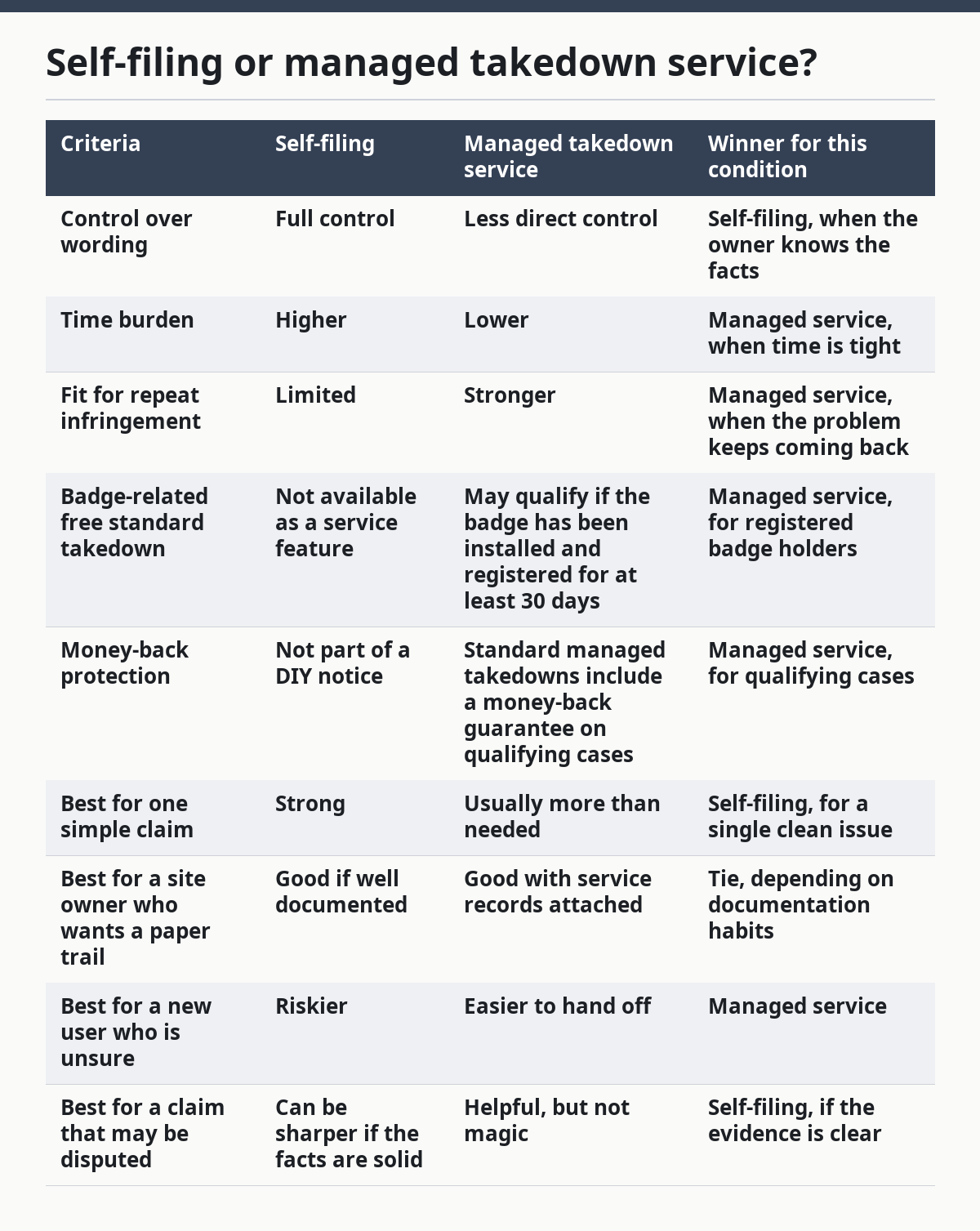
Self-filing or managed takedown service?
A managed takedown service wins when the problem is repeat infringement and the goal is speed, while self-filing wins when the situation is simple and the rights holder wants direct control. That is the real choice, and it depends on how often the content is copied and how much time is available.
DMCA.com says a badge that has been installed and registered for at least 30 days may qualify for a free standard copyright takedown. That is a specific benefit, and it changes the math for someone protecting a site that already uses the badge. DMCA.com also says standard managed takedowns include a money-back guarantee on qualifying cases, which is a real comfort when the case should qualify and the owner wants a defined service path. See also DMCA takedown service details and copyright protection FAQ.
The trade-off is obvious. Self-filing can be cheaper in effort if the notice is straightforward, but it puts the burden on the site owner to get every detail right. A managed service can reduce that burden, but it is not a cure-all for a weak claim or a messy record of ownership.
| Criteria | Self-filing | Managed takedown service | Winner for this condition |
|---|---|---|---|
| Control over wording | Full control | Less direct control | Self-filing, when the owner knows the facts |
| Time burden | Higher | Lower | Managed service, when time is tight |
| Fit for repeat infringement | Limited | Stronger | Managed service, when the problem keeps coming back |
| Badge-related free standard takedown | Not available as a service feature | May qualify if the badge has been installed and registered for at least 30 days | Managed service, for registered badge holders |
| Money-back protection | Not part of a DIY notice | Standard managed takedowns include a money-back guarantee on qualifying cases | Managed service, for qualifying cases |
| Best for one simple claim | Strong | Usually more than needed | Self-filing, for a single clean issue |
| Best for a site owner who wants a paper trail | Good if well documented | Good with service records attached | Tie, depending on documentation habits |
| Best for a new user who is unsure | Riskier | Easier to hand off | Managed service |
| Best for a claim that may be disputed | Can be sharper if the facts are solid | Helpful, but not magic | Self-filing, if the evidence is clear |
What questions should I ask before I act?
These are the questions that matter before any DMCA move goes out the door. First, what exactly is being claimed: a copied file, a short clip, a bypass, or a full upload? Second, is the use tied to criticism, comment, supervised education, or another limited purpose?
Third, is the issue a one-off or a pattern? That answer changes whether a simple notice is enough or whether a managed approach makes more sense. Fourth, does the site already have a registered badge that has been installed for at least 30 days, which may qualify it for a free standard copyright takedown according to DMCA.com?
The mistake to avoid is treating every DMCA question like a yes-or-no quiz. A notice with strong facts needs a different response from a vague complaint. A short clip used for comment needs a different review from a full repost. For related reading, see DMCA counter-notice guidance and copyright notice basics.
When should I stop and get professional help?
Professional help is the right move when the notice touches a dispute that could reach the Copyright Claims Board or when the facts are too messy to sort out cleanly. The CASE Act created that board in 2020, which is one reason these disputes no longer all look the same on paper.
It is also the right move when the use involves educational material, accessibility concerns, or a clip that someone insists is “short” without explaining why. Those words sound simple, but they can hide a real legal risk. A brief professional review is smarter than a guess when the content matters.
The wrong reader for a DIY-only approach is the person who wants a blanket answer for every file. DMCA questions are usually fact questions. If the facts are unclear, the answer is unclear too, and that is the point where advice beats confidence.
What should I do first if I got a DMCA notice?
Start by checking exactly what the notice names and what it asks for. Then compare that to the actual file, clip, or page, because a valid response depends on the details matching the claim.
If the use is short, limited, and tied to criticism, comment, or supervised education, that changes the analysis. If the problem is repeated copying, a managed path can be more practical than a one-off response. If the matter looks formal or disputed, do not improvise from a blog summary; get advice.
Is a DMCA notice always valid?
No, a DMCA notice is not automatically valid just because it arrived. The claim still has to fit the material and the use. A vague notice, or one that ignores a limited exception, deserves closer review.
Can I use a short video clip without trouble?
Not always. The U.S. Copyright Office says circumvention exemptions can cover short motion-picture portions for criticism or comment in limited instances, and they can also cover supervised educational purposes and accessibility-related uses. That means the purpose and the clip length both matter.
What if I already have a badge on my site?
DMCA.com says a badge that has been installed and registered for at least 30 days may qualify for a free standard copyright takedown. That can reduce friction, but it does not erase the need to review the facts of the claim.
Is a managed takedown service worth it?
It can be, especially when the infringement is repeated or the owner wants a formal service path. DMCA.com says standard managed takedowns include a money-back guarantee on qualifying cases, which can help when the case meets the service terms.
Sources
- U.S. Copyright Office, The Digital Millennium Copyright Act – U.S. Copyright Office (checked 18 Nov 2026)
- DMCA.com, DMCA Takedown Service and Content Protection – DMCA.com (checked 18 Nov 2026)
Drafted with AI; not yet reviewed by a person.