
Last updated: November 19, 2026
Quick answer: a practical debt payoff plan for changing income is usually built around your lowest realistic month, with a buffer and a floor payment that you can still make; if your income varies by 20%, 40%, or more, that approach is usually safer than planning around your best month. If your pay changes from month to month, the right debt payoff plan is not always “pay as much as possible.” It is “build a plan that still works in the worst month, then speed up only when cash actually lands.” This is information, not financial advice; a qualified financial adviser or debt counsellor should review your own situation, especially if you are behind, in collections, or dealing with tax debt.
This article on Debt payoff with changing income — The Complete Guide focuses on debt strategy, budgeting mechanics, and the trade-offs people miss when income is irregular.
I write on personal finance with a focus on debt strategy, budgeting mechanics, and the trade-offs people miss when income is irregular.
Key takeaways
- Build your payoff plan around your lowest predictable month, not your best month.
- Keep a floor payment that you can make even when work slows down.
- Separate fixed bills, minimum debt payments, and variable spending before you attack extra principal.
- If your income swing is large, your first job is stability, not aggression.
- The wrong debt strategy on irregular income is the one that assumes every month will be normal.
- Debt snowball and debt avalanche can both work; the better choice depends on payment discipline, interest costs, and how much stress a long payoff creates.
- If you cannot cover minimums without borrowing again, the problem has moved beyond “optimization” and needs outside help.
The first move: stop planning around your best month
The first move is to build a debt plan around your lowest realistic month, because that is the month that decides whether the plan survives. If income varies by 20%, 40%, or more across the year, a payoff schedule based on peak earnings will look strong on paper and fail the first time work slows down.
This is the part generic debt articles usually get wrong. They tell you to make a budget, list debts, and pay extra toward one account. That advice assumes a steady paycheck. With changing income, the real question is simpler: what can you pay on time when the month is bad, not good?
Start with three numbers for the last 6 to 12 months:
- Your lowest dependable monthly income.
- Your unavoidable monthly bills.
- The minimum payment on every debt.
Then compare them. If your lowest dependable income is still above unavoidable bills plus minimums, you have room to build a payoff plan. If not, the priority shifts to protecting essentials and preventing missed payments. That may mean calling creditors, asking for hardship terms, or getting advice before the debt grows through fees and penalties.
A useful rule is to set your “commitment budget” at a level you can meet in a weak month without using credit. Any amount above that becomes the “attack budget” for extra debt payments. Keep the attack budget flexible. Do not make it a fixed promise unless your income really is fixed.
This approach is especially important for freelancers, commission earners, seasonal workers, tipped workers, gig workers, and people with overtime that comes and goes. It is less useful for anyone whose pay is already stable enough that a standard monthly payoff budget is easy to maintain.
Why irregular income changes the payoff strategy

Irregular income changes debt payoff because cash flow timing matters as much as the total amount you earn. A person who earns $60,000 spread unevenly through the year has a very different risk profile from someone who earns the same amount in equal paychecks. The first person can have strong months and still miss a payment if the rent, car note, and card due dates all hit before the next big deposit clears.
That means the core decision is not “how fast can I pay this off?” It is “how do I avoid a missed payment while still making progress?” Missed payments are expensive in more ways than one: late fees, possible penalty interest, possible credit damage, and the stress that pushes people to use another card to fill the gap. Exact penalties depend on the lender, the contract, and the country you live in. Consumer Financial Protection Bureau guidance on credit cards, and FDIC consumer materials on debt and credit, are useful starting points for understanding those risks.
Source: CFPB credit card protections and fees, https://www.consumerfinance.gov/consumer-tools/credit-cards/
Source: FDIC consumer debt and credit resources, https://www.fdic.gov/resources/consumers/money-smart/
The best systems for changing income have three layers:
- a bare-bones monthly plan that covers essentials and minimums;
- a buffer account that absorbs the bad months;
- an extra-payment rule that only activates after the buffer is funded.
The buffer is not wasted money. It is what prevents your debt plan from breaking when income dips. For many people, that buffer is the real difference between a plan that lasts 18 months and one that collapses after 3. The Consumer Financial Protection Bureau recommends building an emergency cushion for unexpected expenses before focusing all spare cash on extra debt payments.
Source: CFPB on building a budget and emergency savings, https://www.consumerfinance.gov/consumer-tools/budgeting/
One practical mistake is treating every extra dollar as debt money. On irregular income, some of that extra money belongs to next month’s bills. Because of that, you should consider a qualified financial adviser or debt counsellor if you are unsure how much to reserve. Another mistake is paying extra on a debt before the minimums and true fixed costs are secure. That creates a short-term win and a long-term failure, so a professional review can help if your cash flow is tight or uneven.
The strategy changes depending on how wide the income swing is. If the swing is small and predictable, you can use a normal payoff method with a slightly larger cash cushion. If the swing is large or the timing is unpredictable, the plan needs more liquidity and less ambition at the start.
Debt snowball vs debt avalanche on variable income
Debt avalanche wins on math; debt snowball often wins on adherence. With changing income, adherence matters more than in a stable-paycheck household, because a plan that feels impossible in a low month will get abandoned. The better method is the one you can keep funding when money is tight.
Debt avalanche means paying extra toward the highest-interest debt first while making minimums on the rest. Debt snowball means paying extra toward the smallest balance first, then rolling that payment into the next debt. Both methods assume minimum payments are current.
Avalanche is the better fit if:
- you are disciplined under stress;
- your income swings are manageable;
- the highest-rate debt is clearly costing you more than your convenience is worth;
- you can tolerate a slower early payoff on the smallest balances.
Snowball is the better fit if:
- you need visible progress to stay engaged;
- your income is volatile enough that motivation has real monetary value;
- you have several small balances that are easy to eliminate;
- a quick win will stop you from reusing credit.
The missing piece in most comparisons is that irregular earners are often not choosing between interest savings and motivation in the abstract. They are choosing between a plan they can follow and one they will abandon after a hard month. That is why snowball can be the better real-world choice even when avalanche saves more on paper.
Still, I would not recommend snowball for someone with a large spread between APRs and strong self-control if the income is only moderately variable. In that case, the interest difference is real enough to matter. Rates differ by lender and country, and some debts have promotional rates or variable rates that change over time, so the exact gap should be checked on your statements.
The honest side-by-side

The right method depends on whether the reader needs maximum control or maximum mathematical efficiency. The table below compares the two approaches on the decision points that actually change the outcome.
| Criteria | Debt snowball | Debt avalanche | Winner for this condition |
|---|---|---|---|
| First extra payment target | Smallest balance | Highest interest rate | Snowball if momentum is fragile |
| Interest cost over time | Usually higher | Usually lower | Avalanche if you can stick with it |
| Emotional payoff | Faster visible wins | Slower early progress | Snowball for anxious borrowers |
| Best fit for variable income | Strong when motivation drops in bad months | Strong when cash flow is planned well | Snowball for unstable habits |
| Handling several small debts | Simplifies account cleanup | Can feel scattered | Snowball when many tiny balances exist |
| Protection against burnout | Better early reinforcement | Better if you are patient | Snowball if debt fatigue is high |
| Suitability for disciplined planners | Good, but not optimal mathematically | Strong | Avalanche for disciplined borrowers |
| Risk of abandoning the plan | Lower for many people | Higher if the payoff feels invisible | Snowball for readers who quit under stress |
| Need for emergency buffer | Still essential | Still essential | Neither — buffer comes first |
| Long-run cost sensitivity | Less favorable | More favorable | Avalanche if interest control matters most |
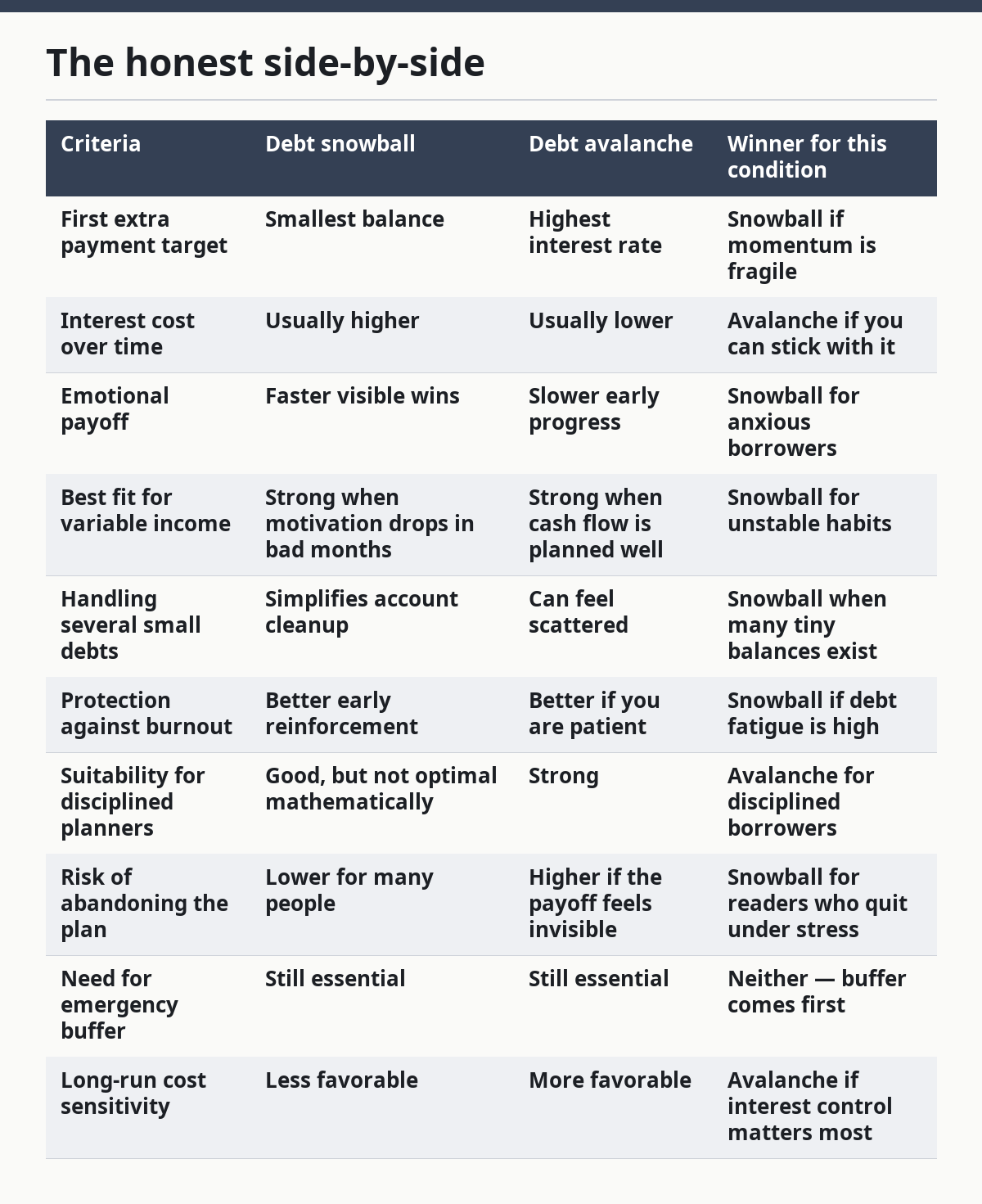
The table makes one thing plain: the winner is not the method with the nicer slogan. It is the method that matches behavior. On changing income, behavior is often the deciding factor because the plan has to survive a lean month before it can save money.
One more point: neither method should be used as an excuse to skip minimums or ignore a cash buffer. A person can run a perfect snowball and still fail if the plan leaves no money for an uneven month. That is the trade-off generic advice usually omits.
Which debt payoff method fits changing income best?
The better method for changing income is usually the one that keeps you paying every month without needing new debt. For many readers, that means starting with snowball, then switching to avalanche only after the account list is under control and the payoff habit is stable.
Choose snowball if the emotional cost of debt is high, your income swings are wide, or you have a history of stopping plans when the numbers feel discouraging. Choose avalanche if your cash flow is predictable enough to support a strict system and you are confident you will not lose momentum waiting for the smallest account to disappear.
The reason I make that call is simple: irregular income punishes fragile plans. A method that depends on perfect discipline every month is a bad fit for many people whose pay is already uncertain. In that sense, snowball is often the more realistic start, even though it may cost more in interest.
That does not mean snowball is universally better. If the interest rate spread is large, or if your debt list contains one especially expensive balance, avalanche can save substantial carrying cost over time. That said, “substantial” is not a substitute for a plan you will actually execute. The right method has to survive the months when work slows, clients pay late, or overtime disappears.
If you have been disciplined for years and your income swings are modest, avalanche is the cleaner choice. If you are trying to regain control after missed payments or repeated resets, snowball is more likely to hold.
The method is only half the decision. The other half is whether you can fund the plan from your lean month, not your best one.
How to build a payoff plan that survives a bad month
A payoff plan that survives a bad month starts with a floor, not a target. The floor is the smallest monthly amount that covers essentials and keeps every debt current. The target is the extra money you apply when income is above average. Confusing those two is how people create a plan that collapses.
Use this order:
- List non-negotiable expenses first: housing, utilities, transportation to work, food, insurance, childcare, and other bills that would cause immediate trouble if unpaid.
- Add minimum debt payments next.
- Compare that total with your lowest realistic monthly income.
- Put the difference, if any, into a buffer account until it can cover at least one bad month of shortfall.
- Only then route extra money into accelerated debt payoff.
The buffer account matters because changing income creates timing risk. A large annual income is not the same as monthly liquidity. This is why people with strong yearly earnings can still miss payments: the cash arrives in uneven chunks.
A practical version of the plan uses three accounts or buckets:
- an operating account for monthly bills;
- a reserve account for income smoothing;
- a debt attack account for extra payments.
If you do not want multiple accounts, the same logic still applies. You just need a written rule for what each incoming payment is for before it gets spent.
The hardest part is resisting the urge to send every windfall to debt. If your income is volatile, a tax refund, bonus, or large project payment may need to refill the buffer first. The exact order depends on whether your reserve is already adequate, whether you have high-cost debt, and whether your income is likely to drop again soon. A qualified adviser can help if you are unsure how to rank those priorities.
One warning: if your minimums already exceed your lean-month income, no payoff plan will work without either higher income, lower expenses, creditor concessions, or outside debt help.
When changing income means the debt plan should stop and be rethought
The debt plan should stop and be rethought when you are using credit to make the minimums on other credit. That is not a payoff strategy. It is a sign the current structure no longer fits reality.
There are a few exception scenarios where the usual recommendations flip:
-
Your income is volatile and your stress level is already high. In that case, snowball beats avalanche because a quick win can keep the plan alive.
-
Your interest-rate gap is large and your income is only mildly variable. In that case, avalanche should usually win because the cost of carrying the expensive debt is hard to justify.
-
Your minimum payments are too close to your lean-month income. In that case, neither payoff method is the right first move. The priority is to cut spending, raise income, or speak with creditors before the next due date.
-
You have one debt with a separate risk profile, such as tax debt or arrears that can trigger severe consequences. In that case, the debt with the harshest consequences may need priority over either snowball or avalanche. The exact rule depends on local law and the creditor’s collection powers.
This is also where people need to be honest about life stage and job type. Someone with seasonal construction income, a commission-heavy sales role, or freelance work with 30- to 60-day invoices does not have the same payoff problem as someone with one missed overtime shift. The wider the swing, the more the plan must protect cash flow before it attacks principal.
A debt plan is worth keeping only if it reflects the income pattern you actually live with. If it only works when everything goes right, it is not a plan.
The verdict: what to choose and what to avoid
Choose debt snowball if your income changes enough that motivation matters more than interest savings, or if you need fast visible progress to keep paying consistently. Choose debt avalanche if your income is only moderately variable, you can follow a strict plan, and the interest-rate gap between debts is meaningful. Neither if your minimums do not fit your lean month, because then the real issue is cash flow, not payoff method.
That is the cleanest answer for changing income. Start with the method you can sustain through a bad month, fund a buffer before you accelerate, and switch methods only if the numbers and your behavior both support it.
If you want the shortest version: the most reliable debt payoff plan on changing income is the one that survives the month your income disappoints. Everything else is secondary.
How to avoid getting trapped in a plan that looks good on paper
The easiest trap is to confuse annual income with monthly safety. A second trap is to set a fixed extra payment that only works when every job, client, or shift shows up on time. A third is to ignore the cost of emotional burnout. All three can wreck progress faster than the debt itself.
A better plan uses thresholds. For example:
- if income is below your lean-month estimate, pay only the floor and protect the buffer;
- if income lands inside your normal range, make minimums plus a modest extra payment;
- if income exceeds your normal range, split the surplus between buffer refill and extra principal.
That kind of rule removes guesswork. It also prevents the all-or-nothing cycle that ruins many debt plans: pay aggressively one month, panic the next, then borrow again.
The other thing worth saying plainly is that there is no universal monthly payment percentage that works for every reader. Rates, lender terms, tax rules, and consumer-protection rules vary by country and change over time. A local financial adviser, debt counsellor, or nonprofit credit counsellor can help you fit the plan to your own rules and risks.
If your income is changing because of a new business, a job transition, parental leave, illness, or a seasonal schedule, the safest next step is not to guess. It is to map the next 6 to 12 months as honestly as possible and set the plan from the lowest likely month forward.
FAQ
How much extra should I pay on debt if my income changes?
Start from your lowest predictable month. Pay the minimums first, then use only the amount left after essentials and a basic buffer. If you are unsure, a qualified debt counsellor or financial adviser can help you set the right floor.
Should I use debt snowball or debt avalanche with irregular income?
Debt snowball is often easier to sustain when motivation drops in lean months. Debt avalanche is usually better if your income is only mildly variable and you can stick to the plan. The Consumer Financial Protection Bureau’s budgeting guidance is a useful place to compare the trade-offs.
Source: CFPB budgeting and savings resources, https://www.consumerfinance.gov/consumer-tools/budgeting/
Do I need an emergency fund before I attack debt?
You usually need at least a small buffer before sending every spare dollar to extra principal. The point is not to save forever; it is to stop one bad month from breaking the plan.
What if I cannot cover minimum payments in a low month?
Then the issue is no longer method selection. Consider creditor hardship options, cutting expenses, increasing income, or getting outside debt help before the next due date.
Is it ever wrong to pay extra on debt first?
Yes, if paying extra would leave you short on minimums, fixed bills, or next month’s essential expenses. In that case, protect the basics and rebuild the plan around your lean month.
Drafted with AI; not yet reviewed by a person.