Last updated: November 19, 2026
Quick Answer: Debt consolidation can turn 2 or more debts into 1 payment, and that single payment can simplify a payoff plan in a very practical way. In Debt Consolidation Explained: What It Is and How It Affects Your Payoff Plan: related questions, the key issue is whether the new terms improve the full payoff timeline, not just the monthly bill. Debt consolidation means combining multiple debts into one new payment, usually so the monthly bill is easier to manage. It can change a payoff plan by lowering the number of due dates and, sometimes, the monthly payment, but it can also stretch repayment longer and increase total interest if the new terms are worse. This is information, not financial advice; a qualified adviser should review your own situation.
Key takeaways
- Debt consolidation changes the structure of repayment, not the debt itself by magic.
- A lower monthly payment can help cash flow, but a longer term can slow your progress.
- The main risk is trading several small balances for one larger balance that lasts longer.
- It is best for people who can keep up with one plan and stop adding new debt.
- It is a poor fit if the new loan, transfer fee, or repayment term makes the payoff date worse.
What does debt consolidation actually mean?

Debt consolidation means replacing 2 or more debts with a single new payment or payment plan. The usual goal is simpler tracking: one due date, one bill, and one payoff path instead of several.
The method shows up in a few forms. A person might take out a personal loan to pay off credit cards, move balances onto a balance transfer card, or use a debt management plan through a credit counseling agency. The label is the same, but the mechanics are not.
The Consumer Financial Protection Bureau and the Federal Trade Commission both warn that consolidation is not a fix by itself; it only works if the new plan fits the budget and the old spending pattern changes too. The FTC’s consumer guidance on debt consolidation loans is a useful starting point: https://consumer.ftc.gov/articles/debt-consolidation-loans. The CFPB also explains debt management plans and related debt options on its consumer pages: https://www.consumerfinance.gov/.
How does it change a payoff plan?
Debt consolidation changes a payoff plan by shifting the fight from several balances to one schedule. That can make the plan easier to follow, but the details of the new term decide whether the debt is actually paid off faster.
If the new payment is lower because the term is longer, the monthly pressure drops, yet the debt may hang around for more months or years. If the new payment is similar but the interest rate is lower, more of each payment can go to principal, which can improve the pace of payoff. The key question is not “Can I afford it this month?” but “What does this do to the full payoff timeline?”
A person should also check whether the old debts are truly paid off or only moved. With a balance transfer, for example, the old cards may be cleared, but the debt still exists on the new card until it is paid down. If the old cards are then used again, the payoff plan can collapse fast.
Which type of consolidation fits which debt?

Debt consolidation through a new loan often works best for a borrower who wants one fixed payment and a clear end date. A debt management plan often fits someone who needs structured help dealing with several unsecured debts and wants fewer moving parts; a qualified credit counselor can help confirm whether that is the right match.
| Criteria | New consolidation loan | Debt management plan | Winner for this condition |
|---|---|---|---|
| Number of payments | One new loan payment | One plan payment to a counseling agency | Tie: both simplify monthly tracking |
| Terms | Usually set by the lender | Set through the plan rules | New loan for borrowers who want direct lender terms |
| Payment control | Fixed by loan agreement | Often designed to fit a budget review | Debt management plan for tight cash flow |
| Interest impact | Depends on the new rate and term | Depends on creditor concessions | New loan if the new terms are clearly better |
| Credit-card use | Cards may stay open unless closed | Cards are often not used while in the plan | Debt management plan for people who need a hard stop |
| Flexibility | Can be more flexible after approval | Can be more structured and less flexible | New loan for borrowers who need more freedom |
| Setup effort | One application | Plan setup and creditor coordination | New loan for speed and simplicity |
| Best for | Stronger credit profile or stable income | People who need repayment discipline | Tie, depending on the budget |
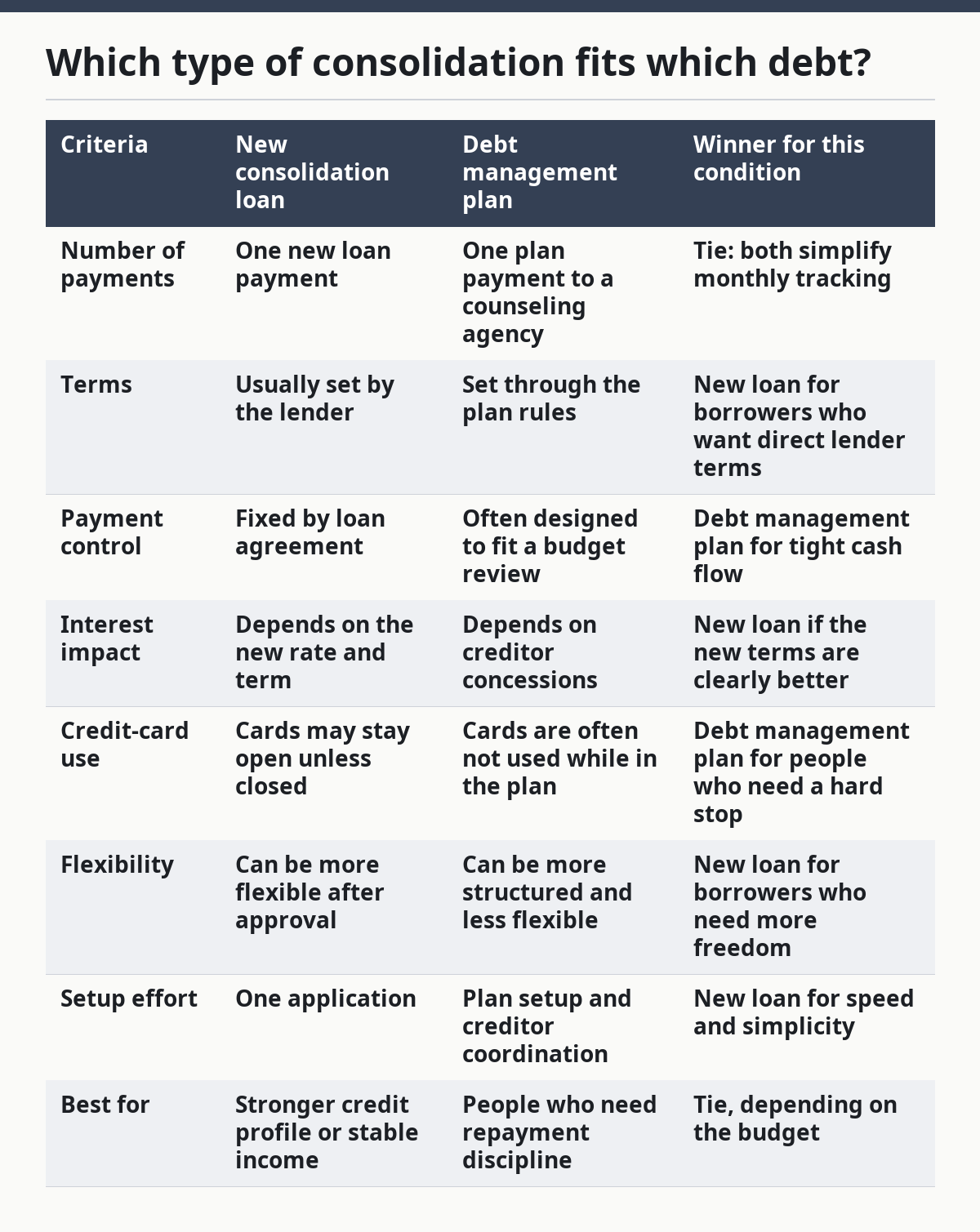
The row that matters most is the one about interest and term. If the consolidation only lowers the monthly bill by stretching the debt out, the payoff plan may look easier while getting slower.
When does debt consolidation help the most?
Debt consolidation helps the most when the current debt mix is messy, the payment dates are hard to track, and the new plan does not make the debt last longer in a harmful way. It is strongest when the person has steady income and a real plan to stop adding new balances.
This is often the right move for someone with several unsecured debts and enough income to handle one payment more easily than four or five, but a qualified professional should review the budget first. It can also help when late fees, missed due dates, or simple confusion are hurting progress. One cleaner monthly bill can reduce missed payments, which protects the payoff plan from small mistakes.
It works less well when the new plan is used to make room for fresh spending. A debt consolidation loan at 0% promotional terms, for example, can still fail if the card balances reappear. The problem is not just the rate; it is the habit that created the debt in the first place.
What are the real downsides?
The biggest downside is that a lower monthly payment can hide a longer repayment path. That is the classic trap: the budget feels better, but the debt lingers.
There are other drawbacks too. Some consolidation methods include fees, and some loans require a decent credit profile or stable income. If the new debt is secured by a home or car, the stakes are higher because missed payments can put that asset at risk, so a qualified professional should review the tradeoff before you sign. That is why consolidation is not automatically the safer path.
It is also a weak choice for someone whose debt came from spending that is still happening. If the card use continues, the person can end up with the old debt paid off and the new debt added on top. At that point, the payoff plan has two problems instead of one.
How should the payoff plan change after consolidation?
The payoff plan should become more direct after consolidation: one payment, one target date, and one rule about new borrowing. If the plan does not change in writing, the debt may stay confusing even after the accounts are combined.
A practical plan usually has 3 parts. First, list the new balance and payment date. Second, stop using the old accounts if the method allows it and if doing so helps prevent reuse. Third, redirect any freed-up cash to the new payoff goal rather than to new spending.
The reader should also compare the old timeline with the new one before signing anything. If the new monthly payment is lower but the term is much longer, the plan may be easier to live with and harder to finish. The best version is the one that makes the debt simpler while keeping the finish line in sight.
What if consolidation is the wrong move?
Debt consolidation is the wrong move if the person cannot keep the old debt from coming back, if the new terms are worse than the old ones, or if the debt is too large for the income available. It is also a poor fit when the borrower is already missing payments and has no room for another fixed bill.
There are 4 exception scenarios where the usual advice flips. One is when the new payment is lower but the total repayment time becomes unacceptably long. Another is when the old debts are unsecured but the new loan is secured, because the risk changes shape, so a qualified adviser should review that shift. A third is when fees or transfer limits swallow the benefit. A fourth is when the debtor needs broader help than consolidation can give, such as a full review of the budget or creditor contact.
In those cases, the better move may be to pause and get outside help from a qualified credit counselor or financial professional. That is not a sign of failure; it is a sign that the debt problem is bigger than a single new account.
What should someone ask before saying yes?
Debt consolidation should be judged by 3 questions: What is the new monthly payment, what is the full repayment timeline, and what happens if spending does not change? Those are the questions that reveal whether the plan is truly simpler or just rearranged.
Ask for the total cost of the new setup, not just the payment amount. If the answer is vague, or if the lender cannot explain how the plan affects the finish date, the offer may not be a good fit. A clean payoff plan is one that a borrower can explain in one sentence and track on one calendar.
FAQ
Is debt consolidation the same as debt relief?
No, it is not the same thing. Debt consolidation combines debts into one payment or one new account, while debt relief usually means trying to reduce what is owed through negotiation or other settlement methods. The difference matters because consolidation changes the payment structure, but it does not automatically reduce the amount owed.
Does debt consolidation hurt a payoff plan?
It can, if it stretches the debt out or adds fees that slow progress. It can also help if it lowers the interest burden and makes the payment easy to keep up with. The payoff plan should be measured by the full timeline, not only by the monthly bill.
Why do people still fail after consolidating debt?
They usually fail because the old spending pattern stays in place. If the newly freed-up credit gets used again, the borrower can end up paying the old debt and the new debt at the same time. Consolidation works best when the person changes the behavior that caused the debt.
Should every person with debt consolidate?
No, not every person should. It is a better fit for someone who can handle a single plan and who will not rebuild the balances after payoff. It is a poor fit when the new terms are worse, the debt is too large for the income, or the borrower needs a different kind of help.
Can consolidation make debt disappear faster?
It can, but only under the right terms. If the new payment goes more to principal or the interest cost drops, the payoff can speed up. If the term becomes longer, the debt may feel easier while taking longer to clear.
Drafted with AI; not yet reviewed by a person.