Last updated: November 19, 2026
Quick answer: choose the debt payoff method that matches your budget pattern and makes your last payment date easiest to control. If your goal is how to choose a debt payoff method when you want to target the last payment date, start by working backward from the date you want and then check whether your monthly payment, extra cash pattern, and posting dates can support it. For personalized guidance, consider reviewing the plan with a qualified financial professional. See the CFPB’s debt collection and budgeting guidance at Consumer Financial Protection Bureau and the FTC’s advice on paying down debt.
Key takeaways
- A target date plan starts with the last payment date, then works backward to the monthly payment you can sustain.
- The best method is usually the one that fits your budget pattern, not just the one that looks fastest on paper.
- Amortization matters because it shows how each regular payment changes the balance over time.
- A method that depends on irregular extra cash can miss the target date if that cash does not show up.
- A simple tracking sheet can tell you, month by month, whether the finish date is still realistic.
Who is this for?

This is for someone who already knows the total debt list, has a stable monthly payment, and wants a specific end date rather than a vague “pay it down faster” plan. It assumes you can list each balance, minimum payment, and due date, even if the balances change a little from month to month.
However, this is not a good fit if you need help choosing between basic debt relief options, if your income changes every 30 days, or if a missed payment would make your plan collapse. In those cases, the deadline itself may be the wrong starting point. A date-first plan works best when the budget is steady enough to hold the line for 6 months, 12 months, or longer.
Because of that, the debt-free date target should be treated like a scheduling problem, but it is still worth checking the numbers with a qualified adviser or counselor if your situation is complex. That way, the deadline is based on a realistic repayment schedule, not on guesswork. See CFPB budgeting tools for a practical starting point.
How do you choose a debt payoff method for a target date?
Choose the method by testing how well it turns one monthly payment into a believable last payment date. A target date plan is usually strongest when it keeps the payoff order clear, keeps the extra payment amount consistent, and does not depend on guesswork.
- List each debt in a simple sheet with balance, minimum monthly payment, and due date, then verify every balance against the latest statement; a mismatch means the finish date estimate is already off.
- Set the target date first, then verify that your current monthly payment plus any fixed extra payment can cover all required minimums; a gap of even one payment means the plan cannot hold.
- Compare the debt snowball and debt avalanche methods against that date, then verify which one gives you the clearest payment sequence; a method that changes order often is harder to track.
- Check your amortization schedule for each debt, then verify how much principal drops after each payment; if the balance barely moves in the first few months, the plan may feel slow even when it is mathematically sound.
- Choose one payoff rule for the extra money, then verify it is simple enough to follow for at least 3 consecutive months; if the rule needs constant recalculation, the date target becomes fragile.
- Assign the full monthly payment path, then verify the order of debts that will receive the extra amount after each balance is cleared; if two debts could swap places, write the tie-break rule down now.
- Track the next 2 to 3 milestone dates on a calendar, then verify each one after every payment posts; if a milestone slips by one cycle, you need to adjust before the delay compounds.
Therefore, the point is to pick the method that lets you predict the last payment date with the least drama. Debt avalanche uses the highest interest rate first; debt snowball uses the smallest balance first. For a deadline, either one can work, but the better choice is the one you can follow without changing the plan every time a balance moves. See debt avalanche vs. snowball for a side-by-side comparison.
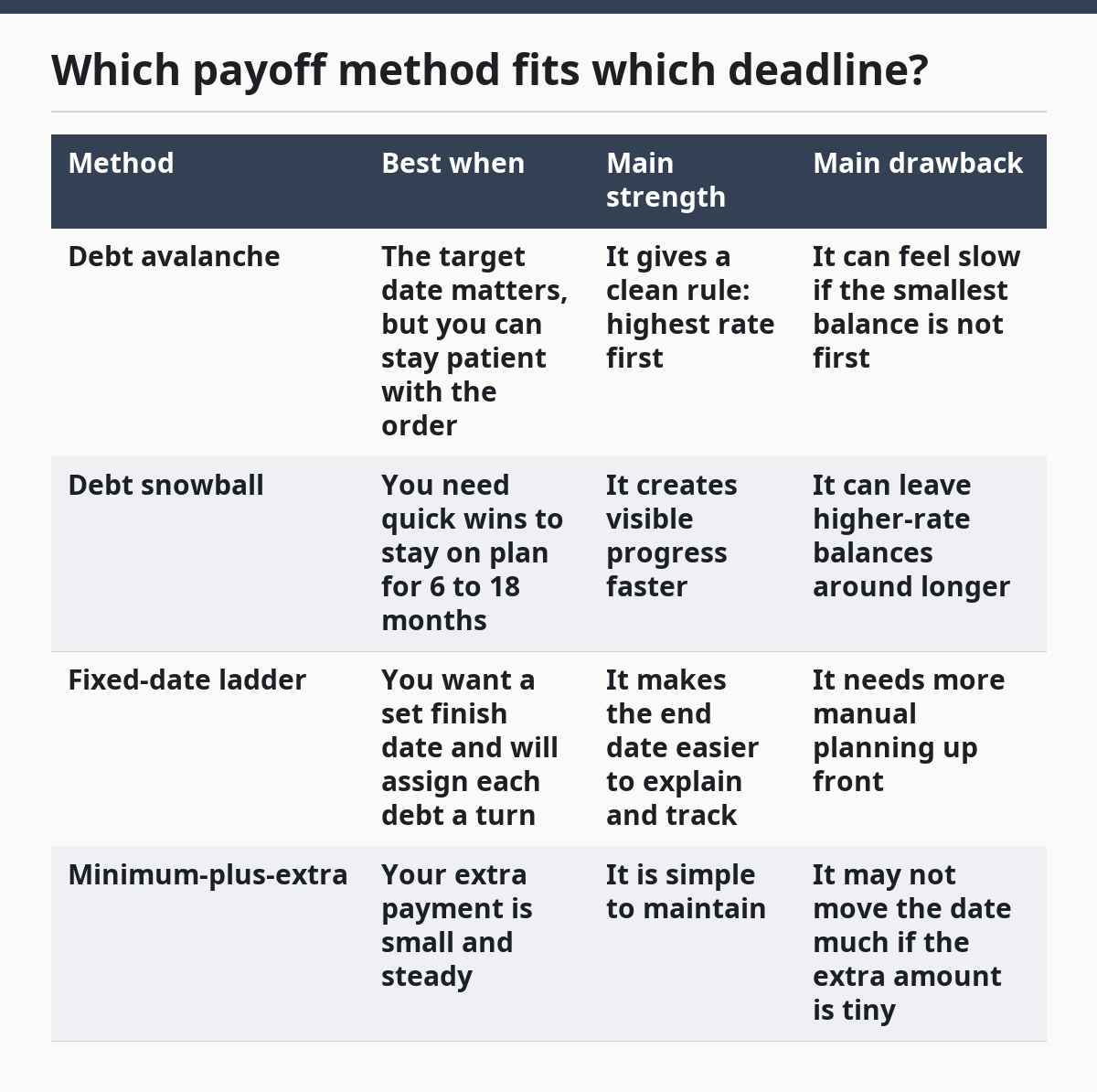
Which payoff method fits which deadline?

In practice, the right method depends on whether the date is fixed, soft, or only a rough goal. A hard date usually calls for the most predictable payment order, while a softer date gives more room to optimize for motivation or total interest saved.
| Method | Best when | Main strength | Main drawback |
|---|---|---|---|
| Debt avalanche | The target date matters, but you can stay patient with the order | It gives a clean rule: highest rate first | It can feel slow if the smallest balance is not first |
| Debt snowball | You need quick wins to stay on plan for 6 to 18 months | It creates visible progress faster | It can leave higher-rate balances around longer |
| Fixed-date ladder | You want a set finish date and will assign each debt a turn | It makes the end date easier to explain and track | It needs more manual planning up front |
| Minimum-plus-extra | Your extra payment is small and steady | It is simple to maintain | It may not move the date much if the extra amount is tiny |
A date target changes the trade-off. The usual question is “which saves the most interest?” This page is about “which keeps the last payment date believable?” Those are not the same question, and they can lead to different choices.
If the date matters more than interest savings, favor the method you can follow without drift. If motivation usually fails after 2 or 3 months, the simplest rule may beat the cleverest one. If you want the broader framework, the hub on debt payoff method fit by budgeting and surplus design is the right place to start.
What should you check before you lock it in?
Since the payment pace has to match your real cash flow, not your best month, start by checking whether the monthly payment still works after rent, food, utilities, and other fixed bills.
Start with the amortization basics. Amortization is the way each payment splits between interest and principal over time, and that split changes as the balance drops. If you have a debt with a long remaining term, the early payments may move principal slowly, which affects how soon the balance disappears. For a deeper explanation, see amortization schedule basics.
Then check three practical items. First, confirm that every debt has a minimum payment covered. Second, confirm that your extra payment is a fixed amount, not a hope. Third, confirm that you can keep the same order of attack for at least 3 months before you change anything.
A target date plan also needs a cushion for timing. Payments post on different days, so a “last payment date” on your calendar may not be the same as the date the balance actually reaches zero. That gap can be a few days or longer, depending on posting rules and payment timing. Build the date plan around the statement cycle, not just your memory. The CFPB’s payment timing guidance and the FTC’s debt advice are both useful references here: CFPB and FTC debt resources.
When should you not use a date-first plan?
A date-first plan is the wrong tool when the budget itself is unstable or the debt picture is changing fast. In those cases, the finish date can give a false sense of control.
Your monthly income changes a lot: the monthly payment may not stay reliable — use a more flexible plan and revisit the date after each full month of income.
You are missing minimum payments: the plan is already broken — get help with the budget first, because a target date cannot survive skipped payments.
The debt list changes often: the amortization path keeps shifting — pause the date target until the balances stop changing every few weeks.
You depend on irregular lump sums: the last payment date is hard to trust — treat those payments as bonus progress, not as the core of the plan, and review the timing with a qualified adviser if the lump sums are central to your strategy.
The balance is tied to a variable rate or fee pattern: the payoff timeline can move — check the statement each cycle and update the date when the required payment changes.
You cannot track one calendar month at a time: the plan will drift — choose a simpler rule and review it after each payment posts.
These are not moral failures. They are signs that the method does not match the shape of the debt. A target date works best when the payment rhythm is steady enough to follow without constant repair. If you need a different starting point, the CFPB’s budgeting tools can help you reset the plan.
What mistakes throw off the last payment date?
The most common mistake is choosing a method for emotion instead of timing. A snowball can feel good after the first small account closes, but if it pushes the finish date out beyond what you can tolerate, the plan starts to wobble. The safer choice is to pick the method that keeps the deadline visible for the full 6 to 12 months ahead, then review it against the actual statement cycle.
Another mistake is treating the minimum payment like a placeholder instead of a real constraint. If one debt gets a minimum payment that is too low to fit the rest of the plan, the target date can slip by an entire cycle. The better move is to verify that every required minimum is included before you assign extra money anywhere, and to consult a financial professional if you are unsure how to prioritize competing debts.
A third mistake is changing the payoff order every time a balance shifts by a small amount. That creates noise and makes the date harder to predict. Pick a rule once, write it down, and only change it when the debt list itself changes in a meaningful way.
A fourth mistake is ignoring posting dates. If you pay on the 28th but the creditor posts on the 2nd, the calendar can show one thing while the statement shows another. The fix is to track the posting date, not just the send date.
A fifth mistake is using a target date as a promise. It is better to treat it as a working forecast. That keeps the plan honest when the final month is close and the balance is not yet exactly zero.
How do you track progress without guessing?
Track progress with one simple ledger and one calendar. A basic spreadsheet or paper sheet can show the balance after each posted payment, the next milestone, and the updated expected last payment date. For a template, see debt payoff tracker.
Use 3 columns for each debt: opening balance, payment made, and remaining balance. Then add a note for the payoff rule you chose, such as avalanche, snowball, or fixed-date ladder. That keeps the method visible when you look back 2 months later and wonder why a payment went where it did.
Check progress once a month, right after the statement closes. That is the cleanest time to compare the planned balance with the actual balance. If the numbers are off by more than expected, the reason is usually a missed extra payment, a fee, or a payment that posted later than planned.
The best result is not a perfect forecast. It is a plan that keeps the debt-free date target close enough to trust and simple enough to repeat. If the ledger stays readable for 12 months, the method is probably doing its job.
Which payoff method is best for a specific deadline?
Because a specific deadline changes the trade-offs, the right method is the one that makes the date easiest to hold, not the one that sounds fastest. If the deadline is firm, a simple and consistent order usually beats a plan that requires frequent changes. If the deadline is flexible, the method that keeps you on track for 6 to 12 months is often the better fit.
How do I shorten the timeline without changing the budget?
Next, use the same monthly payment and make the payment order more disciplined. That means keeping minimums covered, sending extra money to one debt at a time, and avoiding side detours that break the sequence. The timeline only shortens if the money reaches principal earlier, so the main task is to stop the plan from leaking attention.
Should I choose the method that gives the earliest finish date?
Ultimately, choose it only if you can actually follow it for the full run. An earlier finish date on paper means little if the method is too hard to maintain or forces constant changes. The better test is whether the plan fits your monthly payment, your tracking habits, and your tolerance for waiting through the first few months.
Drafted with AI; not yet reviewed by a person.