Last updated: August 10, 2026
- But Debt A would keep compounding at 21% for longer; honestly, that patience costs you real money.
- A thin month might mean £50 extra toward the top-of-list debt; a good month might mean £400.
- Say Debt B sits at £180 and you could clear it in a single month.
- A balance charging 22% annually costs you roughly three times as much per dollar as one charging 7%.
This article is informational only. Not financial advice. Your situation is specific to you — your income, obligations, tax position, and risk tolerance are things only you and a qualified financial adviser can assess together. Rates, thresholds, and rules vary by country and change over time; check current figures for your jurisdiction.
Twenty-two percent annual interest will quietly drain a balance faster than most people expect. You have more than one debt, the rates are different, and you want the mathematically cheapest exit. The debt avalanche method answers that exact question: direct every spare dollar at the highest-rate balance first, then roll that freed payment to the next-highest once the first account is gone. Over time — sometimes years — that sequencing means you pay less in total interest than under any other fixed-payment order.
That is the core of it. Everything a one-sentence definition leaves out — how to build the actual plan, what the numbers look like in practice, where the method genuinely falls short, and when a different approach might serve you better — is what the rest of this guide covers.
What the Debt Avalanche Actually Does (And Why the Order Matters)
Most people with multiple debts make minimum payments on everything and direct any extra money somewhere arbitrary — whichever bill arrived most recently, whichever creditor feels most threatening. The avalanche replaces that arbitrary order with a deliberate one: rank your debts by interest rate, highest to lowest, and aim any money above the minimums at position one until it is gone.
The logic is blunt. A balance charging 22% annually costs you roughly three times as much per dollar as one charging 7%. Every month that 22% balance sits untouched, you are converting money into interest at that high rate. Paying it down faster shrinks the balance on which that rate compounds — and the sooner you destroy the high-rate balance, the less total interest accumulates across your whole debt picture.
Here is a simplified illustration. Suppose you have:
- Debt A: £4,000 at 21% APR
- Debt B: £8,000 at 14% APR
- Debt C: £2,500 at 6% APR
Your minimum payments total £300 per month and you have £500 per month available for debt repayment. Under the avalanche, you pay minimums on B and C and put the remaining £200 toward A. When A is gone, that full freed payment rolls to B. Then B to C.
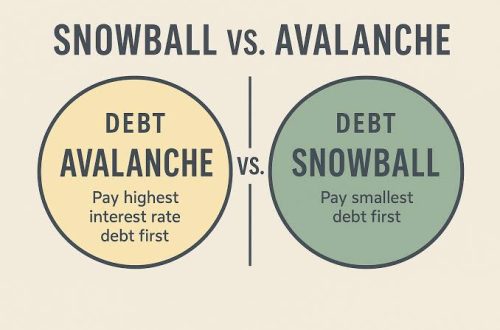
The alternative — the debt snowball, which sequences by balance size rather than rate — would attack Debt C first (smallest balance). You would clear that one faster and get a motivational win. But Debt A would keep compounding at 21% for longer; honestly, that patience costs you real money. The exact difference depends on your specific balances, rates, and timeline, but for debts with large rate gaps, the gap is not trivial.
What the illustration cannot show you is how this feels when month three arrives and Debt A has barely moved. That tension between mathematical optimality and psychological endurance is the most important thing to understand about the avalanche, and I will return to it at length.
How to Build Your Avalanche Plan in Five Steps

The concept is simple. Implementing it cleanly takes about an hour of setup and then a recurring five-minute monthly check.
Step 1: List every debt with its current balance and APR.
Not the introductory rate, not the rate you remember from when you opened the account — the current APR on your statement. Many credit cards show this prominently. With a variable-rate debt, use today’s rate and accept that projections will need updating when it shifts.
Step 2: Confirm your minimum required payment on each.
Missing a minimum to fund the avalanche is counterproductive. Late fees and credit score damage cost you more than any interest-rate optimisation saves.
Step 3: Add up your total minimums and subtract from your monthly debt budget.
The remainder is your avalanche payment — the amount directed at the highest-rate debt each month, on top of that debt’s minimum.
Step 4: Rank your debts from highest APR to lowest.
Ties go to the smaller balance first — clearing it slightly faster reduces the number of active accounts you are juggling.
Step 5: Each time a debt clears, roll its payment to the next debt on the list.
This is the mechanism that accelerates everything. Your total outgoing payment stays constant; it just concentrates on fewer balances as you go.
One practical note: irregular income does not break the method. A thin month might mean £50 extra toward the top-of-list debt; a good month might mean £400. The ranking and rollover principle stay the same either way.
Build this in a plain spreadsheet rather than an app, at least initially. Seeing the projected payoff date shift when you add an extra payment teaches you the relationship between the numbers faster than watching a progress bar.
The Real Difference Between the Avalanche and the Snowball
These two methods share a structure — minimum payments everywhere, extra money concentrated on one target — but they disagree on which debt to target. That disagreement is really about what you are optimising for.
The avalanche optimises for total cost. Follow it faithfully and you will spend less money retiring your debts than under any other fixed-payment sequence.
The snowball optimises for momentum. Clear the smallest balance first, regardless of rate. A complete payoff — one account fully gone — arrives sooner than under the avalanche. That psychological win is not trivial; research in behavioural economics (the work of Amar Bhatt and Avelet Fishbach, among others, though I would encourage you to find current academic sources yourself) has suggested that the early wins of the snowball can support sustained effort in a way the avalanche’s deferred rewards do not always match.
Here is the honest side-by-side:
| Criteria | Avalanche | Snowball | Advantage for… |
|---|---|---|---|
| Total interest paid | Lower | Higher | Avalanche |
| Time to first full payoff | Longer (if largest balance = highest rate) | Shorter | Snowball |
| Total repayment timeline | Often shorter | Often longer | Avalanche |
| Psychological early wins | Fewer, deferred | More, sooner | Snowball |
| Simplicity of logic | Slightly more complex | Very simple | Snowball |
| Benefit when rates are similar | Minimal difference | Same | Neutral |
| Benefit when rates are very different | Meaningful savings | Forgoes savings | Avalanche |
| Suited to high-discipline repayers | Yes | Less necessary | Avalanche |
| Suited to motivation-dependent repayers | Risky | Yes | Snowball |
The rate-difference point matters enormously. A spread of 22% versus 20% saves you very little by following the avalanche over the snowball. A spread of 28% versus 5%? That difference can reach hundreds or thousands of pounds over the repayment period, depending on balance sizes and how long you carry them.
My view: if you are the kind of person who will follow a spreadsheet faithfully for two years without needing a milestone to stay on track, the avalanche is the better mathematical choice. But most people need to feel progress to maintain discipline — and the snowball’s early wins may keep you in the game long enough that a less optimal method actually outperforms an avalanche you abandoned halfway through.
A method you stick with for four years beats a theoretically superior method you quit after fourteen months.
Who Should Use the Avalanche (And Who Probably Shouldn’t)
The avalanche works best for:
Those with stable, predictable income who can commit a consistent monthly surplus to debt repayment without revisiting the question. Borrowers whose debts carry substantially different interest rates — where the sequencing decision actually changes the cost outcome. People who derive motivation from knowing they are doing the mathematically cheapest thing, not from watching accounts close. And those with larger balances on high-rate debts, because those are exactly the situations where the mathematical advantage is most pronounced.
The avalanche is harder for:
Anyone whose highest-rate debt also carries their largest balance. In that scenario, you might spend eighteen months or more attacking a single balance before it clears, watching your other accounts barely move. The motivational cost of that is real — I would not dismiss it as weakness. Behavioural persistence is a resource, and the avalanche spends it faster than the snowball does.
Borrowers with very similar rates across all debts should also pause. With everything sitting between 14% and 17%, the ordering barely matters; pick whichever sequencing feels more tractable.
Anyone in financial crisis should stop here. Choosing between paying a debt and keeping the lights on means systematic optimisation is secondary to immediate stability. Get advice first.
Also worth flagging: a debt on a 0% promotional rate that expires soon can restructure your entire ranking overnight — 0% becoming 25% is not a minor update. Review your list whenever a promotional period ends.
The Honest Limitations of the Avalanche Method
The debt avalanche is arithmetically sound. But several real limitations get glossed over in most write-ups.
Fixed minimum payments are an assumption, not a guarantee. Minimums on credit cards often change as balances shift. Projected payoff dates and total interest figures will drift from reality — update the plan quarterly at minimum.
Balance transfers and refinancing are not part of the model. A lower-rate option becoming available mid-repayment changes that debt’s position in your ranking. This is not a set-and-forget system; apply it to your current balance-and-rate picture, which changes.
Non-interest costs are invisible to the method. Some debts carry annual fees, monthly service charges, or penalties separate from the APR. A debt with a £200 annual fee and a 15% APR might actually cost more per year than a 17% debt with no fees on a similar balance. Do the full annual cost calculation, not just the rate comparison.
The cause of the debt goes unaddressed. Spending that still outpaces income will undo the work — new balances on cleared cards can erase months of progress. The avalanche addresses sequencing; the cash flow problem you have to fix separately.
Slow progress is not a minor caveat. Motivation is a legitimate factor in whether any financial plan succeeds. The avalanche demands patience in a way the snowball simply does not. Know yourself before you commit.
Exception Scenarios: When the Verdict Flips
Exception 1: Your smallest-balance debt is also your highest-rate debt.
Here the avalanche and snowball target the same debt first. Mathematical optimality and the early win — this is the ideal setup for the avalanche, and it removes its main psychological disadvantage entirely.
Exception 2: You are close to clearing a non-highest-rate debt anyway.
Say Debt B sits at £180 and you could clear it in a single month. A brief detour from strict avalanche order may be worth it: the freed payment arrives quickly, your financial picture simplifies, and the additional interest cost is minimal. A judgment call — but a defensible one when the detour is short.
Exception 3: One of your debts has a conditional forgiveness or settlement option.
A creditor offering a settlement on a specific account, or a country where a particular debt type carries forgiveness provisions (certain student loan programmes, though these vary enormously and shift frequently — check with a qualified adviser), makes mathematical sequencing secondary to that specific outcome.
Exception 4: A debt is threatening your credit score or housing situation.
An overdue account about to go to collections, or a debt tied to a lease guarantee, can carry consequences that dwarf any interest savings from strict rate sequencing. Protecting your credit standing or housing is a legitimate reason to address a debt out of avalanche order. A financial adviser familiar with your jurisdiction is better placed than any article to guide this.
Combining the Avalanche with Other Tactics
The avalanche is a sequencing rule. Nothing about it prevents you from applying other approaches alongside it.
Refinancing or balance transfer. Moving a high-rate balance to a lower-rate product resets that debt’s position in your ranking. A 0% balance transfer card, for instance, may push the transferred portion to the bottom of your list for the promotional period — well, usually, assuming the revert rate does not catch you off guard. Read the transfer fee, the revert rate, and the promotional term carefully. Your ability to access these products depends on your credit profile, and I am describing the mechanism here, not recommending a specific product.
Extra lump-sum payments. A work bonus, tax refund, or similar windfall goes straight to the top of your list. Applied to a 22% balance, that lump sum saves materially more than the same amount applied to a 7% balance — the compounding math stops working in the lender’s favour that much sooner.
Automating minimum payments. Late fees and penalty rates are the enemy of any repayment plan. Automating minimums removes the risk of forgetting; your avalanche payment can stay manual if you want that conscious monthly confirmation you are following the plan.
Tracking net worth, not just individual debts. Watching total liability shrink month to month — even when no single account has closed yet — can provide the psychological reinforcement the avalanche otherwise lacks. A simple monthly snapshot of total debt owed substitutes reasonably well for the “account closed” milestone the snowball delivers more frequently.
My Verdict: When to Choose the Avalanche, When to Choose Something Else
Choose the avalanche when your debts carry meaningfully different rates — a spread of more than five or six percentage points between top and bottom — and you are confident you will maintain the plan without needing early payoffs as milestones. The larger that spread and the bigger the high-rate balances, the stronger the case.
Choose the snowball when experience tells you that visible progress is what keeps you committed. Three years of a theoretically inferior method beats ten months of a theoretically superior one you walked away from. No shame in that — just an honest reading of how motivation works.
Choose neither as a starting point if you are in active financial difficulty, behind on any payments, or weighing insolvency-adjacent options. In those situations, a debt management plan, formal repayment arrangement, or equivalent service in your country — accessed through a regulated adviser or a non-profit debt counselling service — is a more appropriate first step than self-directed sequencing.
The avalanche is not magic. Arithmetic, applied consistently. Its power comes entirely from the consistency — putting the right money in the right place every month for as long as the job takes. That duration, and the discipline it demands, is worth taking seriously before you choose it.
As always: this is information, not advice. Your specific income, tax position, credit obligations, and jurisdiction all affect what the right path looks like for you. A qualified financial adviser can work through those specifics in ways a general method never can.