Last updated: November 19, 2026
Quick Answer
If you plan to sell an asset, choose a debt payoff method that matches the sale date, the sale costs, and the certainty of the net proceeds. If the sale is still pending, use the net proceeds, not the headline price, and keep enough cash for at least 1 payment cycle until the funds clear. This guide on how to choose a debt payoff method before an asset sale shows how to line up asset sale proceeds, debt payoff, and timing so you do not overcommit before the money clears.
The decision starts with the money you will actually receive
Pick the method from the net proceeds, not the headline sale price. If a car sale, property sale, or other asset sale is still pending, the amount that matters is what remains after fees, repairs, taxes, payoff to secured lenders, and the closing delay. See the CFPB’s guide to closing costs and settlement estimates, and check a written payoff quote before you count the money.
Picture this: you have a sale scheduled, but the amount that will hit your account is still fuzzy. You want a simple payoff plan, yet the wrong plan can leave a shortfall or force a second payment later. That is why the first job is to match the debt payoff method to the sale timing and the size of the lump sum you expect.
For your own situation, consider a qualified adviser if the sale, the payoff, or the title transfer is complex. For the broader framework, the hub on [debt payoff methods and strategy selection] would sit above this page.
- Net proceeds = sale price minus selling costs and any payoff tied to the asset.
- Transaction costs can include agent fees, repairs, transfer charges, storage, and closing costs.
- Shortfall risk is the chance that the debt is larger than the cash you actually receive.
- Timing risk is the chance that the payment comes due before the sale settles.
Which payoff method fits a planned asset sale?
The best fit is often the method that keeps your debt plan flexible until the sale is finished. If the sale is certain and the proceeds are predictable, a lump-sum payoff can work well. If the amount is still uncertain, a staged plan that makes only minimum or scheduled payments until closing is often safer.
Picture this: you are choosing between a snowball plan, an avalanche plan, and a one-time payoff from a future sale. The real question is not which method sounds smartest on paper. It is which one still works if the closing date slips by 2 weeks or the repair bill rises before the sale.
A simple way to think about the methods:
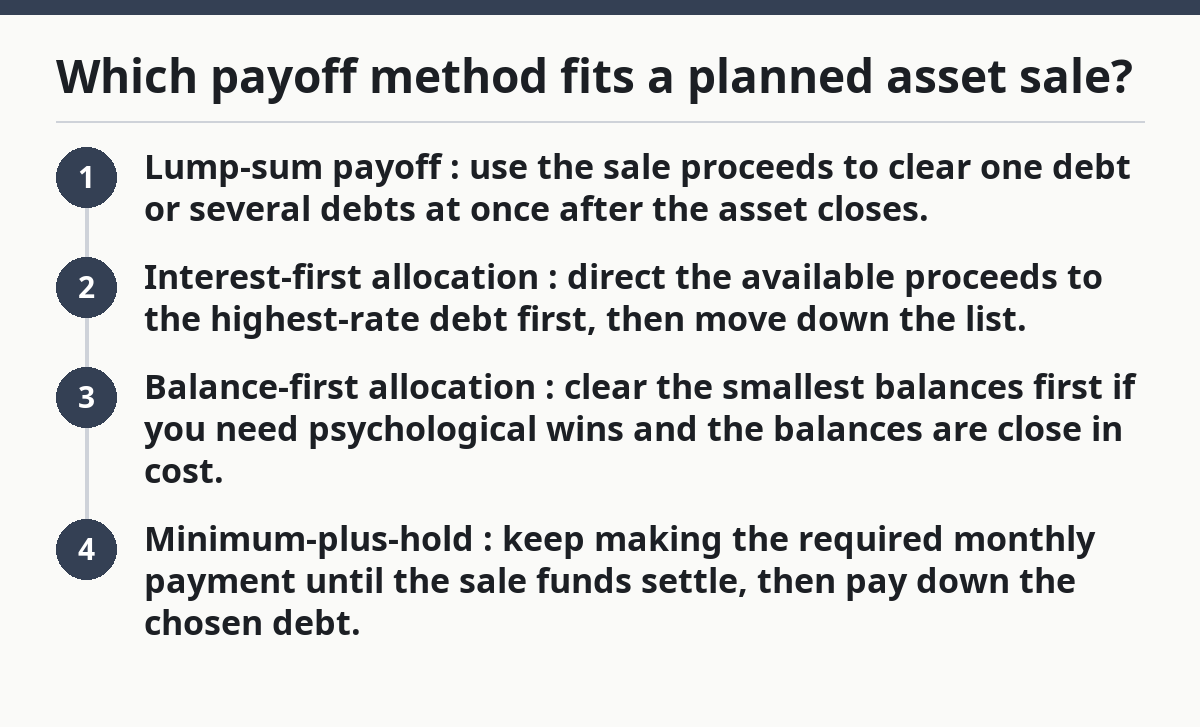
- Lump-sum payoff: use the sale proceeds to clear one debt or several debts at once after the asset closes.
- Interest-first allocation: direct the available proceeds to the highest-rate debt first, then move down the list.
- Balance-first allocation: clear the smallest balances first if you need psychological wins and the balances are close in cost.
- Minimum-plus-hold: keep making the required monthly payment until the sale funds settle, then pay down the chosen debt.
The method that often breaks down is the one that assumes the full sale price is already yours. That is a mistake. It ignores transaction costs, delay, and the chance that the buyer asks for a last-minute concession.
How do I time debt payments around a sale?
Time the payment for after the funds clear unless your lender confirms a payoff quote that stays valid through the closing date. A payoff quote is the exact amount needed to clear a debt on a specific day, and it can change daily because of interest and fees. The CFPB explains why payoff statements matter in mortgage closings, and the same timing logic is useful for other debts too.
Picture this: you are staring at a closing statement and a credit card bill in the same week. One payment can be made today, the other in 10 days, and the sale might slip by a few business days. That gap is where mistakes happen, because a payment made too early can leave you short if the sale net is smaller than expected.
Use this order:
- List every debt tied to the choice. Write down the balance, rate, minimum payment, and whether it has a prepayment fee or a payoff quote. Verify the payoff quote date. If the quote is older than the sale date, it may be wrong.
- Estimate net proceeds, not gross price. Subtract the sale commission, transfer fee, repairs, and any lien payoff from the sale price. Verify the final net using the draft closing statement or settlement sheet. If you cannot get a settlement estimate, you do not yet have a reliable payoff amount.
- Keep cash for the gap. Hold enough to cover at least one debt payment and one sale expense that could change before closing. Verify that the holdback is in an account you can access quickly. If the money is locked up, the plan is too tight.
- Choose the order of debt payoff. If the proceeds will cover only part of the debt list, decide whether to target the highest interest rate, the smallest balance, or the debt with the highest risk of fee penalties. Verify that the order matches your goal. If the order changes every week, the plan is not settled.
- Schedule payments after the sale clears when possible. Ask the lender how long a transfer takes and whether an online payment posts the same day or next business day. Verify the cutoff time. If the payment must be mailed, the timing is too uncertain for a close closing window.
- Check for secured debt rules. If the asset itself is collateral, the loan may have to be paid from escrow or closing before you get any extra proceeds. Verify the lien release process, and consult your lender, escrow officer, or attorney if the rules are unclear. If the lien cannot be released on time, the sale can stall.
- Run a shortfall check. Compare the worst-case net proceeds with the total payoff target. Verify you still have room for a 1- to 2-week delay or a lower sale price. If the numbers only work with perfect timing, the plan is fragile.
A good result is boring. The debt payment lands after the funds settle, the balances match the payoff quote, and no emergency transfer is needed. A bad result is also easy to spot: you are depending on money that has not cleared yet.
What should I check before I use the sale money?
Check whether the sale proceeds are certain enough to assign before closing. If the sale is a car sale, home sale, or other asset sale with fees and lien payoffs, the usable cash may be much smaller than the sticker price suggests. The FTC’s used car buying guide is a useful reminder that transfer and title steps can affect timing and cost.
Picture this: you have an offer in hand and a debt balance you want gone. The temptation is to earmark every dollar today. But a small change in repairs, title work, taxes, or buyer credits can turn a full payoff into a partial one. That is why the net number matters more than the headline.
Use this checklist:
- Get a written payoff quote for each debt you may clear.
- Ask for the closing statement or settlement estimate so you can see the net proceeds.
- Confirm the sale timeline in business days, not just calendar days.
- Check for penalties or fees tied to early payoff.
- Make sure the asset transfer is clean, especially if there is a lien, title issue, or co-owner.
- Leave a small buffer if the sale date and payment date do not line up exactly.
A common mistake is to count the same money twice. For example, a car sale buyer may pay you after a lien is cleared, but the lien payoff may happen first through the title process. That is not free cash; it is moving money through a chain with a delay.
The mistakes people make when they plan around sale proceeds
People usually get tripped up by timing, not by math. The numbers are often fine on paper, but the payment date, settlement date, or payoff quote date does not match the real-world schedule.
Picture this: you set up a payoff plan in the morning and the buyer changes the closing date by Friday. Now the payment you thought would be covered is either early, late, or too large. That is not a theory problem. It is a cash-flow problem.
The most common mistakes are:
-
Using the gross sale price as if it were cash in hand.
The consequence is a shortfall after fees, taxes, and transfer costs. The fix is to plan from the net proceeds. -
Paying debt before the proceeds are cleared.
The consequence is that you can create an overdraft or have to borrow again. The fix is to wait for settlement unless a payoff quote and closing plan are locked. -
Ignoring payoff quote expiration dates.
The consequence is a payoff amount that is off by interest or fees. The fix is to refresh the quote right before payment. -
Putting all proceeds into one debt without checking the order.
The consequence is that a higher-rate debt or penalty-heavy debt may survive while a cheaper one is cleared first. The fix is to set the allocation rule before the sale. -
Forgetting the backup plan if the sale falls through.
The consequence is a monthly budget that no longer fits once the expected lump sum disappears. The fix is to keep the standard payment plan ready for at least one more cycle. -
Missing lien or title requirements on a car sale or other secured asset.
The consequence is delay, extra fees, or a blocked transfer. The fix is to confirm what the lender, title office, or escrow agent needs before the sale date, and consult a professional if the paperwork is unclear.
When should I stop and rethink the plan?
Stop and rethink when the sale is not close enough to be counted as money yet. If any of these situations apply, the standard payoff method is the wrong tool for the moment.
Picture this: you are 3 steps into the plan and one assumption breaks. Maybe the buyer wants a new inspection, maybe the loan payoff statement changes, maybe the closing slips. That is the point to pause and recalculate rather than forcing the debt payment through.
The sale date is not fixed: the closing can move by days or weeks — keep only required debt payments in motion until the date is firm.
The net proceeds are unclear: fees, repairs, or lien payoffs are still changing — wait for a settlement estimate before assigning the money.
The debt has a payoff penalty or unusual release rule: an early payment may trigger extra cost or delay — ask for the payoff terms in writing and compare the total cost.
The asset has a lien or title problem: the sale may not close cleanly — resolve the lien path first, because the money may never reach you as expected.
The sale depends on a second transaction: one closing must happen before another — use a conservative payment plan and avoid assuming both will finish on the same day.
You need every dollar from the sale to keep basic bills current: the debt plan is competing with rent, food, or transport — hold the cash until the budget is stable.
When one of these applies, the wrong move is to force a payoff decision just to feel finished. The better move is to keep the debt plan flexible for another 1 billing cycle or until the proceeds are real.
How does a planned asset sale change the payoff order?
A planned sale changes the payoff order because timing and certainty matter as much as interest rate. If the sale is near and the proceeds are dependable, the order can be based on the debt with the highest rate or the highest fee risk. If the sale is uncertain, the order should favor safety and liquidity.
Picture this: you have two debts and one asset waiting to be sold. One debt has a higher rate, the other has a lower balance, and the sale may take 30 days or more. The best choice is not always the mathematically pure one. It is the one that still works if the sale is delayed.
Here is the practical rule:
- If the sale is certain and close, you can plan a clean lump-sum allocation.
- If the sale is uncertain, keep making regular payments and do not over-allocate the proceeds in advance.
- If the debt is secured to the asset, handle the lien first because the sale process may require it.
- If the debt has a high rate plus no early payoff penalty, it often belongs near the front of the list.
- If the debt has a fee for early repayment, compare the fee to the interest you would save before deciding.
That last point matters. A payoff method is not just about speed. It is about total cost, cash timing, and whether the sale can actually fund the move you want.
Key Takeaways
- Use net proceeds, not the headline sale price, when you plan a payoff.
- Match the debt payoff method to the sale date and the chance of delay.
- A lump-sum payoff works best when the proceeds are clear and close.
- If the sale is shaky, keep regular payments going and leave a cash buffer.
- Check payoff quotes, liens, and transaction costs before assigning the money.
- If the numbers only work in the best case, the plan is too tight.
FAQ
Should asset sale proceeds go to the highest interest debt?
Usually, yes, if the sale is settled and the payoff carries no penalty. The highest-rate debt is often the most expensive debt to keep. If the sale is uncertain or the debt has an early payoff fee, the better choice can be different.
How do I time debt payments around a sale?
Time the payment for after the proceeds clear, unless the payoff quote and closing date are locked together. A payoff quote can change by day, and a sale can slip by a few business days. The safest plan is to keep required minimum payments current until the money is actually available.
Does a planned sale affect payoff method choice?
Yes, because it changes how certain and how soon the money arrives. A close, predictable sale can support a lump-sum debt payoff plan. A sale with uncertain timing, costs, or title issues usually calls for a more flexible plan until the proceeds are confirmed.
Drafted with AI; not yet reviewed by a person.