
Last updated: November 20, 2026
Quick Answer: If the balloon payment is due in under 12 months and the reserve is still short, prioritize the maturity date first. A balloon payment changes the question because one large lump sum can come due on a fixed maturity date, so the method that works for ordinary installment debt may fail if it leaves that final payment underfunded. This is information, not financial advice; your own situation deserves a qualified adviser.
Key takeaways
- A balloon payment can turn a “small monthly payment” into a large deadline problem.
- The right method depends on whether the final lump sum is already covered, partly covered, or still a gap.
- Payoff sequencing changes when one debt has a maturity date that can beat your normal order.
- Refinancing can solve timing, but it adds approval risk and can cost you a new payment structure.
- If the balloon amount is not on track, the method that feels fastest is not always the safest one.
What counts as balloon payment debt?

Balloon payment debt is debt with a regular payment schedule and one larger lump sum due at the maturity date. That means the loan can look manageable month to month while still leaving a large amount to pay all at once. Common examples include some installment loan structures and some refinance loans, though terms vary by country and lender.
Therefore, the key feature is not the label on the statement. It is the structure: smaller payments now, a much larger lump sum later. If the maturity date is close and the balloon payment reserve is thin, a standard debt payoff method may mislead you because it focuses on balances, not deadlines. For a plain-language overview of balloon payments, see the Consumer Financial Protection Bureau.
Because of that, this page is for a reader who already knows the basic difference between debt types and wants to choose a method, not learn what debt is. If the debt is already in default, in collections, or tied to a legal dispute, the decision shifts away from simple payoff ordering and toward urgent qualified help.
How do I choose a payoff method?
Choose the method by comparing the balloon amount, the maturity date, and your extra cash flow. The best approach is usually the one that leaves enough money available for the lump-sum maturity payment without starving the rest of the plan.
| Method | Best when | Main advantage | Main drawback |
|---|---|---|---|
| Snowball | You need momentum and the balloon debt is already covered by a reserve | Fast psychological wins | Can ignore the debt with the nearest maturity date |
| Avalanche | Interest cost matters most and the balloon payment is already funded | Usually reduces interest over time | May leave a near-term balloon underprepared |
| Deadline-first sequencing | One debt has a fixed maturity date that must be met | Protects the balloon payment date | Can slow progress on other balances |
| Refinance-led plan | The balloon debt is hard to fund as written | Can replace a lump sum with new terms | Approval risk and new terms are not guaranteed |
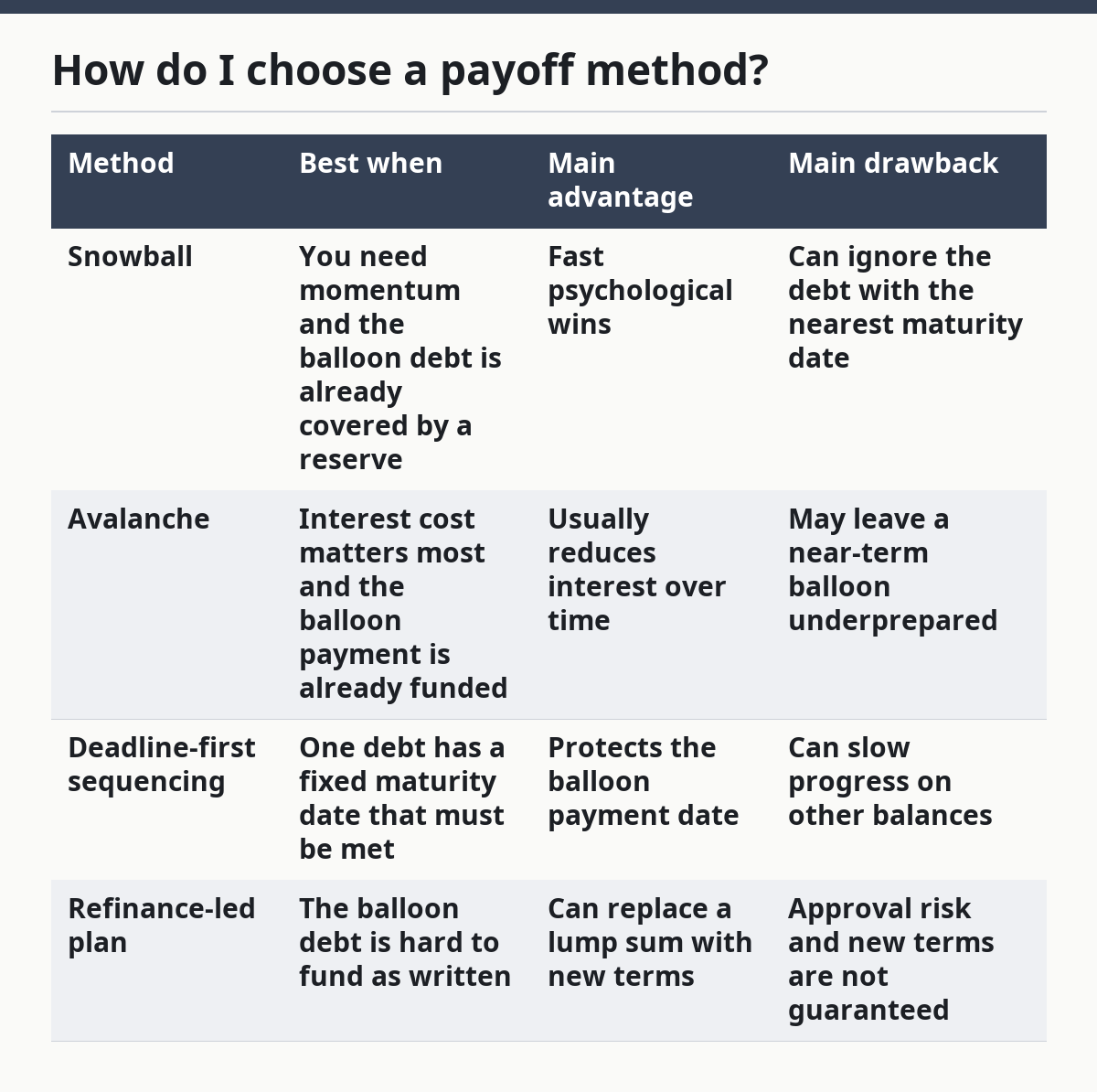
Overall, the balloon payment changes the order if the maturity date comes before your usual winner in a snowball or avalanche plan. A balance with a smaller interest rate can still take priority if its lump sum comes due first and your reserve is not enough. That is the part generic payoff guides miss. For debt-management basics, the FTC and CFPB both explain why payment terms and deadlines matter.
How do you do it step by step?

Use a maturity-date-first plan, then layer your preferred debt payoff method around it. This works best when you have a clear loan statement, a known balloon amount, and at least a rough monthly budget to inspect. It does not work well if the debt terms are unclear or the payoff date has already passed.
- List every debt with its current balance, monthly payment, interest rate if known, and maturity date; verify the balloon amount on the loan document, and if anything is unclear, consult a qualified financial professional before you proceed because you cannot sequence debt safely without a deadline and a reliable source.
- Separate the balloon debt from ordinary installment debt; verify whether the final lump sum is interest-only, principal-heavy, or a full remaining balance, and flag any contract that changes payment size near maturity as a problem because the reserve target may be larger than you first thought.
- Set a balloon payment reserve target equal to the balloon amount plus any likely closing costs or fees tied to refinance or payoff, if those costs are part of the contract; verify the total against the lender paperwork, and if the fee estimate is uncertain, consult the lender or a qualified adviser and use a documented source because underfunding the reserve is the main failure mode.
- Choose your payoff sequence by putting any debt with the nearest maturity date ahead of later-deadline balances unless the reserve already covers it; verify the order on paper, and if the debt mix is complex, consult a qualified professional because a method that leaves the balloon debt last can fail when the reserve is short.
- Allocate monthly extra cash to the balloon payment reserve first, then to the next priority debt; verify that the monthly amount can plausibly close the gap before the maturity date, and treat a gap that cannot close on time as a problem because the plan needs a second source of funds.
- Check refinancing options before the maturity date if the reserve will not fully cover the balloon; verify whether you can meet the new loan’s underwriting rules and whether the new payment changes your budget, and if you are unsure, consult a mortgage or consumer-loan professional because a refinance that only shifts the problem later can replace one deadline with another.
- Review your plan every 30 days until the balloon is paid or refinanced; verify the reserve balance, the statement date, and any lender notices, and treat missed notices or a changing payoff quote as a problem because the final amount can move before closing.
- Pay the balloon amount or the refinance payoff in time for the maturity date; verify the payoff instructions from the lender before sending money, and treat any mismatch between the quote and the remittance instructions as a problem because a wrong payoff figure can leave a small unpaid balance.
That process sounds mechanical, but the order matters. If you start with the most expensive debt and ignore a balloon due in a few months, you can end up with a clean-looking plan that breaks at the deadline. If the balloon is far away and already funded, a normal snowball or avalanche can still make sense for the rest.
When should you stop and rethink the plan?
Stop and rethink the plan when the balloon debt has a problem that a normal payoff method cannot fix. In those cases, the issue is not discipline; it is structure.
The maturity date is inside your realistic savings window: This means the balloon will come due before you can build the reserve — shift the plan toward refinance, payment negotiation if available, or another qualified review because a snowball alone will not create time.
The loan statement does not clearly show the balloon amount: This means you may be guessing about the final lump sum — get the exact payoff terms from the lender because a wrong target can leave you short on the due date.
Your reserve depends on an uncertain windfall: This means the plan assumes money that may not arrive — treat the balloon as unfunded and use a method that works without the windfall, because counting on uncertain cash is a weak safety margin.
The refinance quote changes your monthly payment beyond your budget: This means the fix may create a new cash squeeze — compare the new payment to your ordinary spending before accepting it, because a refinance that breaks the budget can fail faster than the original loan.
The debt is already in delinquency or default: This means the payoff decision is no longer just about sequencing — get qualified help because collection action, late fees, or legal terms may change the math and the deadline.
The contract includes prepayment penalties or payoff fees: This means early payoff can cost more than expected — factor those charges into the reserve or refinance review, because a payoff method that ignores them may be more expensive than it looks.
A balloon payment plan also needs a second look if the maturity date is less than a year away and the reserve is still close to zero. In that case, the right answer may be to stop optimizing between snowball and avalanche and start solving the deadline itself. That is a different job.
What mistakes cost people the most?
The biggest mistake is treating balloon debt like ordinary installment debt. That can push the maturity date to the back of the line, and then the final lump sum arrives before the reserve is ready. The fix is to rank by deadline first when the reserve is short.
Another mistake is using balance size alone to choose payoff order. A smaller balance with a near-term balloon can be more urgent than a larger balance with a flexible term. The fix is to compare balance, interest, and maturity date together, not one at a time.
A third mistake is assuming refinance will be available later. Refinancing risk is real because approval, terms, and underwriting can change before the maturity date. The fix is to check refinance options early enough that you still have time to respond if the first try does not work.
A fourth mistake is building a reserve that covers only the headline balloon amount. Fees, payoff timing, and lender instructions can change the final number. The fix is to confirm the full payoff figure before the due date and leave room for any documented charges.
A fifth mistake is switching methods every time the monthly budget feels tight. That creates drift, and drift is expensive when a fixed date is involved. The fix is to keep one written rule for the balloon debt and review it on a set schedule, such as every 30 days.
When does the usual debt snowball or avalanche still work?
Therefore, the usual snowball or avalanche can still work when the balloon is already covered by a reserve. If the balloon payment reserve is complete and the maturity date is no longer a threat, then the remaining debts can be handled with your preferred method as usual.
Snowball still fits if you need small wins to stay consistent and the balloon is no longer the urgent item. Avalanche still fits if you are mainly trying to reduce interest and the balloon reserve is on track. The difference is that the balloon debt stops being the first priority once its deadline is safely funded.
The method changes only when the balloon payment is not yet secure. That is the line that matters. A normal payoff ranking can handle balances; it cannot rescue a lump sum that arrives before the money does.
How do you plan for the final lump sum?
After the reserve is set, plan for the final lump sum by treating it as a separate savings goal with a date attached to it. That means the reserve is not a vague cushion; it is a specific bucket meant to absorb the balloon payment at the maturity date.
Start with the payoff figure from the lender, then compare it with the money already set aside. If the reserve is short, the gap tells you how aggressive the monthly savings must be. If the gap is too large for the calendar left before maturity, that is a sign to review refinancing risk sooner rather than later.
A good plan makes the final payment feel boring. The account balance, the due date, and the lender instructions should line up before the maturity date arrives. If any one of those pieces is missing, the plan is not finished yet.
Should balloon loans be paid off early?
Because a balloon loan creates a fixed deadline, it should be paid off early when the final lump sum cannot be covered with confidence by the maturity date. Early payoff can reduce deadline pressure, but it is not automatically the right move if it drains cash you need for essentials or a separate higher-priority obligation.
The better question is whether early payoff improves the whole plan. If paying early empties the reserve you need for living costs or taxes, the method may be wrong for your situation. A qualified adviser can help you compare the payoff timing against the rest of your budget.
How do I plan for a balloon payment?
Plan for a balloon payment by confirming the exact amount, the exact maturity date, and the exact source of funds. Then build a reserve and decide whether the reserve, refinance, or a mix of both will cover the lump sum.
The strongest plan uses written dates and amounts, not guesses. If the balloon amount is unclear, or if the monthly budget cannot close the gap before maturity, the plan needs a review before the deadline gets close.
Does a balloon payment change debt snowball or avalanche?
Yes, a balloon payment can change both snowball and avalanche because the maturity date can outrank the usual order. Snowball still uses balance size to create quick wins, and avalanche still uses interest cost to reduce long-term expense, but both can fail if they ignore the lump sum.
The practical rule is simple: if the balloon is not fully funded, it moves to the front of the queue. If the reserve is already complete, your normal snowball or avalanche order can resume for the rest of the debt.
Drafted with AI; not yet reviewed by a person.