
Last updated: November 20, 2026
Quick answer: a separate-finances couple usually does best with one written payoff rule and a 15-minute monthly check-in. If you manage money separately, this article on how to choose a debt payoff method when you and your partner manage money separately focuses on the method that fits the debts you share, the accounts that pay them, and the level of coordination you can both keep for months at a time. The right method is usually the one that gives each partner a clear role without forcing a joint bank account or a full merged budget.
Key takeaways
- Pick the method around account ownership first, not around habit or pride.
- Separate finances can still support one shared debt plan if both partners know who pays what and when.
- The best payoff method is the one you can repeat for 6 months or longer without missed payments, if it matches your real cash flow.
- If the debt is joint, the plan has to protect both credit files and both cash flows.
- When the structure is messy, the problem is often coordination, not the payoff order itself.
Who should use this approach?

This approach is for couples who share a home or goals but keep separate bank accounts, separate spending money, or both. It assumes there is at least one shared bill, one shared debt, or a joint household budget you both can see, even if you do not pool every dollar.
It is not the right fit when one partner has not agreed to the plan, when there is hidden debt, or when one person controls the timing of every payment. A separate-finances setup only works here if both adults can answer two questions in plain language: who pays which debt, and from which account. If either answer is fuzzy, the method will break in a 30-day cycle.
The key terms matter. A joint debt is a balance both people are legally responsible for. A shared bill is a household expense you split, like rent or internet, even if the account ownership is separate. A joint household budget is simply a plan for common expenses; it does not require joint bank accounts. A separate-finances couple can use any payoff method, but the cleanest fit depends on whether the debt is individual or joint.
Which payoff method fits separate finances?
The best payoff method is usually the one that matches ownership, cash flow, and follow-through. For a separate-finances couple, the common options are the snowball method, the avalanche method, or a hybrid plan that treats joint debt differently from individual debt.
| Method | How it works | Best fit | Main drawback |
|---|---|---|---|
| Snowball | Pay smallest balances first | When motivation matters and you want quick wins | Can cost more in interest than methods that target higher rates first |
| Avalanche | Pay highest-interest debt first | When you both want the most cost-efficient order | Progress can feel slow if the largest balance sits untouched |
| Hybrid | Mix one rule for joint debt and another for individual debt | When one partner wants structure and the other wants visible progress | Harder to explain and keep straight |
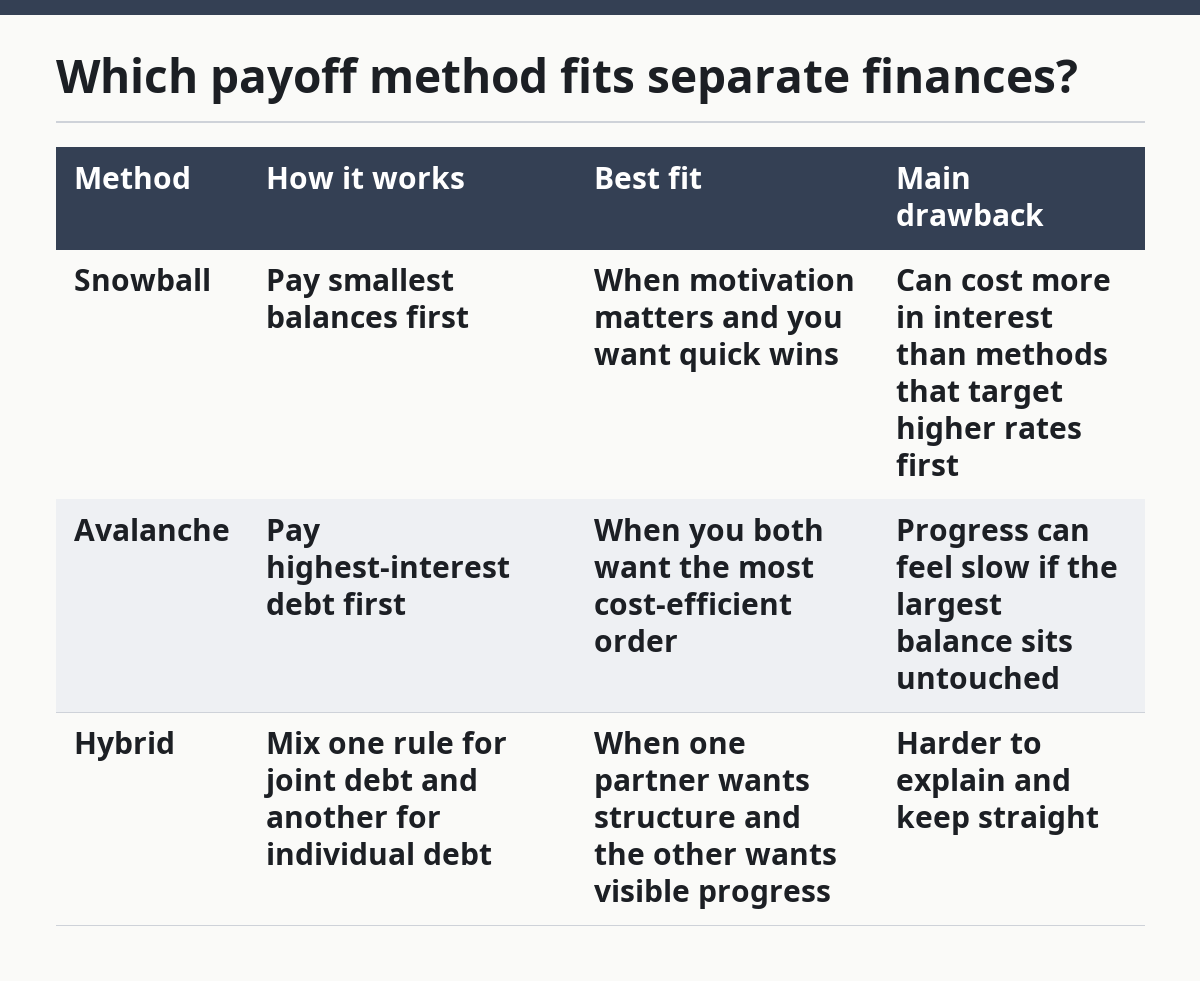
In separate finances, the hybrid often works best because it respects the fact that not all debts belong in the same bucket. If one partner has a credit card in their own name and the household has a shared personal loan, treating both with one rule can create resentment. If the debt is in one person’s name only, the other partner may still help pay it, but the CFPB notes that account ownership and authorized-user status affect who is liable, so it is wise to confirm the setup before choosing the method or to consult a qualified professional.
A quick filter helps: if the couple needs morale, start with snowball logic; if the couple needs to reduce interest cost, start with avalanche logic; if the couple has both joint debt and separate debt, use a hybrid. The right answer is not the most elegant theory. It is the rule that fits two people, 2 or 3 accounts, and the same payment date every month.
How do you choose the method step by step?

Therefore, choose the method by listing debts, assigning owners, and picking one rule you can keep for at least 6 months. The order matters because a payoff method that ignores account ownership will fail before the second billing cycle.
- List every debt on one page, including balance, minimum payment, and due date, and mark whether it is individual or joint; verify that no account is missing, because one omitted debt can break the payoff order and trigger a late fee.
- Sort the list by ownership first, then by balance or interest rate; verify that each debt has one clear label, because a debt with unclear ownership is a coordination problem, not a payoff problem.
- Separate shared bills from shared debt, and put each in its own line; verify that rent, utilities, and joint debt are not mixed together, because mixing them hides the real monthly load.
- Choose one method for individual debts and one rule for joint debts, if needed; verify that both partners can say the rule in one sentence, because a plan neither partner can repeat will not survive a busy month.
- Assign each payment to one account, one person, and one date, such as the 1st or 15th; verify that each payment date fits the pay cycle, because a due date that lands before pay day creates avoidable stress.
- Set a monthly review of 15 minutes to check balances, extra payments, and any missed dates; verify that both partners can attend, because a review one person always misses is not a shared process.
- Write the payoff rule down in plain language and keep it with the budget; verify that the rule names the order of attack, because a vague promise to “pay down debt faster” does not tell either person what happens next.
- Track every extra payment against the target debt and confirm the balance moved as expected within one statement cycle; verify that the statement shows the payment in the right place, because posting errors do happen and can make the plan look broken when it is not.
The point of the method is not to turn both people into one financial unit. It is to make the plan executable across separate accounts. A good result looks boring: the same bills get paid on time, the chosen debt gets the extra payment, and neither partner has to ask who was supposed to do what.
What should you check before you start?
Since the method depends on the account setup, check ownership, cash flow, and the room each partner has for extra payments. Those 3 checks tell you more than the name of the method.
First, check legal ownership. If a debt is in one person’s name only, the other partner may still help pay it, but the risk and control are different from a joint debt. That matters when one partner wants speed and the other wants flexibility. A joint debt needs more care because a missed payment affects both people. The FTC also warns that missed payments can trigger fees and damage credit, so it is worth confirming who is responsible before extra money moves.
Second, check cash flow by account. Separate finances only work when the paying account has enough money on the exact day the payment leaves. A method that depends on one partner “covering it later” is weak if the account already runs close to zero by day 20 of the month.
Third, check how much surplus each person actually has. If one partner can add an extra payment and the other cannot, the plan should not pretend they are contributing the same way. Equal effort is not always equal dollars. Sometimes one partner handles a larger share of a shared bill, while the other sends the extra payment to the selected debt.
This is also the place to check your language. If you say “my debt” and “your debt” about a joint obligation, the plan is already shaky. Use the name of the account and the due date instead. That sounds small, but it prevents the kind of confusion that leads to double payments, skipped payments, and blame.
When should you stop and choose a different method?
Before the plan gets harder to run than the debt itself, stop and change the approach when the structure no longer matches the money. A payoff method that looks tidy on paper can fail fast in a separate-finances couple if the real-world setup is different.
One partner cannot explain the plan in 30 seconds: the method is too complex for daily life — simplify to one rule for all debts or split joint and individual debt into separate rules.
Two debts share the same due date and one payment account is thin: the timing is too tight — move one due date if the lender allows it, or put the method on hold until the cash flow improves.
A joint debt is being paid from one person’s account only: the burden is uneven — change the setup so both people can see the payment and confirm the amount each month.
The monthly review keeps getting skipped for 2 months in a row: the system depends on memory, not process — switch to automatic payments, calendar reminders, or a simpler payoff order.
One partner is hiding balances or minimum payments: the method does not have the facts it needs — pause the payoff plan and rebuild the list before sending more money.
A chosen method creates repeated overdrafts or missed shared bills: the plan is too aggressive for the household — reduce the extra payment and protect the shared bills first.
In money terms, the right stop point is not drama. It is a mismatch between the plan and the account reality. If the method only works when everything goes perfectly, it is the wrong method.
What mistakes do couples make most often?
Therefore, the biggest mistake is choosing a payoff order before checking account ownership. That leads to one partner paying the “wrong” debt while the debt that affects both people gets little attention. The fix is to list joint debt first, then decide where individual debts fit.
A second mistake is splitting all debts 50/50 without looking at cash flow. That may feel fair, but it can leave one person short before payday. The better alternative is to split by capacity for the shared bills and then agree on a separate rule for extra payoff money.
A third mistake is treating minimum payments as optional because the couple wants to attack one balance hard. That can trigger late fees and damage the plan in one billing cycle. The correct alternative is to protect every minimum payment before sending extra money anywhere.
A fourth mistake is using a method that is too hard to track across 2 accounts and 3 due dates. The result is confusion, not progress. The alternative is a single written rule, one shared review date, and one person responsible for each payment.
A fifth mistake is arguing about fairness instead of mechanics. Fairness matters, but a payoff method needs dates, balances, and account names. The fix is to decide which parts are shared and which parts stay separate, then leave the emotion out of the transfer log.
What if your setup is unusual?
If the debt structure does not match a simple snowball or avalanche, use a modified plan. If one partner has most of the individual debt and the other has almost none, the couple may still choose one shared priority for joint debt and a separate priority for personal debt. That lets the household keep one rhythm without pretending every balance is identical.
If there are only 1 or 2 debts, the best method may be the simplest one, not the most famous one. A two-debt plan often needs less sorting and more consistency. If there are 5 or more debts, a written list becomes much more important because memory alone will fail.
If one partner is paid weekly and the other monthly, align payments to the calendar, not to the idea of fairness. A monthly household review can still work, but the payment timing needs to match each person’s cash flow. Otherwise, the partner with the tighter timing will end up carrying more short-term pressure.
If there is no joint household budget at all, start with shared bills before you try to optimize debt. A debt payoff method cannot fix a household that has not decided who pays rent, utilities, or groceries. The budget does not need to be fancy. It just needs enough structure to keep the debt plan from stealing money needed for ordinary bills.
For broader behavior fit, this page supports the hub on debt payoff method fit by psychological and behavior constraints, which is the right next stop if the issue is less about math and more about follow-through. See also debt payoff method by behavior.
How do couples choose a debt payoff method with separate finances?
Since separate finances change the workflow, choose the method by matching the debt structure to the account structure. A separate-finances couple usually does best with a written rule that says which debt gets extra money first, which account sends the payment, and how often the couple checks the plan. The best fit is the one both partners can keep for 6 months without confusion.
Should we combine debts if we manage money separately?
Not necessarily. Combining debts only makes sense if both people want the same level of shared control and can handle the account changes that come with it. Many couples keep separate accounts and still run one payoff plan by sharing information, splitting bills, and assigning the extra payment to one target.
How do we coordinate payoff goals without a joint budget?
Use a shared debt list and a 15-minute monthly check-in. Each partner names the bills they cover, the extra amount they can send, and the debt that gets priority next month. A joint household budget is helpful, but a written plan and a fixed review date can do the job when accounts stay separate. For more on account roles, see joint debt basics.
Drafted with AI; not yet reviewed by a person.