Last updated: November 19, 2026
Key Takeaways
- The best plan is one you can keep for 6 to 18 months without missed payments or shortfalls.
- Protect essentials first, then assign every leftover dollar before it disappears.
- Use snowball for motivation and avalanche for interest savings, depending on your situation.
- Fix the floor, then send extra cash to one debt, then repeat the same sequence monthly.
A debt payoff plan setup and budgeting approach works only when the budget can survive a bad week, not just a good month. If the plan keeps collapsing at the gas pump, at the grocery store, or when an annual bill hits, the problem is not motivation; the problem is the setup.
This guide is for someone who needs to turn a pile of balances into a month-by-month plan that actually fits real life. It explains how debt payoff plan setup and budgeting work together, when to use debt snowball versus debt avalanche logic, how to build a budget around minimum payments, and where people usually break their own plan by making it too tight. This is information, not financial advice; for your own situation, especially if you have tax debt, a mortgage, student loans, or collection accounts, speak with a qualified financial adviser or credit counselor. For background on budgeting and collections, see the Consumer Financial Protection Bureau and the Federal Trade Commission, which both offer consumer guidance that can help you compare options with a professional.
What Actually Determines the Right Debt Payoff Plan?

The right plan is the one you can follow for 6 to 18 months without missing a payment or running out of cash for basic needs. If your budget is unstable, the order of your debts matters less than your ability to keep the plan alive.
The first question is not “snowball or avalanche?” It is “how much extra money can I reliably send after minimums?” If that number changes every month, then the plan needs a larger buffer and fewer moving parts. If your income is steady and your expenses are predictable, then you can use a tighter payoff method and aim your extra payment at one target at a time.
Here is the simple test:
| Situation | Best Path | Why Other Options Fail |
|---|---|---|
| Income changes a lot month to month | Build a wider emergency buffer first, then use minimums plus one small extra debt target | Aggressive payoff orders can force missed payments when income dips |
| Income is steady and debt is mostly credit cards | Use either snowball or avalanche with a fixed extra payment | Random extra payments across several balances slow progress |
| You have past-due accounts or collection calls | Stabilize minimums, due dates, and cash flow before optimizing payoff order | A perfect payoff ranking does not stop late fees or calls |
| You are living paycheck to paycheck with no buffer | Start with a survival budget before any extra principal payment | An overbuilt payoff plan often breaks on the first surprise bill |
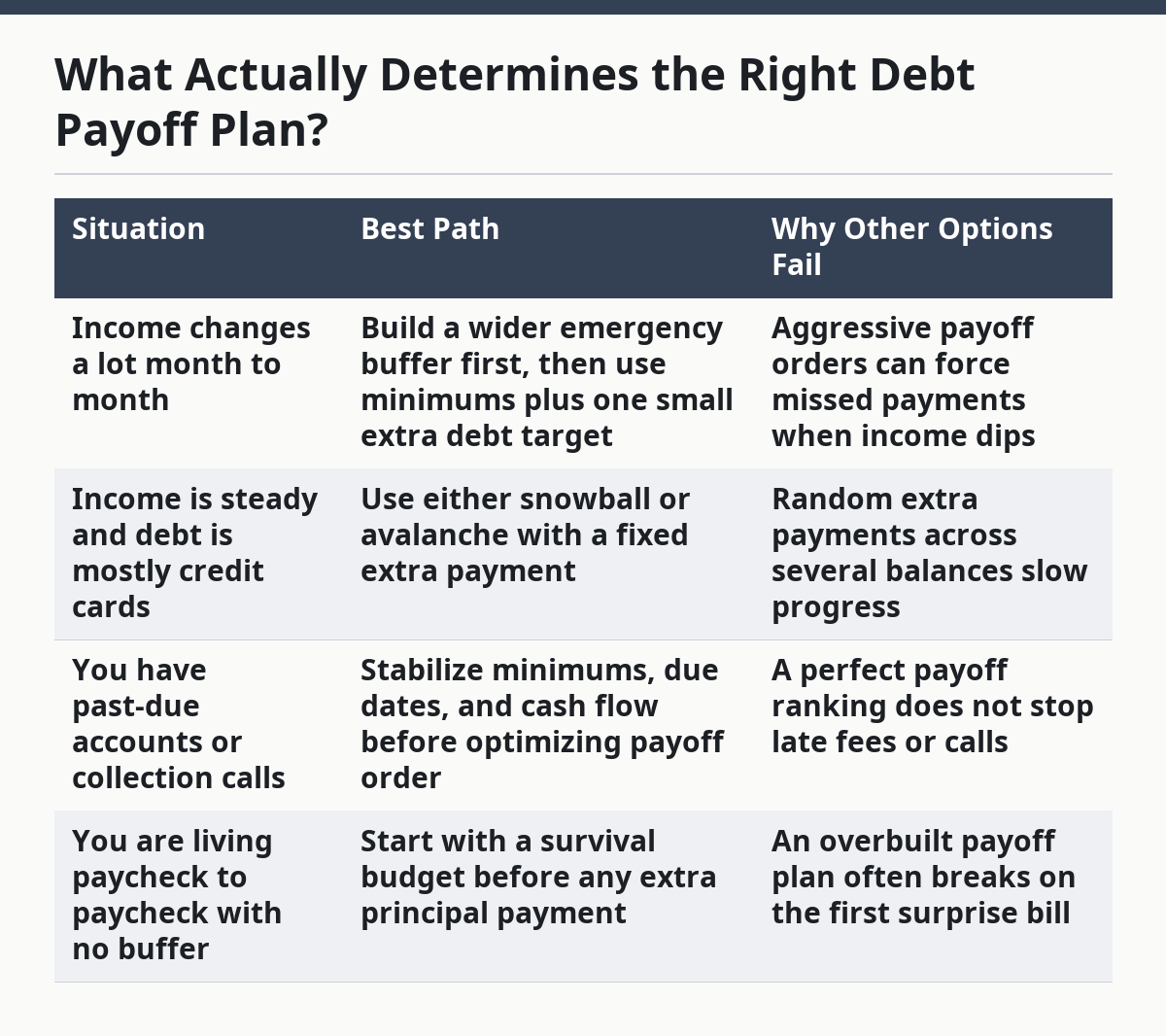
The question is not whether debt payoff is good; it is whether the structure matches your cash flow. The Consumer Financial Protection Bureau has a useful budgeting overview on its site, and the Federal Trade Commission explains debt collection basics if accounts are already in collection. Those are good reference points because the rules and consumer protections can change by country and by account type.
A workable setup usually starts with a 30-day snapshot, not a guess. Track every bill, minimum payment, and recurring expense for one full month. Then compare that with income timing. If you get paid every two weeks, that is 26 paychecks a year, not 24, which changes how you handle monthly bills. If you get paid irregularly, then the plan should be built around your lowest reliable month.
Quick check: if a surprise $200 expense would break your plan, you need a buffer-first budget, not a more aggressive payoff order.
How Do I Set Up a Budget for Debt Payoff?
You set up the budget by protecting the essentials first, then assigning every remaining dollar to a purpose before it disappears. If you skip the setup and just “try harder,” the extra money usually leaks into variable spending.
A clean debt payoff budget has five buckets: housing, utilities and transport, food, minimum debt payments, and a small cushion for irregular bills. Everything left over becomes your extra payoff amount. That extra amount should be named in the budget, not left as vague “savings” or “miscellaneous” money.
Start with these steps:
- List every take-home paycheck and the exact dates it hits your account. Use net income, not gross.
- Write down all fixed monthly bills: rent or mortgage, insurance, phone, internet, subscriptions, and minimum debt payments.
- Add variable necessities: groceries, fuel, prescriptions, childcare, and basic household items.
- Estimate irregular bills by month: car registration, annual fees, holiday spending, school costs, and maintenance. Divide the annual total by 12 if that helps you save steadily.
- Set a floor for cash on hand. Many people use one paycheck, one month of bare-bones expenses, or another cushion that fits their income pattern.
- Only then decide the extra amount for debt payoff. Put that amount in writing and assign it to one debt.
The common mistake is trying to start debt payoff before the budget can absorb normal life. A budget that leaves you with exactly zero wiggle room is fragile. It looks disciplined on paper and then falls apart when the car battery dies or the school fee arrives.
If you use a budgeting app, the tool matters less than the categories. YNAB, EveryDollar, and a plain spreadsheet can all work. The real test is whether the budget separates essentials from extras and forces you to see the trade-off before you spend. A notebook works too if you update it weekly.
For a practical rule: if your budget has no category for irregular expenses, it is not a full budget yet. It is a wish list.
Quick check: if you cannot name your next 3 irregular bills, your payoff budget is not ready.
Should I Use Snowball or Avalanche?

Use snowball if you need quick wins to stay engaged; use avalanche if you can stay steady and want the math to work in your favor. That is the honest answer, and it changes if your behavior or cash flow changes.
Debt snowball means paying extra on the smallest balance first while making minimum payments on the others. Debt avalanche means paying extra on the highest interest rate first. One is not morally superior. One is usually better for motivation, the other for interest cost. In real life, many people do best with the method they will actually continue using for 12 months.
Use this decision table:
| Situation | Best Path | Why Other Options Fail |
|---|---|---|
| You need visible progress fast | Snowball | Avalanche can feel slow if the first target is a large balance |
| You are highly organized and debt has high interest rates | Avalanche | Snowball may keep you paying more interest than necessary |
| You have mixed debts with different terms | Prioritize based on interest, fees, and risk of delinquency | A one-size-fits-all rule ignores penalty APRs and due-date problems |
| You keep quitting when progress feels invisible | Snowball or a hybrid | Pure math loses to motivation if you stop the plan |
A hybrid plan is often the most realistic. You keep all minimums current, then attack the smallest balance with one extra payment until it disappears. After that, you roll that payment into the next debt. If motivation is shaky, that visible win can matter more than shaving a little extra interest off the total.
But if one of your debts has a much higher interest rate and you can stick with the plan, avalanche is usually the cleaner setup. If one account is near delinquency, that may outrank both snowball and avalanche. The debt that is closest to causing penalties, collection action, or a credit score hit needs attention first.
Do not mix methods every month. The plan stops being a plan when the target changes constantly. Pick one rule, write it down, and keep it unless your situation changes.
Quick check: if you need a psychological win to keep going, snowball or a hybrid may fit better than pure avalanche.
How Do I Build the Plan Step by Step?
You build the plan by fixing the floor first, then moving extra cash to one debt, then repeating the same sequence every month. If you skip the floor, the plan breaks the first time life does something normal.
Here is a simple setup process that works for many households with credit card debt, personal loans, or medical bills:
- Collect every balance, APR or fee structure you can confirm, minimum payment, and due date. If the rate is variable, note that too.
- Sort debts by the chosen method: smallest balance for snowball, highest interest rate for avalanche, or highest risk of delinquency first.
- Protect the essentials in your budget so minimum debt payments never compete with rent, food, fuel, or utilities.
- Choose one fixed extra amount. Even $50 or $100 matters if it is consistent, but do not promise an amount you cannot keep.
- Move the extra payment to the first target debt only. Leave the other minimums alone.
- When the target debt is paid off, roll that full payment into the next debt without reducing the extra amount.
- Review the budget on the same day each week, not only when something goes wrong.
The setup works best when you automate what can be automated. Set autopay for minimums if your cash flow can handle it. Use calendar reminders for due dates if your income is irregular. If your bank allows sub-accounts or buckets, separate bill money from spending money so you do not spend the mortgage payment on groceries by accident.
The hard part is not the first month. The hard part is month four, when the novelty wears off. That is why the plan needs a rule for overtime, bonuses, tax refunds, and side income. Decide in advance where windfalls go. If you do not, they vanish into ordinary spending.
One honest limitation: if your debt is so large that even minimums are unstable, a payoff plan may not be the first move. In that case, a nonprofit credit counselor, a lender hardship program, or a formal debt management plan may be worth discussing with a qualified professional. That is not failure; it is matching the tool to the problem.
Quick check: if your plan depends on motivation rather than a written rule, it is too vague.
What If My Budget Is Too Tight to Leave Room?
If your budget is too tight, the answer is not to abandon debt payoff; it is to build a survival budget first and shrink the extra payment until the essentials stop wobbling. A plan that leaves no slack is usually too thin to last.
This is where many generic articles fail. They tell you to “cut spending,” but they do not say what happens if the budget is already bare. If you are already choosing between gas and groceries, then the first goal is not aggressive payoff. The first goal is preventing new debt while keeping current bills current.
Start with the lowest realistic version of your monthly life:
- List only non-negotiable expenses for 30 days: housing, utilities, transportation, food, insurance, and minimum debt payments.
- Pause every optional category for one month if needed: subscriptions, dining out, new clothes, impulse shopping, and extra entertainment.
- Check due dates. If several bills hit the same week, call providers or move payment dates where that is allowed.
- Use every spare dollar to stop the most immediate damage: late fees, overdrafts, or missed minimums.
- Rebuild a small buffer before adding aggressive extra payments. Even a modest cushion can keep the budget from cracking.
If that still does not work, then the issue is not budgeting discipline. It may be income, debt load, or both. In that case, the right next step may be to speak with a nonprofit credit counselor, ask about hardship programs, or look at a debt management plan if your unsecured debt and monthly cash flow make that appropriate. Do not treat every debt problem as a spending problem.
A tight budget also changes the payoff order. A debt with a late fee, a penalty APR, or a risk of collections can outrank a slightly lower-interest debt that is stable and current. That is why the first question is not “which debt is mathematically worst?” It is “which debt causes the most damage if I miss it?”
Quick check: if one surprise bill forces you to miss a minimum payment, your first job is stabilization, not acceleration.
What Are the Biggest Budgeting Mistakes in Debt Payoff?
The biggest mistake is building a plan that only works if nothing goes wrong for 12 straight months. If your plan has no room for repairs, irregular bills, or a pay timing mismatch, it is too brittle.
Here are the traps that break payoff plans:
- Using gross income instead of take-home pay. Your budget must use the money that actually lands in your account.
- Leaving annual costs out of monthly planning. Vehicle registration, memberships, and insurance premiums do not disappear just because they are infrequent.
- Paying extra to several debts at once. That feels productive, but it often weakens momentum.
- Ignoring due dates. A good payoff order can still fail if payments are scheduled after the bill is due.
- Treating bonuses as guaranteed income. Extra money should be a bonus, not the backbone of the plan.
- Skipping a small emergency cushion. A plan with no buffer gets raided the first time life charges a fee.
This section deserves a blunt truth: if you keep making new charges on credit cards while trying to pay them down, the plan is fighting uphill. In that case, the budget needs a spending rule, not just a payoff rule. You may need to freeze discretionary card use for a set period, track every card charge daily, or move to cash/debit for variable spending while the payoff plan runs.
Here is a quick comparison of common mistakes:
| Situation | Best Path | Why Other Options Fail |
|---|---|---|
| Annual bills keep knocking you off track | Add sinking funds in monthly amounts | Hoping to “catch up later” usually turns into missed payments |
| Extra income is irregular | Treat windfalls as optional acceleration, not required cash | Required windfalls make the plan fragile |
| You make multiple small extra payments across debts | Focus extra money on one target | Scattering extra dollars slows visible progress |
| New card charges keep appearing | Tighten spending controls before accelerating payoff | Paying balances while adding new debt creates a treadmill |
A good debt payoff budget is not a punishment budget. It should be strict enough to work and humane enough to survive a normal month. If it requires perfection, it is wrong.
Quick check: if your plan collapses whenever an irregular bill appears, the budget is missing sinking funds.
What Are the Edge Cases That Break the Standard Advice?
The standard advice breaks when your debts, income, or legal situation do not look like a neat credit-card case. If that is your situation, the plan has to change.
- Situation: You have student loans with income-driven repayment. What changes: the minimum may depend on income, not a simple fixed number. What to do instead: include the required payment in your budget first and check the loan servicer rules before making extra payments, because extra principal can behave differently depending on the loan type.
- Situation: You have a mortgage and high-interest card debt. What changes: the mortgage is usually not treated like a typical payoff target because it has different terms, fees, and risk. What to do instead: budget for the mortgage as a fixed priority and focus the payoff plan on unsecured debt unless a qualified adviser tells you otherwise.
- Situation: You have tax debt. What changes: tax agencies may have their own payment arrangements, penalties, and deadlines. What to do instead: do not treat it like a normal installment loan; ask the relevant tax authority or a tax professional about the available payment options.
- Situation: You are behind on utilities, rent, or car payments. What changes: essential-service accounts can trigger shutoff, eviction, or repossession risk before a credit card balance does. What to do instead: prioritize the account with the most immediate real-world consequence, even if it is not the highest APR.
- Situation: Your income is seasonal or commission-based. What changes: a normal monthly budget may fail because your cash flow is lumpy. What to do instead: build the plan on your lowest typical month and use peak months to strengthen the buffer, not just to chase faster payoff.
- Situation: You are in debt settlement or considering bankruptcy. What changes: the payoff plan may no longer be the right tool. What to do instead: stop assuming a DIY budget can solve a legal or insolvency problem on its own and get professional advice promptly.
These cases matter because generic payoff advice often assumes every debt is equal and every paycheck arrives on time. That is not how real money problems work. If your situation includes legal notices, shutoff risk, garnishment, or collection escalation, the order of operations changes fast.
Quick check: if one account could lead to a legal or service cutoff outcome, standard snowball or avalanche advice is not enough on its own.
How Do I Know the Plan Is Working?
The plan is working if balances trend down, minimums stay current, and your budget still has breathing room at the end of the month. If one of those three is missing, the setup needs adjustment.
Use three checkpoints:
- Payment stability: every minimum payment goes out on time for at least 3 consecutive months.
- Balance direction: the chosen target debt falls every month once interest and new charges are accounted for.
- Budget survivability: you still have a small reserve for irregular expenses without borrowing more.
If the balances are not falling, check for new charges, fees, or a wrong payoff order. If the budget is failing, reduce the extra payment and strengthen the essentials. If both are failing, the plan is too ambitious for the current cash flow.
A payoff plan does not need to be glamorous. It needs to be repeatable. The real win is not the spreadsheet; it is reaching the end of a month without borrowing to cover ordinary life. That is what gives the plan a chance to finish.
For a practical outside reference, the CFPB’s budgeting materials and the FTC’s debt collection guidance are both useful starting points for consumer protections and account handling. For anything involving tax debt, secured loans, or legal notices, talk to a qualified professional before making a major move.
Quick check: if your balances are falling but your checking account keeps hitting zero early, the plan needs a bigger buffer, not more intensity.
FAQ
How much should I budget for debt payoff each month?
You should budget only the amount that remains after essentials, minimums, and a small buffer are covered. If the extra amount is unstable, reduce it until the plan can survive a normal month without missing bills.
Should I pay extra on all debts or one at a time?
One at a time is usually clearer and easier to track. If you split extra payments across several balances, progress often feels slower and is harder to manage.
Is a debt snowball budget the same as an avalanche budget?
No, the budget is the same structure, but the payoff order changes. Snowball targets the smallest balance first; avalanche targets the highest interest rate first.
Do I need an emergency fund before paying debt?
Not a large one in every case, but some cushion helps. If you have no buffer at all, even a modest reserve can keep the payoff plan from collapsing on the next surprise expense.
Drafted with AI; not yet reviewed by a person.