Last updated: November 19, 2026
Quick Answer: if you have one missed payment, catch up the past-due account first if you can; then use snowball or avalanche on the remaining current debts. A missed payment changes the debt payoff method you should use because the first job is no longer optimization; it is stopping the account from getting worse. If a credit card, student loan, or auto loan is now past due, the right order is usually: check the delinquency, catch up the account if possible, then choose a debt payoff method that fits the accounts that are still current. This is information, not financial advice, and a qualified adviser should be consulted for your situation.
Key Takeaways
- Know the statement basics first: minimum payment, due date, rate, and balance.
- Pick a payoff method only after checking whether any account is past due and needs catch-up.
- Pull each statement and note the minimum, amount past due, late fee, and next due date.
- Put every debt on one page.
Who this is for, and what I am assuming you already have

This applies to someone who has missed at least one scheduled payment on a debt and still wants to build a payoff plan. I am assuming you know the basic terms on the statement: minimum payment, due date, interest rate, and current balance. I am also assuming you can log in to each account or get a recent paper statement.
This is not the right starting point if you have only one bill and the lender has already closed it, charged it off, or sent it to a collection account. It is also not the right starting point if you are in a formal hardship program, bankruptcy, or a court process; those situations can change the rules in a way a generic debt payoff method cannot. A missed payment on a credit card is treated differently from one on a federal student loan or an auto loan, and country rules vary, so the account type matters. Consult a qualified professional or the lender/servicer for your specific situation. For account-status basics, see the CFPB on late payments and delinquency: https://www.consumerfinance.gov/consumer-tools/credit-cards/answers/what-happens-if-i-miss-credit-card-payment/
The key decision is not “snowball or avalanche” in the abstract. It is whether the missed payment has created a past-due account that needs to be stabilized before any payoff system can work. A debt payoff method is only useful when the payment structure underneath it is still functioning.
For a broader framework on debt payoff methods and strategy selection, the hub on this site can sit beside this page, but this page is about the missed-payment pivot.
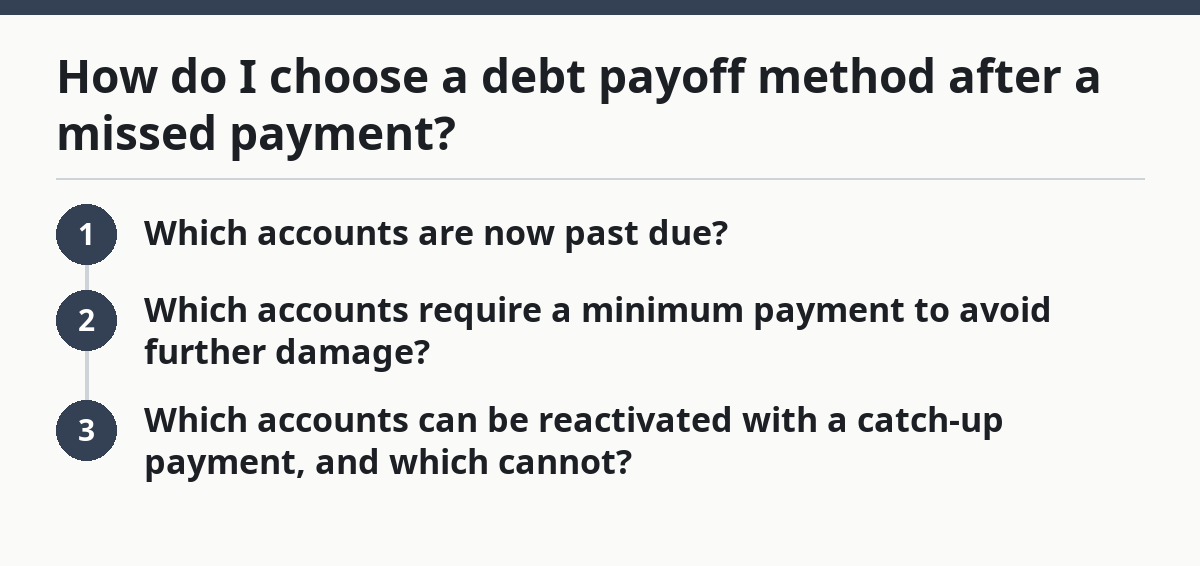
How do I choose a debt payoff method after a missed payment?
Choose the method that fits the accounts that are still controllable, but first check whether the missed payment has created a delinquent account that needs immediate catch-up. A delinquent account is one that is behind its due date; a late fee may already have posted, and the account may move closer to collections if nothing changes. For collections and delinquency basics, the CFPB explains how missed payments can affect an account: https://www.consumerfinance.gov/consumer-tools/credit-reports-and-scores/answers/what-is-delinquency-and-how-does-it-work/
Start with a 3-part filter:
- Which accounts are now past due?
- Which accounts require a minimum payment to avoid further damage?
- Which accounts can be reactivated with a catch-up payment, and which cannot?
If you have one missed payment and everything else is current, the method choice is usually secondary to stabilization. If you have several missed payments across different debts, choose a method only after you know which accounts are still active and which ones are in escalation. That prevents a plan from ignoring the account that is closest to a collection account. Please confirm the escalation rules with the lender or a qualified professional, because cure standards vary by account type.
Here is the practical rule: if the missed payment is recent and the lender still accepts a simple catch-up, stabilize first; if all accounts are current again, then use the debt payoff method that matches your behavior and cash flow. Snowball tends to fit someone who needs small wins and visible closures; avalanche tends to fit someone who can stay disciplined and wants to target the highest rate first. The missed payment does not erase those trade-offs, but it can move the priority from interest optimization to account reactivation.
The wrong move is to start a payoff order by balance size or interest rate while the past-due account keeps aging. That can leave you paying the “right” debt while the “wrong” one gets worse. A missed payment changes the order of operations.
What should I check before I pick a payoff order?

Check the statement details before you decide anything, because the wrong assumption about one account can derail the whole plan within a 30-day billing cycle. Pull the last statement for each debt and note four things: the minimum payment, the amount past due, whether a late fee posted, and the next due date.
Then verify the account type. A credit card, student loan, and auto loan do not all react the same way to a missed payment. Some lenders will accept a single catch-up payment and restore the account to current; others may require the missed amount plus the current minimum payment before they reactivate payment status. If the account has already been transferred to collections or charged off, the standard snowball-or-avalanche decision may no longer be the primary decision.
Check for automatic payments, too. If autopay failed because of a low balance or an expired card, you may be able to fix the payment rail, but that does not erase the delinquency. A missed payment can still trigger a late fee even when the failure was technical. For payment timing and fee effects, see CFPB guidance on missed payments: https://www.consumerfinance.gov/consumer-tools/credit-cards/answers/what-happens-if-i-miss-credit-card-payment/
Next, compare the missed account to your other debts by urgency, not by emotion. A $25 late fee on a credit card matters because it signals escalation, but a past-due auto loan can carry a different practical risk because the lender has a secured interest in the vehicle. A federal student loan may be handled through a separate repayment system entirely. The account type determines what “behind” means. If you are unsure how your lender defines cure or escalation, consult a qualified professional.
A good check ends with a simple list: current, past due, in collections risk, or already transferred. If you cannot place each account in one of those buckets, do not choose a payoff order yet.
How to do it, step by step
Use a 7-step sequence: stabilize the missed account, then choose and start the payoff method that best matches the remaining debt structure.
- List every debt on one page. Write the lender, balance, minimum payment, interest rate if shown, due date, and status for each account. Verify that every item is either current or past due. If you cannot identify a due date or minimum payment, the account is not ready for a payoff method yet.
- Mark the delinquent accounts first. Circle any account with a missed payment, a late fee, or an overdue minimum payment. Verify how many days late each one is. If a lender has already sent a notice about collections risk, treat that account as higher priority than any current account, but confirm the notice and timing with the lender or a qualified professional.
- Contact each past-due lender and ask what is needed to reactivate payment. Use the exact phrase “What do I need to bring this account current?” Verify whether the lender wants one catch-up payment, the missed payment plus the next minimum payment, or a different amount. If the representative cannot explain the cure amount clearly, ask for written confirmation before sending money, and confirm the details with the servicer or a qualified professional. For student loan status rules, see Federal Student Aid: https://studentaid.gov/manage-loans/default/get-out
- Bring the most urgent account current if you can do so without missing another obligation. Pay the cure amount on the account closest to escalation. Verify that the account status changes from past due to current or active in the online portal or on the next statement. If the payment posts but the status does not change, the account may still be delinquent. If you are unsure which account is truly closest to escalation, consult the lender or a qualified professional.
- Set the next 30 days of minimum payments in advance. Make sure every remaining current debt gets at least its minimum payment on time. Verify that the total minimums fit your cash flow before you pick a strategy. If the minimums do not fit, a payoff method alone will not solve the problem.
- Choose the payoff sequence for the debts that remain current. If you need momentum, sort the remaining debts from smallest balance upward. If you can stay steady and want to reduce interest cost, sort them from highest rate downward. Verify that the past-due account is no longer on the list unless it still needs a catch-up balance. A debt payoff method works best when the list only includes accounts you can actually keep current.
- Automate the baseline and schedule the extra payment. Keep autopay on for the minimum payment where possible, and direct any extra money to the first target in your chosen order. Verify the draft date, amount, and funding source. If the autopay date is after the due date, the setup is wrong.
- Review the plan after one full billing cycle. Check whether the target account received the right payment and whether any fees reappeared. Verify that no account slipped back into delinquency. If a second missed payment happens, stop the payoff method and reassess the budget and payment timing.
The good result is a current account, a clear target order, and no new late fee because the payment sequence was set in the right order.
Should I catch up one account before starting a payoff plan?
Yes, if the account is still salvageable and the catch-up amount does not cause another payment to fail. Catching up one account before you start a debt payoff method often matters more than squeezing an extra few dollars of interest savings from the order of the other debts.
The reason is simple: payoff methods assume the debt list is stable. A past-due account can add late fees, trigger collections risk, or interfere with reactivation. On some accounts, payment status is not fully restored until the lender receives the required catch-up amount and records it correctly. That can take more than one payment cycle to show on the portal.
A missed payment does not always mean “pay this first at any cost.” If catching up one account would cause you to miss a minimum payment on another, the plan may need to be adjusted. A current account that turns delinquent creates a second problem. The better sequence is the one that prevents the most accounts from moving into a worse status over the next 30 days.
This is also where the account type matters. A past-due credit card may be reactivated with a cure payment and a current minimum. A student loan may have a different cure process. An auto loan can carry different consequences because the collateral changes the stakes. If the lender has already transferred the debt to a collection account, the catch-up question may be replaced by a separate dispute or settlement process. If you are unsure which debt should be cured first, ask the lender or a qualified professional.
When should I stop and get qualified help?
Stop the do-it-yourself debt payoff method when the account situation is no longer a simple “past due, then current” problem. That is the point where a qualified adviser, credit counselor, attorney, or lender specialist can read the account rules more accurately than a generic method can.
The account has already been sent to collections: This means the delinquency has escalated beyond ordinary payoff sequencing — do not assume snowball or avalanche still solves it, because the account may need a separate collections response.
The lender has charged off the debt or closed the account: This means the original payoff method may no longer apply in the usual way — get written details on the remaining balance and status before sending more money.
You cannot make every minimum payment this month: This means the payoff method is secondary to avoiding further delinquency — pause the strategy and review the budget or get professional help before another payment is missed.
The missed payment is on a secured debt such as an auto loan: This means the consequences can be different from an unsecured card — act on the lender’s cure instructions immediately and confirm them in writing.
The debt is a student loan with special repayment terms: This means the account may follow program rules that do not behave like a standard credit card — check the servicer’s current rules before choosing a payoff order.
You are already in a hardship plan, dispute, or legal process: This means the payoff method may conflict with those terms — do not layer a new plan on top without checking the existing agreement.
For anyone unsure about the account status, a professional review is better than guessing. Financial advice should be tailored to your own circumstance.
The mistakes people make after a missed payment
The biggest mistake is choosing a payoff method before restoring the past-due account to current. That can leave the account adding late fees while you focus extra payments elsewhere. The correction is to verify delinquency status first and cure the account if possible.
A second mistake is assuming every missed payment is the same. A credit card, student loan, and auto loan can each have different cure rules and different escalation paths. The correction is to read the lender’s terms or ask the servicer for the exact reactivation requirement.
A third mistake is paying extra on one debt while ignoring the minimum on another. That can turn one delinquency into two. The correction is to protect every minimum payment before sending extra principal to a target account.
A fourth mistake is using a payoff spreadsheet that does not include late fees. A $0 oversight on paper can become a real balance problem on the next statement. The correction is to update the balance with any posted fee before ranking the debts.
A fifth mistake is assuming autopay solved the problem. If the draft failed because of insufficient funds, the account may still be delinquent. The correction is to confirm the posted payment, not just the scheduled draft.
A sixth mistake is staying with a debt payoff method after a second missed payment. That usually means the plan is outrunning the budget. The correction is to pause, rebuild the payment schedule, and only then choose the method again.
What changes when the debt is a credit card, student loan, or auto loan?
The account type changes how fast the missed payment can snowball into a bigger problem. A credit card is usually unsecured, so the main risks are late fees, higher costs, and possible collections activity. A student loan often runs through a servicer with its own payment rules, so “catch up” may mean something different from a standard card payment. An auto loan is secured, so the lender’s rights over the vehicle make payment status more urgent.
That difference affects the debt payoff method choice. If the missed payment is on a credit card and the account is otherwise current, a snowball or avalanche plan may still work after the account is brought current. If the missed payment is on a student loan, I would verify the servicer’s delinquency rules before assuming the payoff order is straightforward. If the missed payment is on an auto loan, the first question is whether the lender has issued any repossession warning or cure notice; that changes the priority immediately.
This is also where one-size-fits-all advice fails. A generic debt payoff plan often assumes every debt can be lined up by balance or rate. After a missed payment, that assumption can be wrong. The better method is the one that respects account status first and payoff optimization second.
What debt should I pay first after a missed payment?
Pay the account that is most likely to become worse fastest, which is usually the one already past due and closest to escalation. That may be the smallest balance, the highest rate, or the account with the shortest cure window, so confirm the lender’s rules before you send money.
Drafted with AI; not yet reviewed by a person.