Last updated: November 20, 2026
Quick Answer: A practical starting point for how to choose a debt payoff method with co-signed debt is to protect the shared account first, then rank the rest by APR or balance. Co-signed debt changes the payoff choice because one missed payment can hurt two credit files and two people’s finances.
This guide shows you how to match the payoff method to the loan agreement, the default risk, and the relationship with the co-signer. It also shows where refinancing fits and when this problem needs a different strategy.
Key takeaways
- The payoff method for co-signed debt should usually protect the shared account first, then fit the rest of your debts.
- A co-signer is legally tied to the loan, so the payment plan has to account for their exposure, not just yours.
- If a payment slip would trigger a default or strain the relationship, the “best” method on paper may be the wrong one in practice.
- Refinancing can remove a co-signer in some cases, but approval depends on the new lender and the borrower’s credit.
- This is general information, not financial advice; a qualified adviser can help with your own situation.
Who this applies to, and what it assumes
This applies if you have co-signed debt and you are trying to choose between debt snowball, debt avalanche, minimum-payment targeting, or a custom payoff order. It assumes the loan is still active, the co-signer is still on the account, and you know the basics of the balance, APR, minimum payment, and due date.
Picture this: you’re sorting bills at the kitchen table and one loan has your name plus someone else’s. How to choose a debt payoff method with co-signed debt is not just about math now; it has to respect the loan agreement, the co-signer’s liability, and the chance of default.
That is why the same payoff method does not fit every debt stack. A method that works for clean solo debt can fail when a parent, partner, or friend is legally exposed. If the debt is already in collections, or if you are dealing with a joint account or authorized user debt, that is a different page and a different decision.
Before choosing a method, you need four facts in front of you: the current balance, the monthly minimum, the interest rate if it is fixed or variable, and whether the lender allows extra principal payments or charge-offs after missed payments. If you do not have those, start there.
How do I choose a payoff method for co-signed debt?
You choose the method that keeps the co-signed account current while minimizing the chance of missed payments and surprise damage to the co-signer. In practice, that usually means treating the co-signed loan as a protected account, not as just another line in the stack; if you are unsure how the lender handles missed payments or extra principal, check the loan agreement and consider a qualified adviser.
Picture this: you have three debts, and one of them has a co-signer who never misses a bill. If that account is even one payment away from trouble, your payoff order has to account for that first. The method is less about “fastest” and more about shared liability.
Start by separating debts into two buckets:
- debts with a co-signer
- debts without a co-signer
Then decide which bucket gets priority based on risk:
- If the co-signed debt has the highest default risk, protect it first.
- If it has a high APR but is stable, it may sit inside a snowball or avalanche plan.
- If the co-signer is helping you because the loan would not have happened otherwise, that account often deserves tighter payment control.
Use these rules of thumb:
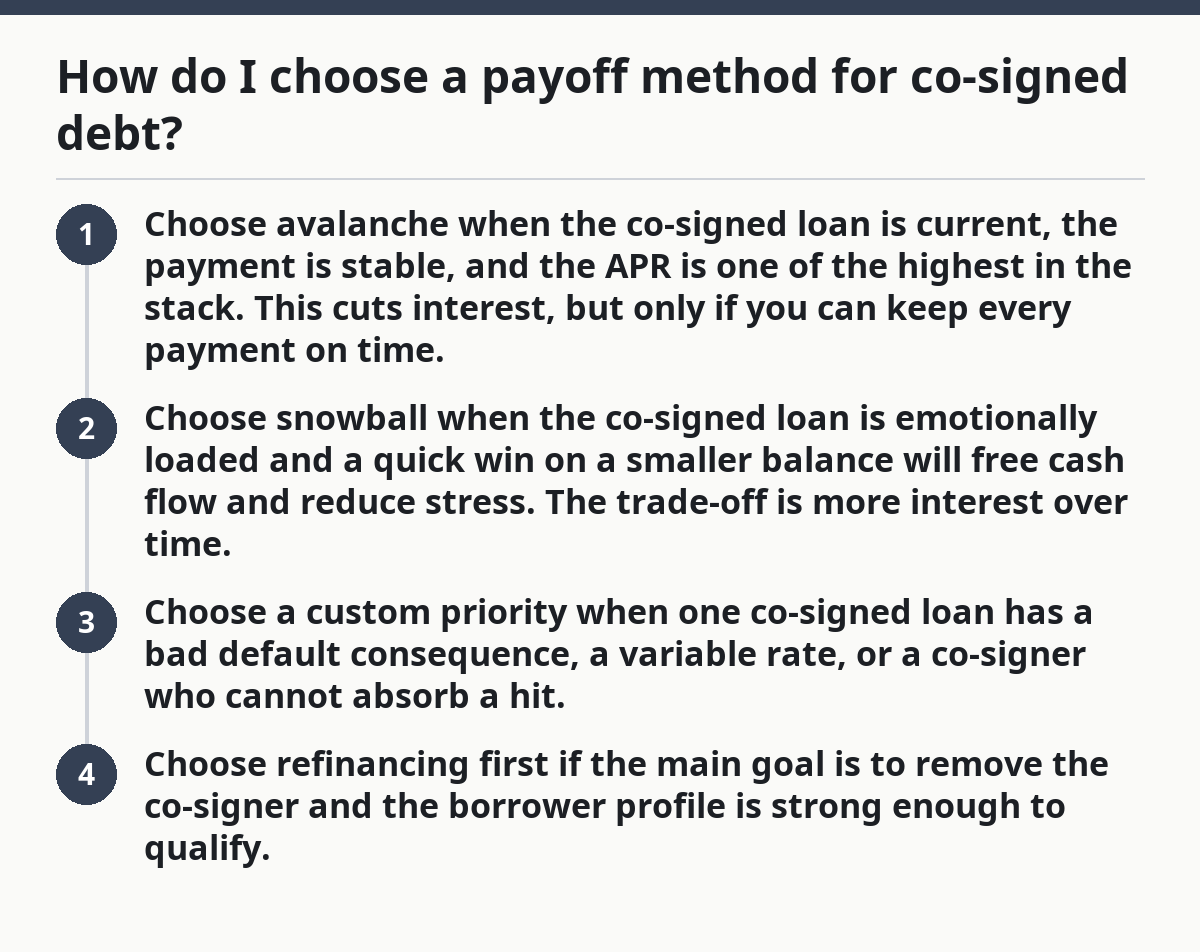
- Choose avalanche when the co-signed loan is current, the payment is stable, and the APR is one of the highest in the stack. This cuts interest, but only if you can keep every payment on time.
- Choose snowball when the co-signed loan is emotionally loaded and a quick win on a smaller balance will free cash flow and reduce stress. The trade-off is more interest over time.
- Choose a custom priority when one co-signed loan has a bad default consequence, a variable rate, or a co-signer who cannot absorb a hit.
- Choose refinancing first if the main goal is to remove the co-signer and the borrower profile is strong enough to qualify.
The best method is usually the one you can follow for 6 to 24 months without missing a due date. If the “best” plan depends on willpower you do not have, it is probably not the best plan.
Step by step: build the payoff order
You build the order by ranking the co-signed loan’s risk before you rank interest alone. The process is simple on paper, but each step needs a number, a date, or a clear account term so you do not guess.
Picture this: you’re staring at statements, and one account has a co-signer, a 15th-of-the-month due date, and a balance that makes everyone nervous. The job here is to turn that mess into a ranked list you can follow for the next 3 months and then review again.
- List every debt with its balance, APR, minimum payment, and due date. Use the most recent statement or online portal, and mark which loan has a co-signer. Verify that the APR and minimum are current; a variable-rate loan or a changed minimum can make the old plan wrong. A problem sign is any missing number.
- Mark the co-signed account as protected. Put a star next to any loan where a missed payment could affect another person’s credit. Verify that you understand who the co-signer is and whether the loan agreement makes them jointly responsible. A problem sign is assuming the co-signer is only a backup.
- Check the default trigger in the loan agreement. Find out what happens after a missed payment, a 30-day delinquency, or a late fee. Verify the lender’s written rules, not a guess from customer service. A problem sign is not knowing whether one missed payment can start a harsher collection path.
- Compare APRs, but only after the protection check. Rank high-interest debts within the safe group first, then within the protected group. Verify that the extra payment goes to principal, not just to future installments. A problem sign is paying extra without confirming how the lender applies it.
- Decide whether the co-signed debt gets the first extra dollar. If the account is fragile, direct extra money there until it is stable. If it is current and low-risk, place it by APR or balance size. A problem sign is putting all extra cash toward a different debt while the co-signed loan sits one mistake from default.
- Set a payment buffer. Keep at least one payment cycle of cash on hand if the loan and your budget are tight. Verify the buffer covers the minimum payment plus any likely late fee. A problem sign is using every spare dollar on principal and leaving no room for a 2-week cash gap.
- Choose a review date every 30 days. Recheck balances, fees, and income changes monthly. Verify that the payoff order still matches the current risk profile. A problem sign is letting an 18-month plan run untouched after the loan terms or your income changes.
If you want a plain rule: protect the co-signed loan first, then use avalanche or snowball on the rest. That keeps the method tied to the real risk instead of to a slogan.
What should I check before I pay extra on a co-signed loan?
You should check the loan’s rules, the co-signer’s exposure, and your cash cushion before sending extra money. That matters because a fast principal payment does nothing if the next month’s minimum gets missed.
Picture this: you have $300 extra and want to throw it at the biggest balance. The smarter move may be to confirm whether the lender charges a prepayment penalty, how it posts extra funds, and whether the co-signed loan needs that cushion more than a non-shared debt.
Use this checklist:
- Loan agreement: Look for late fee rules, grace periods, and prepayment language.
- Co-signer notice: Ask whether the co-signer gets payment alerts or delinquency notices.
- Payment posting: Confirm whether extra money goes to principal or the next installment.
- Auto-pay: Turn on automatic minimum payments if the lender offers it and the account is reliable.
- Emergency buffer: Keep enough cash to avoid a missed payment after one bad week.
- Refinancing path: Ask whether the current balance and credit profile make refinancing realistic.
A co-signed loan is not a place to wing it. If you cannot answer how the lender treats a missed payment, extra principal, and payoff quotes, check the loan agreement and, if needed, consult a qualified adviser before you choose a payoff method.
When the standard payoff approach does not fit
The standard approach does not fit when the co-signed loan has unusual terms, the co-signer cannot absorb risk, or refinancing is the cleaner path. That is where a standard snowball or avalanche plan needs a guardrail.
Picture this: the debt is current, but the co-signer is a retired parent, the APR is variable, and one delay would be a family problem. The method has to fit the human cost, not just the spreadsheet.
The co-signed loan is one payment away from delinquency: the default risk is too high for a method that delays this account — switch to a plan that protects the minimum here first.
The co-signer cannot tolerate a credit hit: shared liability makes this account a priority — focus on keeping it current and communicate before changing payment dates.
The loan has a variable rate: the payoff math can change during the plan — review the APR each statement cycle and shorten the review interval to 30 days.
Refinancing is available in your name only: this may remove the co-signer if approved — compare the new term, total payment, and any fees before you accept.
Extra payments are being misapplied: the method may look good but fail in practice — get written confirmation that extra funds hit principal.
The co-signed debt is the emotional center of the problem: stress can make a plan impossible to keep — choose the method you can follow for 6 months without breaking down.
The line that matters is simple: if the account has shared downside, the payoff method has to reduce shared risk first.
Where refinancing fits
Refinancing can be a strong structural fix when the borrower can qualify on their own and the goal is to remove the co-signer. It changes the debt itself, so it can make any payoff method easier afterward.
Picture this: you have a co-signed private student loan or personal loan, good payment history, and enough income to stand on your own. If a new lender approves a solo refinance, the old shared loan may be replaced by a single-borrower loan, which changes the payoff decision entirely.
The catch is that refinancing is not automatic and it is not always available. Lenders look at credit, income, debt-to-income ratio, and the loan’s current status. If the current loan is already delinquent or the borrower’s credit is weak, refinancing may be off the table for now.
Refinancing also has trade-offs:
- It can reset the term length.
- It can change the interest rate.
- It can remove flexible borrower protections that the old loan had.
- It can require a stronger credit profile than the original loan.
If refinancing is realistic, it often comes before the payoff method question. If it is not realistic, treat the existing loan as shared risk and choose the payment plan around that fact.
For a broader framework on matching payoff method to debt shape, the hub guide on Debt payoff method fit by debt portfolio structure sits one level up from this page, and the related guide on debt snowball vs debt avalanche can help you compare payoff order choices.
The mistakes that cost people the most
The biggest mistake is treating co-signed debt like any other balance and ignoring the second name on the contract. That can turn a normal payment slip into a relationship problem and a credit problem at the same time.
Picture this: you think you are “making progress,” but the co-signed loan is drifting because the smallest bills are getting attention first. The result is not just slower debt payoff; it can also create a default risk the other person never agreed to carry silently.
Common mistakes:
- Using snowball without checking risk. This can leave a fragile co-signed account exposed. The better move is to protect the shared loan first, then snowball the rest.
- Using avalanche and ignoring cash flow. A mathematically clean plan fails if it leaves you short before payday. The better move is a plan you can fund every month.
- Not telling the co-signer about changes. Surprise is the fastest way to break trust. The better move is a plain update before you change the payment schedule.
- Sending extra money without checking posting rules. The lender may apply it to future payments instead of principal. The better move is to confirm the posting method in writing.
- Waiting too long to explore refinancing. If the loan is stable enough, refinancing can remove shared liability. The better move is to check eligibility while the account is still in good shape.
A good payoff method for co-signed debt is not the prettiest one. It is the one that keeps the loan current, keeps the co-signer informed, and still moves the balance down.
Who is responsible if I miss a payment?
If you miss a payment on co-signed debt, both the borrower and the co-signer can be responsible under the loan agreement. The lender can pursue either party for the payment, and both credit files can be affected if the account becomes late. Read the agreement and contact the lender before the due date if trouble is coming.
Can I remove a co-signer?
You can remove a co-signer only if the lender allows it or if you refinance into a new loan without that person. Many lenders require a strong payment history, updated income, and a credit check before they will release a co-signer. If you need this outcome, ask the lender for the written release rules.
Drafted with AI; not yet reviewed by a person.