Last updated: August 10, 2026
- A Worked Example: The Numbers in Practice Three debts, straightforward setup: DebtBalanceAPRMinimum Credit card A$4,80024%$96 Credit card B$1,20018%$36 Personal loan$6,00011%$120 Total minimums: $252/month.
- Suppose you can afford $400/month total — that’s $148 in extra payment going to Card A.
- Month one on Card A: interest = $4,800 × (0.24 ÷ 12) = $96.
- Payment = $96 + $148 = $244.
Quick Answer: Using a debt avalanche calculator, most people with two to four debts totalling $10,000–$30,000 and $100–$300 in monthly extra payments can expect a full payoff timeline of three to seven years, depending on their rates and balances. The avalanche method — highest interest rate first — typically reduces total interest paid compared to paying debts in any other order, because it eliminates the most expensive balances fastest.
Key Facts
-
The debt avalanche method directs extra payments to the highest-APR debt first, minimizing total interest paid over time.
-
Your payoff timeline depends on four inputs: current balance, APR, minimum payment structure, and monthly extra payment amount.
-
A percentage-based minimum payment falls each month as the balance falls — entering it as fixed makes your calculator too optimistic.
-
Doubling your extra payment cuts the timeline by more than half, because lower principal means lower future interest charges compound less.
-
The avalanche method outperforms the debt snowball on total interest when rates differ by roughly 8 or more percentage points.
-
Project at three extra-payment levels (current, half, best-case) to understand your real range of outcomes.
-
Any projection assumes no new debt; a single emergency charge to the target card restarts the clock on that balance.
Attack the highest interest rate first. That’s the avalanche method — and for borrowers juggling two or three high-rate cards alongside a personal loan, a debt avalanche calculator makes the math impossible to ignore. This guide explains how to estimate your payoff timeline, where those calculations break down, and what to do when clean numbers meet a messier reality.
This article is informational and does not constitute financial advice. Rates, tax rules, and limits vary by country and change frequently. For decisions specific to your situation, speak with a qualified financial adviser.
What the Debt Avalanche Method Actually Does
An ordering strategy — that’s all the avalanche method is. You don’t change how much total money you send to creditors each month; you change where the extra goes.
Simpler than it sounds, honestly. List every debt by interest rate, highest to lowest. Pay the minimums on everything. Then direct every available additional dollar toward the top of that list. Once the highest-rate debt is gone, you “roll” its minimum payment into what you’re already putting toward debt number two. Repeat until done.
Why does this tend to minimize total interest? Interest accrues as a share of the outstanding balance — so wiping out a 22% balance before a 7% one means the expensive money stops compounding sooner. That math is straightforward once you see it.
What it does not do is get you to a closed account quickly. Your highest-rate debt also happens to be your largest balance? You could be chipping away at it for a long time before anything disappears. This psychological reality is the avalanche’s main honest trade-off, and it becomes important when comparing methods later.
The Inputs Your Debt Avalanche Calculator Needs — and Why Getting Them Right Matters
Garbage in, garbage out — a debt avalanche calculator is only as accurate as the numbers you feed it. Most people underestimate at least one of these inputs, which is exactly why calculated payoff dates often slip in practice.
Balance: Use the current balance today, not the original loan amount and not an estimate. Log into the account and copy the number.
Interest rate (APR): For credit cards, this is usually the purchase APR — a different number from the promotional rate, the cash advance rate, or the penalty rate. Already triggered a penalty APR after a late payment? Use that one instead. The gap between a 22% purchase APR and a 29% penalty APR can meaningfully extend an 18-month payoff timeline, so confirm which rate applies before entering anything.
Minimum payment: This is where projections go wrong most often. Many revolving accounts calculate minimums as a share of the outstanding balance, meaning the required amount drops each month as the balance drops. Enter a fixed minimum when the actual structure is percentage-based, and your timeline looks rosier than it should be. Well-designed calculators typically let you specify which applies — check your cardholder agreement to find out.
Monthly extra payment: The additional amount you can direct toward the top debt. Even small numbers here shift the timeline significantly. Bumping from $50 extra to $150 extra per month can meaningfully shorten the payoff of a mid-sized balance, particularly in early months when the balance is still large and compounding quickly.
How to Build the Calculation Step by Step
No fancy tool required. A spreadsheet works fine. Here’s the logic, laid out plainly.
Step 1 — Sort your debts. List every debt: balance, APR, minimum payment. Sort descending by APR. The first row is your target.
Step 2 — Simulate month one on the target debt. Multiply the balance by (APR ÷ 12) to get one month of interest. Subtract your payment (minimum + extra) and add the interest charge. The result is your new balance.
Step 3 — Work through all other debts. These receive only minimums. Apply the same interest calculation for each: balance × (APR ÷ 12), subtract minimum payment, add interest.
Step 4 — Repeat for month two, month three, and so on. The target balance will decrease. When it hits zero, stop paying it. Add that debt’s old minimum to your extra payment pool, then aim the full combined amount at the next highest-rate debt. This is the “roll” — it’s what makes the avalanche accelerate over time.
Month by month, keep counting. The month where every balance hits zero is your payoff date.
Rather not build this from scratch? Free online calculators (search “debt avalanche payoff calculator”) handle the iteration automatically. But understanding what’s happening inside them matters — because when a number looks wrong, you want to be able to check it yourself.
A Worked Example: The Numbers in Practice
Three debts, straightforward setup:
DebtBalanceAPRMinimum
Credit card A$4,80024%$96
Credit card B$1,20018%$36
Personal loan$6,00011%$120
Total minimums: $252/month. Suppose you can afford $400/month total — that’s $148 in extra payment going to Card A.
Month one on Card A: interest = $4,800 × (0.24 ÷ 12) = $96. Payment = $96 + $148 = $244. New balance = $4,800 + $96 − $244 = $4,652.
Notice what’s happening there. Without the extra $148, the minimum alone would cover only the interest — a common trap on high-rate cards whose balances are large enough that the minimum roughly equals one month’s interest. Pay only the floor on a card like that and the principal barely budges.
A precise month count would require the full simulation (whether minimums are recalculated monthly, whether any balance briefly grows), so run it in a spreadsheet to get your real number. Don’t trust a back-of-envelope estimate here.
Because principal falls faster with every extra dollar applied early, future interest charges fall with it. Doubling your extra payment doesn’t halve your timeline linearly — it typically cuts more than that, compounding the benefit in a way the raw numbers make visible once you build the full simulation out.
Avalanche vs. Snowball vs. Other Approaches: The Real Difference and When the Verdict Flips
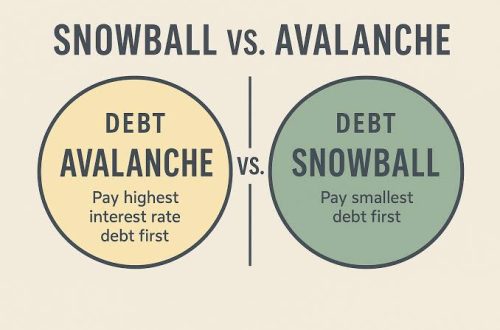
The avalanche’s main competitor is the debt snowball — pay smallest balance first, regardless of rate. The case for snowball is psychological: closing a small debt quickly gives you a win and keeps momentum going. Research on behavior change, including work cited by the Consumer Financial Protection Bureau, supports the idea that early wins matter for sustaining effort. That’s a real argument, not just a feel-good one.
CriteriaAvalancheSnowballMatters more when…
Total interest paidLowerHigherYou can sustain the plan without early wins
Time to first zero balanceLonger (if top debt is large)ShorterMotivation is genuinely at risk
Months to full payoffShorter overallLonger overallYour rates vary widely
Simplicity of logicStraightforwardStraightforwardBoth are equally easy to track
Rate differences are smallMinimal advantageSame resultAPRs cluster within 2–3 points
Largest debt = highest rateStrong advantageWeakest caseLarge, high-rate debt dominates your list
Psychological fragilityHigher risk of giving upLower riskYou have a history of stopping plans
Beyond those two, some borrowers use a hybrid approach: clear one small balance first for a quick win, then shift to avalanche order for the remainder. Others consolidate multiple debts into a single lower-rate loan (covered below). The right method is the one you will actually follow — a mathematically optimal plan abandoned after three months costs more than a slightly less efficient plan you stick with for three years.
Avalanche wins when your rates vary significantly (say, 8 points or more between highest and lowest) and you’re confident you’ll stay the course without a near-term win.
Snowball wins when you’ve tried and quit debt repayment plans before, or when the numbers show your highest-rate debt will take more than a year to clear before any balance reaches zero.
Neither works when your monthly cash flow doesn’t cover minimums. No ordering strategy fixes a cash-flow problem. That requires either increasing income or reducing expenses first — or, depending on the severity, a conversation with a nonprofit credit counselor or a qualified financial adviser.
The Three Inputs That Destroy an Otherwise Accurate Projection
Even a correctly built avalanche projection can drift from reality. Most of that drift traces to one of three causes.
Variable rates. Credit card APRs in most countries can shift with market rates or at the issuer’s discretion with notice. A projection built on today’s 22% APR could be wrong by the time you’re halfway through the plan. Build the projection twice: once at the current rate, once a few points higher. The gap between those two timelines is your uncertainty band — treat it as a range rather than a single date.
New debt. Any projection assumes you add no new balances. One emergency charge to the card you’re attacking restarts the clock on that balance — the math stops working fast once that happens. Building even a modest emergency fund before accelerating payoff helps prevent that scenario; the two goals aren’t permanently competing. Most advisers suggest at least a small liquid buffer before directing every spare dollar at debt. To determine the right balance for your household, talk with a licensed financial adviser. (FDIC Money Smart offers free tools for thinking through this trade-off.)
Income disruptions. A job change, reduced hours, or unexpected expense shrinks the extra payment you can make. Because that risk is predictable, a conservative projection uses a lower monthly extra than you currently have available — not the maximum you can stretch to. Project using a stretch number, then life softens your income for two months, and suddenly you’re behind your own plan. That discouragement is entirely foreseeable and entirely avoidable.
When to Reconsider the Avalanche Entirely
Useful for many borrowers — but the avalanche isn’t always the right frame for the problem.
Considering debt consolidation? Rolling multiple debts into a single loan at a lower rate changes the calculation entirely. Both the new rate and the consolidation fee need to be in the math. A consolidation loan at a lower APR often shortens the timeline and cuts total interest, but the fee — typically expressed as a percentage of the loan amount — eats into that advantage. Run the numbers both ways. Don’t take the consolidation marketing at face value.
Any debts in collections or default? Standard avalanche logic doesn’t apply cleanly there. Settlements, payment plans, and the statute of limitations on debt collection vary by jurisdiction and by the type of debt. In those situations, guidance from a nonprofit credit counselor or a licensed financial professional matters far more than any calculator.
Carrying high-interest debt while holding zero liquid savings? The conventional view is to build a small emergency buffer first, then attack debt. The exact threshold varies by household — but a purely mathematical approach sometimes produces a plan that’s technically optimal and practically fragile. Worth thinking through before committing.
Getting a Number You Can Actually Trust
The most useful output from a debt avalanche calculator isn’t a single payoff date. It’s a range.
Specifically, build three versions: one using your current extra payment amount, one using half that amount (simulating a lean month), and one using your best-case extra. The spread between those three timelines tells you more than any single projection. Six months between best-case and worst-case? You have meaningful uncertainty to plan around. Two months apart? The plan is fairly stable.
After the initial projection, revisit it every three to six months with actual current balances. Rate changes, extra payments that varied from the plan, any new charges — all of it shifts the timeline. A projection built eighteen months ago isn’t a forecast anymore; it’s a historical artifact. For further reading, the CFPB’s debt repayment resources and the FDIC Money Smart program both offer tools grounded in federal consumer protection research.
The goal of the calculator, in the end, isn’t a date to put in your calendar. It’s clarity: proof that the finish line exists, a rough sense of when you’ll cross it, and a clear view of which lever — extra payment size, highest-rate ordering, or a lump-sum reduction — moves that date the most. That’s the decision-support a good debt avalanche projection actually delivers.