Last updated: November 20, 2026
Quick Answer: Start with the loan that has the highest risk of losing a benefit, then choose the payoff method that lowers your total cost without breaking federal protections. If you have only student loans, the right payoff method depends on whether your loans are federal or private, whether forgiveness is on the table, and whether extra payments would trigger capitalization or wipe out repayment-plan benefits. The steps below settle which method fits your situation in How to choose a debt payoff method when you have only student loans.
What this guide applies to
This guide applies if your debt stack is only student loans and you want a clean way to decide between standard repayment, graduated repayment, income-driven repayment, and extra-principal paydown. It assumes you can read your loan servicer statement, know whether each loan is federal or private, and can tell the difference between a payment plan and a payoff order.
This is information, not financial advice. Student loan rules change, and federal rules differ from private-loan contracts; a qualified adviser or the U.S. Department of Education’s Federal Student Aid resources should be consulted for your own situation.
Picture this: you have a single loan file, but it holds 3 or 10 separate loans, some with federal protections and some with none. That split changes the payoff method more than the balance itself. It changes the order. It changes the risk.
If you need a broader framework after this page, the hub on debt payoff method fit by debt portfolio structure fills in the other portfolio types.
Key takeaways
- Federal loans and private loans should not be treated the same way; if you are unsure how your loans are classified, check with your servicer or a qualified adviser and review Federal Student Aid guidance.
- If forgiveness or income-based relief matters, the payoff plan has to respect that path first.
- Extra payments can help, but they can also make you lose repayment-plan benefits if they are applied badly.
- The best method is usually the one that matches your loan group, not the one with the loudest fan base online.
First, split your student loans into the right groups
You should choose the payoff method by loan group first, then by interest rate or payment size. A lot of borrowers mix all student loans together in their heads, but servicers do not treat them that way; if the grouping is unclear, consult your servicer or a qualified adviser and check Federal Student Aid’s loan-type guidance.
Picture this: you open one account and see four Direct Loans, two private loans, and a repayment plan tied to your federal group. That is not one decision. It is two loan systems sharing one monthly budget.
Here’s the catch: federal and private loans behave differently, and federal loans can also sit in different repayment groups. That means the same extra $100 can do different things depending on where you send it.
- List every loan separately. Write down the lender or servicer, type, balance, interest rate, and whether it is federal or private. Verify the type in your promissory note or federal loan portal. If you cannot tell the type in 5 minutes, the grouping is probably wrong.
- Mark federal loans with repayment options. Identify which loans can use income-driven repayment, standard repayment, or graduated repayment. Verify the plan name, not just the monthly amount. If the portal does not show the plan, ask for the written plan terms.
- Group loans by forgiveness path. Separate any loan that could count toward Public Service Loan Forgiveness or another forgiveness track from loans that do not. Verify the qualifying status before you aim extra money at them. If the count toward forgiveness is unclear, pause.
- Separate private loans. Private loans usually follow contract terms, not federal plan rules. Verify whether there is a fixed rate, variable rate, grace period, or prepayment penalty clause. If you see a penalty, stop and read the contract carefully.
- Check whether interest is subsidized. Some federal loans may have periods where interest is handled differently. Verify whether unpaid interest is currently adding to principal. If interest is accruing faster than your payment covers it, the balance can grow.
- Sort by payoff constraint, not just rate. A loan with forgiveness or special repayment rules may need a different method even if the rate is low. Verify which rule is stronger: plan protection or rate attack. If you cannot name the rule, you are not ready to choose.
- Choose one group to optimize first. Your first target should be the group where a wrong move causes the most harm. Verify that the chosen group is the one you can change without breaking forgiveness or plan benefits. If not, choose a different group.
For this step, the simplest method is a spreadsheet or a plain paper list. A 10-minute inventory can save you from sending the wrong payment for 10 years.
Should I use standard, graduated, or income-driven repayment?
Choose the repayment plan that protects your monthly cash flow first, then compare the cost of staying on that plan for its full term. Standard repayment is the fixed-payment baseline, graduated repayment starts lower and rises over time, and income-driven repayment ties payment to income and family size under federal rules.
Picture this: your salary is steady, your loans are federal, and you can afford the 10-year standard payment without stress. That is a very different case from a borrower whose income changes every 12 months or who may need forgiveness later.
The truth is, the “fastest payoff” plan is not always the best first move for every borrower. If income-driven repayment keeps your budget alive, it may be the better bridge even when the balance falls more slowly.
- Use standard repayment when you can afford the fixed monthly amount and you want the clearest path to full payoff. Verify that the payment fits even in a bad month. If it does not, the plan is too tight.
- Use graduated repayment when you expect income to rise and need lower early payments. Verify that the later payment steps still fit your budget. If the future payment jumps beyond your comfort zone, the plan may just delay pain.
- Use income-driven repayment when payment flexibility matters more than speed, or when forgiveness timelines matter. Verify which federal plan you qualify for and how recertification works. If the required documentation is hard to keep current, the plan can go off track.
- Use extra principal paydown only after the base plan is stable. Verify that extra money is being applied to principal, not future interest or a separate fee bucket. If the servicer applies it wrong, call and correct the allocation.
- Use refinancing only after you understand the trade-offs. A refinance can replace federal protections with a private contract. Verify what you lose before you compare the lower rate. If the old federal benefits matter, refinancing may be the wrong move.
The most common mistake is choosing the lowest monthly payment without checking whether that plan changes the long-term path. On federal loans, the monthly number is only half the story.
How do forgiveness timelines change the payoff method?
Forgiveness timelines should come before aggressive payoff if your loans may qualify for a federal forgiveness program. A borrower who is 2 years from a possible forgiveness milestone should think differently from a borrower with no forgiveness track at all.
Picture this: you are making steady payments on federal loans while a forgiveness clock is already running. Throwing every spare dollar at principal can feel disciplined, but it can also be the wrong trade if those dollars do not improve your outcome.
Here’s why. Forgiveness changes the math of “best” from shortest term to lowest net cost under the program rules.
- Check whether your loan type can count. Federal loans may qualify for some forgiveness paths; private loans usually do not. Verify the exact program rules for your loan type. If the loan type is excluded, do not build your plan around forgiveness.
- Check whether your payments count. Some programs care about the plan you are on and whether payments are qualifying payments. Verify that your current plan and payment history meet the program terms. If they do not, the timeline may be longer than you think.
- Check whether extra payments help. Extra payments can reduce principal, but they may not move the forgiveness clock the way you expect. Verify whether extra principal changes the qualifying count. If it does not, the extra payment may only lower balance, not timeline.
- Check tax treatment separately. Forgiveness and tax rules can differ by country and by program. Verify current tax treatment before treating forgiven balance as “free.” If the tax side is unclear, consult a qualified tax professional or adviser.
- Check your recertification date. Income-driven repayment often requires periodic income updates. Verify the next deadline on your calendar. If you miss it, your payment can jump.
The key question is simple: is your goal to clear the loan, or to reach a forgiveness milestone with the least damage along the way? Those are not always the same plan.
Where interest capitalization changes the answer
Interest capitalization can make a low-payment strategy more expensive than it looks. Capitalization means unpaid interest gets added to principal, and after that you can pay interest on the interest.
Picture this: a repayment pause ends, or you leave an income-driven plan, and the unpaid interest on a federal loan gets folded into the balance. The loan still looks manageable on paper, but the starting line just moved.
A generic article often misses this part. That is a mistake. Capitalization is one of the main reasons a borrower thinks they are paying down debt while the balance barely moves.
- Ask when capitalization can happen. It can occur after certain plan changes, deferment ends, or other contract events. Verify the trigger in your promissory note or servicer notice. If the trigger is unclear, assume it exists until you confirm otherwise.
- Check whether unpaid interest is building now. If monthly payments do not cover all interest, the unpaid part may accumulate. Verify the interest line on the statement each month. If the balance rises while you pay, the method is not controlling costs.
- Use extra payments with precision. If you pay extra, ask for principal-only application when the loan terms allow it. Verify the servicer’s payment instructions. If the servicer spreads the money across future months, the payoff effect may be weaker.
- Protect plan changes. Leaving a plan can sometimes trigger capitalization. Verify the timing before switching. If the switch creates a bigger principal balance, the “better” plan may be worse in practice.
A good rule: if capitalization risk is active, the method that looks cheapest on a calculator may not be cheapest in real life.
When should I stop and get qualified help?
You should stop and get qualified help when your student loans involve forgiveness, mixed federal and private rules, or a repayment change that could alter the legal terms of the loan. This is money work with real downside, and some choices cannot be undone cheaply.
Picture this: you are one form away from switching plans, but that form could change capitalization, restart a timeline, or remove a protection you need. That is the point to slow down.
- You are pursuing forgiveness. The consequence of a bad move can be losing qualifying time or making a payment that does not count. Get help before changing plans.
- You have both federal and private loans. The consequence of using one method across both is usually a bad mismatch. Use separate rules or get help.
- You are considering refinancing. The consequence may be giving up federal protections for a private contract. Review the full terms before you act.
- You do not know your current repayment plan. The consequence is that you cannot tell whether extra payments help or hurt. Identify the plan first.
- Your servicer history is messy. The consequence can be misapplied payments, missed counts, or capitalization surprises. Get the account history clarified before choosing a method.
- Your income is changing fast. The consequence is that a fixed plan may fail within months. Recheck the plan when your income shifts.
If any of those apply, the right move is not “pay harder.” It is “get the rule set right.”
The mistakes that make student loan paydown worse
The worst mistakes are paying by habit, not by loan rules. That usually means more interest paid, a longer payoff, or loss of a benefit that was already available.
Picture this: you tell the servicer to send every extra dollar to the biggest balance, and it feels productive. Then you learn the highest balance was the one on track for forgiveness, or the one with the most favorable repayment feature.
- Treating all student loans as one bucket. The consequence is that federal protections get ignored. The alternative is to split loans by type and plan.
- Choosing a method from a generic debt article. The consequence is a payoff plan that fits credit cards but not student loans. The alternative is to start with repayment rules, then choose the method.
- Ignoring capitalization. The consequence is a balance that grows while you think you are making progress. The alternative is to check how unpaid interest is handled before you change plans.
- Sending extra money without payment instructions. The consequence is that the servicer may apply it in a way you did not intend. The alternative is to confirm principal-only application where allowed.
- Refinancing without checking benefits first. The consequence is losing federal options you cannot get back. The alternative is to list every benefit tied to the existing loans before comparing offers.
- Assuming the lowest payment is the best plan. The consequence is a longer and costlier path if the plan does not fit your timeline. The alternative is to compare monthly fit, total cost, and forgiveness impact together.
That is the real decision structure: not “snowball or avalanche” in the abstract, but “which rule matters most for these loans right now?”
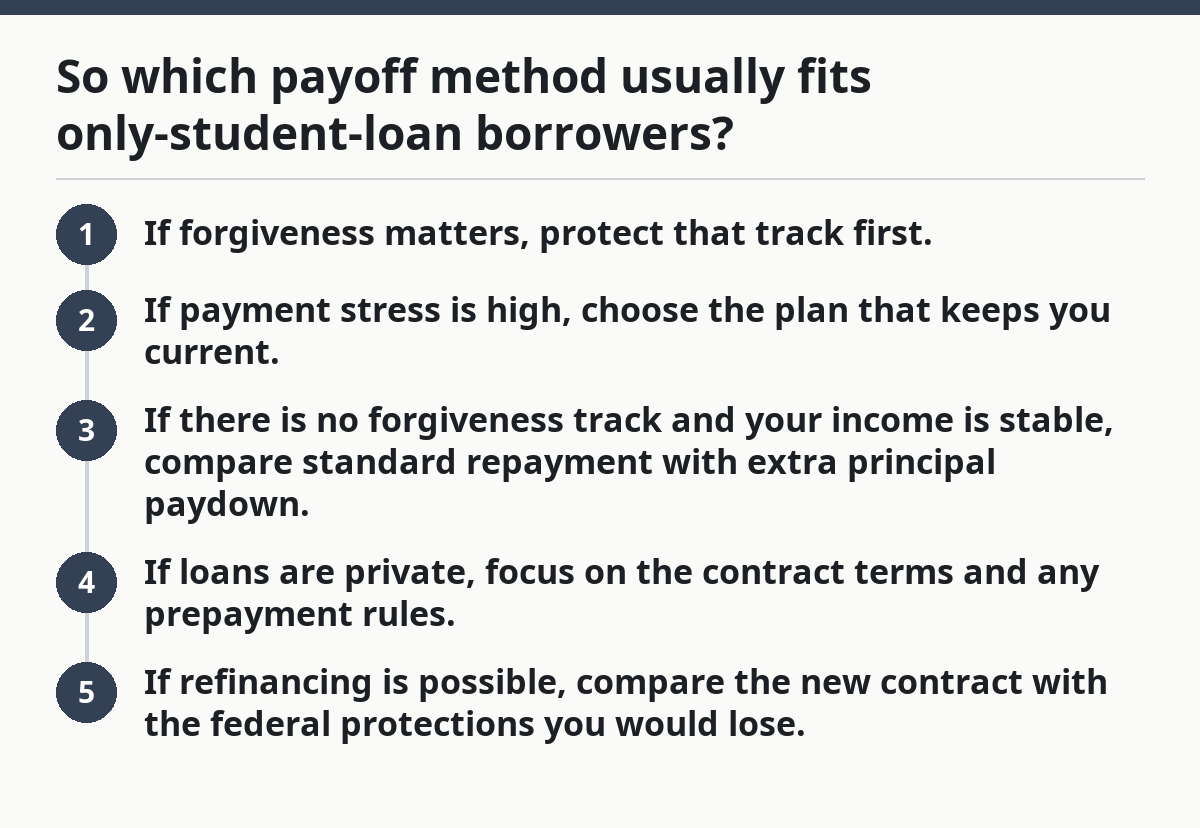
So which payoff method usually fits only-student-loan borrowers?
The right payoff method is the one that matches your loan rights, not just your debt balance. For many borrowers with only federal loans, that means starting with the repayment plan that best fits cash flow and forgiveness rules, then using extra payments only when they do not damage those benefits.
Picture this: you have one clean portfolio, but it still has two possible jobs. One job is keeping payments manageable. The other is clearing the debt as cheaply as possible. Those jobs do not always point to the same method.
A simple decision order helps:
- If forgiveness matters, protect that track first.
- If payment stress is high, choose the plan that keeps you current.
- If there is no forgiveness track and your income is stable, compare standard repayment with extra principal paydown.
- If loans are private, focus on the contract terms and any prepayment rules.
- If refinancing is possible, compare the new contract with the federal protections you would lose.
For more detail on repayment rules, see the Federal Student Aid repayment plans overview, the U.S. Department of Education page on Public Service Loan Forgiveness, and the CFPB guide to student loan repayment.
What that means in practice is simple: do not chase the fastest-looking payoff if it breaks a more valuable rule. In student loan repayment, the best method is usually the one that preserves your options while lowering cost.
For related planning, compare your approach with the debt payoff method fit by debt portfolio structure, review student loan refinancing basics, and check how extra student loan payments are applied.
Drafted with AI; not yet reviewed by a person.