
Last updated: November 20, 2026
Quick Answer: in most cases, start with the debt whose payment can change the most in 1 to 3 business days, then compare interest and fees second. If your debt is in another currency, the “fastest” debt payoff method can lose to timing risk, bank fees, or a creditor that charges in a different currency than your income. This is information, not financial advice; for your own situation, a qualified adviser should review the debt, your income currency, and the payment route.
Key Takeaways
- Cross-border debt can change the payoff order because the amount you owe may move before settlement.
- Put the most currency-exposed debt ahead of debt that is only exposed to interest.
- Match the payoff method to the payment route, then recheck the order after each payment step.
- The best order usually targets the most unstable payment first, not always the smallest balance.
Who should use this approach?

This approach fits anyone paying cross-border debt with a mismatch between the currency of the debt and the currency of the money they earn. That includes foreign-currency debt, a card balance billed through a credit card network in one currency while the biller or lender settles in another, or a loan from a cross-border lender that expects payment by international bank transfer. It also fits people whose payment date matters because exchange rates move while a transfer is still in transit. For background on exchange-rate and transfer timing risk, see the CFPB and the Federal Reserve CFPB international money transfer rules, Federal Reserve payment services, and BIS payment system statistics.
It assumes you already know the basics of the common debt payoff methods: snowball, avalanche, and hybrid payoff ordering. The question here is not which method is popular. The question is which method still makes sense when the payment itself can change value between the day you send it and the day it lands. A plan that works on paper can fail once the money crosses a border.
This is not the right guide if the debt is all in your local currency and paid through a local account. It also does not cover the separate question of how to rank mixed debt types, secured versus unsecured debt, or account structure. Those need their own decision rules, and if the facts are unclear, a qualified adviser should help you choose the right ranking method.
What changes when debt crosses a border?
Cross-border debt changes the payoff choice because the amount you owe can move even when the principal does not. An exchange rate is the price of one currency in another currency, and that price can shift between paycheck day and payment day. A transfer fee can also make a “small” debt more expensive to clear than its balance suggests.
Three risks matter most. First is exchange rate risk, which is the chance that the debt costs more in your income currency by the time you pay. Second is payment timing risk, which is the chance that a transfer sent today settles after the rate has moved. Third is transfer friction, such as bank fees, intermediary bank charges, or card network conversion costs. Those costs can change the best order, especially when two debts are close in balance or timing.
Local creditor and foreign creditor also matter. A local creditor can usually apply payments faster and with less currency noise. A foreign creditor may require a bank wire, a card network conversion, or a payment rail that adds delay. If one debt can absorb a payment instantly and the other can take several business days, the debt with the moving exchange rate carries more uncertainty.
How do I choose the payoff method?

Choose the method by ranking the debt that is most exposed to currency movement ahead of debt that is only exposed to interest. The method is a control system, not a slogan. If one debt has a foreign currency balance, a slow settlement path, or a fee-heavy transfer route, that debt often needs earlier attention than a purely domestic balance with a slightly higher rate.
Debt snowball vs debt avalanche is only the starting point. How to prioritize debt payoff should include currency exposure, and how to budget for debt payoff should include the transfer buffer.
| Payoff method | Best use in cross-border debt | Main drawback |
|---|---|---|
| Avalanche | When interest is clearly the main cost and the payment currency is stable | Can ignore exchange-rate movement and settlement delay |
| Snowball | When a small foreign-currency balance creates outsized transfer friction or timing risk | Can cost more in interest if the smallest debt is not the riskiest |
| Hybrid | When one debt has currency risk and another has much higher interest | Takes more judgment and more tracking |
| Fixed-date payoff | When the biller settles on a set date and rate changes matter | Requires tighter timing and cash buffer discipline |
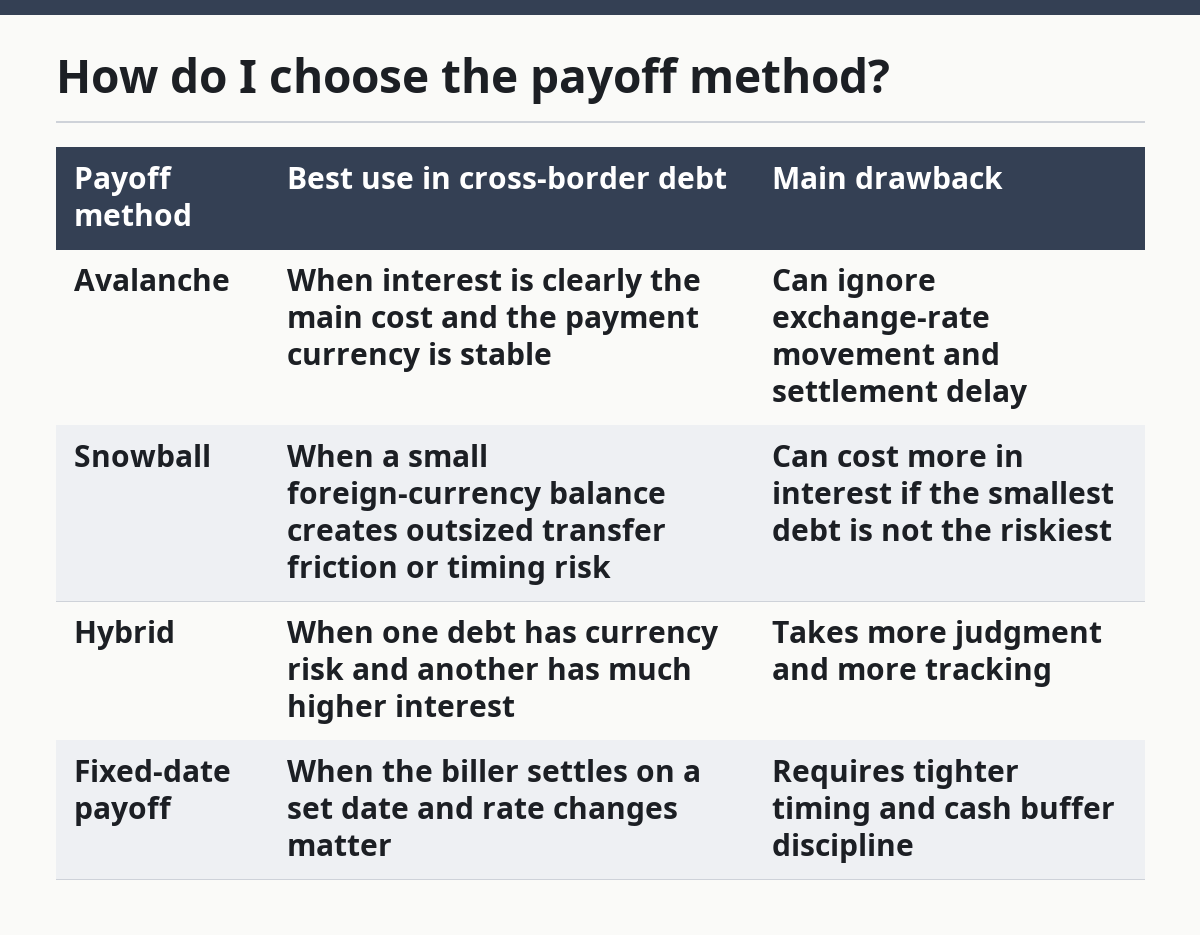
The clean rule is simple: if currency risk can move the effective cost faster than interest does, do not let a pure interest ranking control the order. If payment friction is the bigger issue, do not let balance size alone control the order either.
This is where a generic debt payoff article often gets it wrong. It treats every balance like it lives in one currency, on one calendar, with one transfer method. Cross-border debt does not behave that neatly. For payment timing and transfer basics, see the CFPB and the Federal Reserve CFPB remittance guidance and Federal Reserve wire transfer resources.
What steps should I follow?
Follow the debt payoff method that matches the payment route, then check whether exchange-rate exposure changes the order after each step. The process below keeps the decision tied to the actual transfer mechanics, not a guess.
- List each debt in the same units, usually your income currency, and note the quoted balance, the billing currency, and the next due date. Verify that every balance includes the same date and currency basis. If one debt has an unclear converted amount, the ranking is already unreliable.
- Identify the payment path for each debt: local transfer, international bank transfer, credit card network, or lender portal. Verify the settlement time in business days, not just the send date. A problem exists if you cannot tell when the creditor actually receives value.
- Estimate the currency exposure by asking how much can change before settlement. Verify whether the payment is due in a foreign currency or converted by the bank at the time of transfer. A problem exists if the debt amount can rise between payday and settlement with no buffer.
- Compare transfer friction for each debt, including bank fees and any cross-border charges that apply. Verify whether one payment method adds a fixed cost that makes repeated small payments inefficient. A problem exists if the fee is large enough to distort your payoff order.
- Rank the debts first by currency risk, then by interest, then by fee drag. Verify that the top-ranked debt is the one where a delay or rate move would hurt most. A problem exists if the highest-rate debt is not the one with the biggest real-world cost.
- Choose a payoff pattern that matches the ranking: aggressive extra payments to the most exposed debt, or a hybrid if one debt is volatile but another is much more expensive in interest. Verify that the order still works if the exchange rate moves before the next due date. A problem exists if one rate change would reverse the logic.
- Set a payment buffer in the debt’s billing currency or in your local currency if conversion happens at the creditor side. Verify that the buffer covers likely movement and fees without straining cash flow. A problem exists if one missed transfer would create a chain of late fees or a collection issue.
- Review the order before each payment date and after any change in transfer route, billing currency, or income currency. Verify that the same debt still has the highest combined risk. A problem exists if the route changes but the payoff order stays frozen.
If a debt’s effective cost can change in 1 to 3 business days, treat that as part of the payoff decision. A plan that ignores timing risk is not a plan; it is a guess with a schedule.
Which payoff order usually makes sense?
The order that usually makes sense is the one that reduces the most unstable payment first, even if that is not the smallest balance. That means a foreign-currency bill with a bank wire settlement delay can outrank a domestic balance that looks worse on interest alone. It also means a card network conversion issue can matter more than the printed rate if the payment route adds a hidden spread or delay.
Here is the clean way to think about it. If the exchange rate can change your payment amount before settlement, the payoff method should account for that movement as a real cost. If transfer fees are fixed and repeat often, a fast paydown of a fee-heavy debt can save more friction than a slow, rate-only approach. If neither of those is true, then a standard avalanche order may still be fine.
The wrong choice is usually one of two extremes. Some people ignore currency risk and rank by interest only. Others panic about every small rate move and abandon a workable debt order too often. Both create noise. A better choice is to treat currency exposure like another cost, then decide where it belongs in the ranking.
A cross-border lender can change the picture because lender rules may control how payments post. A payment that looks on time from your bank side may still be late on the lender side if it crosses on a weekend or needs currency conversion first. That is why the payment calendar matters as much as the balance sheet.
When should I stop and get help?
Stop and get qualified help when the cross-border details are too messy to rank with confidence. On a money issue, a wrong move can cost real cash, so the point is not bravado. The point is to avoid choosing a payoff method when the payment mechanics are still unclear.
The creditor can change the settlement currency: the amount you owe may shift after you send the payment — get help if you cannot confirm the conversion rule before the due date.
The transfer takes several business days: timing risk can turn a correct payoff order into a late payment — use a buffer or ask for a payment route with clearer posting rules.
You pay through a credit card network with currency conversion: the posted amount may differ from the amount you expected — confirm the conversion method before sending extra payments.
The lender is foreign and uses local banking rules: a domestic payment habit may not apply — check posting cutoffs, holidays, and required reference numbers.
The debt is near a hardship or collection stage: payoff ordering may not be the main issue anymore — focus on preventing default and get tailored advice quickly.
Your income is in one currency and the debt in another, with no spare cash buffer: a small exchange move can break the plan — seek advice on whether the payment schedule itself needs redesign.
What mistakes do people make most often?
The most common mistake is ranking debt only by interest rate. That can push a foreign-currency balance to the bottom even when exchange-rate movement makes it more expensive in practice. The better alternative is to rank by effective cost, which includes currency risk and transfer friction.
Another mistake is paying at the last minute because the balance “should” arrive in time. With cross-border debt, “should” is not enough. If the transfer needs 2 to 5 business days, the payment should leave early enough that a weekend or holiday does not turn it late.
A third mistake is ignoring the currency in which the creditor books the payment. If the creditor converts on receipt, your bank’s rate is not the whole story. The correct alternative is to check who does the conversion and when.
A fourth mistake is sending many small extra payments through an international bank transfer when each transfer has its own fee. That can make the payoff method look active while adding avoidable cost. A better alternative is to batch payments when the lender allows it, or to choose a payoff order that reduces the number of cross-border transfers.
A fifth mistake is assuming a local creditor and a foreign creditor behave the same way. They do not. The local creditor may post faster and with fewer fees, while the foreign creditor may require tighter timing and a clearer payment reference.
How do I pay foreign debt from a U.S. bank account?
You pay foreign debt from a U.S. bank account by matching the transfer route to the creditor’s posting rule and the debt’s currency. The key is not the country label alone; it is whether the creditor wants local-currency funds, foreign-currency funds, or a payment through a card network that converts on the way.
Start by checking whether the creditor accepts an international bank transfer, an online card payment, or a domestic proxy account. Then confirm the fee path, the settlement time, and the currency conversion point. If the payment can sit in transit for several business days, build that delay into the payoff order so a due date does not outrank the transfer window.
A U.S. bank account does not remove cross-border risk. It simply shifts where the risk shows up: bank fees, conversion spread, and timing. The right payoff method still depends on the debt’s actual payment route, not on the country where the checking account sits. For U.S. transfer details, see Federal Reserve international wire guidance and CFPB money transfer resources.
What does a good result look like?
A good result is not “debt gone as fast as possible” in the abstract. A good result is that the most exposed debt gets paid first, the payment lands on time, and the exchange-rate move does not overturn the plan between paydays. That usually means fewer surprises, fewer late fees, and less wasted money on repeated cross-border transfers.
The plan should also be easy to repeat for the next payment cycle. A fresh spreadsheet every week is often too fragile. A better plan has a clear ranking, a payment buffer, and a rule for re-checking the order when the currency, transfer path, or due date changes.
The right method for cross-border debt is often a hybrid, not a pure snowball or pure avalanche. That is not a weakness. It is the honest response to a debt that lives in more than one currency and more than one payment system.
Does exchange rate risk change debt payoff priority?
Yes, exchange rate risk can change debt payoff priority because the real cost of the debt may move before the payment settles. If a foreign-currency balance can rise in your income currency over a few business days, that debt may deserve attention ahead of a higher-rate domestic balance.
The size of the change depends on the currency pair, the payment route, and the creditor’s posting rule. A qualified adviser can help if the debt is large or the cash buffer is thin.
How do I pay foreign debt from a U.S. bank account?
You pay foreign debt from a U.S. bank account by using the route the creditor accepts and checking when conversion happens. That may be an international bank transfer, a card network payment, or another approved payment channel with its own fees and settlement time.
The main risk is not sending the money; it is sending it too late or in the wrong currency. Confirm the posting window, the reference number, and any transfer fee before you rank that debt in your payoff order.
Should I pay off cross-border debt faster?
Often yes, if the debt has more currency risk or payment friction than your other balances. A foreign-currency balance that can move against you before settlement may deserve earlier payoff than a domestic balance with a similar or even slightly higher rate.
That does not mean every cross-border debt should jump to the top. If the debt is small, stable, and cheap to transfer, a standard payoff method may still fit. For a personal decision, a qualified adviser should review the full picture.
Drafted with AI; not yet reviewed by a person.