Last updated: November 20, 2026
Quick Answer: For Debt payoff method fit by repayment mechanics and payment flow — The Complete Guide, the best fit is the method that matches your due dates, income timing, and extra-payment consistency; if timing is the problem, a cash-flow-first plan usually comes before snowball or avalanche. This guide is information, not financial advice; for your own situation, a qualified adviser can help.
The sections below settle which debt payoff method fit by repayment mechanics and payment flow matches your repayment mechanics, where each one breaks down, and what to do when your cash flow is uneven.
Which debt payoff method fits your payment flow?
The right method is the one that matches your money movement, not the one with the flashiest name. If your repayment flow is simple, a single-focus method like the snowball or avalanche can work; if your balances and due dates are tangled, a cash-flow-first method usually fits better.
Key takeaways
- Pick the method that matches how many accounts you have, when income arrives, and whether you can add one steady extra payment.
- Snowball fits people who need fast wins and can pay the same extra amount every month.
- Avalanche fits people who want the most interest savings and can stay patient.
- Cash-flow methods fit people with irregular income, variable expenses, or many due dates.
- If your budget keeps breaking, the problem may be the payment system, not your motivation.
Picture this: you have four bills, three due dates, and one paycheck that lands unevenly. A payoff plan that ignores timing will feel like a fight every month. A plan that matches the flow of your money can feel much less chaotic, even before the balance drops.
The catch is that most advice talks about debt payoff as if all debt behaves the same. It doesn’t. A credit card with a 0% promo period, a student loan with fixed installments, and a store card with a small balance but a weird due date all respond differently.
Here are the main payoff mechanics:
- Snowball: pay minimums on all debts, then throw extra money at the smallest balance first.
- Avalanche: pay minimums on all debts, then attack the highest interest rate first.
- Cash-flow / due-date method: line up bills with your pay schedule, then use any extra cash to clear the next most disruptive payment.
- Hybrid method: combine one order for emotion and one order for math, such as lining up due dates first and then attacking the highest-rate debt inside that structure.
If you want the shortest answer: choose the method that removes the biggest friction in your month. Sometimes that’s interest. Sometimes it’s timing. Sometimes it’s the mental cost of too many bills.
How does repayment mechanics change the best payoff method?

Repayment mechanics can change the best payoff method because the problem is not just debt size — it’s how each account consumes cash every month. A method that looks optimal on paper can fail if it creates overdrafts, late fees, or constant rebalancing.
Picture this: your pay lands on the 1st and 15th, but one card drafts on the 3rd, another on the 12th, and a loan on the 28th. You can be “on budget” and still have a bad cash flow month if the bills hit before the money does.
That’s why repayment mechanics matter:
- Minimum-payment mechanics reward consistency. If you can keep every account current, snowball and avalanche both work.
- Interest-rate mechanics reward arithmetic. High-rate balances cost more every cycle, so avalanche reduces drag faster.
- Due-date mechanics reward timing. If one payment always hits before payday, you may need a flow-based plan before any payoff order makes sense.
- Fee mechanics punish misses. Late fees, returned-payment fees, and penalty rates can erase the benefit of a mathematically perfect order.
A lot of beginner articles skip this. A debt plan that does not match due dates can fail even if the payoff order is mathematically sound.
Use this simple filter:
- If your payments are all fixed and your income is steady, you can compare snowball and avalanche directly.
- If your income varies, look first at due dates and buffer cash.
- If one missed payment would trigger penalties or shut off a service, that bill gets protected first.
- If you have promotional rates, check the end date and the regular APR before you decide the order.
For consumer debt, rates and rules vary by country and by lender, so the exact best order can change. Check your own statements and, if needed, a qualified adviser.
Snowball: when small balances beat perfect math
Snowball fits people who need quick wins and can keep sending the same extra payment every month. It is the cleanest method for people who feel stuck, because the first closed account appears sooner and gives the plan visible movement.
Picture this: you look at three balances and one of them is much smaller than the others. If that small account can disappear in a few months, the emotional payoff can make the whole plan easier to keep alive.
Snowball’s strength is momentum. The small win is not just feel-good talk; it reduces the number of active accounts you have to track, which lowers the chance of missed dates and sloppy payments. That matters when mental load is part of the problem.
But snowball has a real cost. If your smallest balance also has the lowest interest rate, snowball can leave a higher-rate debt growing longer than necessary. The difference may be modest or large depending on the balances and rates, but the direction is clear: you often pay more interest than with avalanche.
Snowball also depends on steady behavior. If the “extra” payment changes every month, the method can get messy fast. It works best when you can define one repeatable amount and keep it flowing to the same target until that balance is gone.
Use snowball if:
- You have several balances and feel overwhelmed by account count.
- You need quick progress to stay engaged.
- Your budget can support one fixed extra payment.
- You are more likely to follow a plan that feels rewarding than one that is purely mathematical.
Skip snowball if:
- You are carrying one very high-rate balance.
- Late fees or penalty APRs are already a problem.
- Your cash flow is so tight that you need the most efficient interest order, not the fastest psychological win.
A good example is a borrower with five accounts and enough monthly surplus to attack one balance at a time. In that setup, snowball can simplify the payment flow enough to keep the plan alive. It is not the cheapest path on paper. It is often the easiest path to sustain.
Avalanche: when interest cost is the real enemy
Avalanche fits people who can tolerate a slower first win and want the payoff order to follow the numbers. It is the most direct method when high interest is the main drain on your budget, because it sends extra money to the balance costing you the most.
Picture this: you have one card at a much higher APR than the rest, and the minimums barely touch the principal. If you ignore that rate, the balance can linger for a long time and siphon cash that could have gone to your next goal.
The strength of avalanche is efficiency. A higher-rate balance compounds the cost of delay, so this method usually reduces the total interest you pay compared with snowball, assuming the same payment amounts and the same discipline. That can matter a lot on revolving credit.
Here’s the catch: avalanche can feel slow at the start. If the highest-rate debt also has a large balance, you may not see a closed account for a while. Some people quit before the math pays off because the plan does not give them an early reward.
Avalanche also requires accurate rate data. If you don’t know the APR on every account, or if a promotional rate changes soon, the order can shift. A balance with a temporary 0% rate may not belong at the top if the promo period is still active, but it may jump to the front when that period ends.
Use avalanche if:
- You can stay committed without needing a quick emotional win.
- Your rates are clearly listed and you can compare them.
- You want the lowest-interest order among standard payoff methods.
- Your debt is mostly revolving credit where APR matters every month.
Skip avalanche if:
- You need visible progress to stay on track.
- You keep missing due dates because the payment calendar is messy.
- Your income swings so much that any extra payment is uncertain.
If you read the fine print and the rates are the main problem, avalanche usually wins on dollars. If the plan keeps collapsing because it feels too slow, the best math still loses to poor follow-through.
Cash-flow payoff: when due dates matter more than the balance order
Cash-flow payoff fits people whose main problem is timing, not just debt size. If your paycheck arrives after some bills are due, or if your income comes in bursts, a timing-based method can reduce late fees and keep the whole system from breaking.
Picture this: you get paid twice a month, but three debts pull from your account before payday. No amount of “best order” talk fixes that unless the payment flow changes too. That’s why cash-flow payoff often comes before snowball or avalanche in real life.
This method starts with the calendar. You map income dates, due dates, grace periods, and any auto-drafts. Then you decide which debts must be protected first so the month stops leaking through overdrafts or penalties.
The strength here is stability. You are not just choosing which debt to attack; you are making the payment system easier to run. That can free up cash that would otherwise vanish into fees. On a tight budget, that can matter more than shaving a few extra interest dollars.
The weakness is that cash-flow payoff is less tidy to explain and less satisfying to watch. It may not feel like a classic “debt payoff method” because some of the work is about rearranging payments, not just crushing balances. That is also why it is so useful.
Cash-flow payoff is usually the better fit if:
- Your income is irregular, commission-based, seasonal, or gig-based.
- Several due dates cluster before your main payday.
- You are getting hit with late fees, returned payments, or overdrafts.
- You need to stop the monthly scramble before you can optimize interest.
Skip it if:
- Your dates are already stable and the only question is which debt to hit first.
- You have plenty of margin and can run a clean snowball or avalanche.
- Your debts are simple enough that calendar juggling would add unnecessary work.
For many borrowers, this is the missing middle step. Once the calendar is under control, snowball or avalanche becomes much easier to run.
Which payoff method fits uneven income and variable bills?
Uneven income fits a buffer-first method, not a rigid payoff order. If your pay changes from month to month, the main job is to protect essentials and keep a small cash cushion so one weak month doesn’t derail the whole plan.
Picture this: one month is strong, the next is thin, and your bills do not care which month it is. If you use a fixed extra-payment plan without a buffer, you may have to reverse course and borrow again.
A generic payoff plan often assumes the same extra payment every month. That assumption breaks fast with variable income. The better fit is to:
- Cover minimums first.
- Hold back a cash buffer before sending all surplus to debt.
- Use a timing order for bills that hit early.
- Send extra money to the target debt only after the next cycle is protected.
That is the part most articles miss. A debt payoff method is not only a ranking system; it is a cash-management system. If the next paycheck is uncertain, your first victory is a month without new damage.
This is where a hybrid can help. You might use due-date order for the monthly flow, then use avalanche inside the leftover cash to target the highest-rate balance. Or you might use snowball for motivation while still keeping one larger buffer on hand.
The honest limitation: a payoff method cannot fix an income gap that is too wide. If your core expenses already exceed your income in a normal month, the real issue is budget structure, income, or both. A debt method can organize the problem, but it cannot erase it.
Good fit signs:
- You need a plan that survives a bad month.
- Your earnings vary by week or by season.
- You can’t commit every spare dollar to debt on day one.
- You need a cash buffer more than you need a perfect payoff sequence.
Not a fit if:
- Your income is stable and your only issue is motivation.
- You already have a healthy emergency fund and clean due dates.
- Your accounts are simple enough that a plain snowball or avalanche would do the job.
A buffer-first plan is often the difference between “I started paying it down” and “I had to start over.”
The honest side-by-side: what changes the choice?
The main choice comes down to three things: math, timing, and behavior. If you know which one is causing the most pain, the right method usually becomes obvious.
Picture this: two people have the same total debt, but one keeps missing due dates while the other never misses a payment and hates slow progress. They should not use the same payoff order, because their mechanics are different.
| Criteria | Snowball | Avalanche | Winner for this condition |
|---|---|---|---|
| Fastest visible win | Usually yes, because the smallest balance can close first | Usually no if the highest-rate balance is large | Snowball |
| Total interest cost | Often higher if low balances are low-rate | Usually lower when rates are the main problem | Avalanche |
| Ease of sticking with it | Often easier for people who need momentum | Can feel slow at the start | Snowball |
| Works well with irregular income | Only if the extra payment stays flexible | Only if the payment amount stays predictable | Neither by itself; timing plan first |
| Best when rates vary a lot | Less precise | More precise | Avalanche |
| Best when due dates are messy | Can still fail if timing is ignored | Can still fail if timing is ignored | Cash-flow method |
| Risk of giving up early | Lower for people who need wins | Higher if no account closes for a while | Snowball |
| Need for exact APR tracking | Helpful but less critical | Critical | Avalanche |
| Good fit for fee problems | Only after the calendar is fixed | Only after the calendar is fixed | Cash-flow method first |
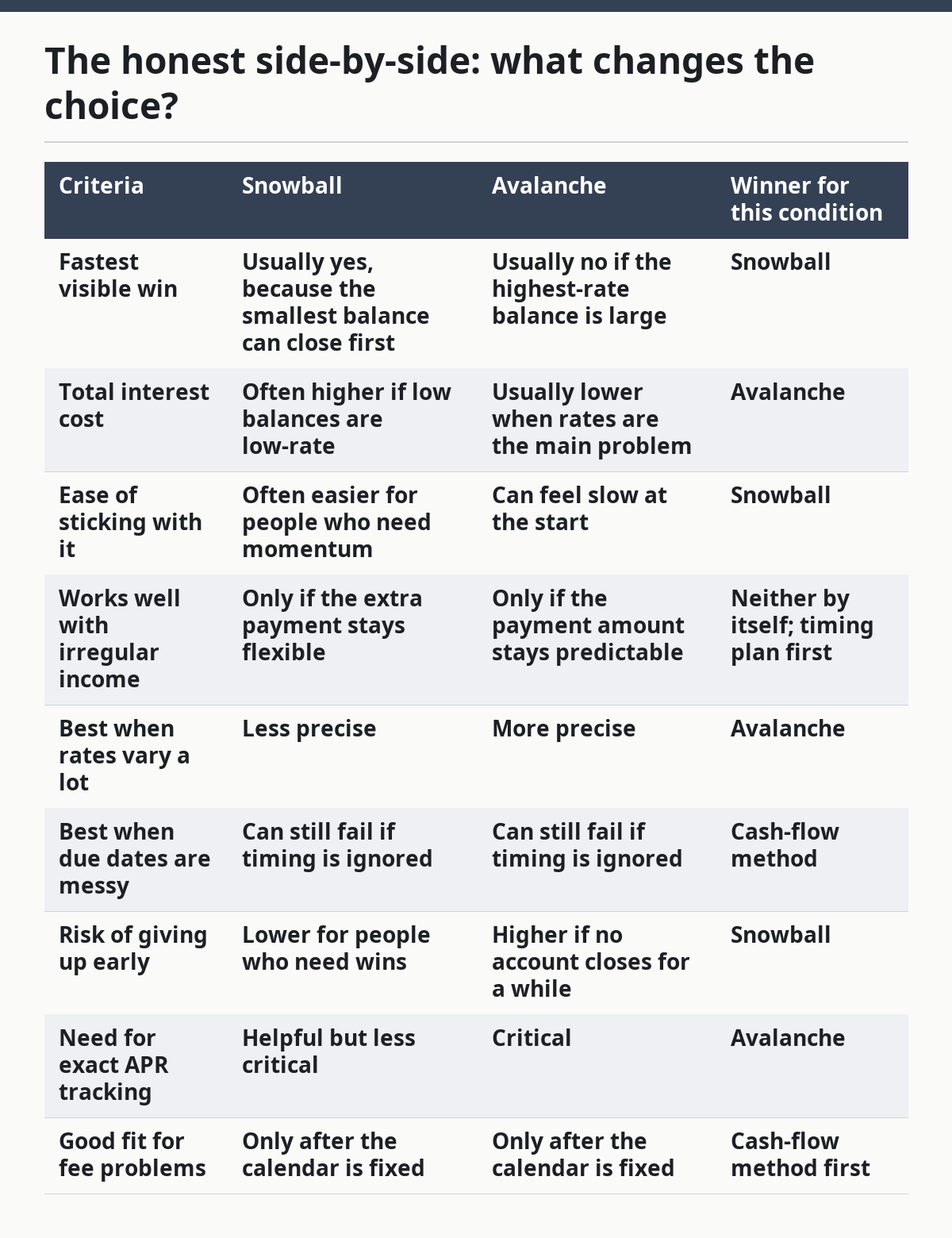
The table leaves out one huge issue on purpose: the method that wins on paper can lose if it does not fit the way money enters and leaves your account. That is why timing and behavior belong in the decision, not just interest rate math.
If you want a simple rule, use this:
- Pick snowball if motivation is your biggest bottleneck.
- Pick avalanche if interest cost is your biggest bottleneck.
- Pick cash-flow management first if timing is your biggest bottleneck.
Exception scenarios: when the verdict flips
The overall verdict flips when one account, one calendar problem, or one promo term changes the whole picture. That is normal. Debt plans are not static.
Picture this: you were ready to choose the “best” payoff order, then one card’s promo rate ends next month or one bill starts drafting before payday. The best method can change in a single statement cycle.
Here are the cases where the usual answer changes:
- A promotional rate is ending soon. A balance with a temporary low rate may need to move up the list before the rate resets. A generic snowball plan may miss the deadline.
- You are getting late fees or overdrafts. Cash-flow repair comes before any debate about interest order. If a due date is breaking your month, timing wins.
- You can only make a very small extra payment. A tiny extra amount may not produce the emotional lift snowball depends on, and may not meaningfully change avalanche math either. In that case, simplifying the calendar first can help more.
- One debt is tied to a service you need every day. Missing a utility, phone, or rent-type payment can create a bigger problem than a higher-rate revolving balance. Protect the essential payment first.
This is where generic advice gets sloppy. It treats every debt the same. It isn’t. A small balance can be urgent if it causes a fee cascade, while a large balance can be less urgent if it is on a fixed, low-rate schedule and not threatening your monthly cash flow.
The best check is this: if a single account can break your month, that account is not just another line item. It is a system risk. Treat it that way.
What if I want the simplest possible plan?
The simplest plan is the one you can repeat without rethinking it every week. For many people, that means snowball if they need emotional traction, or avalanche if they already know their rates and can stay disciplined.
Picture this: you want a method you can write on one page and follow for months. Simplicity matters because a plan that is too clever becomes a second job.
A simple plan usually has three parts:
- Pay every minimum on time.
- Send one fixed extra amount to one target.
- Recheck the target only when the target is gone or when a rate changes.
That sounds basic because it is. Basic is good when money is tight. The goal is not to win a spreadsheet contest. The goal is to stop the debt from controlling the month.
The method that stays simplest depends on your pain point:
- If you quit when progress feels invisible, snowball is simpler to live with.
- If you care most about cost and can handle delayed wins, avalanche is simpler to justify.
- If your dates are a mess, a cash-flow plan is simpler because it removes overdraft risk before it optimizes anything else.
If you want one sentence to keep: use the method that reduces the number of decisions you make after payday. Fewer choices usually means fewer mistakes.
Is there a best method for people with many debts?
The best method for many debts depends on whether the trouble is the number of accounts or the size of the rates. If the account count is what overwhelms you, snowball often helps; if the rates are the real drag, avalanche usually makes more sense.
Picture this: you have six or seven balances, and each one comes with its own minimum and due date. That many moving parts can turn a simple payoff order into a scheduling problem.
Here’s the catch: many-debt situations often need two layers. First, organize the payment flow so nothing gets missed. Then choose the payoff order. Without that first layer, the second one can fall apart.
A practical sequence looks like this:
- List every debt, due date, minimum, and APR.
- Fix the payment calendar so essentials are protected.
- Decide whether your extra payment goes to the smallest balance or the highest rate.
- Keep the method unchanged until the target balance is gone.
- Re-rank only when the facts change.
That sequence works because it respects both mechanics and human behavior. It also avoids one of the biggest mistakes: mixing payoff methods every month. Switching back and forth can feel active, but it usually slows you down because no single balance gets enough extra money.
For many-debt borrowers, the best method is often not the purest one. It is the one that keeps every account current, keeps your cash from getting trapped, and lets one target disappear at a time. That is the point.
FAQ
Is snowball or avalanche better for most people?
Avalanche is usually better if the main goal is reducing interest cost, while snowball is often better if you need faster emotional wins. The better method depends on whether your biggest problem is math or follow-through. If you know your rates and can stay patient, avalanche often fits. If you need progress to stay engaged, snowball can be the better working tool.
What if my due dates do not line up with my paycheck?
A timing-based plan is usually the first fix. If a bill drafts before your income arrives, the order of payoff matters less than preventing late fees and overdrafts. Shift due dates where possible, protect essential bills first, and build a buffer before you try to optimize the payoff order.
Can I mix snowball and avalanche?
Yes, and that hybrid can fit a lot of real budgets. A common version is to fix the calendar first, then use snowball for motivation or avalanche for cost control once the system is stable. The important part is not to keep changing the target every month.
What if I only have a small amount of extra money?
A small extra amount can still work, but the payoff method should be simple. Snowball may feel better if you need a visible win, while avalanche may save more interest if the rates are high enough. If the amount is so small that it barely moves anything, focus first on keeping every payment current and avoiding fees.
When should I stop focusing on payoff order and fix the budget first?
If you keep missing minimums, relying on overdrafts, or using one bill to patch another, the budget comes first. A payoff method cannot solve a monthly cash shortfall. Fix the timing, the spending plan, or the income gap before you worry about which balance gets the next extra dollar.
Drafted with AI; not yet reviewed by a person.