
Last updated: November 20, 2026
How to choose a debt payoff method with payment holidays
Quick Answer: use 1 rule — choose the debt payoff method with payment holidays that still works after the holiday ends, not the one that only looks cheapest for the next few weeks. In the topic of how to choose a debt payoff method with payment holidays, that means checking whether interest keeps growing during the holiday, then choosing a method that fits the loan agreement, the repayment schedule, and your cash reserve plan. This is information, not financial advice; for your own situation, a qualified adviser should review the full picture.
Key takeaways

- A payment holiday can make a debt look quiet while interest, fees, or capitalized interest keep building.
- The right payoff method is the one that still works on the restart date, not just during the pause.
- A debt with holiday terms can change the order you pay in, because the balance may grow while payments are paused.
- Read the loan agreement closely for interest accrual, deferred installments, and any interest capitalization.
- Build a small cash buffer for the return to the normal repayment schedule so you do not miss the first resumed payment.
What is a payment holiday in debt payoff planning?
A payment holiday is a set period when required payments pause, but the debt does not disappear. In a loan agreement, the holiday may be called deferred payment, holiday period, or temporary payment pause, and the terms can differ a lot from one lender to another. Some loans keep charging interest during the pause; some add that interest to the balance later through interest capitalization.
This matters because the debt payoff method with payment holidays depends on what the debt will look like when payments restart. A balance that stays flat for 3 months is different from one that grows each month. A deferred installment can also create a bigger bill later if the missed amount is spread across the remaining repayment schedule.
The question is not “Which method is best in general?” It is “Which method still makes sense once this debt resumes?” That is why the same rule that works for ordinary debt can fail here. A method that ignores the holiday period can leave you surprised by a larger balance or a tighter monthly bill later.
How do you choose the method step by step?

You choose the debt payoff method with payment holidays by checking the holiday terms first, then ranking the debts by what will cost the most after the pause ends. Start with the debt that has the clearest restart date and the clearest interest rule, because that is the debt most likely to cause trouble if you guess.
-
List every debt and note the payment holiday dates, the resume date, the current balance, and the normal monthly payment. Verify the exact wording in the loan agreement, not just the lender app. If the holiday dates are unclear, the schedule is not safe to plan around.
-
Check whether interest accrues during the holiday and whether it is capitalized at the end. Verify whether the lender adds unpaid interest to principal, because that changes the future balance. If the contract does not make this clear, the debt needs a manual review before you rank it. For background on interest capitalization and deferred repayment terms, see Federal Student Aid and the CFPB.
-
Mark the repayment schedule after the holiday ends, including any deferred installments. Verify whether the normal payment simply restarts or whether the lender adds a catch-up amount. If the new payment is higher than expected, your method must leave room for that increase.
-
Compare the debts by total cost pressure, not by the current payment alone. A debt with a holiday but ongoing interest can become more expensive than a debt with a steady payment. If you cannot compare the terms cleanly, avoid using a method that depends on a precise ranking.
-
Choose a payoff order that keeps the holiday debt from turning into a balance shock later. Verify that the debt you are leaving for later will still be manageable when its payment restarts. If the projected restart payment strains the budget, the method is a poor fit even if it looks efficient on paper.
-
Set a cash reserve for the restart month before you send extra money to other debts. Verify that the reserve can cover the resumed payment plus any deferred installment or interest catch-up. If the reserve is missing, the payoff order may be too aggressive. A basic cash buffer is also consistent with the FTC’s debt advice to keep payments manageable and avoid missed due dates.
-
Review the plan at the end of the holiday period and again 1 month before the first resumed payment. Verify that the lender’s balance and schedule still match your notes. If the figures differ, stop using the original order until you understand the change.
A holiday-aware method is usually the one that protects against surprise growth, not the one that merely attacks the smallest or largest balance on day one. If you need a broader framework, the hub article on debt payoff method fit by debt portfolio structure can help place this page in context.
Which payoff method fits a holiday debt?
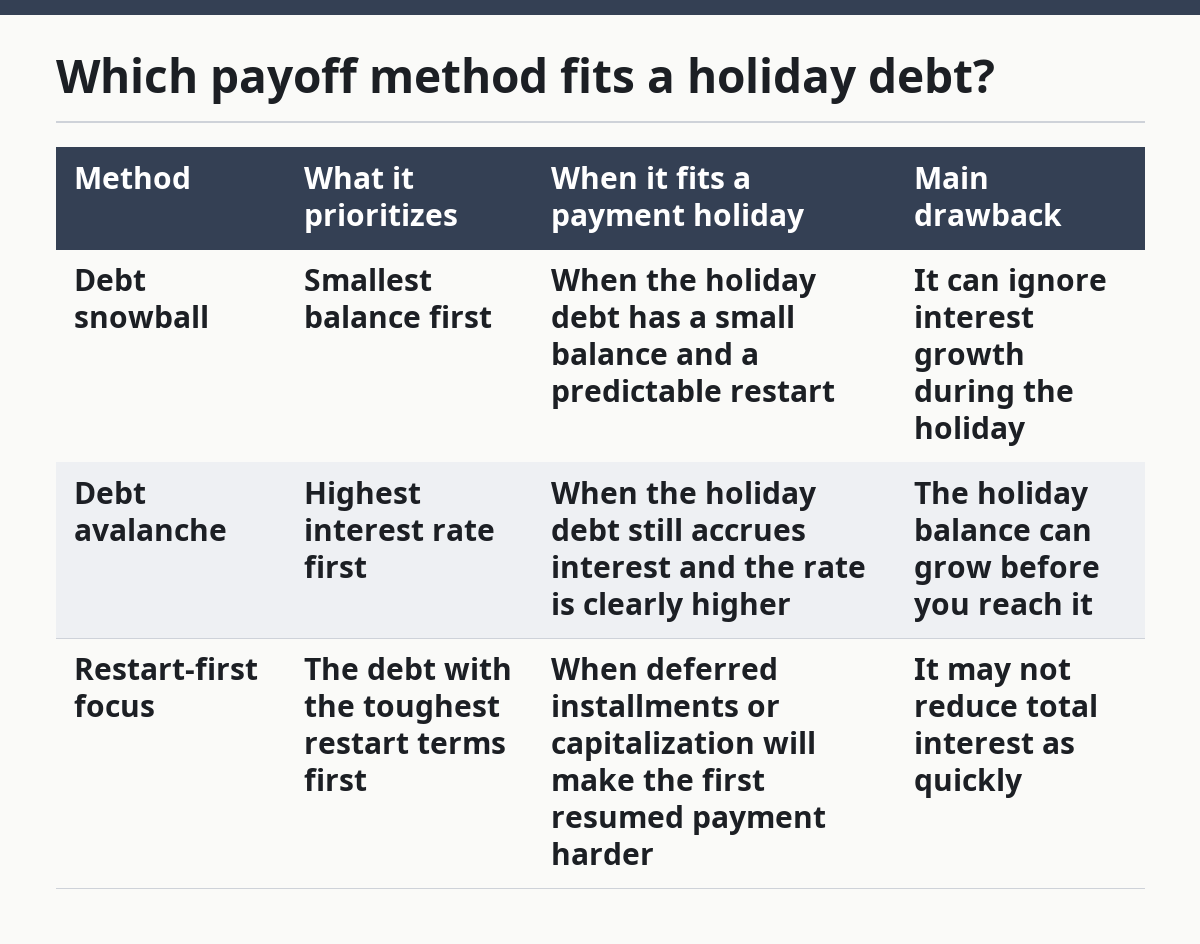
The debt payoff method with payment holidays is the one that matches the debt’s post-holiday shape, and that choice changes with the terms. Debt snowball, debt avalanche, and a “protect the restart first” approach can all work, but they solve different problems. Snowball focuses on small balances; avalanche focuses on higher interest; a restart-first approach focuses on the debt most likely to bite when the holiday ends.
| Method | What it prioritizes | When it fits a payment holiday | Main drawback |
|---|---|---|---|
| Debt snowball | Smallest balance first | When the holiday debt has a small balance and a predictable restart | It can ignore interest growth during the holiday |
| Debt avalanche | Highest interest rate first | When the holiday debt still accrues interest and the rate is clearly higher | The holiday balance can grow before you reach it |
| Restart-first focus | The debt with the toughest restart terms first | When deferred installments or capitalization will make the first resumed payment harder | It may not reduce total interest as quickly |
A generic article often tells you to pick one method and stay loyal to it. That is too simple for payment-holiday debt. A debt that pauses today can still be the debt that causes the biggest problem next month if the balance grows or the payment jumps.
If the holiday debt does not accrue interest, a standard ordering method may still work. If interest keeps accruing, the debt can become a moving target, and the right method is often the one that leaves enough cash to absorb the restart. That is why a method that looks mathematically neat can still be the wrong tool. For a side-by-side comparison, see debt snowball vs avalanche and debt avalanche method.
What should you check before you send extra money elsewhere?
You should check the interest rule, the restart date, and the size of the first resumed payment before you redirect extra cash. Those three items tell you whether the holiday debt is a pause or a trap. A 0% payment pause and a debt with monthly interest accrual are not the same problem.
Read the loan agreement for three phrases: payment holiday, deferred payment, and interest capitalization. Then look for any mention of a revised repayment schedule after the holiday. If the agreement says the lender may recalculate the schedule, the payment you expect may not be the payment you get.
It also helps to set aside a cash reserve before the holiday ends. The reserve does not need to be large enough to cover everything, but it should reduce the risk of missing the first resumed payment. If you spend every spare dollar on another debt and the holiday debt restarts with a higher charge, the plan can break at the worst moment.
When should you stop and get a second look?
You should stop relying on a standard payoff order when the holiday terms change the debt faster than you can model it. This is where the usual “smallest balance first” or “highest interest first” rule can stop being reliable. A qualified adviser should review the full situation if any of these apply.
The holiday debt accrues interest daily or monthly: the balance is growing while payments are paused — compare the post-holiday balance to other debts before choosing the order.
The lender will capitalize unpaid interest: the deferred interest becomes part of principal — expect a larger balance and a different repayment schedule.
The first resumed payment is higher than the old payment: the debt now needs more cash each month — keep extra room in the budget before paying other debts faster.
A deferred installment is due at the end of the holiday: the pause was not free, only delayed — set aside cash for the catch-up amount.
The contract allows the lender to change the schedule after the holiday: the plan you made today may not match the final terms — confirm the new schedule before you commit extra payments elsewhere.
You are unsure which balance includes capitalized interest: the numbers may be incomplete — ask for a written payoff statement before making a ranking decision.
The rule here is simple: if the holiday changes the size or timing of the debt in a way you cannot verify, do not treat it like an ordinary loan. If that happens, consult a qualified adviser or lender representative and check the written terms first. That is not a failure of effort; it is a signal that the terms need a closer review.
What mistakes do people make most often?
The most common mistake is paying other debts aggressively while ignoring a holiday debt that will get larger later. The consequence is a surprise jump in balance or payment after the pause ends. The better alternative is to check the repayment schedule and set aside a buffer first.
Another mistake is assuming the holiday means no cost. If interest still runs, the debt may grow even though the payment is paused. The correct move is to confirm whether interest accrual or capitalization applies before you rank the debts.
A third mistake is using the current monthly payment as the main comparison point. That can hide the real problem, which is the future payment after the holiday. The better alternative is to compare the restart terms, not just today’s bill.
A fourth mistake is skipping the loan agreement and trusting a dashboard or app summary. Those summaries may leave out deferred installments or special holiday wording. The safer alternative is to read the contract language and, if needed, get a written schedule from the lender.
A fifth mistake is draining every spare pound, dollar, or euro into one debt and leaving nothing for the restart month. The consequence is a missed payment when the holiday ends. The better alternative is to keep a cash reserve sized to the first resumed payment and any catch-up amount.
How long does the planning take?
The planning usually takes less time than the payoff itself, but it needs careful review of the holiday terms. A clean case may take one sitting with the loan agreement, the payment schedule, and a calculator. A messier case takes longer because the balance can change when the holiday ends.
A good result is not a perfect method. It is a method that still works when the holiday ends, the payment restarts, and the lender’s schedule takes over again. If you can explain in one sentence why a debt is first or last in the order, based on the holiday terms, the plan is probably sound.
If you cannot say what happens on the resume date, the plan is not finished. The whole point is to avoid paying in a way that creates a larger problem later.
Should I pay off a loan during a payment holiday?
Yes, if the loan agreement shows that interest or deferred charges will make the balance heavier later. A payment holiday does not mean the debt is harmless; it only means the payments are paused for a period. If the loan resumes with a bigger balance or a higher required payment, paying it down can reduce later strain.
If the holiday is short and the debt does not accrue interest, you may decide to leave it in place and focus elsewhere. The key is to confirm the terms, not guess. A qualified adviser can help if the agreement is hard to read or the schedule is changing.
Do payment holidays affect payoff strategy?
Yes, because they change the size and timing of the debt you are trying to clear. A normal payoff method compares debts that are all active at the same time, but a holiday debt may be temporarily quiet while its balance or future payment is changing. That can distort the ranking.
The strategy should reflect the holiday period, the deferred installments, and any interest capitalization. If those terms are present, the debt may need priority even if it looks small today. The point is to choose the order that still makes sense on the date payments restart.
What happens when payments restart?
The lender usually puts the debt back onto its repayment schedule, and the first payment may be the old amount, a recalculated amount, or the old amount plus catch-up charges. The exact result depends on the loan agreement and whether interest accrued during the holiday. That is why the resume date matters so much.
Before that date, verify the new balance and the next required payment in writing if possible. If the figures do not match your notes, do not assume the lender will correct them automatically. A quick check can prevent a missed payment or a larger bill than you planned for.
Drafted with AI; not yet reviewed by a person.