
Last updated: November 20, 2026
Quick answer: if a creditor offers a hardship program, use the payment terms to choose your payoff method first, then the balance order second. In this guide to how to choose a debt payoff method when your creditors offer a hardship program, a reduced payment plan or interest rate reduction can shift which debt should be attacked first, because the cheapest-looking debt before hardship is not always the one that costs the most during the program.
Key takeaways
- A hardship program changes the math, not just the monthly bill.
- The payment you can actually keep up with matters more than a method you can only follow on paper.
- A lower interest rate can make a balance less urgent; a short-term reduced payment can make cash flow more urgent.
- Account status during hardship affects timing, reminders, and the risk of falling behind after the program ends.
- A payoff method that still works after the concession stops is usually the safest choice.
What does a hardship program change?

A hardship program changes the cost, timing, and order of repayment, so the old payoff rule may no longer fit. In how to choose a debt payoff method when your creditors offer a hardship program, a creditor may offer a reduced payment plan, an interest rate reduction, or another payment arrangement that lasts for a set period, often months rather than years.
That matters because payoff methods depend on what each debt costs and how much cash is left after minimums. If one account now has a lower rate for 6 months, while another stays expensive, the right order may shift. The key question is often not “What was the best method before hardship?” but “What method still works while this concession is in place?”
Hardship program debt is still debt. The balance does not disappear, and the terms can change again when the program ends. If the new payment is too low, the back-end balance can become harder to handle later. If the new payment is too high, the plan can fail before it reaches the finish line.
This guide is for a person who has at least one creditor offering temporary relief and wants to choose a payoff method with a clear head. It assumes the reader knows the balance, the minimum payment, and the basic due dates. It does not fit a person who is already dealing with collections, bankruptcy planning, or a lawsuit risk; those are different problems with different rules.
Which payoff method fits a hardship program?
The best fit is often the method that keeps the account current and targets the debt with the highest true cost after the concession is applied. In practice, that often means comparing avalanche, snowball, and a hybrid plan.
| Method | How it works | Best when | Main drawback |
|---|---|---|---|
| Avalanche | Extra money goes to the highest interest rate first | The rate reduction still leaves one debt clearly more expensive | Slower early wins can feel discouraging |
| Snowball | Extra money goes to the smallest balance first | Motivation matters more than math and several accounts need quick movement | Can cost more if a high-rate balance sits too long |
| Hybrid | Protects the hardship plan first, then attacks the most expensive remaining balance | One account has a temporary concession and the others do not | Needs closer tracking and more follow-up |
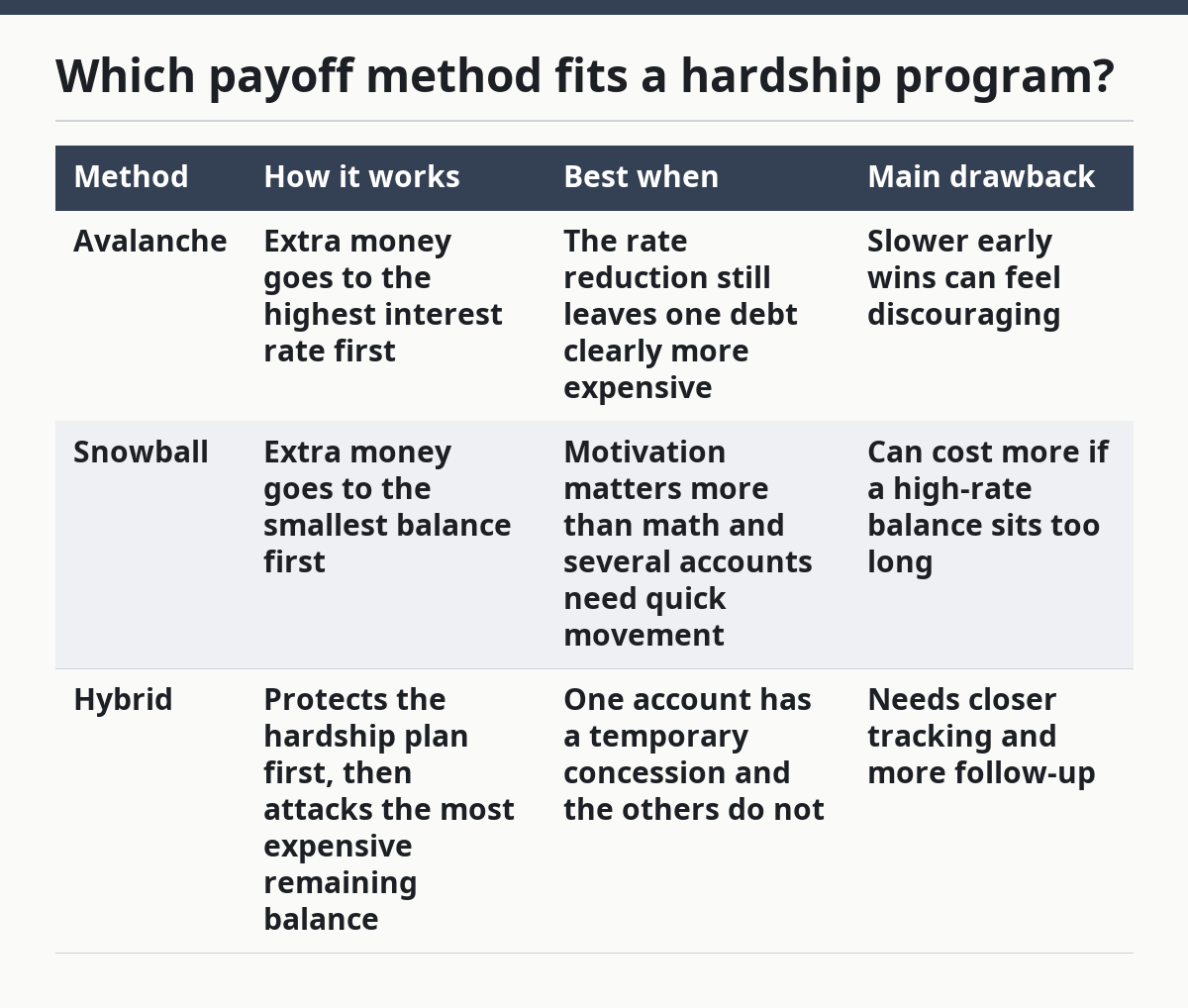
A hardship program often weakens the case for a pure snowball plan if the smallest balance is no longer the most expensive debt. It can also weaken a pure avalanche plan if the creditor’s reduced payment is so low that the account will end with a lump-sum catch-up or a higher payment later. In that case, the right “priority” may be the account that is easiest to finish on schedule, not the one with the biggest rate on paper.
A reduced payment plan also changes cash flow. If the current minimums free up only a small amount, a payoff method that needs large extra payments may not work. A method that depends on consistency over 12 months may be better than a method that assumes extra cash every month.
For related background, see debt avalanche vs. debt snowball and how to make a debt repayment plan.
How do you choose step by step?

Choose the method by mapping the hardship terms, the true monthly room in the budget, and the order of debts before any extra payment is assigned. This is the practical way to decide when creditors have changed the rules for one or more accounts.
- List each debt, creditor, and current concession. Write down the balance, due date, interest rate, and whether the creditor offered a reduced payment plan, interest rate reduction, or both. Verify the program length and the exact month it ends; if that date is missing, the plan is incomplete.
- Calculate the actual monthly payment floor. Add the hardship payment and every other minimum payment that still applies. Verify that the total fits your current budget without using an unproven future raise or refund; if it does not, the method is too aggressive.
- Check which account is still the most expensive after hardship. Compare the rate that applies during the program, not the old rate. Verify whether any deferred interest, fees, or step-up payment will appear later; if the creditor cannot explain that clearly, the comparison is unreliable.
- Choose avalanche if the reduced rate still leaves one debt clearly costlier than the others. Put extra money there after all required payments are covered. Verify that the hardship account will stay current; if the required payment is too low to protect the account from a jump later, the choice needs review.
- Choose snowball if the program gives you little to no rate relief but you need fast wins to stay engaged. Aim extra money at the smallest balance first after the minimums are met. Verify that the small balance is not also the only account with a major rate change; if it is, snowball may cost more than it saves.
- Choose a hybrid if one account has a temporary concession and the others do not. Keep the hardship account on its required payment, then direct extra cash to the next most expensive debt. Verify the order every month during the program; if the creditor changes the terms, the ranking can change too.
- Build the post-program payment now. Estimate what the account payment becomes after the hardship period ends, even if you cannot know the final figure exactly. Verify that the future payment will still fit the budget; if it will not, the plan should be adjusted before the program runs out.
- Set one review date before the hardship ends. Use a 30-day or 60-day check before the final month, not after it. Verify that you have enough cash to handle the next required payment level; if not, contact the creditor early rather than waiting for a missed payment.
The cleanest method is the one that survives the full timeline, not just the first 2 months. A hardship program can make a debt look easier while creating a bigger payment later, so the method has to be judged on both sides of the program.
For a budgeting refresher, see how to build an emergency budget and how to prioritize bills when money is tight.
What should you check before you commit?
You should check the program terms, the account status, and the end date before you shift any extra money. A hardship program that lowers a payment for 3 months is very different from one that lasts 12 months or changes the rate for the whole term.
The first thing to confirm is whether the creditor is changing the interest rate, the minimum payment, or both. A payment arrangement with no rate reduction can still help cash flow, but it may not lower the total cost much. An interest rate reduction can change the payoff order because the lower-rate account may stop being the urgent one.
The second thing to confirm is how the account will be reported and managed during hardship. Some programs keep the account active with a special arrangement; others may pause regular billing or adjust the due date. If the account’s status is unclear, the risk is simple: the payoff method may be built on a payment date that no longer exists.
The third thing to check is what happens after the program ends. A lower payment for 6 months that turns into a much higher one later can force a change in strategy. The right answer is often to keep the hardship account in good standing now while saving a buffer for the later step-up.
The fourth thing to check is whether the creditor expects a catch-up payment, reinstated rate, or new minimum. Those terms can affect the best method more than the balance size itself. A person who ignores that detail may choose a method that looks efficient but fails the month the concession ends.
For official guidance, see the Consumer Financial Protection Bureau and the National Foundation for Credit Counseling. You can also review the FTC on debt and credit for general consumer information.
When should you stop and get qualified help?
You should stop trying to force a standard payoff method when the hardship program changes the debt in a way you cannot model with the information you have. In that case, the wrong method can create a missed payment or a broken arrangement.
The creditor will not give the end terms in writing: This means the payment could change without warning — ask for the agreement in writing before moving extra payments.
The hardship program includes a future balloon or step-up payment: This means the later payment may be too large for your budget — plan around the larger future amount, not the reduced one.
The account is already past due before the program starts: This means the hardship plan may not fix the arrears by itself — confirm what amount cures the past-due balance and when it is due.
The interest rate reduction is temporary and the old rate returns quickly: This means the account may become expensive again after a short window — review whether avalanche still makes sense once the concession ends.
You cannot cover all required minimums plus the hardship payment: This means the plan is too tight — the method should shift to cash-flow protection, not aggressive extra payments.
You are relying on one future event to finish the plan: This means the strategy is built on a guess — use a plan that works on current income, not hoped-for income.
This is where a qualified adviser can help sort the terms before the budget breaks. That is especially true if multiple creditors are offering different concessions at the same time and the payment order is no longer obvious.
What mistakes do people make with hardship programs?
The most common mistake is treating a hardship program like a permanent fix. It is usually temporary, often measured in months, and the debt still needs a post-program plan. The result is a sudden payment jump that can knock out the payoff method at the finish line.
Another mistake is using the old interest rate to pick the order. If a creditor reduced the rate for the hardship period, the account may no longer deserve first priority. The correct move is to compare the rate that applies right now, then compare the rate that will return later.
A third mistake is making extra payments without checking whether the creditor applies them to principal or simply advances the due date. If the payment does not reduce the balance the way expected, the payoff method loses its advantage. The better move is to verify the payment application rules before sending extra money.
A fourth mistake is choosing snowball only because the balance is small, even when the hardship account still carries the highest cost. That can slow progress and raise total cost. The better alternative is to pick the account that fits the current terms, not the one that feels easiest to attack.
A fifth mistake is forgetting the program end date. If the plan ends in 90 days and the next payment step is not ready, the whole strategy can fail at the last turn. The correct alternative is to schedule a review before the final month and adjust early.
What happens after the hardship program ends?
The payment usually reverts, rises, or changes shape after the hardship program ends, so the payoff method should shift before that date arrives. A reduced payment plan is only useful if the next payment is already part of the plan.
The first task after the program ends is to recalculate the monthly floor with the restored payment terms. If the account returns to a higher rate or a higher minimum, the debt may move back into the front of the queue. If the new payment is still manageable, the same method may continue with a new order.
The second task is to check whether the account stayed current throughout the concession. A clean run through the program supports the next phase of the payoff plan. A missed payment or unclear status means the method may need to shift from acceleration to repair, which should be reviewed with a qualified adviser.
The third task is to choose the next target based on the post-hardship math, not the old plan. A debt that was discounted for 6 months may no longer deserve top priority. A debt with no concession may again become the most expensive balance in the stack.
A good result is simple: the program ends without a missed payment, the budget still works, and the next debt target is clear on day one of the new terms. A bad result is also simple: the payment rises, the plan was never adjusted, and the reader is left scrambling.
How do you use a hardship program without losing your payoff plan?
You use it by treating the concession as a temporary rule change and then rebuilding the payoff order around that change. That means the hardship account gets protected first, then the extra payment follows the math that exists during the program and after it.
The most useful habit is a monthly check of the three numbers that matter most: the required payment, the interest rate, and the end date. If any of those changes, the payoff order may need to change too. A rigid method can fail simply because the program was not rigid.
One solid external reference for payment and debt planning principles is the Consumer Financial Protection Bureau’s debt collection and payment resources, and the National Foundation for Credit Counseling also publishes consumer guidance on debt management. Those sources are useful for general understanding, but the exact hardship terms still come from the creditor and the account contract.
For the reader comparing methods, the practical question is not “Which strategy is best in theory?” It is “Which strategy still works when the creditor has already changed the terms?” The answer is the method that protects the hardship plan, preserves cash flow, and survives the month the concession ends.
Should I accept a hardship program before choosing a payoff method?
Usually, yes if the program improves your cash flow and you can meet its terms, because the new payment can change which payoff method makes sense. The key is to read the payment amount, interest rate, and end date before you choose avalanche or snowball. If the program is vague or unaffordable, the method should wait until the terms are clear.
Does hardship status change my payoff strategy?
Yes, because hardship status can lower the payment, reduce the interest rate, or change when the balance grows. That can move an account up or down in your payoff order. The strategy should be based on the terms in force during the program, then reviewed again when the program ends.
What should I do after a hardship program ends?
Recheck the new payment, the interest rate, and the account status right away. Then rebuild your payoff order using the post-program numbers, not the temporary concession. If the new payment no longer fits your budget, speak with the creditor early and get qualified help before the account goes off track.
Drafted with AI; not yet reviewed by a person.